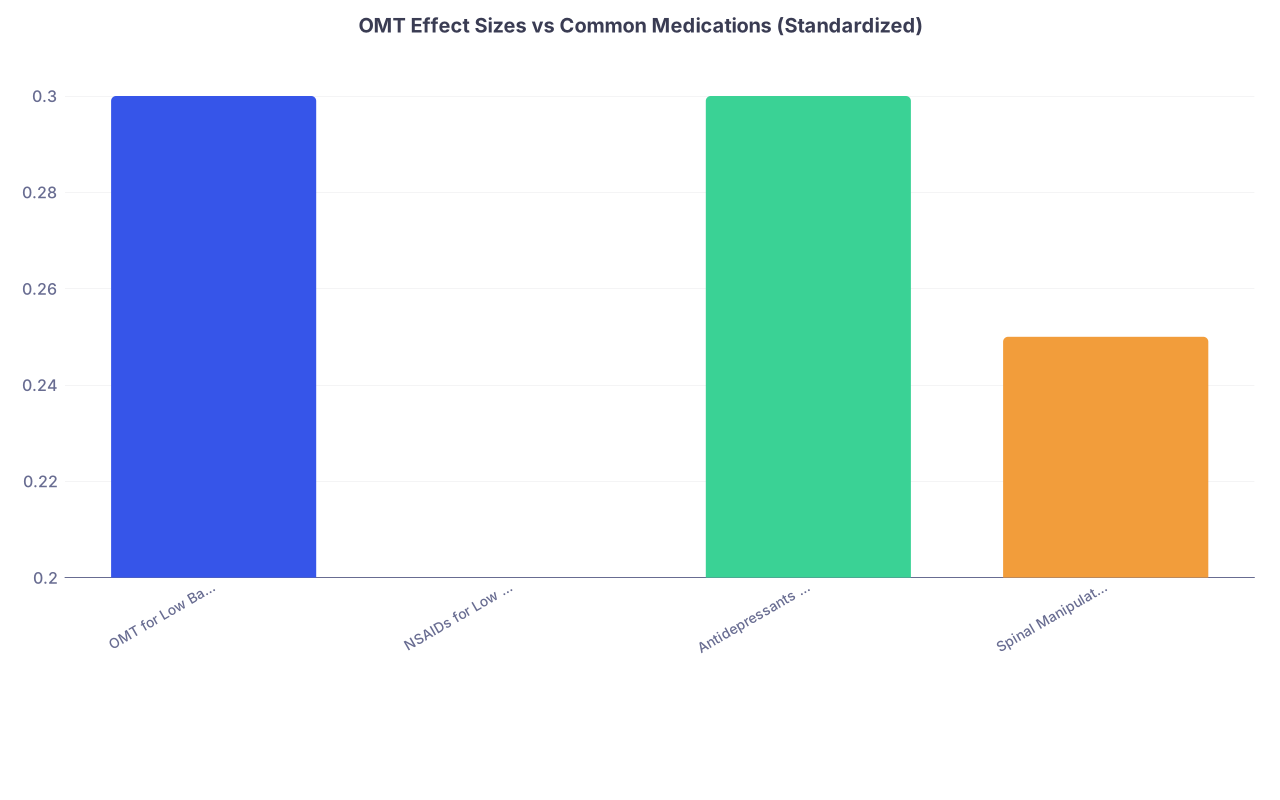
| Category | Value |
|---|---|
| OMT for Low Back Pain | 0.3 |
| NSAIDs for Low Back Pain | 0.2 |
| Antidepressants for Chronic Pain | 0.3 |
| Spinal Manipulation (Mixed Providers) | 0.25 |
Is OMM Just Placebo? Research on Osteopathic Manipulative Treatment
Osteopathic manipulative medicine is not “just placebo.” The joke that “DO school teaches fancy massage and placebo” sounds clever. It just does not match the data.
You do not have to love OMT. You do not have to use it in residency. But if you’re going to dismiss it, at least know what you’re throwing out.
Let me walk through what the research actually shows, where it’s weak, where it’s solid, and what that means for you as a premed or med student wondering whether DO = placebo doctor.
What OMM/OMT Actually Is (And What It Is Not)
First, ground reality.
OMM/OMT is not one thing. It’s a cluster of techniques and approaches used by DOs:
- High-velocity low-amplitude (HVLA) “thrust” techniques (the pops you hear)
- Muscle energy (patient contracts against resistance)
- Counterstrain
- Myofascial release
- Lymphatic techniques
- Cranial techniques (the most controversial)
So any blanket statement like “OMM doesn’t work” is already sloppy. It’s like saying “drugs don’t work” without distinguishing antibiotics from homeopathy.
Most research on osteopathic manipulation focuses on:
- Low back pain
- Neck pain / musculoskeletal pain
- Pregnancy-related back pain
- Postoperative recovery
- Respiratory conditions (like pneumonia)
- Headache
You almost never see solid RCTs on “OMT for everything.” Good studies pick a specific condition and a specific protocol.
The Gold Standard: OMT for Low Back Pain
If you remember only one thing: low back pain is where OMT has the best, most reproducible data. And no, that’s not just DO propaganda; it’s in mainstream journals.
Key evidence
The classic is Licciardone et al., Annals of Internal Medicine, 2003.
Randomized controlled trial. Non-specific low back pain. They compared:
- OMT
- Sham OMT (placebo-like hands-on treatment)
- No treatment
Result? The OMT group had greater improvements in pain and function vs no treatment. Versus sham, the differences were smaller but still present in some outcomes.
Not perfect. But not “no difference at all.”
Then you have the 2005 meta-analysis by Licciardone et al. (Journal of the American Osteopathic Association). They pooled several trials of OMT for low back pain and found:
- Moderate effect sizes on pain and function
- Benefits that persisted for months
- Similar magnitude to what you see with NSAIDs and physical therapy
That is the part people conveniently ignore when they say “it’s just placebo.”
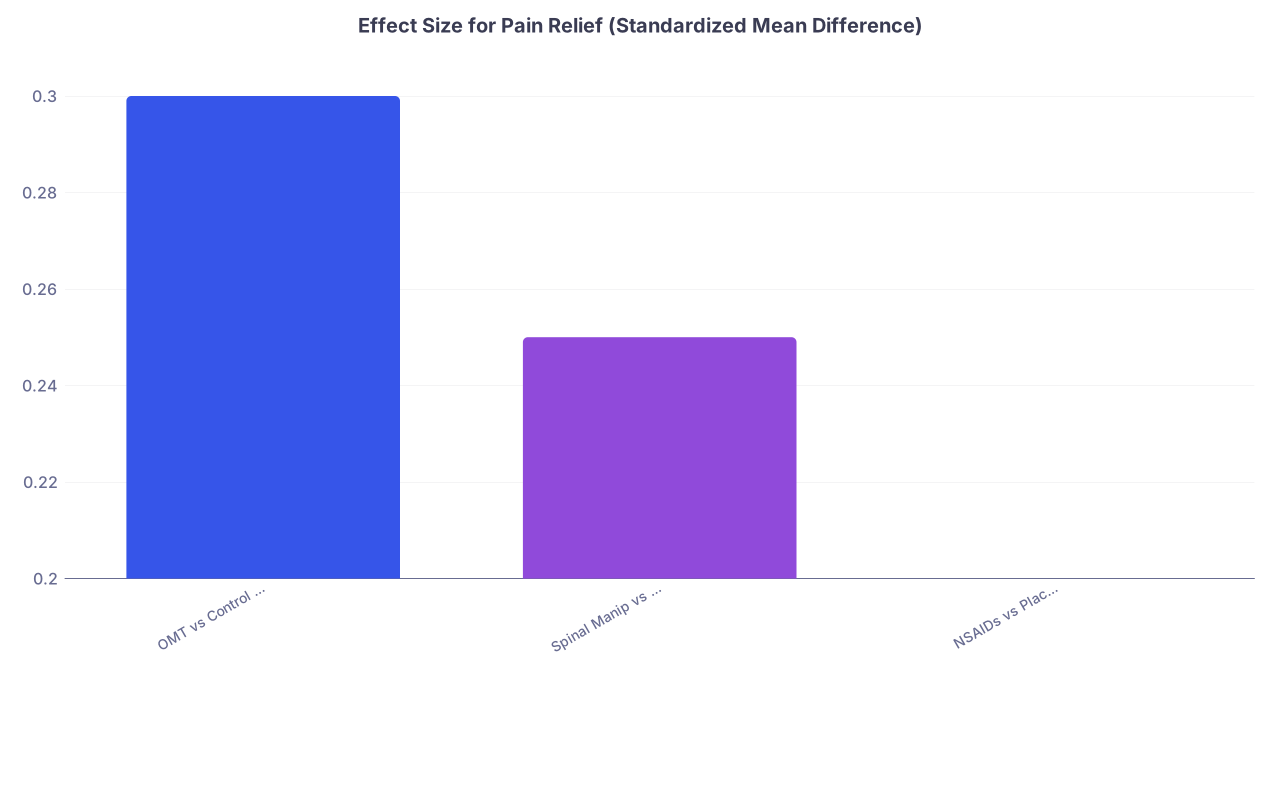
| Category | Value |
|---|---|
| OMT vs Control (LBP) | 0.3 |
| Spinal Manip vs Sham | 0.25 |
| NSAIDs vs Placebo (LBP) | 0.2 |
Those are not miracle numbers. They are “real-world medicine” numbers—on par with a lot of things you already accept without argument.
Could placebo contribute? Obviously. It always does in pain trials. But when OMT outperforms sham in at least some studies, you cannot flatten it to “all placebo.”
Where OMT Actually Looks Useful (And Where It Does Not)
Let’s stop treating OMT like magic or trash and break it down by indication.
1. Non-specific low back pain
Verdict: Reasonable evidence. Not superstition.
Across multiple RCTs and meta-analyses:
- OMT produces small-to-moderate improvements in pain and functional status
- The magnitude is similar to guideline-recommended therapies
- Adverse effects are rare and usually mild (temporary soreness)
If you replaced the word “OMT” with “PT exercise program” and gave the same numbers, no one would be yelling placebo. They’d call it “evidence-based multimodal care.”
2. Pregnancy-related back pain
Verdict: Emerging but promising.
There have been randomized trials on OMT for low back/pelvic pain in pregnant patients. Some were funded through NIH. Patterns:
- Reduced back pain and improved function vs usual care alone
- Less deterioration in back-related function over the third trimester
- No significant safety concerns
Are these mega-studies with thousands of patients? No. They’re modestly-sized trials. But the signal is there.
For a population where you want to minimize medications, having one more non-pharmacologic option that actually shows benefit is not trivial.
3. Postoperative recovery and pain
Verdict: Mixed but interesting.
There are RCTs looking at OMT after surgery (e.g., abdominal surgery, orthopedic procedures). What you see:
- Some show decreased pain scores and less opioid use
- Some show shorter hospital stays
- Others show minimal differences
These are often small, single-center studies with different protocols, which makes pooling data difficult. But again, it’s not “zero signal.”
4. Respiratory conditions (like pneumonia or COPD exacerbations)
Verdict: Controversial and inconsistent.
You’ll see DO schools brag about OMT improving outcomes in pneumonia. The data:
- Some older trials in hospitalized pneumonia patients suggested shorter length of stay and fewer complications with OMT
- More recent, larger studies (e.g., the Osteopathic Trial in Elderly Patients with Pneumonia – the OSTEOPATHIC trial) weakened that enthusiasm
- One subgroup had benefit
- But when you strip out some biases, effects look modest or not robust
So here, the evidence is not strong enough to claim “this clearly changes hard outcomes.” At best: maybe helpful as an adjunct, needs better trials.
5. Headache and migraine
Verdict: Limited but non-zero.
There are small RCTs and pilot studies showing:
- Reduced frequency and intensity of tension-type headaches and some migraines
- Improvements in associated disability scores
But sample sizes are small, techniques vary, and blinding is tricky. Compared to the low back pain data, this is weaker.
6. Cranial OMT / craniosacral therapy
Verdict: This is the soft underbelly.
The most controversial branch by far. Claims about moving cranial sutures or palpating cranial rhythms are, bluntly, weakly supported at best.
Systematic reviews of craniosacral therapy (not just DO-based) consistently show:
- Very low-quality evidence
- High risk of bias
- Effects that largely overlap with placebo
If you want to call anything “probably placebo,” cranial OMT is the primary candidate. Even many DOs quietly avoid it.
The “Placebo” Argument: Why It’s Too Lazy
Let’s dismantle the reflexive “hands-on = placebo” opinion.
First: every pain treatment has placebo contribution. SSRIs. NSAIDs. PT. Injections. Surgery. That is how the human brain works.
Second: when you have:
- Randomized, controlled trials
- Sham-manipulation arms
- And you still see differences favoring OMT (even if modest)
You cannot just shrug and say “all placebo.” You’re now arguing that sham was somehow a worse placebo. Which occasionally happens—but you better show why.
Third: the “time and touch” factor.
Yes, part of OMT’s benefit is that DOs doing it often:
- Spend more time with patients
- Touch the patient in a focused, attentive way
- Explain the body’s mechanics in a way patients can understand
That psycho-social component is therapeutic. You know what we call that when a therapist does it? Good care.
Calling everything that isn’t a pill “placebo” is usually code for “I haven’t read the trials and I’m annoyed someone else has a tool I don’t use.”
Methodological Problems: Where the Critics Aren’t Wrong
Now, if you’re thinking, “Some of this still sounds squishy,” you’re not wrong. The OMT literature has real weaknesses.
Common issues:
- Small sample sizes
- Heterogeneous techniques (one DO’s “standard OMT” ≠ another’s)
- Difficulty in blinding practitioners
- Sham controls that might be partially active treatments
- Publication bias (positive small studies get published; negative ones die quietly)
If you held OMT to the same harsh standard you’d use for a new biologic drug, most of the data would look flimsy.
But that’s also true for a lot of mainstream non-pharmacologic therapies we use all the time—chiropractic manipulation, PT protocols, acupuncture, even some surgery indications.
The intellectually honest position is not “OMT is useless.” It’s:
- The evidence is strongest for musculoskeletal pain (especially low back pain)
- Benefits are modest but clinically meaningful for some patients
- Some domains (cranial OMT, broad systemic disease claims) are weakly supported or speculative
- We need larger, better-designed RCTs
That’s how you talk if you’re reading the literature instead of Twitter.
DO vs MD: What This Actually Means For You
If you’re premed or early in training, you’re really asking a different question: “If I go DO, am I signing up for pseudoscience?”
No.
Here’s the real breakdown:
Your core training in physiology, pharmacology, internal medicine, surgery, etc. is the same evidence-based foundation as MD programs, governed by LCME-like standards and COMLEX/USMLE content.
OMT is an add-on skillset. You get extra hours in anatomy lab, hands-on techniques, and a different lens on structure–function relationships.
You can choose how much you use it.
- Some DOs never use OMT after residency
- Some build entire practices around it (especially in FM, sports, PM&R, pain)
- Many fall in the middle: they use a few techniques for specific situations
The claim that “DO = placebo doctor” falls apart as soon as you actually look at their practice patterns:
- They prescribe the same medications
- They order the same imaging and labs
- They follow the same clinical guidelines
OMT is an option, not a replacement for real medicine.
If you want zero association with hands-on manual therapy ever, fine—go MD. But don’t pretend the DO route is inherently anti-science. The actual curriculum and board exams would laugh at that.
The Right Way To Think About OMT As A Future Physician
Here is the adult, non-dogmatic stance:
- Use OMT where evidence is reasonably strong (e.g., non-specific low back pain, certain musculoskeletal complaints, pregnancy-related back pain).
- Be transparent with patients—“This helps many people, the effect size is modest, and it’s low-risk. We can try it along with exercise and other treatments.”
- Drop the magical thinking. No “OMT cures asthma,” no pretending neck manipulation replaces anticoagulation for stroke risk.
- Be equally skeptical of everything:
- Don’t trash OMT while blindly accepting injections with no RCT backing.
- Don’t worship OMT as superior to all meds either.

| Step | Description |
|---|---|
| Step 1 | Patient with Pain |
| Step 2 | Standard medical workup |
| Step 3 | Offer options: PT, meds, OMT |
| Step 4 | Trial OMT + standard care |
| Step 5 | Standard care only |
| Step 6 | Reassess benefit/risk |
| Step 7 | Mechanical/MSK pattern? |
| Step 8 | Red flags? |
| Step 9 | Patient interested in OMT? |
You want to be the person who can look at data, not dogma, and then pick the right tool. Sometimes that tool is an NSAID. Sometimes it’s a mobilization technique. Sometimes it’s “stop fiddling, refer to surgery.”
So… Is OMM Just Placebo?
Here’s the clean answer:
- For low back pain and some other musculoskeletal conditions:
No. There’s consistent evidence of modest benefit beyond no treatment, and at least some signal beyond sham in certain studies. - For cranial techniques and grand systemic claims:
It veers much closer to placebo and wishful thinking. - Overall:
OMT is an evidence-limited but not evidence-free manual therapy, comparable to other accepted non-pharmacologic treatments in scope and impact.
If that sounds less exciting than miracle cures or total fraud, that’s because reality usually is.
Years from now, you will not remember which Reddit thread called DOs “placebo doctors.” You will remember whether you trained yourself to actually read data—and whether you treated tools like OMT as things to evaluate, not punchlines to repeat.
FAQ (Exactly 5 Questions)
1. If OMT works, why don’t more MDs use it?
Because learning and applying high-quality manual therapy requires time, training, and repetition that most MD curricula simply do not offer. MDs often refer to PTs, chiropractors, or osteopathic colleagues instead. It’s not usually ideology; it’s workflow and training exposure.
2. Is OMT safer than medications like NSAIDs for back pain?
For most patients, short courses of OMT are very low risk—usually limited to transient soreness. NSAIDs, while effective, carry risks of GI bleeding, kidney injury, and cardiovascular issues, especially with long-term use or in higher-risk patients. “Safer” depends on context, but OMT avoids systemic drug exposure.
3. Can you match into competitive specialties as a DO who likes OMT?
Yes. Your OMT interest does not block you from dermatology, radiology, EM, or anything else. Program directors care about scores, clinical performance, research, and fit. Some primary care and sports programs actually see OMT skills as a plus, not a minus.
4. Is there strong evidence that OMT improves hard outcomes like mortality or hospitalization rates?
No, not strong evidence. Most of the decent data is on pain, function, and symptom scores—soft clinical endpoints. Some trials hint at better postoperative or pneumonia outcomes, but the evidence is nowhere near definitive for mortality reduction or big system-level metrics.
5. If I’m a DO student and skeptical of OMT, should I still learn it seriously?
Yes. You do not have to become an OMT evangelist, but ignoring a skill your degree is built around is shortsighted. Learn it well enough to use it for the conditions where evidence is decent. Later, once you’re in practice, you can decide which techniques earn a permanent place in your toolkit.