The biggest myth in premed culture is that “research is research” and the school label does not matter. It does. The research infrastructure gap between most DO and most MD schools is real, structural, and it will shape your options if you care about competitive residencies or academic careers.
Let me break this down specifically.
You are not just choosing between letters (DO vs. MD). You are choosing between ecosystems: NIH funding levels, lab density, mentorship pipelines, publication culture, IRB turnaround times, statistical support, and how program directors read your CV.
If you understand those differences early, you can game the system in your favor. If you do not, you can work hard for four years and still look “light” compared to peers from research-heavy MD schools.
1. The Structural Gap: Why DO and MD Research Opportunities Differ
At the macro level, follow the money and the hospitals. That explains 80% of the research gap.
NIH funding and research scale
Most MD schools, especially those attached to large academic medical centers (think: UCSF, Michigan, Baylor, Emory, Mount Sinai), sit on millions to hundreds of millions of dollars in NIH funding annually. That money pays for:
- Full-time research faculty
- Longitudinal projects with stable funding
- Biostatistics and data core facilities
- Protected time for clinicians to do research
- Paid student research positions
Most DO schools do not. There are exceptions, but they are exactly that—exceptions.
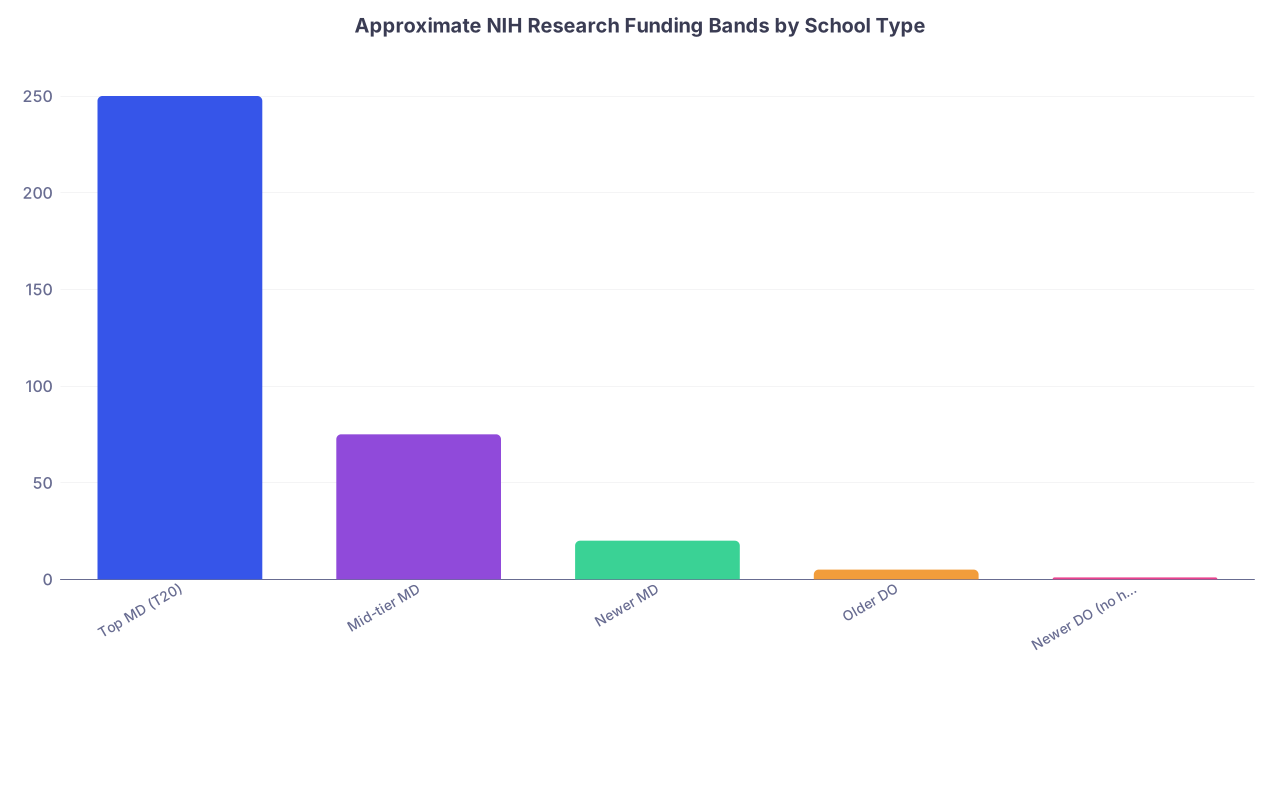
Here is the general pattern:
| Category | Value |
|---|---|
| Top MD (T20) | 250 |
| Mid-tier MD | 75 |
| Newer MD | 20 |
| Older DO | 5 |
| Newer DO (no hospital) | 1 |
Values are rough “millions per year” bands to illustrate scale. You do not need the exact dollar amount to understand the implication: MD schools operate in a different research universe.
At many DO schools, you will find:
- Few R01-level investigators
- Limited lab space
- Little or no PhD-heavy departments housed on site
- Minimal big-data infrastructure or clinical trial coordinating centers
Some DO schools have been slowly building this out (UNTHSC/TCOM, MSUCOM historically, PCOM to a degree), but they still lag most mid-tier MD schools.
Academic medical centers vs. community partners
Most MD schools are physically integrated with, or immediately adjacent to, large academic hospitals. Rounds, consults, tumor boards, and IRB-ready patient populations are right there.
Many DO schools are:
- Standalone campuses
- Partners of multiple community hospitals
- Rotating students through distributed sites with variable research cultures
That means you often do not have:
- One unified EMR to query for retrospective projects
- A single centralized IRB that moves quickly
- A large cadre of fellowship-trained subspecialists doing trials and registries
So the typical MD student at a research-heavy school can stumble into:
- Oncology attending with 3 ongoing trials needing chart reviewers
- Cardiology fellow tracking registry outcomes
- Neurology lab needing someone to quantify imaging data
The typical DO student has to deliberately hunt for any of that, often off-site.
2. What “Infrastructure” Actually Looks Like on the Ground
People throw around “research opportunities” like it is a checkbox. I care about infrastructure: the invisible scaffolding that makes producing publishable work realistic rather than heroic.
MD school environment (research-heavy or research-competent)
At a solid MD academic center, you usually see:
Research offices and cores
- Centralized office that handles IRB submissions and training
- Biostatistics and data core (with analysts who can run your regressions)
- Clinical research coordinators who manage consent, enrollment, REDCap databases
Faculty culture
- Many attendings with ongoing projects and grants
- Fellows who must publish to match into subspecialty fellowships
- Clear expectation that residents and students will generate posters and papers
Formal student research pathways
- Summer research programs after M1 with stipends
- Optional research tracks, scholarly concentration programs
- Easy mapping between “I like cardiology” and “here are 10 investigators you can work with”
Output norms
- Students graduating with 5–20+ PubMed-indexed papers, depending on specialty and motivation
- DOIs and PubMed IDs attached to real journals, not predatory ones
DO school environment (typical, not the best-case)
At a typical DO school (especially newer, community-based, or for-profit):
Fragmented or thin infrastructure
- Small or non-existent biostatistics support
- IRB might be external or slow, used mostly for faculty projects
- Limited on-site clinical trials or labs; many faculty are primarily clinicians at outside hospitals
Faculty constraints
- Heavy clinical loads for teaching faculty
- Very few full-time clinician-scientists
- Many adjunct/community preceptors with no research expectation and no protected time
Student research “system”
- A few motivated faculty who carry most of the student projects
- One “research office” that is actually one overworked administrator
- No integrated summer research structure, usually no stipends
Output norms
- Many students graduating with 0–2 PubMed papers unless they aggressively self-organize
- Posters at local or regional DO conferences, which are fine but carry less weight for competitive specialties
Let me be blunt: at many DO schools, if you want a research portfolio that competes with MD peers in derm, ortho, ENT, neurosurgery, or academic internal medicine, you will be building it almost from scratch. It is possible. It is just not frictionless.
3. How Program Directors Actually Interpret DO vs. MD Research
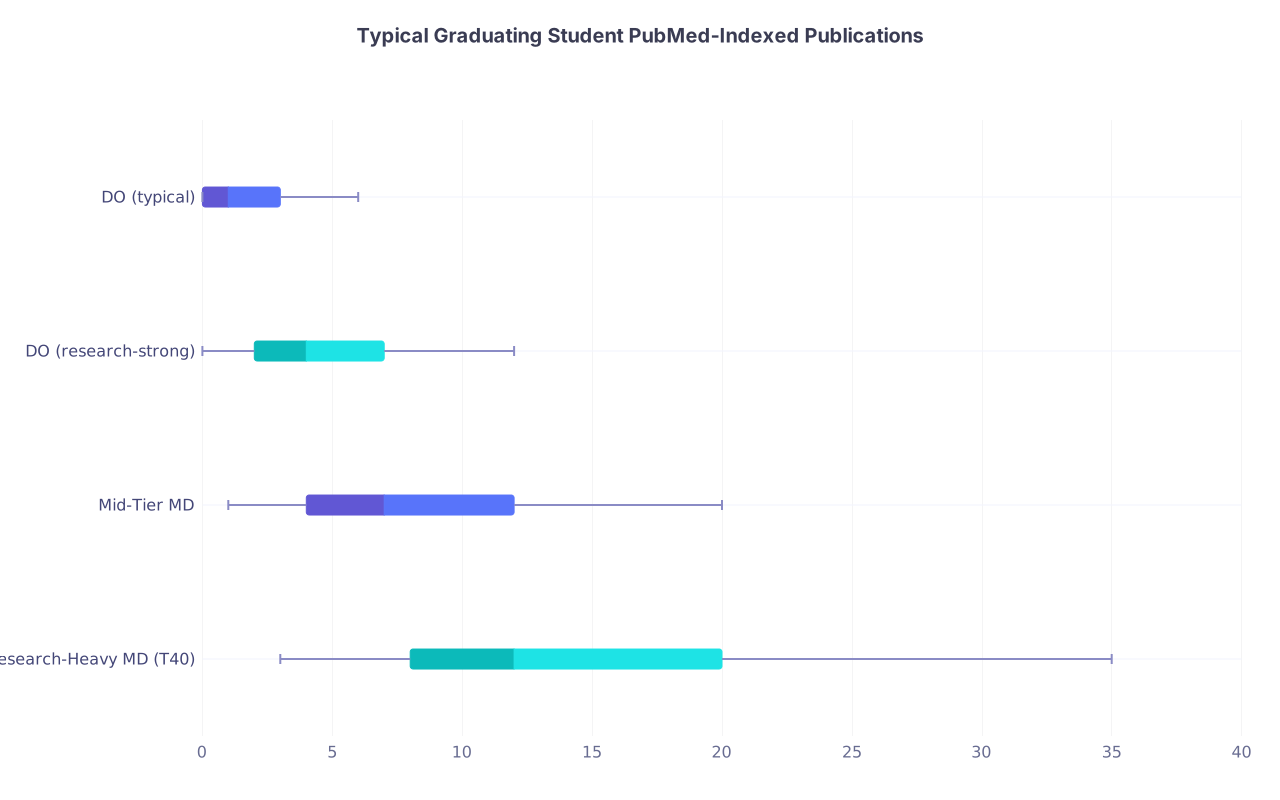
Residency PDs, especially in competitive specialties, do not pretend all research is equal. They do pattern recognition.
| Category | Min | Q1 | Median | Q3 | Max |
|---|---|---|---|---|---|
| Research-Heavy MD (T40) | 3 | 8 | 12 | 20 | 35 |
| Mid-Tier MD | 1 | 4 | 7 | 12 | 20 |
| DO (research-strong) | 0 | 2 | 4 | 7 | 12 |
| DO (typical) | 0 | 0 | 1 | 3 | 6 |
Again, these are indicative bands, not hard numbers. But PDs have seen thousands of applications. They see these patterns every cycle.
The MD research “baseline”
From a mid-tier MD school with a decent academic center, PDs expect that:
A student targeting competitive specialties will often have:
- Multiple PubMed-indexed papers
- Some as first-author, many as middle-author on fellow/attending projects
- Posters at national meetings (ACS, AAS, AAN, ASCO, ACC, etc.)
Even an average student going into IM, peds, EM might have:
- 1–3 publications or abstracts
- Some involvement in quality improvement or outcomes research
This becomes the de facto baseline for competitive specialties.
The DO school discount (harsh but real)
For DO students, PDs know there is often less opportunity. Some will cut you slack for that. Others will not, especially at top-tier academic programs.
Two important dynamics:
The “excuse” problem
If your application is light on research and you are DO, some PDs will accept the infrastructure explanation. Others will think:
“The MDs in my program all found ways to get 10+ pubs. If this applicant really wanted derm/ortho/neuro, they would have found a way too.”The signal amplification when you do have research
When a DO student shows:- Strong, PubMed-indexed work
- Multi-year continuity with a mentor
- Presentations at national meetings
PDs take notice. Because you did not get that by floating along. You had to push against institutional friction.
Type and venue of research matters
PDs care about:
- Clinical vs. bench: For most residencies, clinical and outcomes research is more directly relevant than basic science.
- Where published:
- PubMed-indexed, non-predatory journals > random unindexed online outlets
- Specialty journals and respected general journals > obscure “international journal of…” with suspiciously broad scope
- Role and continuity:
- First-author original paper > 6 case reports with your name buried
- A 3-year relationship with one PI > 10 disconnected one-off posters
DO students, because of infrastructure limitations, often end up with case reports and local posters. Better than nothing, but not in the same league as robust clinical series or multi-center work.
4. If You Are Pre-Med: Choosing DO vs. MD With Research in Mind
If you are premed and research/academics/competitive specialties are on your radar, you cannot ignore this. You should be slightly ruthless in how you assess schools.
Step 1: Decide how research-critical your long-term goals are
Be honest about where you might be heading:
- If you are highly drawn to: dermatology, orthopedic surgery, neurosurgery, ENT, plastic surgery, radiation oncology, interventional fields, or serious academic medicine → research will matter a lot.
- If you lean toward: family medicine, outpatient IM, general peds, community EM, or non-academic careers → research is helpful but not existential.
You can match into competitive specialties from DO schools, but it is already harder on reputation and bias alone. Doing that without strong research is stacking another obstacle.
Step 2: When comparing acceptances, look past the brochure language
Every school says they “support student research.” I ignore that sentence completely. I look for hard evidence:
- How much NIH funding does the institution receive? (NIH RePORTER is public.)
- Are there PhD programs or robust basic science departments on campus?
- Is there an affiliated academic medical center, and is it the primary training site?
- Do they list student publications with citations, not just “presentations”?
- Are there named research tracks or scholarly concentration programs with defined outputs?
If you are comparing:
- A lower-ranked MD school with a real academic hospital
- Versus
- A newer DO school with mostly community sites and vague “research opportunities”
and you care about competitive specialties, the MD option is almost always the smarter play.
Step 3: Specific red flags in DO school research infrastructure
Some DO schools are pushing hard to improve. Others are coasting on tuition dollars and marketing. Red flags:
- No on-campus hospital, everything is “affiliated” and spread out
- Very few faculty profiles listing PubMed-indexed publications
- No clear list of student research mentors by specialty
- No summer research program for rising MS2s
- Heavy emphasis on “case reports” as the main student research output
I have seen DO students accepted to such schools with vague dreams of “I’ll just do research later,” only to find out there is no realistic way to get more than 1–2 low-impact case reports without leaving the state every summer.
5. Already in a DO School? How to Navigate the Gap Aggressively
Now the more interesting part. Suppose you are already at a DO school or committed, and you still care about research-heavy specialties or academic careers. You are not doomed. But you need a deliberate strategy.
Strategy 1: Front-load your research mindset before M1
If you are pre-matriculation:
- Finish and submit any ongoing undergrad/lab work. Get it out the door. Papers in the pipeline count.
- Ask old mentors: “Can I stay involved remotely during M1–M2 for data analysis, writing, or follow-ups?”
- Gather contacts at MD institutions near your DO school’s location. Proximity matters.
You want to walk into M1 with at least one existing research relationship, preferably at an MD academic center.
Strategy 2: Map every possible research outlet in your ecosystem
During M1:
- Identify:
- On-campus DO faculty who publish
- Affiliated hospital attendings who have ongoing projects
- Any local MD school / academic center within commuting distance
Create a personal “research map”:
- Who are the cardiologists, orthopedic surgeons, neurologists, etc., at the big tertiary centers nearby?
- Which of them actually publish? Check PubMed. Do not rely on titles alone.
- Which residents/fellows at those institutions are research-active and might want a hungry student?
You are not limited to your DO campus. The best DO students I have seen in derm/ortho/ENT built their portfolios with MD mentors at nearby academic centers.
Strategy 3: Treat research like a second longitudinal course
This is where most students fail. They think in semesters. Research is not a class. It is a multi-year storyline.
You want:
- 1–2 main mentors (ideally at academic centers)
- A mix of projects:
- Short-term (case reports, chart reviews you can turn around in months)
- Long-term (retrospective or prospective cohorts, QI projects, maybe a basic project if available)
You schedule it like this:
- M1 fall: Light involvement, literature review, data cleaning
- M1 spring: First poster / abstract submission
- M1–M2 summer: Heavy involvement (40-hour weeks if possible), multiple projects
- M2: Manuscript drafting, follow-on analyses, new questions from previous datasets
- M3: Specialty-specific work tied to your audition rotations and interests
You are aiming to have 3–8 PubMed-indexed items by ERAS submission if you are gunning for competitive fields. That is hard but not insane if you treat research as longitudinal, not episodic.
6. Working Around Weak On-Campus Infrastructure: Concrete Tactics
Let me give you specific tools, not vague slogans.
Use regional MD centers and residents/fellows as leverage points
Residents and fellows in academic training programs are overloaded. Many need:
- First-authored papers for fellowship or faculty jobs
- Help with data collection, chart review, and initial drafts
You can be extremely valuable to them.
The playbook:
- Identify residents/fellows in your target specialty at nearby MD institutions with a track record of publications.
- Cold email with a short, specific message:
- Who you are (DO MS1/MS2 at X)
- What you have done (any prior research, even if small)
- Clear interest in their field and willingness to help with tedious parts (data abstraction, chart review, etc.)
- Attach a CV that does not look like a joke. Clean, 1–2 pages, with any relevant projects.
You will get ignored a lot. That is fine. You only need one or two people to say yes.
Exploit retrospective and QI projects at rotation sites
During clinical years, every inpatient service has QI problems and data hiding in the EMR. MD students at research-heavy places have many people trying to spin those into projects already. At community-heavy DO sites, almost nobody is.
So you:
- Pay attention on rotations. Where are there obvious gaps? High readmission rates, slow time-to-antibiotics, frequent falls, etc.
- Ask your attending or chief resident: “Is anyone formally looking at X? I’d be interested in turning this into a QI or retrospective project.”
- Partner with the most research-minded faculty on that team and push the IRB / QI approval yourself if needed.
These projects are perfect for DO environments:
- They do not require a lab.
- Data is local and accessible.
- Journals and national QI conferences love them if the design is competent.
Use multi-institutional DO/MD collaborations
There are increasingly more:
- National student research collaboratives
- Specialty-specific study groups that include DO and MD students
- Online groups (yes, I mean carefully curated, not random social media) organizing multi-center chart reviews
These can give you:
- Co-authorship on larger studies
- Access to better mentorship infrastructure than your home DO campus
- A network outside your school’s limitations
You still have to vet for quality. Avoid “inflated authorship” vanity projects in predatory outlets.
7. Pitfalls DO Students Hit When Chasing Research
I have watched a lot of DO students waste time. Not from lack of effort, but from bad strategy.
Here are the big traps.
Trap 1: The case report rabbit hole
Case reports are:
- Easy to start
- Tempting because they offer quick gratification
- Overproduced and undervalued by PDs
One or two case reports is fine, particularly if they are weird, instructive, or in reputable specialty journals. Eight case reports and zero real studies screams “no access to substantive research.”
Use case reports as door openers and teaching tools, not as your main event.
Trap 2: Low-quality / predatory journals
Because DO schools often lack strong institutional guardrails, students get pulled into publishing in:
- Journals with no real peer review
- “International journal of X, Y, and Z science” with suspiciously high acceptance rates and fees
- Outlets not indexed on PubMed / MEDLINE / reputable databases
Program directors notice. A couple of those is forgivable. An entire CV built on them looks bad.
If you are not sure about a journal:
- Check if it is indexed on PubMed.
- Check if people at reputable MD schools publish there.
- Check for obvious red flags (typos on the website, absurd scope, ridiculous fees).
Trap 3: Being “too polite” about authorship and expectations
At weaker research institutions, there is often no formal culture of:
- Clear authorship agreements
- Timelines
- Accountability on mentors’ side
You cannot be passive. You have to ask directly:
- “If I do X, Y, and Z, will I be first author on this project?”
- “What is a realistic timeline for submission?”
- “Who is responsible for what sections of the manuscript?”
If a mentor is chronically unresponsive, does not move projects forward, or repeatedly shelves your work, you eventually cut your losses and move to another mentor. Time is your most finite resource.
Trap 4: Trying to do everything solo
DO students under weak infrastructure sometimes try to:
- Design projects
- Write IRBs
- Collect all data personally
- Analyze statistics themselves
- Draft entire manuscripts
That is not feasible at scale. You will not beat MD students who are plugging into existing pipelines with support staff and statisticians.
You win by:
- Plugging into pre-existing projects with momentum
- Doing a narrower but deep subset of work well
- Being the student that multiple mentors want on their teams because you deliver reliably
8. Building a Competitive Research Profile as a DO Student: A Realistic Model
Let me outline what a strong DO research arc can look like if you play this smart.
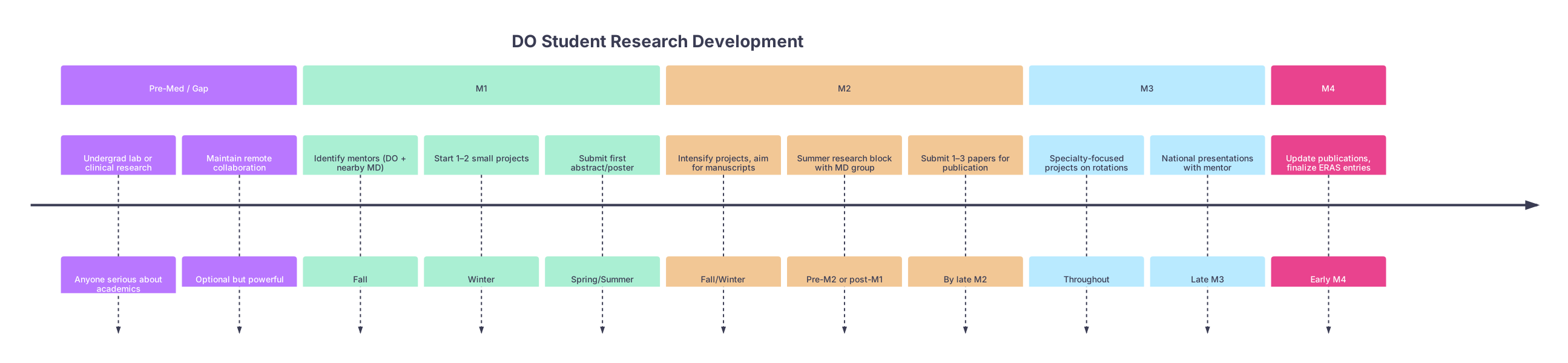
| Period | Event |
|---|---|
| Pre-Med / Gap - Undergrad lab or clinical research | Anyone serious about academics |
| Pre-Med / Gap - Maintain remote collaboration | Optional but powerful |
| M1 - Identify mentors (DO + nearby MD) | Fall |
| M1 - Start 1–2 small projects | Winter |
| M1 - Submit first abstract/poster | Spring/Summer |
| M2 - Intensify projects, aim for manuscripts | Fall/Winter |
| M2 - Summer research block with MD group | Pre-M2 or post-M1 |
| M2 - Submit 1–3 papers for publication | By late M2 |
| M3 - Specialty-focused projects on rotations | Throughout |
| M3 - National presentations with mentor | Late M3 |
| M4 - Update publications, finalize ERAS entries | Early M4 |
By ERAS submission, a DO student targeting, say, ortho or derm might realistically have:
3–7 PubMed-indexed pieces:
- 1–2 substantive retrospective or outcomes papers
- 1–2 smaller series or high-quality case reports
- 1–3 posters/abstracts at national meetings
Clear continuity:
- 2–4 years working with the same MD or DO mentor(s)
- Specialty-aligned work (e.g., mostly ortho if applying ortho)
PDs reading that application will know exactly what you did: you fought the infrastructure gap and won. That carries weight.
9. A Quick Reality Check: When the MD Label Should Trump Everything
Some people will not like this, but it is true: if you have an acceptance to a reasonably solid MD school with a proper academic hospital, and your DO acceptance is to a newer, lightly-resourced DO school with little proven research output, and you care about:
- A very competitive specialty
- Or a strongly academic career trajectory
You are stacking the deck against yourself by choosing the DO in that scenario.
However:
- If your MD option is an offshore or questionable program vs. an established DO school with at least some research structure, the DO may be better.
- If you are headed toward primary care and will be happy in a community setting, a DO with strong clinical training and minimal research is fine.
Your decision should follow your actual goals, not your ego or Reddit folklore.
10. Bottom Line: How to Think About DO vs. MD Research Gaps
Let me strip away the noise.
The research infrastructure gap between most MD and most DO schools is real and structural. It comes from NIH funding, academic hospitals, faculty expectations, and the presence (or absence) of full research ecosystems. Ignoring that is naive.
You can absolutely overcome that gap as a DO student, but not by accident. You do it by:
- Leveraging nearby MD institutions and residents/fellows
- Treating research as a longitudinal commitment from M1 onward
- Avoiding low-yield traps like endless case reports and predatory journals
Your school choice should match your ambition. If competitive, research-heavy specialties or academic medicine are serious goals, then:
- Prefer MD programs with real academic centers when you have that option
- If you choose or land at a DO school, assume from day one that you will need to build your own infrastructure through external mentors and multi-institutional projects
If you internalize those three points early, you will stop asking “Can I do X from a DO school?” and start asking “What specific moves do I need to make this year to close the gap?” That is the question that actually gets you where you want to go.