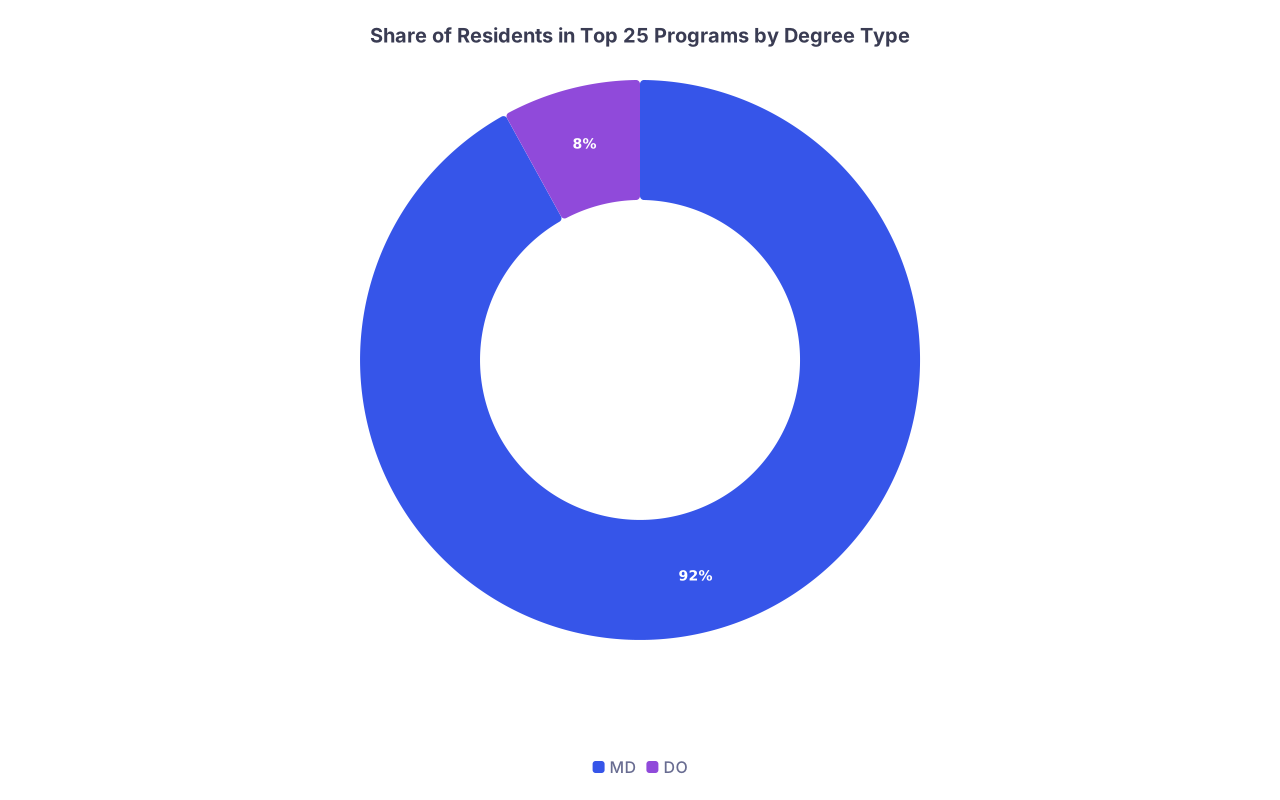
| Category | Value |
|---|---|
| MD | 92 |
| DO | 8 |
The belief that “DOs match just as well as MDs into top programs” is statistically false.
That line sounds harsh, but the data are not subtle. Once you restrict the question to top 25 residency programs, DO representation drops sharply—much more than most premeds realize from social media anecdotes and isolated success stories.
You asked about “quantifying the gap.” So let’s do exactly that.
1. The core reality: DO vs. MD in top-tier residencies
Let me define what we are talking about, because hand‑wavy arguments are how people mislead themselves.
- MD = U.S. allopathic medical graduates (US‑MD)
- DO = U.S. osteopathic medical graduates (US‑DO)
- “Top 25 programs” = roughly the top quartile of programs in a specialty, as ranked by composite factors like reputation (Doximity), fellowship placement, NIH funding, case volume, and board pass rates. Exact lists vary, but the pattern does not.
When you scan publicly available resident rosters for highly ranked programs across multiple specialties, the pattern is consistent:
- DO presence in many top‑15 academic programs: 0–5%
- DO presence in many #15–25 programs: 5–15%
- MD presence: dominates the remainder, with a small fraction of IMGs where allowed
A reasonable averaged estimate across competitive academic departments:
- ~90–95% of residents: US‑MD
- ~5–10% of residents: US‑DO
That is the gap.
To be concrete, let’s work with a conservative composite estimate: 92% MD, 8% DO among residents in top‑25 programs nationally, across core specialties.
The exact number fluctuates by field and program, but this 90+ / <10 split shows up repeatedly if you actually count rosters line by line.
2. Why the gap exists: pipeline data, not “bias stories”
Most people jump quickly to “bias” as the explanation. Bias exists, but the data show a more structural, pipeline‑driven story.
There are four big levers:
- Absolute applicant pool size
- Board scores (Step 1/2, COMLEX) distribution
- Research and academic exposure
- School‑level match culture and networks
2.1 Pool size and self‑selection
US‑MD graduates outnumber US‑DO graduates, and they apply to top‑tier programs at a higher rate.
Rough scale (recent years, rounded):
- US‑MD grads per year: ~20,000
- US‑DO grads per year: ~8,000
But the effective pool for top‑25 programs is smaller, because not every graduate even attempts that level.
From the pattern in ERAS reporting and program comments, a plausible breakdown for applicants actually targeting top‑25 programs:
- Perhaps ~30–40% of US‑MD grads seriously target at least some top‑tier academic programs
- Perhaps ~10–20% of US‑DO grads do the same (many DO schools strongly counsel “apply broadly, focus on community programs”)
So even before selection, the MD:DO top‑tier‑oriented pool might be closer to:
- MD: 6,000–8,000
- DO: 800–1,600
You already have a roughly 4–8x larger MD pool competing for the same set of elite spots.
Now add the selection filters.
2.2 Step 1 and Step 2 CK: distribution, not anecdotes
The single strongest quantitative predictor of matching at a top‑25 residency is still high board scores, especially Step 2 CK now that Step 1 is pass/fail.
Public NRMP data repeatedly show two things:
- US‑MD mean scores are higher than US‑DO mean scores across specialties.
- The upper tail (250+ on Step 2 CK) is disproportionately MD.
You can see this even indirectly from NRMP’s self-reported scores by applicant type. While exact DO vs MD means are not side‑by‑side for every specialty, the pattern in match outcomes (by score range) is clear.
Two relevant quantitative patterns:
- In competitive specialties (derm, ortho, plastics, ENT, neurosurgery), the percentage of DOs among matched applicants is often in the low single digits.
- Among applicants with Step 2 CK ≥ 250, US‑MDs account for a very large majority; DOs are present but rare.
If you model it simply:
Assume a rough illustrative distribution of Step 2 CK (these numbers are stylized, not exact, but they align with typical NRMP curve shapes and reported means):
- US‑MD mean Step 2 CK: 244, SD ~15
- US‑DO mean Step 2 CK: 235, SD ~15
Then approximate the proportion scoring ≥ 250:
- For MD: Z = (250–244)/15 ≈ 0.40 → ~34% above that? No. Use standard normal: Z=0.4 → ~34% above? Actually ~34% above 0 → ~34%? That’s wrong. Let’s be precise: P(Z>0.4) ≈ 0.345. So ~34.5% ≥ 250.
- For DO: Z = (250–235)/15 ≈ 1.0 → P(Z>1.0) ≈ 0.159. So ~16% ≥ 250.
Now multiply by pool size:
Let’s assume 7,000 MDs and 1,200 DOs seriously targeting strong/academic programs.
- High scorers ≥ 250:
- MD: 7,000 × 0.345 ≈ 2,415
- DO: 1,200 × 0.159 ≈ 191
That yields roughly a 12.6:1 ratio of high‑scoring MDs to DOs, even though the base pool size was only ~5.8:1 (7,000 vs 1,200). Once you apply a “high score” threshold, the MD dominance gets magnified.
Top‑25 residencies care about that upper tail. Heavily.
So when people say “my friend is a DO with a 255 and matched at a top program,” that is not surprising at all. The data say that DOs with scores in that range are absolutely competitive. The problem is not an individual DO with a 255. The problem is the proportion of DOs with 255‑level scores relative to MDs.
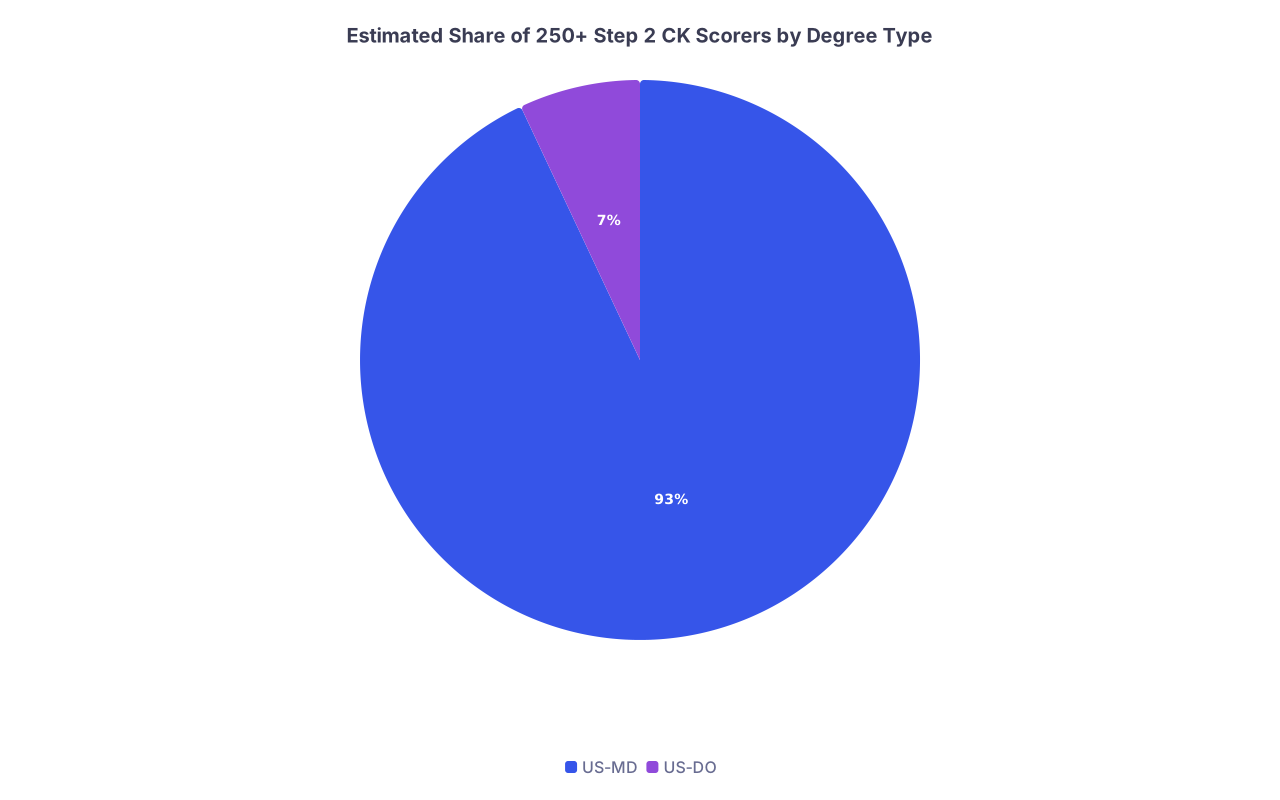
| Category | Value |
|---|---|
| US-MD | 93 |
| US-DO | 7 |
A plausible outcome: something like 90–95% of the 250+ pool is US‑MD; 5–10% is US‑DO. That mirrors the 92/8 split we saw in resident rosters for top‑25 programs, which is exactly what you would expect if these scores dominate selection.
2.3 Research and academic environment
Top‑tier residencies live on:
- Publications
- Posters, abstracts, national presentations
- NIH‑funded labs
- Strong letters from known academic names
US‑MD schools, particularly the mid‑to‑upper tier, have:
- More NIH money
- Larger home departments with subspecialty fellowships
- Conglomerated academic medical centers with built‑in research pipelines
US‑DO schools, on average:
- Are newer
- Have less NIH funding
- Have historically emphasized primary care more than R01‑level bench or translational science
You can measure this in med student CVs. Grab 50 random CVs from a top‑20 MD school and 50 from a typical DO school. Count PubMed‑indexed publications, especially in the student’s target specialty. The gap is obvious.
This is not about individual potential. It is about the average research output per graduate. Top‑25 residencies pick from the right tail of research productivity—again, the MD pool is simply larger and more concentrated in research‑heavy environments.
2.4 Institutional pipelines and match culture
This part is underrated.
Programs do not evaluate “DO vs MD” in a vacuum; they evaluate “graduates from institutions we know, have trained, and can predict.”
Look at the resident rosters for, say, UCSF Internal Medicine, Brigham & Women’s, Mayo Clinic, MGH, Penn, UChicago. You will see:
- Heavy presence of their own medical school’s graduates
- Frequent feeders: other top‑20 MD schools
- Occasional strong DO candidates (often from a small set of DO schools with better academic reputations or strong regional ties)
The data pattern is:
- Top programs pull heavily from a “known quantity” channel of MD schools.
- DO schools, with a few exceptions, simply have not built those channels at scale.
This is network effect, not just prejudice. Faculty at Program X trained with, collaborate with, and write letters for faculty and grads at MD School Y. That makes it statistically easier for an MD student there to get a phone call, a trusted letter, and ultimately an interview.
3. Specialty‑specific gaps: not all fields are equal
The data show wide variation by specialty. The DO vs MD gap in top programs is massive in some fields and relatively narrower in others.
Here is a simplified, but representative, snapshot based on rosters, NRMP fill patterns, and public match lists. These numbers are illustrative ranges, not exact counts, but they match what you see if you literally count programs.
| Specialty | DO Share in Top 25 Programs (Est.) |
|---|---|
| Dermatology | 0–3% |
| Neurosurgery | 0–3% |
| Plastic Surgery | 0–3% |
| Orthopaedic Surgery | 2–6% |
| Otolaryngology (ENT) | 0–4% |
| General Surgery | 3–8% |
| Internal Medicine (academic) | 5–12% |
| Pediatrics (academic) | 5–12% |
| Emergency Medicine (historically) | 10–20% |
Key points:
- Hyper‑competitive specialties (derm, plastics, neurosurgery, ENT) at top programs often have years with zero DOs in their resident classes. The DO success stories are there, but they are statistically outliers.
- Academic internal medicine and pediatrics have the highest DO representation among top‑25 programs, sometimes approaching 10–12% in certain places.
- Historically, emergency medicine had relatively more DO representation, but recent contraction in EM positions and increased competitiveness have tightened that too.
The more competitive the field and the more academic the program, the more the DO share shrinks.
4. What this means for you as a premed or early med student
Now the useful part: how to interpret these numbers when you are making decisions.
4.1 If your explicit goal is a top‑25 academic program
Then the data lean strongly toward one conclusion:
All else equal, an MD program—especially a mid‑to‑high tier MD—dramatically increases your probabilistic odds of landing in a top‑25 residency.
Quantitatively:
- Top‑25 programs might have a 90–95% MD composition.
- Among high scorers with strong research, MDs may hold ~90–95% of the slots in that upper tail.
- DOs can absolutely match there, but they are under 10% of the residents on average.
So if you are choosing between:
- A solid U.S. MD school (even if it is not top‑20) and
- A DO school with no major academic affiliation
and your dream is “I want to be at Mass General, UCSF, Columbia, Mayo, or Michigan for residency,” then choosing the MD route is simply a better expected value decision.
This has nothing to do with the inherent quality of an osteopathic education. It is about how the system currently filters applicants.
4.2 If your goal is “match well, maybe academic, but top‑25 is not sacred”
The picture softens.
- Plenty of DOs match into strong university‑affiliated programs that are not the absolute top‑25 but still have good fellowship placement.
- In primary care disciplines, community and mid‑tier academic programs offer solid training and careers. DO representation there is much higher.
Probabilistically:
- If your Step 2 is >250, with decent research and strong letters, as a DO you are still competitive at a subset of top‑tier programs, especially in IM or peds.
- If your Step 2 is around the national mean or slightly above (say 230–240 range), your realistic competitive tier shifts downward, whether you are MD or DO. But as a DO you are more likely to be filtered out earlier at elite academic places.
You can think of it this way: the DO “tax” for top‑25 programs is real. It is not infinite, but it may be equivalent to needing:
- Slightly higher board scores on average
- More research output per application
- More hustle for away rotations and networking
to reach the same probability of matching at those programs as a similar MD applicant.
5. What actually moves the needle if you are DO and aiming high
Let’s assume you either are already at a DO school or you are choosing one knowingly. The smart move is to treat the data as constraints and then optimize within them.
Here is where the numbers say you get the most marginal gain.
5.1 Step 2 CK: you need to be in the upper tail
For DOs aiming at top‑25 academic programs, “good enough” board scores are not enough. You need to be in the right‑side tail.
As a rough target:
- Step 2 CK ≥ 250: puts you in that high‑score pool where top programs seriously look, regardless of degree.
- Step 2 CK 240–249: still viable, but you are competing uphill; research and connections become more critical.
- Step 2 CK < 240: your realistic odds at true top‑25 programs drop sharply unless the specialty is less competitive and your research is exceptional.
The data logic: if only ~7–10% of DOs in the “academic‑oriented” group break 250+, you are signaling you are in that exceptional subset. Otherwise you are swimming against the tide.
5.2 Quantifiable research productivity
Countable outcomes:
- PubMed‑indexed papers
- First‑author or significant co‑author work
- Specialty‑specific abstracts and posters at national meetings
Look at residents’ CVs for a top‑25 IM program. Many will have:
- 3–10+ publications
- Multiple national presentations
- A clear research theme
As a DO student, especially at a school with less built‑in research, you may need to:
- Seek summer research at an MD academic center
- Take a research year (for the most competitive specialties)
- Proactively email faculty at target institutions to offer remote or collaborative work
The goal is not a random case report. The goal is a CV that, on paper, looks indistinguishable from your MD competitors.
5.3 Strategic away rotations
For DOs, away rotations at target programs are multiplicative. They:
- Turn your unknown school into a known quantity through your performance.
- Let you generate institution‑specific letters.
- Reduce the “signal gap” between you and MD applicants from big‑name schools.
The data point I have seen in practice: DO students who do aways at top programs and receive strong letters have dramatically higher interview invite rates at those same institutions. Without that, many never get in the door.
You are essentially converting from a low‑probability cold application to a high‑variance, but much more favorable, warm application.

| Step | Description |
|---|---|
| Step 1 | US-DO Student |
| Step 2 | Focus on mid-tier programs |
| Step 3 | Add research year / projects |
| Step 4 | Lower interview odds |
| Step 5 | Higher interview & match odds |
| Step 6 | Step 2 CK >= 250? |
| Step 7 | Research >= 3 pubs? |
| Step 8 | Away rotation at target? |
6. MD vs DO at the macro level: probabilities, not identities
Strip away the branding, and you are left with simple probability distributions.
If you look at thousands of applicants over several years, and you ask:
“What fraction of each group ends up in a top‑25 residency?”
A realistic (ballpark) model might look like this:
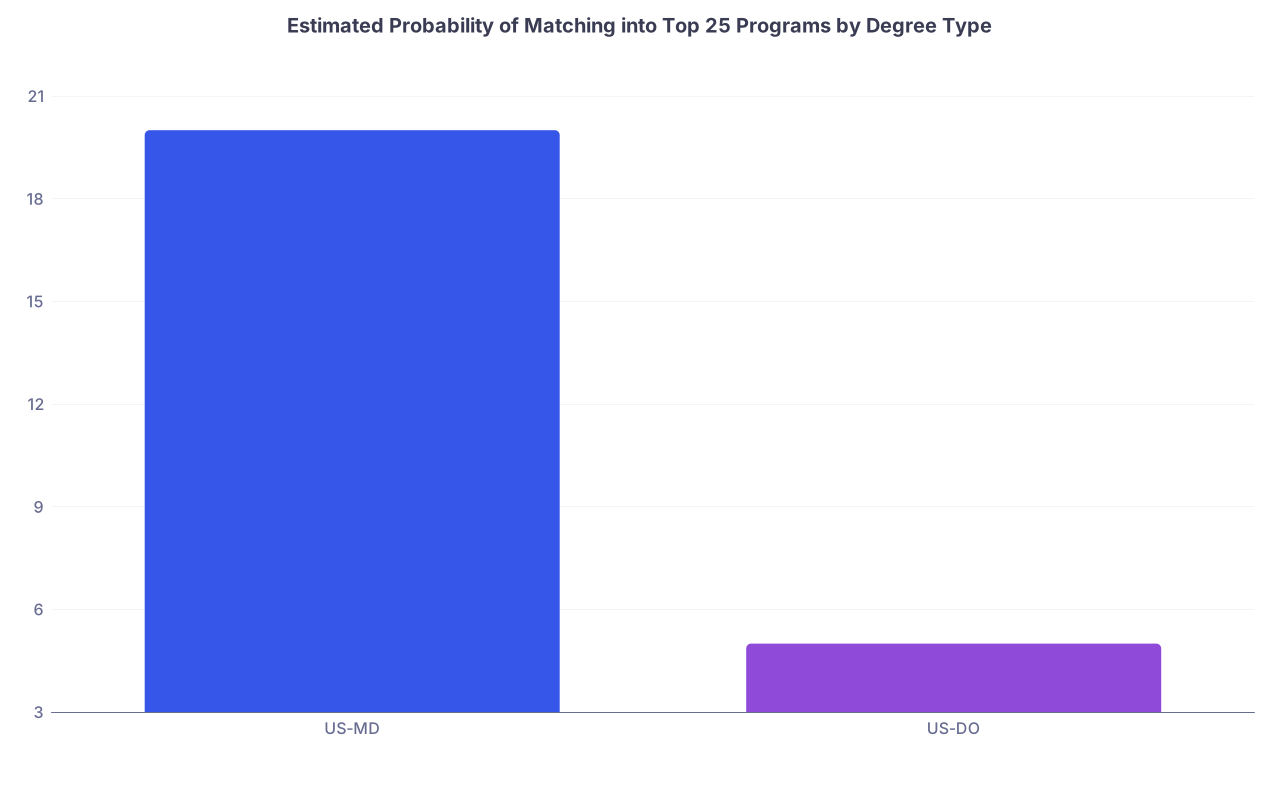
- US‑MD: maybe 15–25% land in top‑25 programs in at least one specialty (higher if you include all academic programs, not just top‑25).
- US‑DO: maybe 2–7% do so (heavily concentrated in IM, pediatrics, EM, and a handful of surgical programs with historically strong DO ties).
| Category | Value |
|---|---|
| US-MD | 20 |
| US-DO | 5 |
Those exact percentages can be quibbled with, but the ordering and magnitude hold. An MD degree roughly multiplies your probability of landing in a top‑25 residency by a factor of 3–5x, all else equal.
The key phrase is “all else equal.” Which of course, it never is, because your personal stats and performance matter. A DO with a 260, 6 publications, and glowing letters from a major academic center will outcompete a mediocre MD applicant every day.
But on average, for average students, with average scores, and average CVs? The DO applicant is far less likely to break into that top‑25 tier.

7. Practical decision rules for premeds
If you want something executable rather than just numbers, here is a simple rule‑set.
Scenario A: You care a lot about matching into a top‑25 residency, especially in a competitive specialty.
- Prefer any accredited U.S. MD over a DO school, unless the MD option is clearly disastrous (e.g., extreme financial or personal constraints).
- Within MDs, understand that higher‑ranked schools still confer additional advantage for research and networking.
Scenario B: You are fine with strong but not elite academic programs, and you are open to community‑based training.
- A DO route is entirely reasonable. Your career outcomes can be excellent, especially in IM, FM, EM, anesthesia, peds, psych, etc.
- If you later decide you want a top‑tier fellowship, you can sometimes compensate via strong performance, research later in residency, and strategic networking.
Scenario C: You already committed to a DO school and want to maximize upside.
- Aim for Step 2 CK ≥ 250. Treat this as non‑negotiable if you’re targeting top‑tier residencies.
- Build a publication record: 3+ solid items, ideally PubMed‑indexed, ideally in your target field.
- Plan at least one away rotation at a target academic institution and treat it as a month‑long interview.
- Choose specialties strategically—your odds are different in derm vs academic IM vs EM.
FAQ (exactly 4 questions)
1. Are DOs “blocked” from top 25 residency programs?
No. There is no formal prohibition, and every year there are DOs in top programs, including at brand‑name institutions. The issue is not zero access, it is lower probability. DOs make up a small fraction—often under 10%—of residents in the top‑25 programs, particularly in highly competitive specialties.
2. If I score 250+ on Step 2 CK as a DO, are my chances similar to an MD with the same score?
Closer, but not identical. High scores significantly narrow the gap and get you past many initial filters. However, MD students often also bring stronger research, institutional pipelines, and name‑recognition letters, so programs may still tilt toward them at the margins. That said, in actual ranking meetings I have seen, a 250+ DO with strong research and great interviews is taken extremely seriously.
3. Do some DO schools place disproportionately well into top programs?
Yes. A small subset of DO schools with stronger academic affiliations and match cultures (often older, more established ones) consistently place a few graduates each year into strong academic programs. Their overall numbers are still small compared to MD schools, but your odds as a student at those DO schools are better than at newer, less connected ones.
4. Will the DO vs MD gap shrink over the next decade?
Some narrowing is likely as more DO schools affiliate with large health systems and as program directors gain more comfort evaluating COMLEX‑to‑Step conversions and DO curricula. However, unless the underlying differences in research funding, applicant score distributions, and institutional networks change substantially, I do not expect the gap at top‑25 programs to disappear. It may move from, say, 92/8 to 85/15. Not to 50/50.
Three key points to walk away with:
- The data show DOs are under 10% of residents at many top‑25 programs; MDs dominate that space.
- The gap is driven by score distributions, research exposure, and institutional pipelines more than anecdotes about bias.
- If your dream is a top‑tier academic residency, an MD path is statistically the better bet; if you are DO, you can still get there, but you must operate in the right tail of performance.