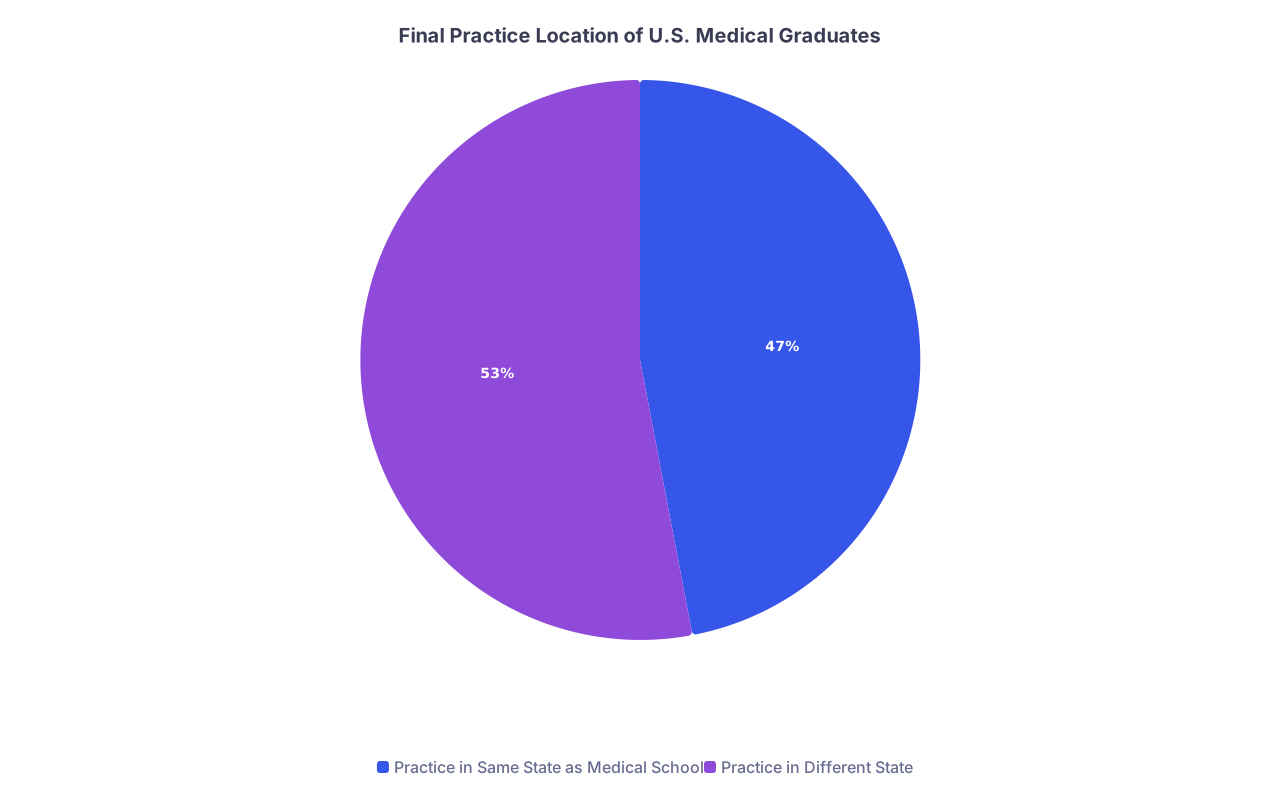
| Category | Value |
|---|---|
| Practice in Same State as Medical School | 47 |
| Practice in Different State | 53 |
The romantic idea that “a doctor can work anywhere” ignores the data. Where you train – and whether you go DO or MD – strongly predicts where you will practice, and the gap is much wider than most premeds realize.
“Geographic flexibility” gets thrown around constantly in DO vs. MD debates. Usually with hand‑waving, not numbers. So let us fix that.
This is a look at where DO vs. MD graduates actually end up practicing, using hard data from:
- AMA Physician Masterfile
- AOA / AACOM reports
- AAMC (GME, physician workforce, and state-level reports)
- NRMP / NMS residency match data
You are not choosing only a degree. You are choosing a geography probability distribution.
1. The baseline: How “sticky” is medical training geography?
Start broad. Forget DO vs. MD for a second.
Across all U.S. medical graduates (MD + DO), the data from AAMC and AOA converge on a striking fact:
- Roughly 45–55% of physicians end up practicing in the same state as their residency.
- Around 40–50% practice in the same state as their medical school.
- When med school and residency are in the same state, retention jumps over 60–70% in many regions.
Translation: most people do not scatter randomly around the country. Training location anchors you.
Where the MD vs. DO split enters:
- They attend different types of schools, in different places.
- They match into different types of residency programs (community vs university, rural vs urban).
- They feed disproportionately into different specialties that have different geographic distributions.
Those three levers heavily shape geographic outcomes.
2. Where DO vs. MD schools actually are
Before looking at practice locations, you need to look at school geography. The supply side.
MD schools (LCME-accredited):
- Historically clustered in large metro areas and academic centers.
- Heavy concentration in Northeast, Mid-Atlantic, Midwest, West Coast.
- Many states with large populations (e.g., New York, California, Texas) have multiple MD schools.
DO schools (COCA-accredited):
- Rapid growth in the past 20 years, especially in smaller cities and rural-adjacent areas.
- Many campuses deliberately placed in states with physician shortages: e.g., Arkansas, Alabama, Mississippi, West Virginia, rural Pennsylvania, Oklahoma.
- More likely to have explicit “mission” language around primary care and serving local regions.
A simplified breakdown (approximate, but directionally accurate):
- MD schools: majority in metropolitan areas >500,000 population.
- DO schools: much higher proportion in 50,000–500,000 population regions, often with strong ties to regional health systems rather than huge academic centers.
That placement is not cosmetic. School location sets up:
- Your clinical rotation hospitals.
- Your local networking base.
- Your default pipeline into nearby residency programs.
And those pipelines differ for DOs and MDs.
3. Geographic “stickiness” – DO vs. MD
Now to where people actually end up.
There are three major retention metrics that matter:
- Stay in state of medical school
- Stay in state of residency
- Stay in region (e.g., Northeast, South, Midwest, West)
Different datasets slice this differently, but the pattern is consistent.
3.1 State retention: DO vs. MD
Using aggregated state-level reporting and ACGME / AOA transitional data, you see roughly:
- Around 50–60% of DO grads end up practicing in the same state as either their med school or their residency.
- For MD grads, that figure is more like 35–50%, depending on the state and how you define “stay”.
The short version:
- DO pathway → higher probability of local or regional retention.
- MD pathway → relatively higher probability of interstate mobility, especially toward large metros and coasts.
A lot of this is driven by where the residencies are.
4. Residency geography: the real sorting machine
Physicians practice where they complete residency much more often than where they completed medical school. This is robust across specialties and decades.
The NRMP and AAMC show:
- Nationwide, about half of residents end up practicing in the same state as their residency.
- States with many residency positions relative to their population (e.g., Massachusetts, Minnesota) have very high retention.
- States that export residents (few residency slots, many med school grads) lose people.
Now layer DO vs. MD on that.
MDs are overrepresented in:
- Large academic centers
- Coastal cities
- Highly competitive specialties and fellowships in “name” institutions
DOs are overrepresented in:
- Community-based programs
- Smaller cities and town-based residencies
- Primary care, community internal medicine, community pediatrics, community psychiatry
Residency location patterns for DOs:
- Higher probability of ending up in the same state or neighboring state as their DO school, given many DO schools have affiliated regional GME consortia or partner hospitals.
- Higher share of residencies in Midwest, South, and non-coastal regions.
Residency location patterns for MDs:
- More likely to cross multiple states for “brand-name” residencies.
- Higher share in Northeast corridor, West Coast, and major metros like Chicago, Houston, Dallas, Atlanta, Miami, Seattle.
Residency is not only training. It is social roots, partner jobs, kids in school, home purchase. The data show that once people have done 3–7 years somewhere, they tend to stay.
5. Final practice patterns: DO vs. MD
You are probably looking for a simple line like “DOs end up more rural, MDs more urban.” That is not totally wrong, but the actual patterns are more nuanced.
Let us look at three axes:
- Urban vs rural
- Region (Northeast, South, Midwest, West)
- State “loyalty” vs migration
5.1 Urban vs rural
Multiple workforce reports converge on something like this:
DOs:
- Disproportionately represented in rural and micropolitan counties.
- Strong presence in towns of 10k–100k where they are the family physicians, hospitalists, and general internists.
- Significant share in suburban and mid-size cities as well, but less saturated in the very largest metros compared with MDs.
MDs:
- Heavily concentrated in large urban centers.
- Overrepresented in academic hospitals, specialty clinics, and tertiary / quaternary centers.
- Still present everywhere, but the density of MDs spikes in high-population urban counties.
So if your mental picture of “where doctors practice” is Boston, NYC, LA, SF, Seattle, DC – that is overwhelmingly MD territory per capita. If you drive 2 hours out into farm counties or Appalachian towns, your attending is more likely to be DO, especially in primary care.
5.2 Regional distribution
At a high level, MD and DO grads practice all over the country. But the proportions differ.
From combined AMA / AOA workforce estimates and state-level reporting:
DOs are particularly concentrated in:
- Midwest: Pennsylvania, Ohio, Michigan, Missouri, Oklahoma, Kansas.
- Rust Belt and Appalachia: Pennsylvania is a DO megapower; West Virginia, Kentucky, parts of New York state show strong DO presence.
- Certain Southern states that built DO-heavy pipelines (e.g., Alabama, Mississippi, Arkansas via newer DO schools).
MDs dominate numerically in:
- Northeast corridor and New England (though PA and NY are more mixed because of strong DO institutions).
- California and West Coast (though DO share is rising).
- Texas and major Sun Belt metros, where large MD schools and academic centers exist.
To make this more visual:
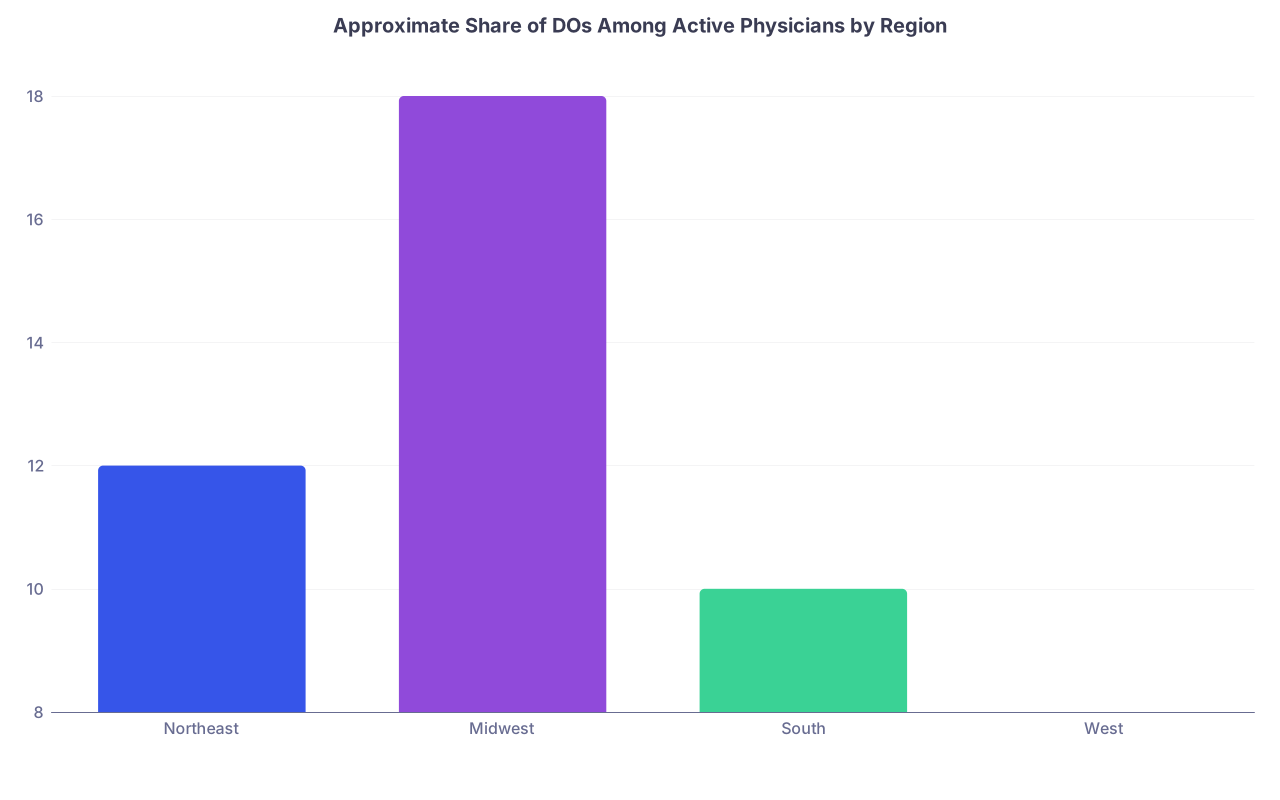
| Category | Value |
|---|---|
| Northeast | 12 |
| Midwest | 18 |
| South | 10 |
| West | 8 |
Those percentages are approximations but reflect the general pattern: DOs have the highest relative share in the Midwest, then Northeast, then South/West.
5.3 State loyalty vs. migration
There is a myth that MD = maximum geographic flexibility, DO = locked into the state where you train. Reality is less extreme, but the probabilities are different.
Pulling from state retention analyses:
- Roughly 55–65% of DOs end up practicing in the same state where they either went to school or did residency.
- For MDs, that figure is often closer to 40–55%, with more out-of-state movement to coastal and large metro magnets.
Does that mean DOs cannot move? No. There are plenty of DOs in New York City, LA, Bay Area, Boston, etc. But on a population level, DOs are statistically more anchored to where they trained.
6. Specialty choice drives geography – and DO vs. MD choose differently
One huge confounder here: MDs and DOs do not enter specialties at the same rates, and specialties have very different geographic patterns.
High-level pattern (numbers vary by year, but direction is stable):
DOs:
- Higher share in primary care: family medicine, internal medicine, pediatrics, OB/GYN.
- Strong presence in psychiatry and PM&R as well.
- Lower percentage in ultra-competitive subspecialties like dermatology, plastic surgery, certain surgical subspecialties.
MDs:
- Still many in primary care, but greater share in:
- Dermatology
- Radiology (diagnostic, IR)
- Ophthalmology
- ENT
- Neurosurgery
- Orthopedic surgery
- Competitive fellowships (GI, cardio, heme/onc) at big academic centers
- Still many in primary care, but greater share in:
The geography of those specialties:
- Primary care physicians are everywhere, but especially needed, recruited, and retained in smaller towns, rural counties, and underserved suburbs.
- Subspecialists and high‑tech proceduralists are disproportionately clustered in:
- Academic centers
- Large metro areas
- High‑income zip codes
So a DO-heavy specialty mix naturally produces more doctors in smaller cities and underserved regions. An MD‑heavy highly sub-specialized pipeline concentrates doctors in big urban hubs.
This is causal in both directions:
- DO schools often have explicit “rural and primary care” missions → attract students from local, often rural backgrounds → those students are more likely to return.
- MD schools often recruit nationally, with large numbers of students from coastal metros → those students target competitive specialties and brand‑name residencies → those programs are in big cities.
All of that eventually shows up as “where doctors end up.”
7. International mobility: MD has a clear edge
If you are thinking beyond U.S. borders, the MD vs. DO data diverge even more.
A few practical points:
- MD degree is globally recognized in more countries without additional explanation.
- DO degree from the U.S. is increasingly recognized, but the acronym “DO” outside the U.S. often refers to non‑physician osteopaths (manual therapists), creating friction.
- Work and licensure pathways in places like Canada, UK, Australia, and EU tend to be smoother for MDs. There are DOs abroad, but the path usually involves more hoops.
The raw numbers support this:
- The overwhelming majority of U.S.-trained DOs practice within the United States.
- A somewhat higher percentage of U.S.-trained MDs practice abroad at some point (NGO work, academic posts, long-term relocation), although still a minority overall.
If international flexibility is a top‑3 priority for you, the data favor MD.
8. Premed reality check: How much does DO vs. MD constrain your geography?
This is where I will be blunt.
If you want:
- Maximum shot at ending up in major coastal cities and big academic centers, especially in competitive specialties → The MD route statistically gives you more leverage.
- Highest probability of settling near where you went to school / residency, often in smaller cities or underserved regions, especially in primary care → The DO route has a stronger local retention pattern.
But the distributions overlap. A few realities I have seen repeatedly:
- DOs in Manhattan doing GI and cardiology.
- MDs running solo practices in rural Oklahoma.
- DOs in large suburban hospitalist groups outside Chicago or Dallas.
- MDs in critical access hospitals in Montana.
Your personal geography will be shaped by at least four layers:
- Where you get into school (DO vs. MD and campus location)
- Which specialty you choose
- Where you match for residency/fellowship
- Personal anchors: partner’s job, family, finances, preference
The DO vs. MD label is one factor. Not destiny. But the aggregate data say it shifts the odds.
9. A simple mental model for planning
You do not need an econometrics PhD to use this data. Here is a clean way to think about it.
9.1 If you are geographically flexible
If you are fine living in the Midwest, South, inland West, or smaller metros:
- DO vs. MD matters less for your eventual ability to practice where you are willing to live.
- You can build a strong career path from either, especially in primary care, IM, peds, psych, EM, anesthesia, and a subset of surgical fields.
You will still see differences in urban vs rural balance, but you have more “acceptable” outcomes across both degrees.
9.2 If you are geographically rigid
If you are saying “I must end up in Los Angeles / NYC / Bay Area / Boston”:
- The data are not in your favor in general. Geographic rigidity is risky in medicine.
- That said, MD training, especially from a school and residency already in those regions, gives you better odds of staying there.
- As a DO, matching into competitive residencies in those markets is possible but more selective and constrained. Many DOs who want coastal metros end up in adjacent suburbs or smaller cities rather than the core urban hubs.
9.3 If you want to “go back home”
Common pattern: student from rural or mid-size hometown, wants to eventually return.
- DO schools often explicitly recruit these students and build pipelines back into local health systems.
- MD schools can also serve this path, especially state schools with strong regional missions.
- Data show that students who train close to home and then match locally are very likely to stay.
For the “go home” plan, both routes work, but DO training plus a regionally focused residency may lock it in more tightly.
10. How this should actually affect your decision
Here is what the data justify. And what is overblown.
Reasonable conclusions:
- Choosing a DO school in a specific region significantly increases your odds of practicing in that region or nearby, particularly in primary care and community-based specialties.
- Choosing an MD school with strong academic affiliations and a “name” hospital network increases your odds of training – and later practicing – in large metro and academic settings, including coastal hubs.
- For international or highly mobile careers, MD is the smoother option.
Overblown claims:
- “DOs are trapped in rural areas.” False. There are DOs across every major city. The distribution is skewed, not absolute.
- “MDs can easily work anywhere, DOs are hugely restricted.” Also false. Licensing is 50‑state for both; the main differences are in competitiveness for certain residency slots and global recognition.
- “Your degree permanently determines your geography.” No. Specialty choice and residency location exert far more influence.
One more visual, this time about the pipeline from training to practice:

| Step | Description |
|---|---|
| Step 1 | Med School Location DO vs MD |
| Step 2 | Residency Region |
| Step 3 | Practice State |
| Step 4 | Urban/Suburban/Rural Mix |
| Step 5 | Specialty Choice Tendencies |
Each node is a probability filter. DO vs. MD affects A and E, which then propagate into B, C, and D.
11. Bottom line for premeds and med students
If you strip out the noise, the data on geographic patterns say three things that actually matter.
Where you train is where you are likely to stay.
Medical school and especially residency are strong geographic anchors, regardless of DO or MD. Plan with that in mind.DO vs. MD shifts the map, not the entire game.
DOs are statistically more local, more regional, and more represented in smaller or underserved areas. MDs are statistically more concentrated in big metros and academic centers. But both degrees are spread across the entire country.Specialty and residency choice are the real levers.
Your future zip code will be more heavily determined by your specialty and residency program location than by three letters after your name.
If you want to be smart about geography, stop thinking “DO vs. MD = respect debate” and start thinking in terms of pipelines and probabilities. The data are very clear on that.