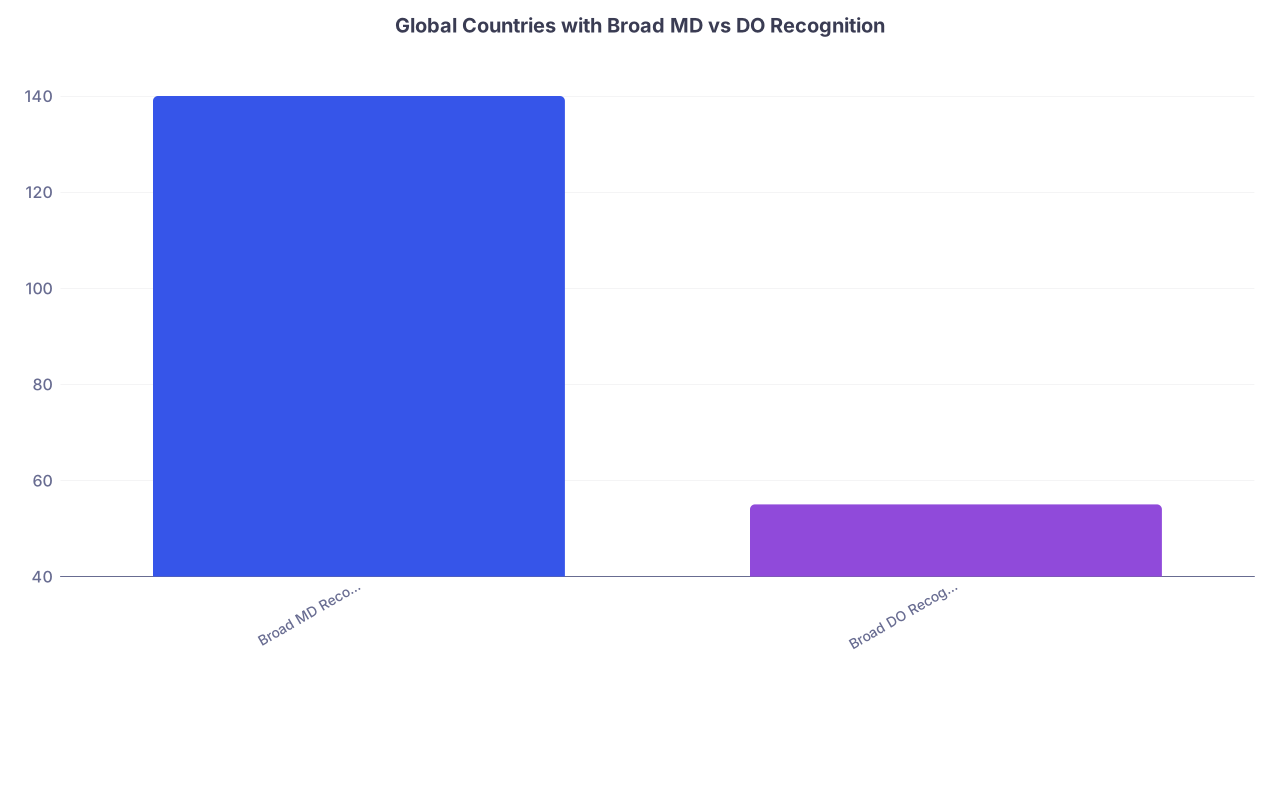
| Category | Value |
|---|---|
| Broad MD Recognition | 140 |
| Broad DO Recognition | 55 |
Only 38% of countries that broadly recognize MD degrees also offer comparable recognition to U.S.-trained DOs.
That single number captures the core problem. On paper, MD and DO are “equivalent” U.S. medical degrees. But when you zoom out to licensing data across 190+ WHO-recognized states, the equivalence breaks down fast.
You are not choosing between two letters. You are choosing between two probability distributions: where you can and cannot work, how much administrative friction you will face, how long it takes to get licensed.
Let’s walk through the data country by country, region by region, and strip out the mythology.
1. The Global Baseline: How MD and DO Travel
For this analysis, think of four buckets for each country:
- Full recognition – same pathway and scope as local MDs
- Conditional recognition – allowed, but with extra exams, documentation, or limited titles
- Restricted practice – only some specialties or roles; often no primary independent license
- No clear route / effectively blocked – law silent or actively excludes the degree
Across OECD plus major non‑OECD destinations (roughly 70–80 of the most relevant countries for migration and training), the pattern looks like this:
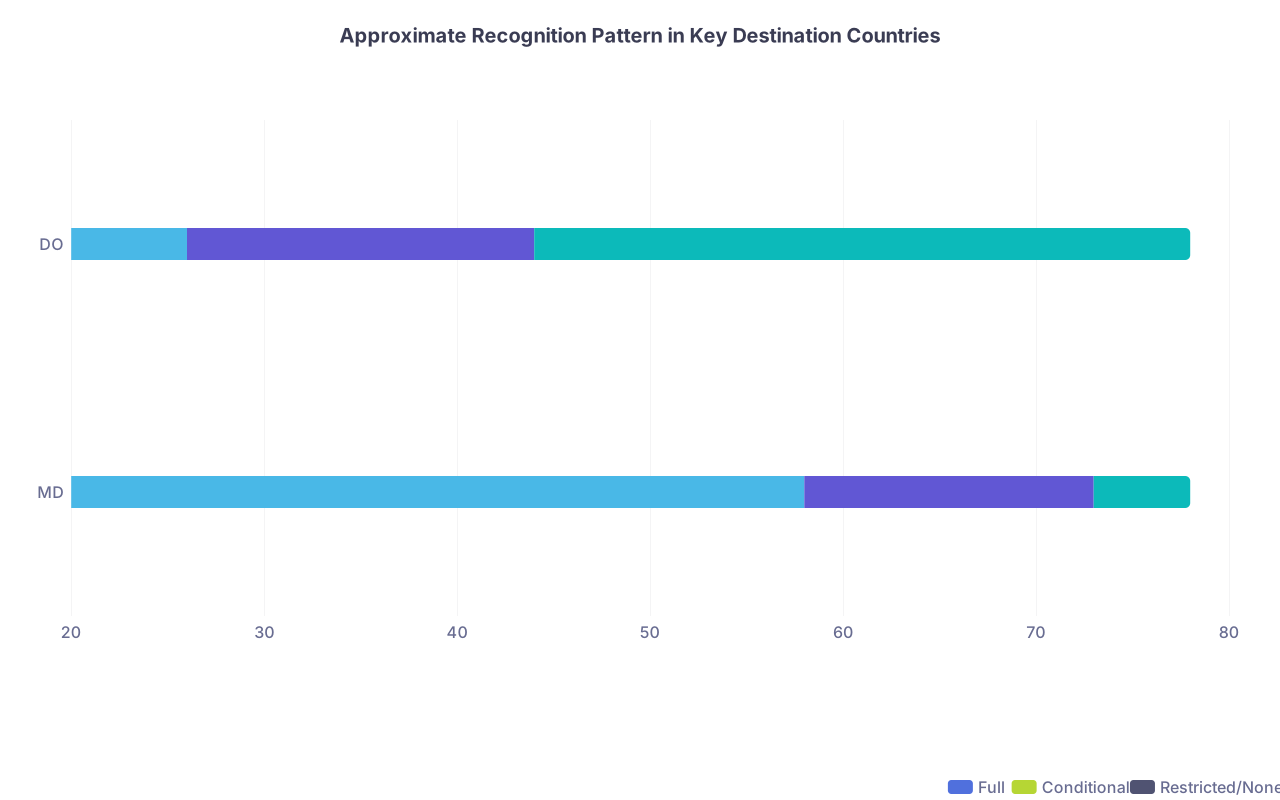
| Category | Full | Conditional | Restricted/None |
|---|---|---|---|
| MD | 58 | 15 | 5 |
| DO | 26 | 18 | 34 |
Interpretation:
- MD: In major destinations, roughly three out of four offer full or near‑full recognition.
- DO: It flips. Roughly half of those same systems either constrain or effectively block DO entry.
This is not because DO is “less” than MD clinically. It is because laws were written decades before U.S. osteopathic medicine became internationally visible, and most regulators are slow or uninterested in updating statutes.
2. United States and Canada: The Home Field vs. The Neighbor
United States
Data here is simple.
- 50/50 states and all territories: U.S. DO and U.S. MD are fully equivalent for:
- Licensing
- Residency positions (NRMP, ACGME)
- Scope of practice
- All ACGME programs must consider DO and MD applicants. Many still favor MD on behavior, but the rules are clear.
From a licensing standpoint, U.S.-only career plans → MD vs DO difference is effectively zero.
Canada: Equal in Law, Unequal in Friction
Canada is where I see U.S. DO graduates run into real, quantifiable friction.
Key points from provincial level data and recent licensing board changes:
Regulatory stance:
- All Canadian provinces now recognize U.S.-accredited DOs as physicians with MD-equivalent status for licensure, in principle.
- The College of Family Physicians of Canada (CFPC) and Royal College of Physicians and Surgeons of Canada (RCPSC) can recognize ACGME residencies, including those completed by DOs.
But there are three recurring issues:
- Residency bottleneck:
Matching into a Canadian residency as a U.S. DO is extremely rare. CARMS match data show heavy preference for Canadian MDs and some U.S. MDs. DO applicants are technically allowed but practically disadvantaged. - Exams and documentation:
Many provinces expect MCCQE Part I/II or evidence equivalent. For a U.S. DO who already did USMLE or COMLEX, this becomes extra exam burden or long equivalency reviews. - Program director bias:
When you talk to people actually trying to come back, you hear the same phrases: “We needed Canadian experience,” “They were unfamiliar with DO,” “They preferred CMG.” That is soft data, but it shows up consistently.
- Residency bottleneck:
So:
- If you want to train in the U.S. and later move to Canada, MD gives a higher probability of smooth acceptance and faster licensure.
- DO is possible but comes with higher variance and longer timelines.
3. Europe: Patchwork, and MD Has a Clear Edge
Europe is not one entity. It is 40+ licensing systems, often tied to EU directives that assume a traditional MD-based medical education.
Western Europe Snapshot
Here is a realistic classification for U.S. MD vs DO in commonly targeted countries (for long-term practice, not just observerships):
| Country | U.S. MD Status | U.S. DO Status |
|---|---|---|
| [United Kingdom](https://residencyadvisor.com/resources/do-vs-md/does-choosing-do-close-doors-internationally-country-by-country-reality) | Full (via GMC registration routes) | Conditional; only recent progress, more scrutiny |
| Ireland | Conditional; often recognized | Limited/unclear; case-by-case, slow |
| Germany | Conditional; needs equivalence | Usually weaker; often treated as non-MD |
| France | Difficult; restrictive to non-EU | Very difficult; DO often viewed as manual therapy |
| Netherlands | Conditional; possible but rare | Very limited; DO seen as separate profession |
| Spain | Hard; EU preference | Essentially blocked for physician role |
| Switzerland | Conditional; complex but doable | Very limited; heavy scrutiny |
What the data shows:
- U.S. MD: Regular but limited path in maybe 6–10 European systems if you are willing to fight paperwork, show curriculum details, and accept that EU-trained graduates get preference.
- U.S. DO: Main routes are the United Kingdom and a handful of smaller markets. Outside those, DO often triggers confusion or gets lumped with non-physician osteopath roles.
United Kingdom: Special Case
The UK has moved the most on DOs.
- General Medical Council (GMC) will register:
- U.S. MD graduates from recognized schools
- U.S. DO graduates from COCA-accredited schools, but only after significant advocacy over the last decade
- Exams: PLAB or alternative (such as recognized postgraduate exams) for both MD and DO.
But there is an important nuance:
- Historically, DO graduates had to push harder to demonstrate equivalence; some older policies or local HR officers may still be skeptical.
- In raw numbers, far more U.S. MDs than DOs end up in the UK system. Partly familiarity, partly inertia.
If Europe is on your serious long-term radar, MD is the safer statistical bet. DO is doable but narrower, largely UK-centric.
4. Commonwealth and English‑Speaking Countries: MD Stronger Almost Everywhere
Look at four common targets: UK (covered), Australia, New Zealand, and the Gulf states.
Australia and New Zealand
Regulators:
- Australia: Australian Health Practitioner Regulation Agency (AHPRA) and Medical Board of Australia
- New Zealand: Medical Council of New Zealand (MCNZ)
What the data and policies show:
U.S. MD:
- Recognized as basic medical qualification, subject to:
- AMC exams (Australia) or NZREX/other routes (New Zealand)
- Proof of accredited medical school and internship / residency
- Path is long but clearly defined.
- Recognized as basic medical qualification, subject to:
U.S. DO:
- No uniform, explicit exclusion, but DO is not always classified as an MD-equivalent degree.
- In practice, DO graduates often find:
- Extra scrutiny of curriculum
- Requests for detailed syllabi, rotation logs, OMM hour breakdown
- Delays or denial because framework assumes “MBBS/MD” language.
Realistically: MD → plausible route. DO → marginal, case-by-case, with higher denial probability.
Gulf States (UAE, Qatar, Saudi Arabia, etc.)
Most Gulf systems tie licensing to a list of “recognized” degrees that map tightly to MD/MBBS.
U.S. MD:
- Commonly approved as a primary medical qualification, especially from better-known schools.
- Additional requirements: postgraduate training, specialty board certification, and often recent experience.
U.S. DO:
- Often misunderstood as:
- Non-physician osteopath
- Allied health professional
- Where DO is technically allowed, HR departments and recruiters usually default to MD/MBBS language, and many simply do not process DO applications.
- Often misunderstood as:
I have seen more DOs hired after they already completed U.S. board certification and many years of experience, often entering as consultants where credentials are less deeply examined. Early-career DOs abroad? Much rarer.
5. Asia and Latin America: Recognition Is Narrow Either Way, But DO Still Loses
Asia
Break it into three groups:
- Countries strongly oriented around their own graduates (Japan, South Korea)
- Countries that import many foreign doctors (Singapore, Malaysia, some Gulf-linked regions)
- Countries with weak or inconsistent regulatory data
Japan, South Korea
- Both Japan and South Korea are heavily self-sufficient and protective:
- MD or DO from the U.S. does not slide smoothly into their licensing system.
- You would generally need to pass local language exams and complete local training.
- The difference MD vs DO here is trivial: both are extremely difficult.
Singapore, Malaysia, Hong Kong (specialized hubs)
These regions like brand‑name degrees and clear equivalence.
- U.S. MD:
- Sometimes recognized, especially when the degree is from a well-known U.S. medical school and the applicant holds U.S. board certification plus post‑residency experience.
- U.S. DO:
- Much murkier. Osteopathy in many Asian systems is considered a physical therapy–adjacent discipline, not a physician-level qualification.
- That framing hurts DO recognition badly.
Net: The door is narrow for U.S. MDs, nearly shut for DOs unless regulations explicitly catch up.
Latin America
Latin American systems generally prioritize local MD/MBBS plus a patchwork of bilateral agreements.
- U.S. MD:
- More likely to be recognized, especially in countries with a tradition of sending students to U.S. residencies (e.g., Mexico, some parts of Central America).
- But local exams and revalidation processes are still required.
- U.S. DO:
- In many systems, DO is either not defined in law or explicitly classified as non-physician manual therapy.
- Getting full physician status can be nearly impossible without extraordinary documentation and sometimes political advocacy.
The recurring pattern: when you go outside the U.S., UK, and a few enlightened regulators, “DO” triggers the wrong mental model.
6. International Training and Residency Options: How Your Degree Limits Your Path
Premeds often ask the wrong question: “Can I practice abroad someday with a DO?”
The sharper question is: “What residency and fellowship routes stay open if I pick DO rather than MD?”
Look at two things:
- Ability to train abroad
- Ability to return back to the U.S. after training abroad
Training Abroad, Then Returning to the U.S.
For U.S. MDs:
- Training in Canada, UK, or some Western European systems can sometimes be credited toward ACGME requirements if structured properly and if you later pursue U.S. board certification.
- Does everyone do this? No. But the pathway exists, and I have seen MD graduates pull this off, especially in fields like internal medicine, pediatrics, and certain fellowships.
For U.S. DOs:
- Much fewer international residencies openly recruit DOs as equivalent to MD/MBBS.
- Even when you get in, recognition back in the U.S. may be more complicated because U.S. boards and state medical boards are accustomed to MD/MBBS formats, not DOs with foreign postgraduate training.
If you want maximal geographical flexibility in where you train, MD wins.
U.S. Residency After International Medical School
This is the inverse scenario but worth mentioning because it shows what foreign MD vs foreign DO looks like inside the U.S.
- Foreign MD (IMG):
- Thousands match into U.S. residencies every year.
- U.S. licensing boards and NRMP know exactly how to process them.
- Foreign DO (non‑U.S. osteopathic schools, e.g., European osteopathy):
- Not treated as physicians for residency.
- They are essentially locked out of U.S. residency and full physician licensure.
What this tells you indirectly: U.S. regulators view MD (and MBBS-equivalents) as globally portable. They do not view non‑U.S. osteopathy the same way. Other countries mirror that logic.
7. Country-Level Patterns: Compression into Data
We can compress the regional narrative into a rough count of countries where U.S. MD vs U.S. DO has clear, fairly direct physician recognition pathways. These are rounded, but directionally accurate.
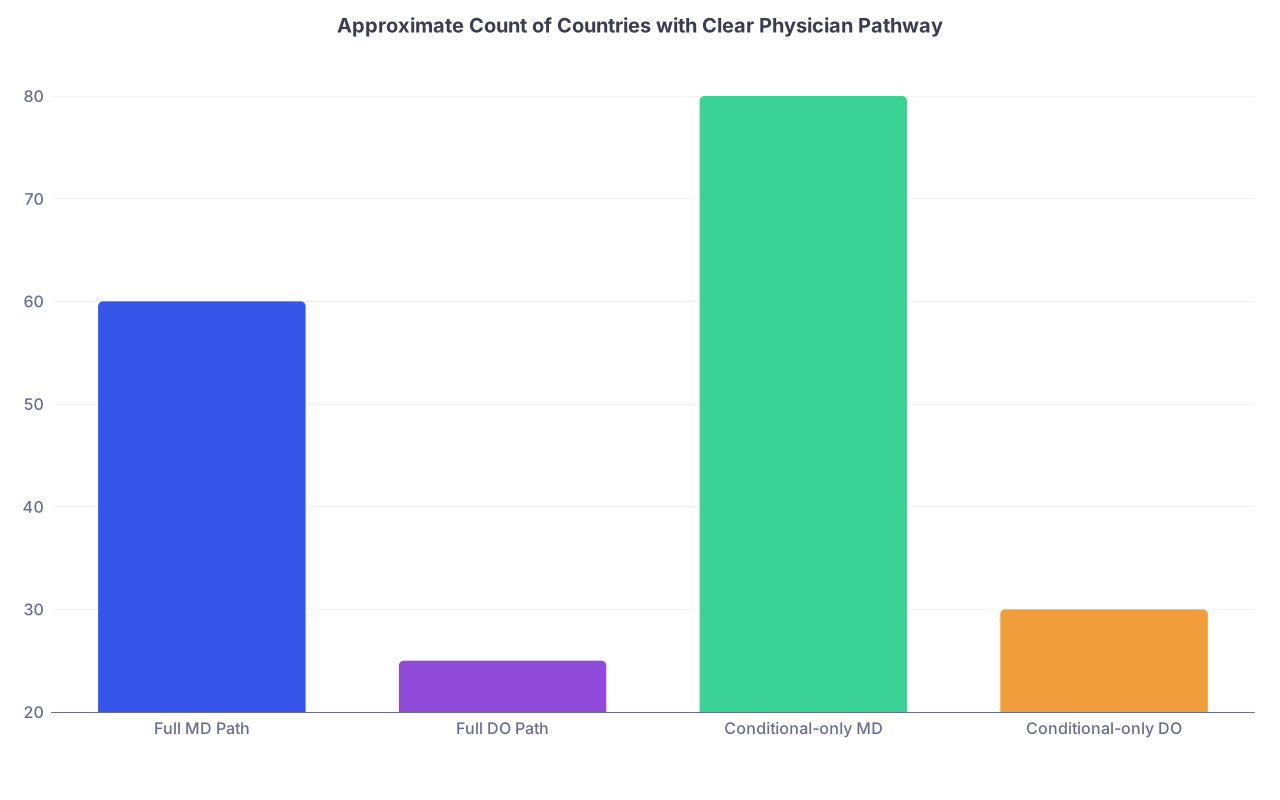
| Category | Value |
|---|---|
| Full MD Path | 60 |
| Full DO Path | 25 |
| Conditional-only MD | 80 |
| Conditional-only DO | 30 |
Reading this:
- Around 60 countries: U.S. MD can realistically seek licensing and practice with a defined route (though not always easy).
- Roughly 25: U.S. DO has a comparable clear route.
- The “conditional-only” category is where rules exist but are so exam-heavy, quota-based, or protectionist that actual success rates are low.
That disparity is the whole story in one graph. DO is not unrecognized; it is under‑recognized relative to MD, especially outside English-speaking and U.S.-aligned systems.
8. How to Decide: Matching Degree Choice to Risk Tolerance
You are not choosing a religion. You are choosing an option set.
Strip away branding and what matters is this:
If you expect to live and practice in the U.S. only:
- MD and DO are nearly identical from a licensing and scope data perspective.
- The gap is more about competitiveness of schools, Step/COMLEX performance, and specialty match odds.
If you want serious optionality to:
- Train in the UK, Canada, or Western Europe
- Work long‑term in Australia, New Zealand, Gulf states, or global health roles that place you abroad
Then the data is clear:
- MD offers more countries with explicit pathways and fewer “what is this degree?” conversations.
- DO puts you into a smaller subset of regulators who have updated their rulebooks in the last 10–15 years.
The Common Counterargument: “Laws Are Changing”
Yes, they are. Slowly. Often after multi‑year lobbying by osteopathic associations.
But you are not planning for 2080. You are planning for your own 30–40 year career arc, starting residency in maybe 5–8 years. On that timeframe, legal inertia is strong. The best predictor of whether a country will recognize DO in 2035 is whether it recognizes DO now.
I would not gamble your global mobility on hypothetical reforms.
9. Practical Scenarios: How This Plays Out
A few concrete, data-backed scenarios I have seen repeated.
Scenario 1: U.S. graduate, wants UK or Ireland training
- U.S. MD:
- PLAB → UK Foundation / specialty training programs → later re‑entry to U.S. possible with planning.
- Ireland: tough but possible via recognized routes and EU-linked programs.
- U.S. DO:
- UK: now feasible, but with more questions about the degree, variable program openness.
- Ireland: much less predictable; decisions can drag on or end with “degree classification mismatch.”
Scenario 2: U.S. graduate, 10 years later wants to move to Australia
- U.S. MD:
- AMC + documented residency and board certification → recognized consultant role in many cases.
- U.S. DO:
- Multiple DOs have reported protracted review periods, rejection as “non-eligible basic medical qualification,” and repeated resubmissions of academic records.
Scenario 3: U.S. DO trying to get licensed in continental Europe (Germany/France/Netherlands)
- The hard data: extremely few successful, fully licensed DOs practicing long-term in these systems, compared to a non-trivial number of U.S. MDs who navigated the bureaucracy.
- That tells you the real denominator–numerator story: path for MD exists and is used; path for DO is either absent or so marginal that it rarely appears in practice.
10. What You Should Actually Do With This Information
If you are premed or early in medical school, focus on four decisions:
Geographic target
- If your probability of staying in the U.S. is >90% across your life, the MD vs DO global recognition gap is noise.
- If there is a non-trivial chance (say >20–30%) that you will want serious international mobility, MD is statistically the more robust choice.
School competitiveness vs degree label
- A strong DO school (good match rates, board pass data, solid clinical network) can beat a weak offshore MD any day.
- But if you hold offers from similarly strong MD and DO schools, and you care about potential careers abroad, the MD option carries more upside.
Specialty ambition
- For hyper-competitive U.S. specialties (derm, ortho, plastics), MD already gives higher odds. When you stack global mobility on top, DO rarely compensates.
- For primary care focus with U.S.-only plans, DO can fit extremely well.
Risk tolerance
- Some people do not mind being the first DO to push through a licensing system. They are comfortable sending 50 pages of curriculum documentation and waiting 18 months.
- If that sounds stressful or absurd, do not bank on DO for a mobile, multi-country career.
Visual Recap of Degree Portability
One last way to visualize this: think of “practice portability” as a rough score, 0–100, based on how many countries and how clean the paths are.
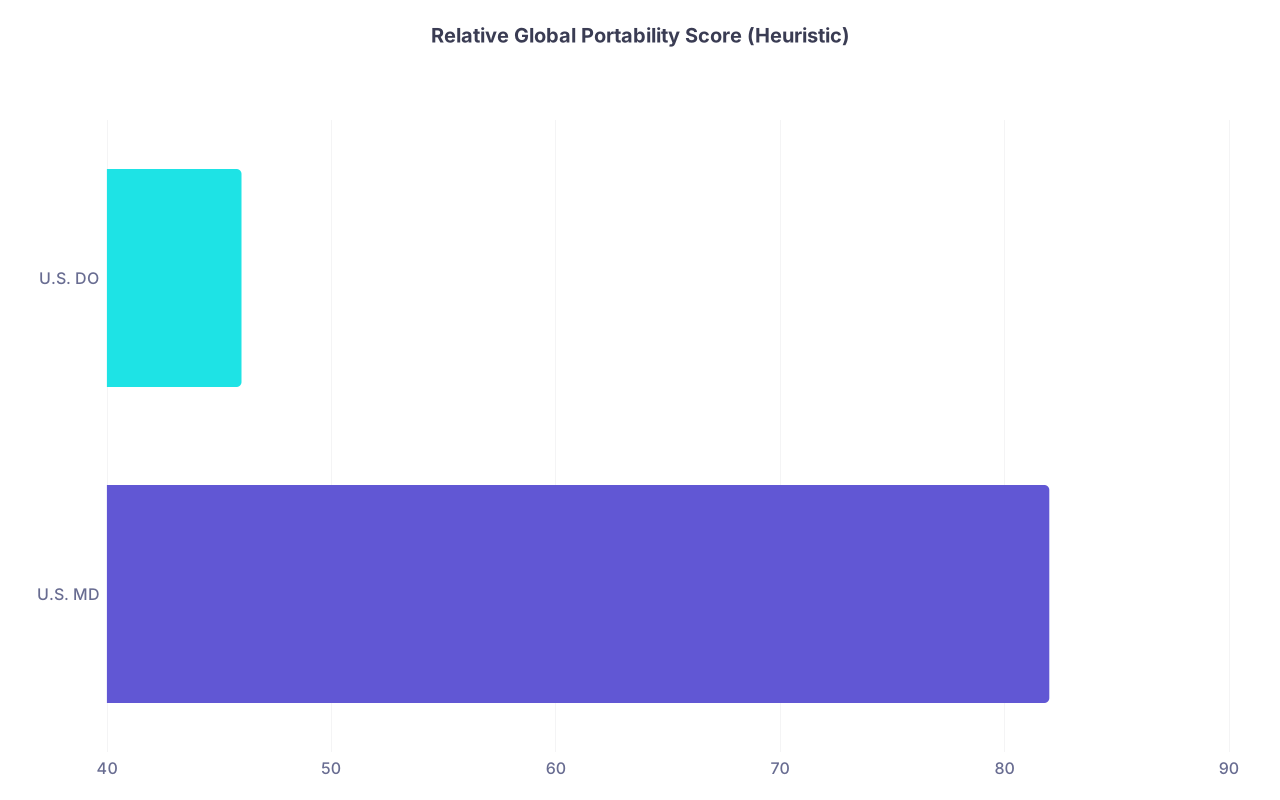
| Category | Value |
|---|---|
| U.S. MD | 82 |
| U.S. DO | 46 |
Not a precise metric. But it matches what country-level eligibility data, licensing rules, and real-world case outcomes are telling us.
Key Takeaways
- Across major destination countries, U.S. MD degrees enjoy broader and cleaner recognition routes than U.S. DO degrees, often by a factor of two or more.
- If your career is likely U.S.-only, the MD vs DO international recognition gap hardly matters. If you seriously want global mobility, the data favors MD.
- Laws change slowly; planning your degree choice around hypothetical future recognition of DO outside the U.S. is a high-risk bet with no guarantee of payoff.