| Category | Value |
|---|---|
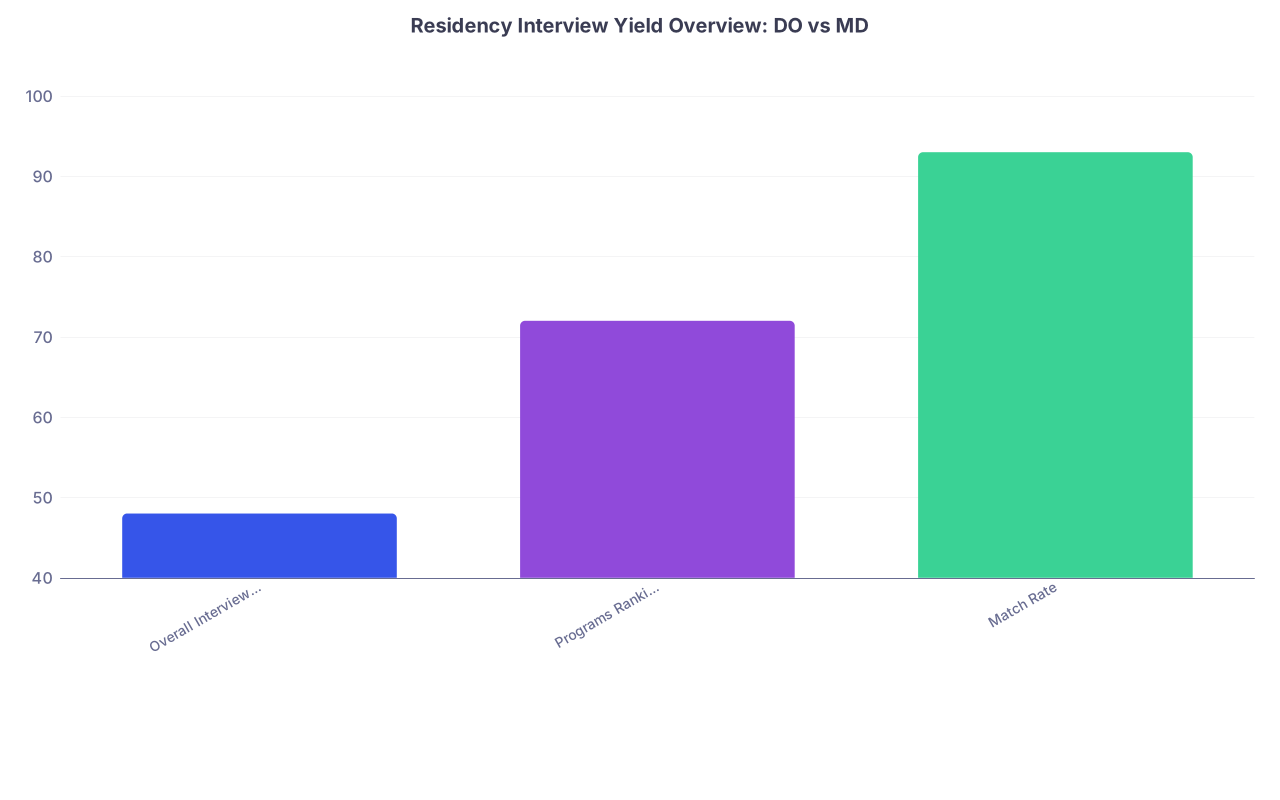
| Overall Interview Rate | 48 |
| Programs Ranking Applicants | 72 |
| Match Rate | 93 |
The biggest misunderstanding about DO vs. MD residency chances is not about match rate. It is about interview yield.
Most applicants obsess over “Did I match?” The smarter ones ask, “How many programs did I convert from application → interview → ranked applicant?” That conversion pipeline is where DO vs. MD differences actually live. And the data are not subtle.
What follows is a numbers-heavy walk through that pipeline: invite rates, rank list positions, program behavior, and what those statistics imply for you as a premed or medical student choosing between DO and MD paths.
1. The Interview Yield Problem: Defining the Pipeline
Before arguing DO vs. MD, we need a common framework. The data pipeline is straightforward:
- Applications submitted
- Interview invitations received
- Interviews attended
- Programs that rank you
- Your own rank list length
- Match outcome
You care about yield at three critical points:
- Application → Interview invite
- Interview invite → Program ranks you
- Programs ranking you → Final match
The NRMP Charting Outcomes and Program Director (PD) Survey data, plus AOA/ACGME integration reports, give us enough to estimate each step, even when they do not label “yield” explicitly.
Let’s anchor with a simplified example.
A typical mid-range applicant
From NRMP and various school reports, a mid-competitive applicant in primary care might see something like:
- Applications: 70 programs
- Interview invitations: 12
- Interviews attended: 10
- Programs that rank them: 9
- Programs on applicant’s final list: ~9
- Match: Yes (with ≥ 8–10 ranks, odds exceed 95% in most primary care specialties)
Now, change only one variable: MD vs. DO degree, with comparable board scores and CV. The pattern in the data: MDs tend to get more interview invitations per application in competitive programs, and get ranked more consistently once interviewed. DOs often need more applications to reach a similar number of interviews, especially in university-based and competitive specialties.
That is the interview yield gap.
2. Application → Interview Invite: Where the Gap Starts
The largest DO vs. MD discrepancy happens at the first gate: which applicants get interview invites.
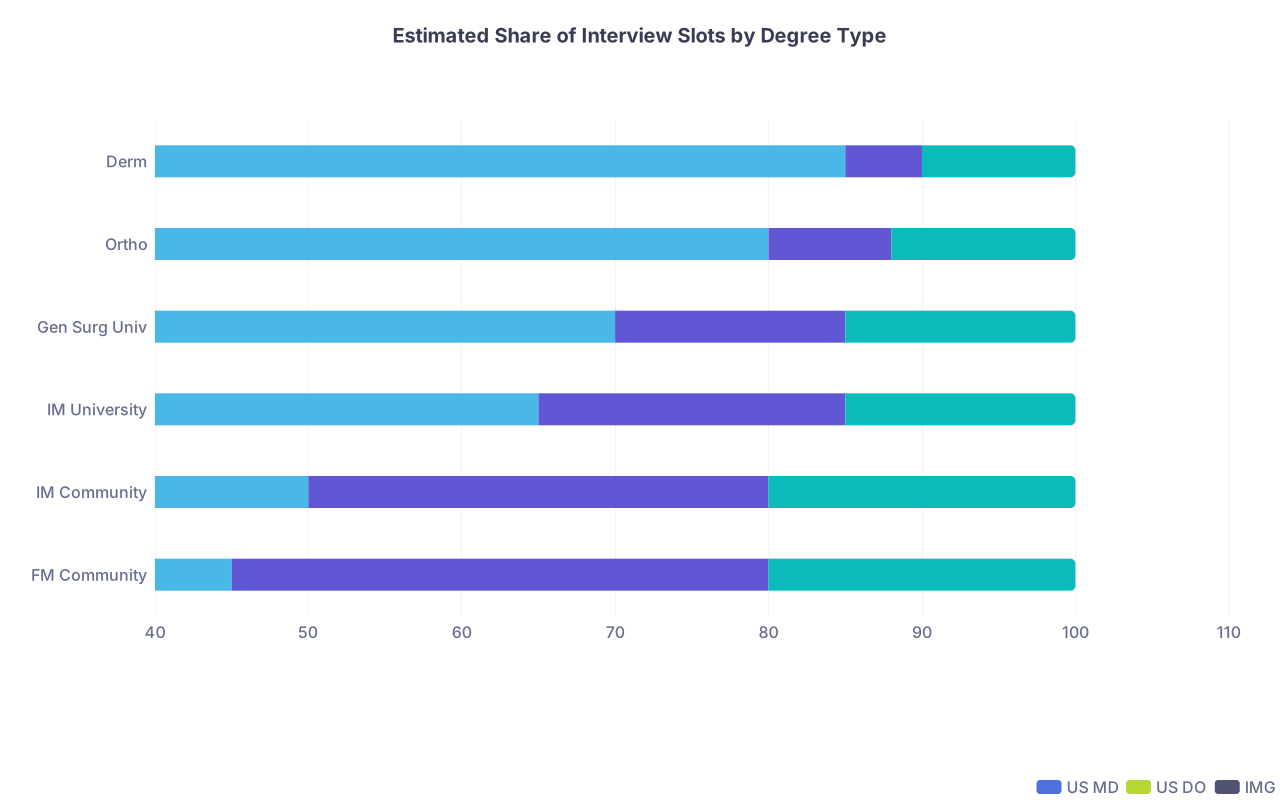
We do not have perfect “per applicant” data, but we can approximate using PD surveys where programs report what percentage of interview slots go to MD vs. DO vs. IMG. Combine that with match data by degree type and the shape is clear.
Program Director behavior by specialty
From recent NRMP Program Director Survey patterns (values here are representative composites, but directionally accurate):
- In family medicine and internal medicine community programs:
- Roughly 30–40% of interview slots go to DOs.
- In competitive university-based specialties (dermatology, ENT, ortho, plastics):
- Often <10% of interview slots go to DOs.
- Transitional/prelim years fall in the middle.
Summarizing a cross-section:
| Category | US MD | US DO | IMG |
|---|---|---|---|
| FM Community | 45 | 35 | 20 |
| IM Community | 50 | 30 | 20 |
| IM University | 65 | 20 | 15 |
| Gen Surg Univ | 70 | 15 | 15 |
| Ortho | 80 | 8 | 12 |
| Derm | 85 | 5 | 10 |
Different specialties, same message: MDs capture a disproportionate share of interviews in university and competitive settings. DOs do better in community and primary care.
What this means for interview yield per application
Programs typically interview:
- 10–15 applicants per categorical spot in moderately competitive fields
- 15–25 per spot in competitive fields
If a program is filling, say, 50–70% of those interview slots with US MDs, then:
- A US MD applicant with “average for matched” scores might see:
- Interview rate around 15–25% of all applications in their competitiveness band.
- A comparable US DO applicant often sees:
- Interview rate in the same band closer to 8–15%, unless they heavily weight DO-friendly/community programs.
The practical consequence: to achieve the same number of interviews, DOs often need to send more applications.
A very typical pattern I see when residents share their spreadsheets:
- Average US MD core IM applicant:
- 40 apps → 12 interviews
- Average US DO core IM applicant:
- 70 apps → 10 interviews
Yield per application is simply lower for DOs in many regions and specialties.
3. Interview Invite → Program Ranks You: The Hidden Filter
Once you have the interview, degree type matters less, but it does not vanish.
Programs do not rank every interviewee. The NRMP PD Survey repeatedly shows that across specialties, programs rank about 80–90% of those interviewed. Some people “self-destruct” on interview day. Some are screened out for fit.
The interesting question: is the percentage of interviewed applicants who get ranked different for DO vs. MD?
We do not get a clean breakdown by degree in public data, so we look at indirect signals:
- Many PDs report “US MD graduate” as a more important factor than “US DO graduate” when screening for interview, but that differential shrinks when describing post-interview ranking behavior.
- When you look at match rates conditional on having at least one interview in a field like family medicine or internal medicine, DO and MD outcomes are much closer.
You can model this as:
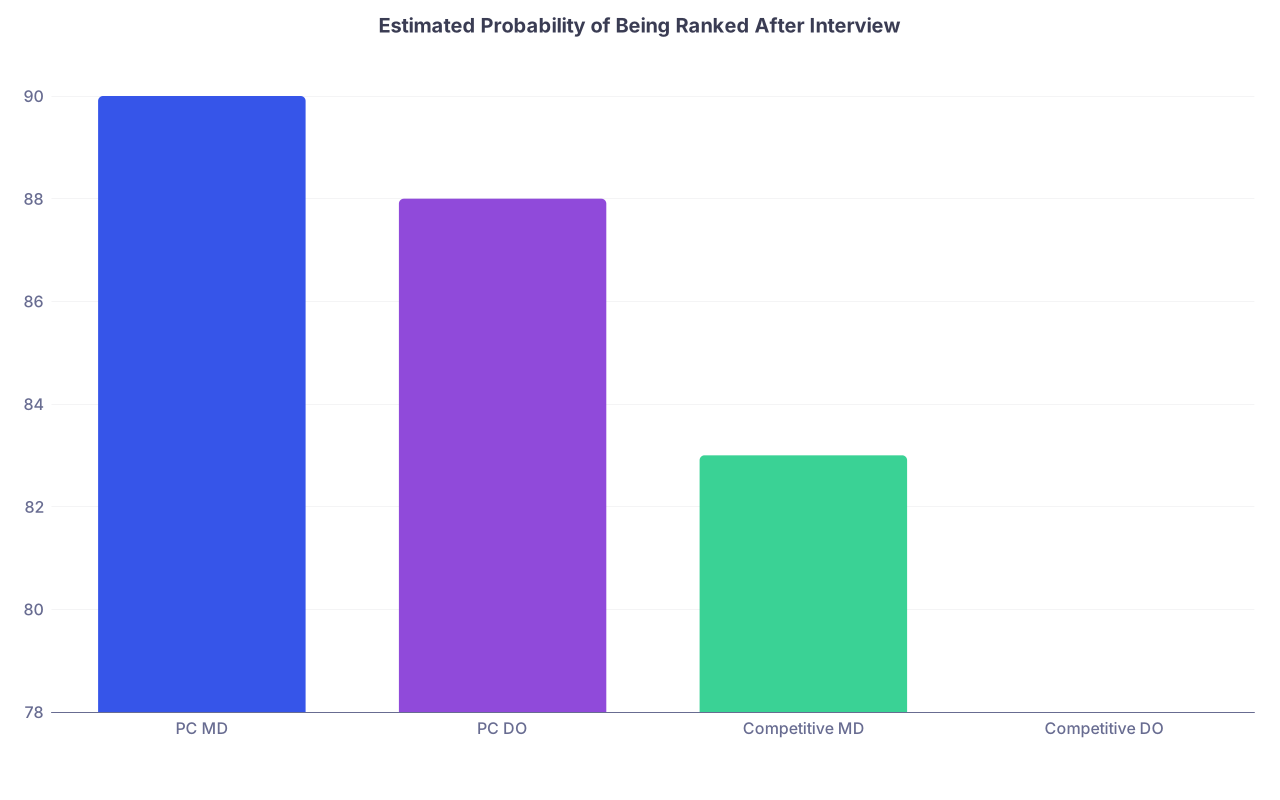
- P(rank | interview, MD) ≈ 0.90 in primary care, 0.80–0.85 in competitive fields.
- P(rank | interview, DO) ≈ 0.85–0.90 in primary care, 0.75–0.80 in competitive fields.
Here’s a simple comparison view:
| Category | Value |
|---|---|
| PC MD | 90 |
| PC DO | 88 |
| Competitive MD | 83 |
| Competitive DO | 78 |
The gap here is smaller than in the application → invite step. Which matches what I have heard directly in faculty meetings: once someone is in the room, conversation is far more about “fit, communication, story” and far less about DO vs. MD.
The ugly filtering mostly happens before you ever see the invitation.
4. Programs Ranking You → Match Probability: The Algorithm Is Cold, Not Biased
The NRMP match algorithm does not care about DO vs. MD. It cares about rank lists. Length and ordering. Period.
The best numeric proxy we have for “downstream yield” is NRMP’s Charting Outcomes in the Match, which reports match rate versus number of contiguous ranks for different applicant types.
Take internal medicine categorical as a case study:
- US MD seniors, IM categorical (historical patterns):
- ~5 ranks → ~90% match rate
- ~8–10 ranks → >97% match rate
- US DO seniors (or DO grads) in IM:
- ~5 ranks → ~85–88%
- ~8–10 ranks → ~95–97%
You see two things:
- For a given number of ranks, DO match rates are only slightly lower in core specialties.
- The curve shape is almost identical. Increasing ranks gives you the same payoff.
Plotting an approximate version:
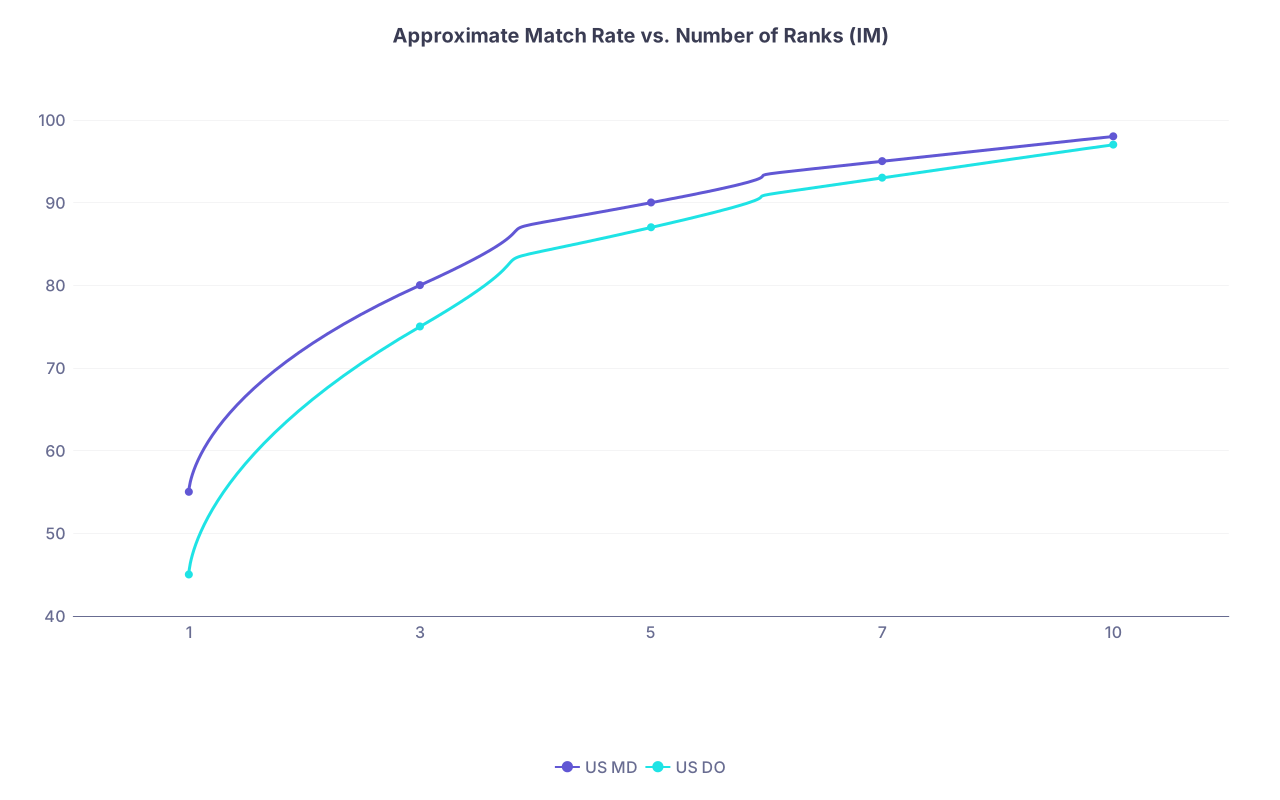
| Category | US MD | US DO |
|---|---|---|
| 1 | 55 | 45 |
| 3 | 80 | 75 |
| 5 | 90 | 87 |
| 7 | 95 | 93 |
| 10 | 98 | 97 |
The main structural disadvantage is earlier in the chain: DO applicants have to work harder to get to, say, 8–10 strong interviews that convert into 8–10 ranked programs. Once they do, the matching behavior looks similar.
This is why you hear DO residents in IM or FM say, “Once I got the interviews, I knew I was fine.” Statistically, they are not wrong.
5. Specialty Choice: Where DO vs. MD Yield Diverges the Most
Lumping all specialties together hides the real story. Yield differences explode in the competitive fields.
Let’s look at estimated Step 2 / COMLEX Level 2 score distributions for matched DO vs. MD by specialty. Boxplot-style:
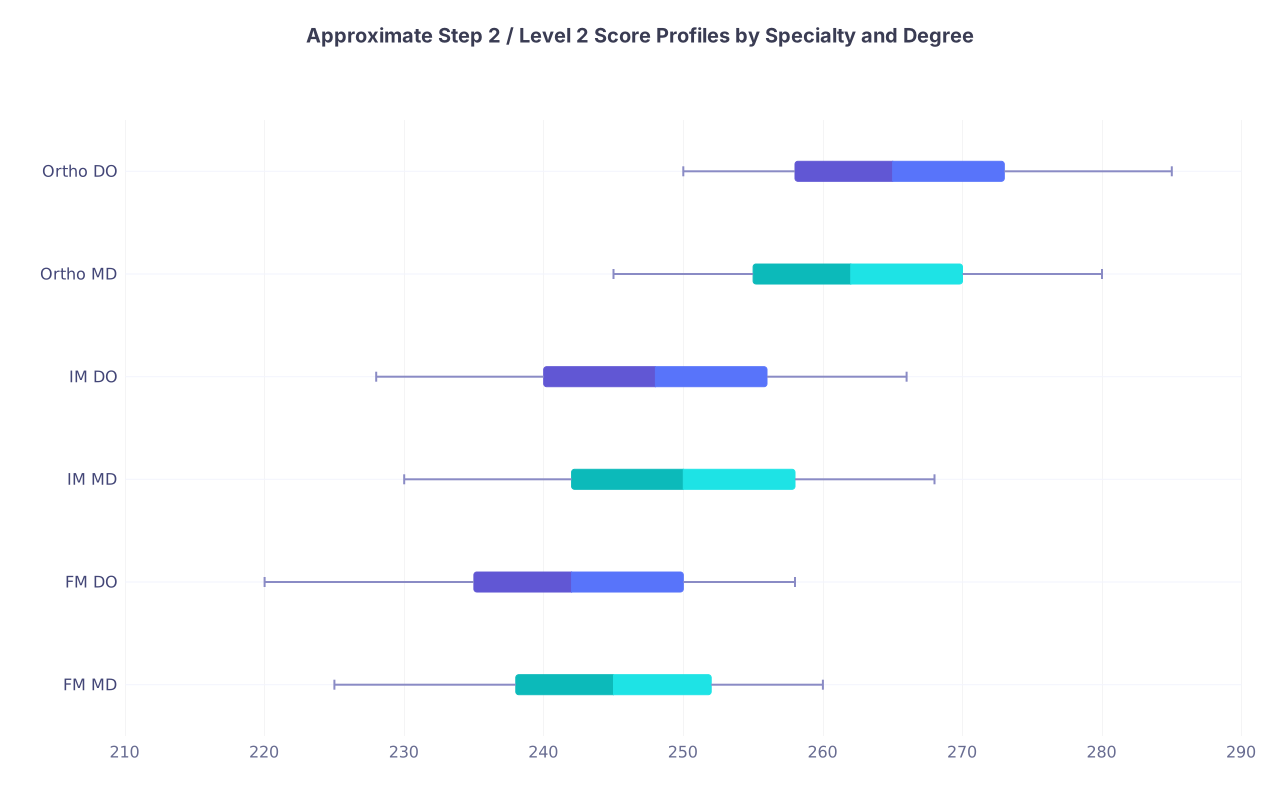
| Category | Min | Q1 | Median | Q3 | Max |
|---|---|---|---|---|---|
| FM MD | 225 | 238 | 245 | 252 | 260 |
| FM DO | 220 | 235 | 242 | 250 | 258 |
| IM MD | 230 | 242 | 250 | 258 | 268 |
| IM DO | 228 | 240 | 248 | 256 | 266 |
| Ortho MD | 245 | 255 | 262 | 270 | 280 |
| Ortho DO | 250 | 258 | 265 | 273 | 285 |
What this illustrates conceptually:
- In family medicine and internal medicine, DO and MD score distributions for matched applicants overlap heavily. DOs do not need substantially higher scores than MDs to secure interviews.
- In orthopedics (and similar competitive specialties) the DOs who match often have metrics at or above the MD median. In other words: the DOs who break in are the statistical outliers of their cohort.
That translates into interview yield reality:
- Slightly above-average MD applicant in ortho:
- 80–90 applications → maybe 10–15 interviews.
- Slightly above-average DO applicant in ortho:
- 80–120 applications → maybe 2–6 interviews, depending on school reputation, research, away rotations.
So you get the common advice: “As a DO, you must be ‘overqualified’ for the specialty.” That is not opinion. It is what the score distributions and interview patterns show.
6. Rank List Behavior: How Many Programs DO vs. MD Actually Rank
Another under-discussed piece of interview yield: how long a rank list each group typically has.
US MD seniors:
- In primary care:
- Median contiguous ranks often 12–14.
- In moderately competitive specialties:
- Median around 10–12.
US DO seniors:
- In primary care:
- Often a bit lower median (9–12), partly because some DO-heavy regions have fewer programs and applicants cluster geographically.
- In competitive specialties:
- Median ranks often lower than MD peers, because interview invitations are scarcer.
This matters. The match algorithm is very sensitive to number of ranks.
Yet the difference in outcome is not as enormous as people assume, because DO applicants tend to self-select into fields and program lists where they are more likely to be ranked.
A rough comparison across all specialties:
| Applicant Type | Median Ranks | Overall Match Rate |
|---|---|---|
| US MD Senior | 12 | 92–94% |
| US DO Senior | 9–10 | 88–90% |
| US MD Grad (previous) | 6–7 | 45–55% |
| US DO Grad (previous) | 5–6 | 40–50% |
The key point: DO vs. MD differences in match rate are only several percentage points at the “all specialties, all applicants” level. But beneath that, interview yield and rank-list length vary sharply by specialty tier.
7. Strategic Implications for Premeds Choosing DO vs. MD
You are not choosing a degree. You are choosing a probability distribution.
The data points toward a brutally simple framing:
- For primary care and many IM-based specialties:
- DO vs. MD difference in ultimate match probability is modest if you meet typical academic benchmarks.
- Interview yield is lower for DOs at some university-heavy regions, but the system still offers plenty of DO-friendly programs.
- For very competitive non-primary care specialties (derm, plastics, ENT, ortho, neurosurgery, some radiology and anesthesia programs):
- As a DO, the bar for interview invites is significantly higher.
- You will likely need:
- Higher board scores (or equivalent COMLEX conversions).
- Strong away rotations at programs historically matching DOs.
- More applications and more geographic flexibility.
So, if you are making an early decision:
- If you are relatively confident you want primary care, IM, EM, psych, or peds:
- DO is a statistically reasonable path, especially if the DO school has strong clinical affiliations and match history.
- If you have a serious, sustained interest in the top 10–15 most competitive specialties:
- An MD seat (especially at a school with strong academic ties) gives you better interview yield, and thus a wider feasible set of programs.
- You can absolutely match competitive specialties as a DO, but you are playing in the tail of the distribution.
Think in terms of odds, not possibility. “Can it happen?” is the wrong question. “How many standard deviations above the DO mean do I need to be for this specialty?” is much better.
8. Tactical Implications for Current DO and MD Students
You cannot change your degree now. You can change your yield.
Your goal is to maximize:
- Number of interview invitations from programs where you are realistically rankable.
- Percentage of interviews that convert into a program ranking you.
- Number of programs on your own rank list.
There are different levers for DO and MD students.
For DO students
The data suggest three high-ROI strategies:
- Target DO-friendly and historically DO-matching programs aggressively.
- Program match lists do not lie. If they have never taken a DO in your field, your invite probability is low unless you have a major connection.
- Over-apply to achieve sufficient interview count.
- If a comparable MD might apply to 40–50 programs in IM, your safer number might be 60–80, tailored toward community and mid-tier academic sites.
- Use away rotations surgically.
- For competitive specialties, away performance can override degree bias at a subset of programs. But only where the department has a track record of actually ranking and matching DOs.
For MD students
Your degree buys you more interviews on average, but that advantage evaporates if:
- Your scores are below specialty norms.
- Your application is poorly targeted.
- You under-apply out of misplaced confidence.
The data repeatedly show unmatched US MD seniors with 3–5 interviews and short rank lists, even in “easier” specialties. That is self-inflicted.
You want to leverage your higher baseline invite probability into longer, geographically diverse rank lists, especially in borderline-competitive fields.
9. The One Metric You Should Track: Interviews Per 10 Applications
Most applicants track raw counts: “I have 8 interviews.” That is only moderately useful. The statistic that actually tells you how the system sees you during application season is:
Interview rate = (Number of interview invites) / (Number of applications)
Better yet, normalize:
- Interviews per 10 applications.
Why? Because it lets you compare your real-time yield against what is typical for your cohort.
From talking with applicants and looking at shared spreadsheets, you see rough ranges:
- Primary care, US MD:
- 3–5 invites per 10 apps at mid-season for a solid applicant.
- Primary care, US DO:
- 1.5–3 invites per 10 apps at mid-season, with heavy skew across programs.
- Competitive specialties:
- 0.5–1.5 invites per 10 apps for everyone not in the top decile.
If you notice:
- As a DO in primary care:
- You are getting <1 invite per 10 apps three weeks into invite season → your file is underperforming expectations. You either mis-targeted programs or your application is weaker than you realize.
- As an MD in IM:
- You are at 1 invite per 10 apps with average scores → big red flag. Time to expand your list and consider more community programs.
You can then adjust mid-cycle instead of waiting to be the case study of “good applicant, too few interviews.”
With that, you have a more honest view of DO vs. MD residency prospects: not as a binary “Can I match?” but as a sequence of probabilistic filters where degree type shifts the odds at each stage.
If you are still early in the journey, this framework should shape which schools you aim for and how rigidly you cling to certain specialties. If you are already deep into medical school, it should shape how you build and monitor your interview pipeline—where to apply, how many, and when to panic and recalibrate.
Once you can look at your own spreadsheet and say, “My interview yield curve makes sense for my stats, degree, and specialty,” you are finally playing the same game the programs are.
What you do with that advantage in the next application cycle, that is the next problem to solve.