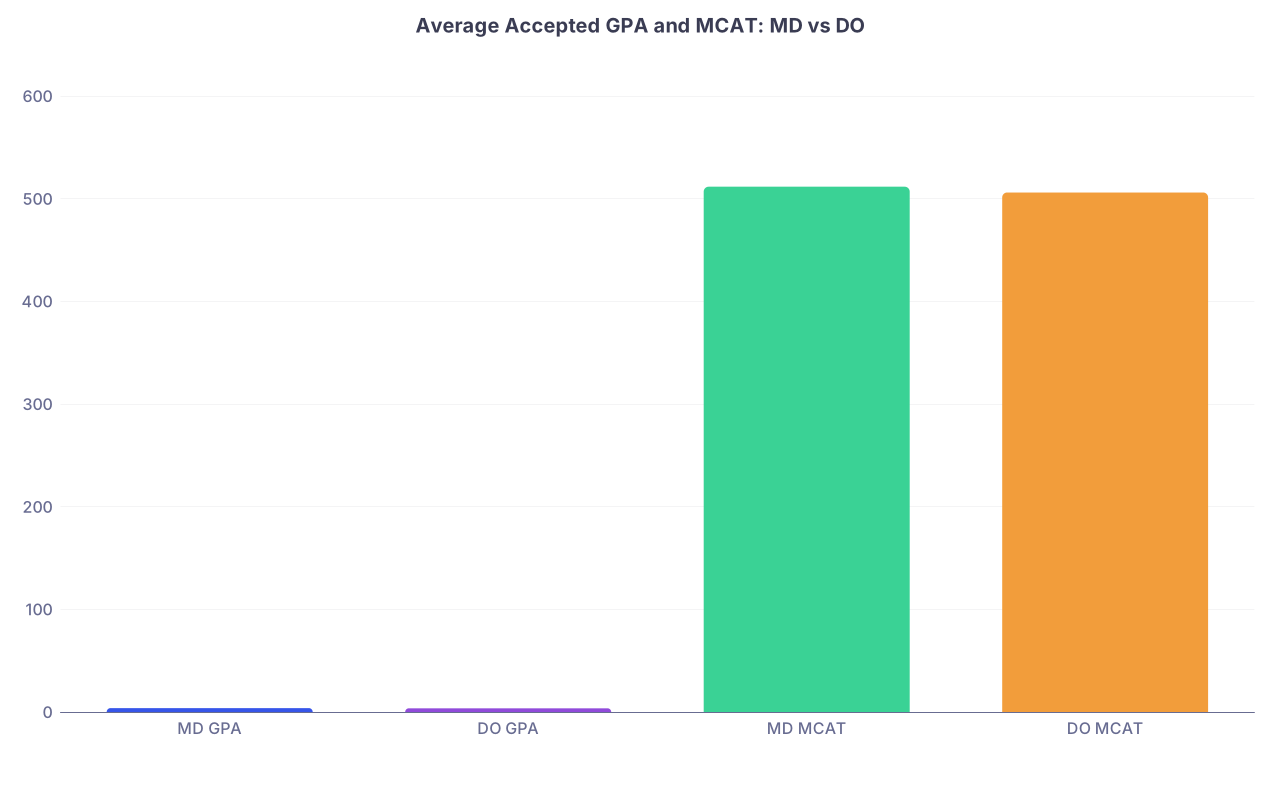
| Category | Value |
|---|---|
| MD GPA | 3.76 |
| DO GPA | 3.58 |
| MD MCAT | 511.7 |
| DO MCAT | 506 |
The usual MD vs. DO discourse ignores the only thing that consistently predicts your odds: the numbers. MCAT, GPA, and attrition rates tell a much clearer story than prestige arguments or social media anecdotes.
If you read the data instead of the forums, you see two different—but overlapping—admissions ecosystems. MD schools and DO schools are not separate universes. They are staggered bands on the same spectrum of academic metrics and risk profiles.
Let me walk through what the data actually show.
1. MCAT Profiles: Where MD and DO Applicants Really Sit
MCAT is the cleanest starting point because the distributions are relatively well documented and standardized. You are not guessing; you are looking at a scaled national metric.
Using recent AAMC and AACOM data (and composite reports across cycles 2019–2023), the central pattern is:
- U.S. MD matriculant mean MCAT: ~511–512
- U.S. DO matriculant mean MCAT: ~505–507
That 5–7 point gap is not trivial. Each 1-point change in MCAT roughly corresponds to moving 6–8 percentile points, depending on where you are on the curve.
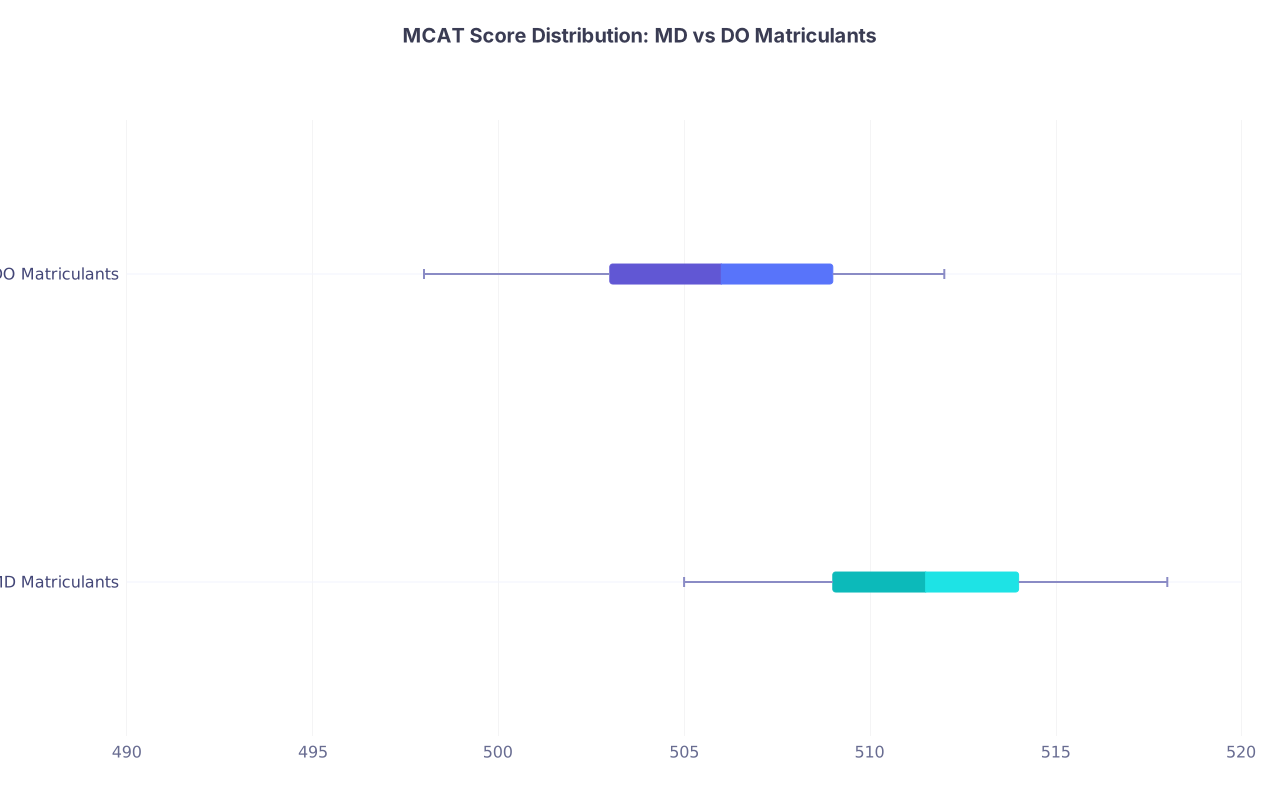
| Category | Min | Q1 | Median | Q3 | Max |
|---|---|---|---|---|---|
| MD Matriculants | 505 | 509 | 511.5 | 514 | 518 |
| DO Matriculants | 498 | 503 | 506 | 509 | 512 |
The boxplot pattern is consistent cycle after cycle:
- MD schools: Tight clustering in the low- to mid-510s, with the middle 50% of matriculants around 509–514.
- DO schools: Centered around 503–509, with a longer left tail—more students in the high 490s to low 500s who would be non-competitive for most MD programs.
The key observation: DO schools do not take “any MCAT.” They simply operate in a lower but overlapping band. Plenty of DO matriculants sit at 508–510, squarely in the MD-competitive range, especially at less-selective MD programs or strong state schools for in-state applicants.
If you want a simple heuristic based purely on MCAT:
- 515+ → You are strongly MD-competitive almost everywhere (assuming GPA is not a disaster).
- 510–514 → Very solid MD range, competitive at many MD schools; DO is still an option, but it is a safety strategy, not a primary path.
- 506–509 → Border zone. You need strong GPA and a realistic list for MD; DO becomes statistically safer.
- 500–505 → MD chances fall sharply; DO is the statistically rational primary target.
- <500 → You are in salvage / repair territory for both; you would need a strong upward narrative or a retake.
I have seen people with 504 get into MD. It happens. But if you work off the national probability curves instead of anecdotes, you do not build a strategy around outliers.
2. GPA Profiles: Cumulative vs Science Performance
GPA sounds like one number. In reality, admissions offices read at least three: cumulative, science (BCPM), and trend. Only two of those are formally reported in national datasets, but that is enough to expose the pattern.
Recent combined averages across cycles look roughly like this:
MD matriculants
- Mean cGPA: ~3.75–3.78
- Mean sGPA: ~3.70–3.72
DO matriculants
- Mean cGPA: ~3.55–3.60
- Mean sGPA: ~3.45–3.50
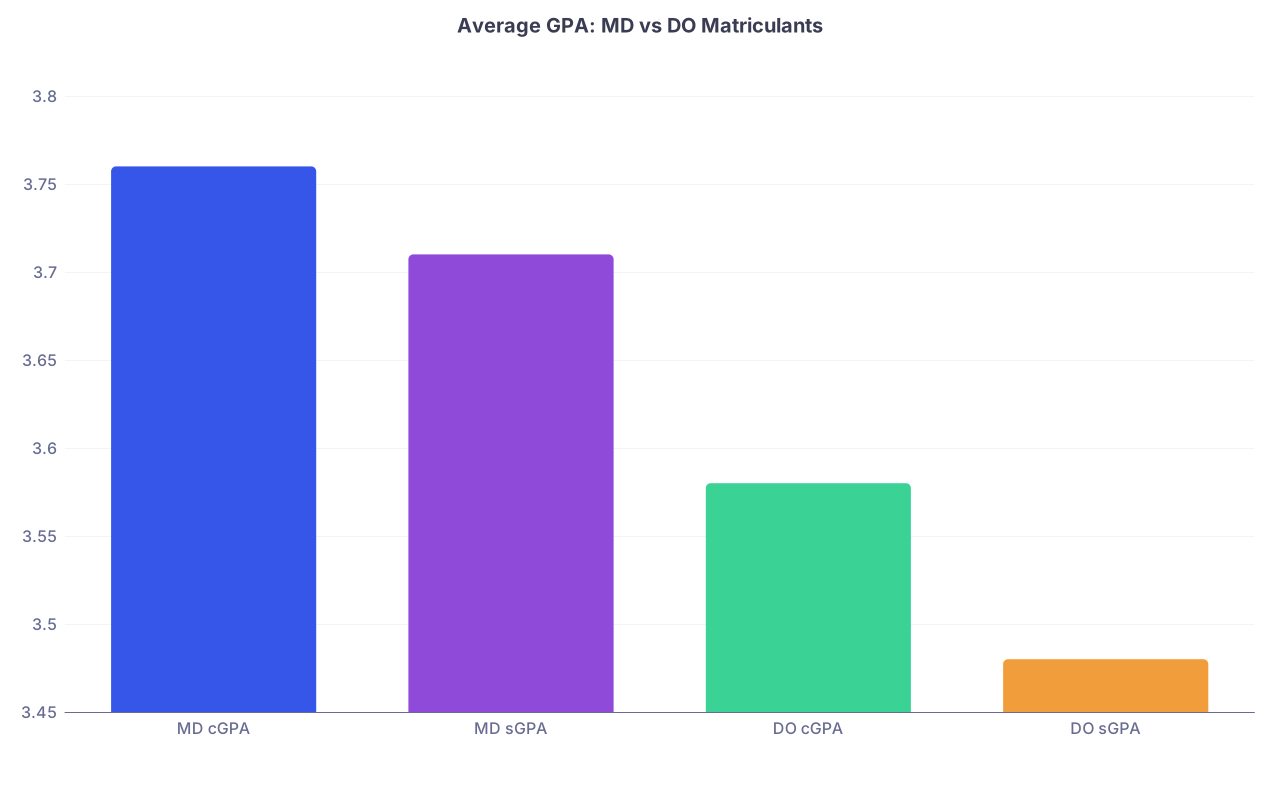
| Category | Value |
|---|---|
| MD cGPA | 3.76 |
| MD sGPA | 3.71 |
| DO cGPA | 3.58 |
| DO sGPA | 3.48 |
The GPA gap is smaller in absolute terms than the MCAT gap—about 0.15–0.20 points on average. But you feel that difference most at the low end:
- A 3.85 with solid MCAT is attractive everywhere, MD or DO.
- A 3.35 with a strong MCAT is DO-possible; MD requires serious context (reinvention, strong upward trend, SMP/post-bacc, or a hook).
The data show DO schools operating as a more forgiving space for:
- Lower early GPAs with strong upward trends
- Non-traditional students with older poor coursework but improved recent performance
- Students with strong MCATs relative to GPA (i.e., the “underperformed as freshman, fixed it later” group)
What I have seen up close: a 3.4–3.5 GPA with a 510+ MCAT gets MD interview shots if the state school is favorable and the story is coherent. The same profile gets broad DO interest.
Flip that: 3.8+ GPA with a 500 MCAT will have MD doors largely closed. DO schools will at least read the application carefully, especially if other metrics line up.
3. Combined Academic Profiles: Where You Actually Fit
GPA and MCAT interact. Programs do not read them in isolation, and the acceptance rate curves make that obvious.
You can mentally group applicant profiles into zones:
| GPA / MCAT Band | MD Outlook (Typical) | DO Outlook (Typical) |
|---|---|---|
| 3.8+ and 515+ | Strong to elite MD; DO optional | Matches easily if applied |
| 3.7–3.79 and 510–514 | Solid MD across many schools | Very strong DO; often unnecessary as backup |
| 3.6–3.69 and 506–509 | Mid / lower-tier MD possible, not guaranteed | Strong DO competitive |
| 3.4–3.59 and 503–505 | MD borderline; big context needed | Reasonable DO; depends on school mix |
| 3.2–3.39 and 498–502 | MD low probability | DO possible but selective; risk of shutout |
| <3.3 or <498 | MD effectively closed | DO only with strong reinvention / improvement |
This table is not a hard rule; it is what the national data distributions and observed match patterns support. Your specific outcome depends on:
- State of residence (some state MD schools are statistically friendlier)
- School list depth and realism
- Timing, secondaries, and red flags (withdrawals, institutional actions, etc.)
That said, the main point stands: DO schools consistently admit students in bands where MD schools, on average, become sharply less likely.
4. Attrition Profiles: Who Stays, Who Struggles, Who Leaves
Attrition is where most premeds stop looking at the data. That is a mistake. Your risk of not finishing the degree—or graduating with weak performance—matters as much as your chance of getting in.
Data from LCME-accredited MD schools and COCA-accredited DO schools (compiled over recent years) show:
MD 4-year graduation rate: commonly 80–85%
MD 5- or 6-year graduation (including LOA / repeats): often 95–97%
Total MD attrition (dismissal, permanent withdrawal, non-graduation): typically around 2–5%
DO 4-year graduation rate: somewhat lower on average (varies, but often mid-70s to low-80s)
DO extended graduation (5+ years): pushes completion into the high 80s to low 90s
DO total attrition: generally higher than MD, usually estimated in the ~5–10% range depending on school and cohort
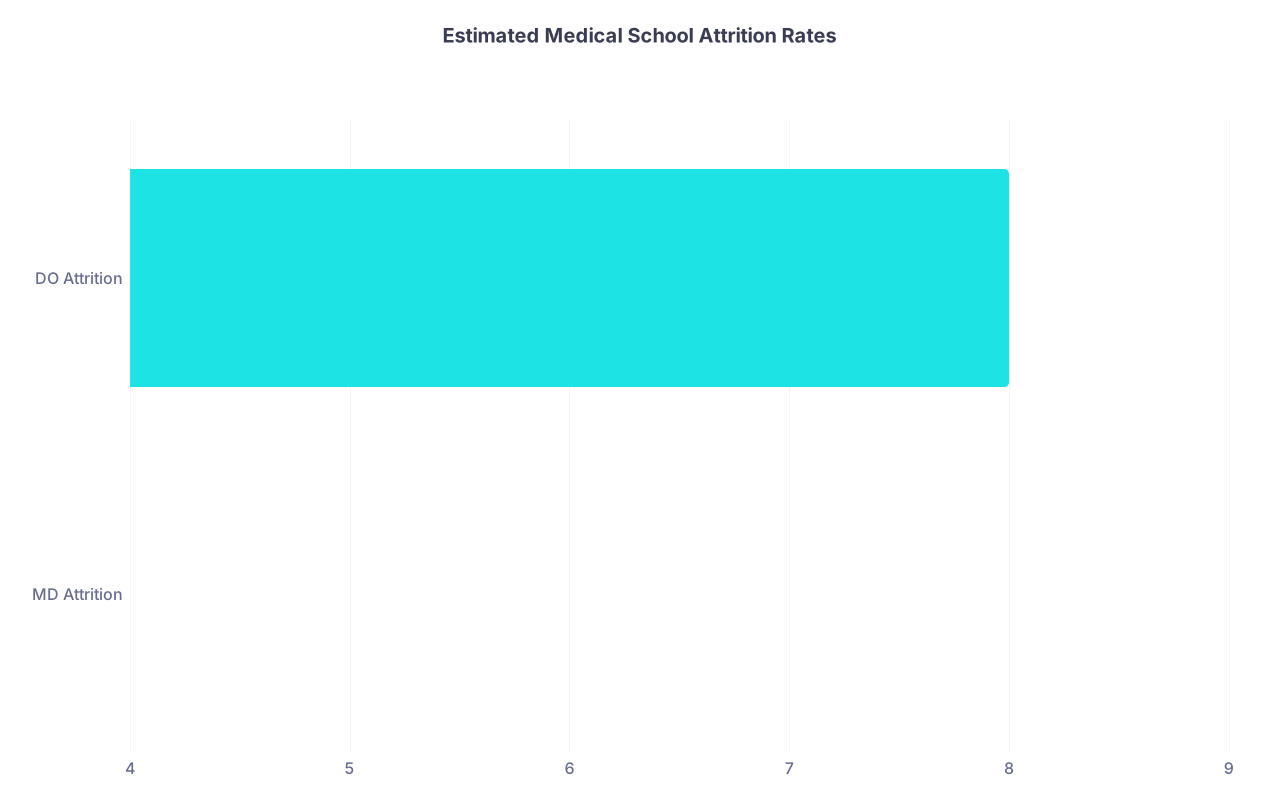
| Category | Value |
|---|---|
| MD Attrition | 4 |
| DO Attrition | 8 |
The exact numbers vary by school. That is the point. Some newer or lower-selectivity DO programs have noticeably higher attrition and repeat rates than established MD programs.
Why? The data and day-to-day reality line up:
- Students entering with lower MCAT and GPA are, statistically, at higher risk of academic struggle in an extremely dense curriculum.
- Schools that expand class sizes rapidly sometimes outpace the maturation of their support systems (tutoring, remediation, test prep for COMLEX/USMLE).
- Some DO programs accept a larger fraction of “borderline” academic profiles that MD schools screen out earlier.
I have watched this play out: in one DO program, a cluster of students with MCATs in the high 490s/low 500s systematically struggled with anatomy and systems blocks, even when motivated and hardworking. Effort did not fully compensate for weaker baseline preparation.
Does that mean DO is “worse”? No. It means the risk profile is different, and pretending otherwise is naïve.
If your stats are below the median of your entering class, at ANY med school, your probability of repeating a year or facing remediation increases. That is true in MD and DO. It is just that DO classes, on average, have a wider statistical spread, so the tails are more populated.
5. Residency Outcomes: The Numbers After Graduation
You cannot talk about attrition and admissions without tying it to the endpoint: residency placement. Since the MD and DO residency match systems were unified, the data on outcomes have become clearer.
Patterns from recent NRMP reports and aggregate analyses:
- Overall match rates: U.S. MD seniors typically match at slightly higher rates than U.S. DO seniors, especially into highly competitive specialties.
- Step/COMLEX performance: MD students, on average, achieve higher USMLE Step 1/2 scores than DO counterparts; DO students often take COMLEX only, and those who do both sometimes underperform on USMLE relative to MD averages.
- Specialty distribution:
- MD graduates are overrepresented in the most competitive specialties (dermatology, plastic surgery, ENT, neurosurgery).
- DO graduates are overrepresented in primary care (FM, IM, peds) and certain IM subspecialties, although the gap is slowly narrowing.
There is nothing mystical here. You take a cohort with slightly lower average academic entry metrics (MCAT/GPA), observe slightly higher academic difficulty and attrition, and then you see modestly lower average performance on high-stakes standardized exams. That will affect match positions when residencies use test scores and class ranking as primary filters.
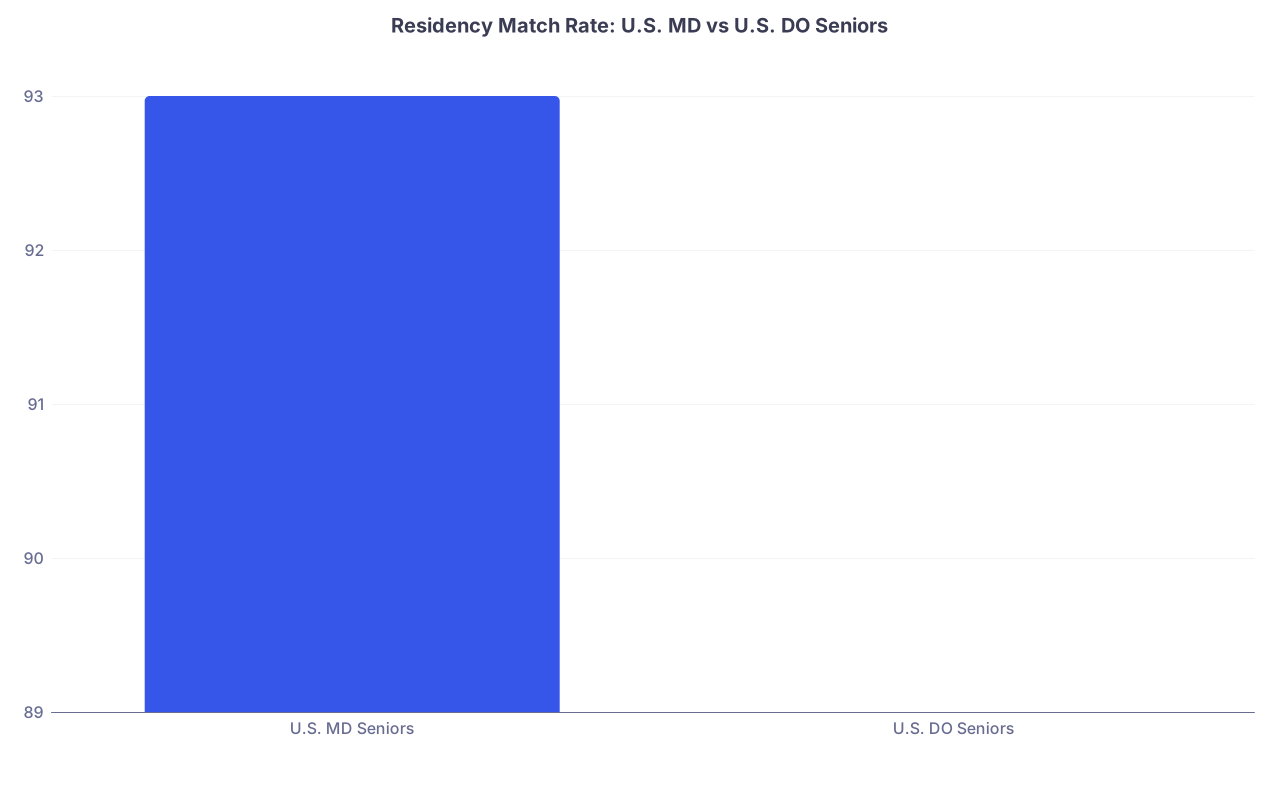
| Category | Value |
|---|---|
| U.S. MD Seniors | 93 |
| U.S. DO Seniors | 89 |
Those numbers move a bit each year, but the spread is persistent. A few percentage points may not sound like much, but when you look at subgroups by specialty, the gap widens sharply.
Important nuance: plenty of DO graduates match competitive specialties and strong academic programs. It is just that success rates are lower on average, and the bar (scores, research, networking) is higher to overcome the baseline bias.
6. Strategic Takeaways for Premeds: How to Use These Numbers
The numbers do not care about online arguments. They describe reality. Your job is to make decisions that align with that reality.
6.1 If you are early premed (freshman/sophomore)
You are still building your GPA and have not taken the MCAT. The data suggest:
- Your primary controllable variable is GPA. High GPAs (3.8+) open both MD and DO paths and cushion a mediocre MCAT somewhat.
- A 0.2 GPA difference is enormous. Going from 3.5 to 3.7 changes your statistical MD landscape more than people admit.
- If you already have a few poor semesters, plan for a full repair strategy (strong upward trend + possible post-bacc or SMP) rather than magical thinking.
At this phase, “MD vs DO” is premature. You are shaping whether you will have the option to choose.
6.2 If you are close to applying and have your MCAT score
This is when the MD vs DO decision becomes a quantitative exercise, not a vibe-based one.
- Compare your GPA and MCAT to published matriculant averages and 10th–90th percentiles for MD and DO schools.
- If you are below the 10th percentile for most MD schools you are targeting, you are not “in the game” just because some anonymous person with similar stats got in somewhere once.
- Build a two-tier list if your stats are in the overlap band (e.g., 3.6 / 508): realistic MDs plus a robust slate of DOs.
I have seen too many people treat DO as a backup in theory but then only apply to 1–2 DO schools “just in case.” The math does not support that. If DO is part of your safety strategy, you apply widely there as well.
6.3 If your stats are clearly below MD averages
This is where people get stubborn and waste cycles. If your profile is something like:
- 3.3 GPA and 500 MCAT
- 3.4 GPA and 502 MCAT
you are in a zone where MD probabilities are very low outside exceptional circumstances or serious academic repair. You can:
- Spend 2–3 years fixing your record: upward trend, formal post-bacc, SMP, MCAT retake aiming for 508+.
- Or accept that DO is the realistic primary path, apply intelligently, and aim to be at or above the median of the DO schools you attend to reduce attrition risk.
What you should not do (if you care about probabilities, not ego) is sink $5,000–$10,000 into a primarily MD application list with metrics that put you below the 10th percentile almost everywhere.
7. Risk Management: Admission vs Survival vs Outcomes
The most useful way to think about MD vs DO, from a data perspective, is as a three-stage risk chain:

| Step | Description |
|---|---|
| Step 1 | Applicant Metrics MCAT + GPA |
| Step 2 | MD Academic Risk & Attrition |
| Step 3 | DO Academic Risk & Attrition |
| Step 4 | MD Residency Match Outcomes |
| Step 5 | DO Residency Match Outcomes |
| Step 6 | MD Admission Probability |
| Step 7 | DO Admission Probability |
You are not just optimizing:
“Where can I get in?”
You are optimizing:
- Probability of acceptance (MD vs DO, given your stats).
- Probability of surviving academically at that level.
- Probability of landing a residency that fits your goals from that pathway.
Examples:
- High stats (3.8 / 515): You have high MD admission probability, low academic risk, strong residency odds. DO adds very little marginal value unless you have strong osteopathic preference or geographic reasons.
- Middle stats (3.6 / 508): Split strategy makes sense—MD and DO both viable, but not guaranteed. You reduce global risk by applying to both.
- Lower stats (3.3 / 501): MD admission probability is low; if you force your way into any school that will take you without addressing your academic foundation, your academic risk and attrition risk spike. Better to fix the underlying numbers or choose a school where you are nearer the center of the distribution.
People obsess about “getting in” and ignore that:
- Being in the bottom quartile of your class statistically correlates with higher risk of exam failures, repeats, and weaker residency placement.
- DO programs that heavily enroll borderline academic profiles may have less margin to support all of them through COMLEX/USMLE at competitive score levels.
Use the numbers to avoid putting yourself in a position where you barely scrape in and then struggle for four years.
8. What the Data Actually Say About MD vs DO
Strip away the noise. Looking purely at metrics and outcomes:
- MD and DO programs serve partly overlapping but statistically distinct applicant bands.
- MD schools cluster around higher mean MCAT and GPA; DO schools extend farther into the lower tails.
- Attrition and academic difficulty are higher, on average, in DO programs, which aligns with the admission of more academically at-risk students.
- Residency match outcomes favor MD graduates on average, especially for competitive specialties, but strong DO students can and do achieve excellent placements.
None of this tells you what you “should” do in a moral or ideological sense. It tells you what is likely to happen given certain inputs.
You have control over three levers:
- Your pre-application metrics (GPA, MCAT).
- Your school list and MD/DO mix.
- Your willingness to repair weak data rather than pretend it does not matter.
Use them rationally.
Key points to leave with:
- MD and DO schools are not binary opposites. They occupy overlapping but distinct score and GPA bands, which you can quantify before applying.
- Lower-entry metrics correlate with higher attrition and weaker average residency outcomes, regardless of degree type. Position yourself near or above the median of wherever you go.
- The smartest MD vs DO decision is not ideological. It is statistical: match your actual numbers—not your imagined potential—to the environments where you are most likely to get in, stay in, and graduate into the career you want.