| Category | Value |
|---|---|
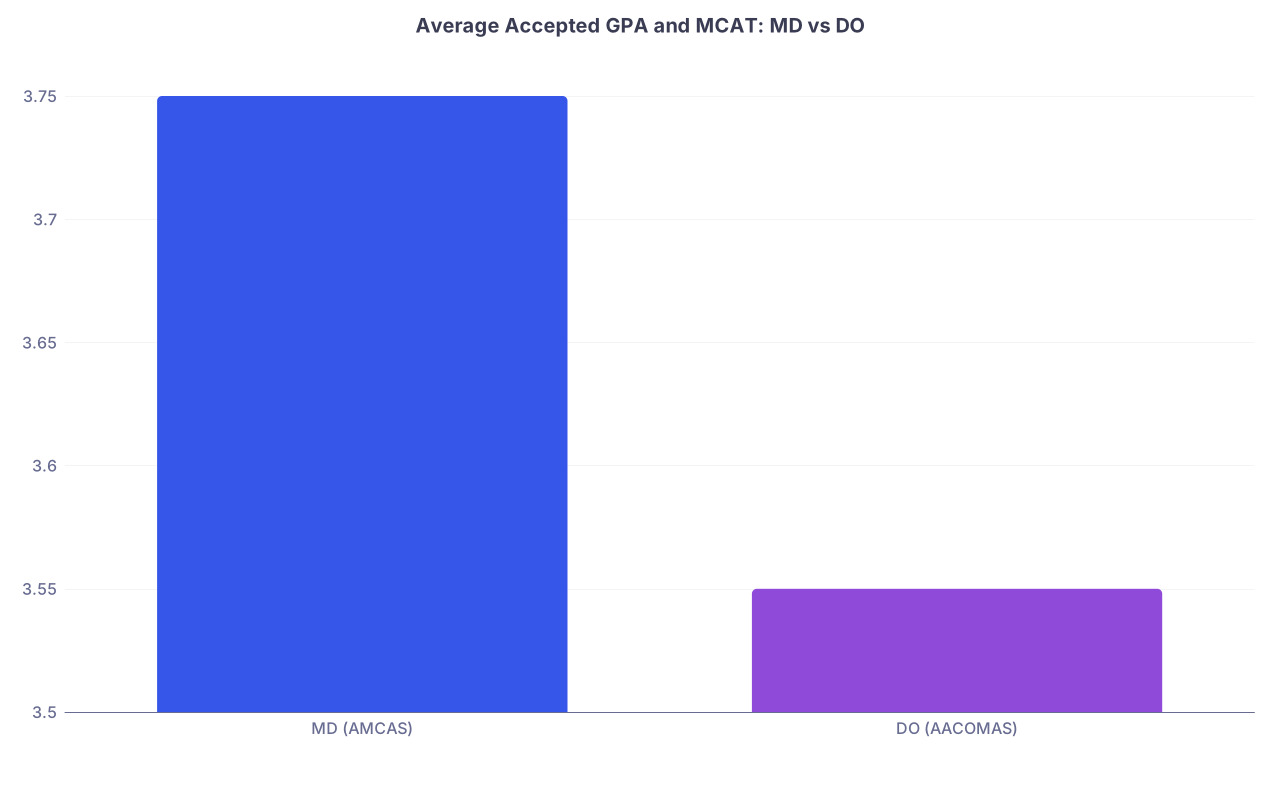
| MD (AMCAS) | 3.75 |
| DO (AACOMAS) | 3.55 |
The common claim that “DO students are just weaker MD rejects” is lazy, outdated, and only half-supported by actual admissions data.
If you want the real answer, you have to stop cherry-picking MCAT screenshots from SDN and look at the full distribution, how the systems work, and what happens after people graduate. Because the data tells a more uncomfortable story for both sides.
Let’s walk through it like adults.
Myth: “DO Students Are Just Less Competitive MD Wannabes”
Here’s the stereotype you already know:
MD = top students, high stats, “real” doctors.
DO = lower stats, backup option, less competitive.
There is a kernel of truth in there. Then it gets wildly oversimplified.
Yes, on paper, the average DO matriculant has lower numerical metrics than the average MD matriculant. That’s not controversial.
Where people go wrong is turning “lower averages” into “academically inferior” or “unqualified.” Or pretending the gap is the same at every point of the distribution. It is not.
Let’s put some numbers on this before someone waves around a single school’s average like it’s the Ten Commandments.
What The Admissions Numbers Actually Show
I’ll use public association data here: AAMC for MD (AMCAS) and AACOM for DO (AACOMAS). Numbers shift a bit year to year, but the pattern is consistent.
GPA: The Academic Baseline
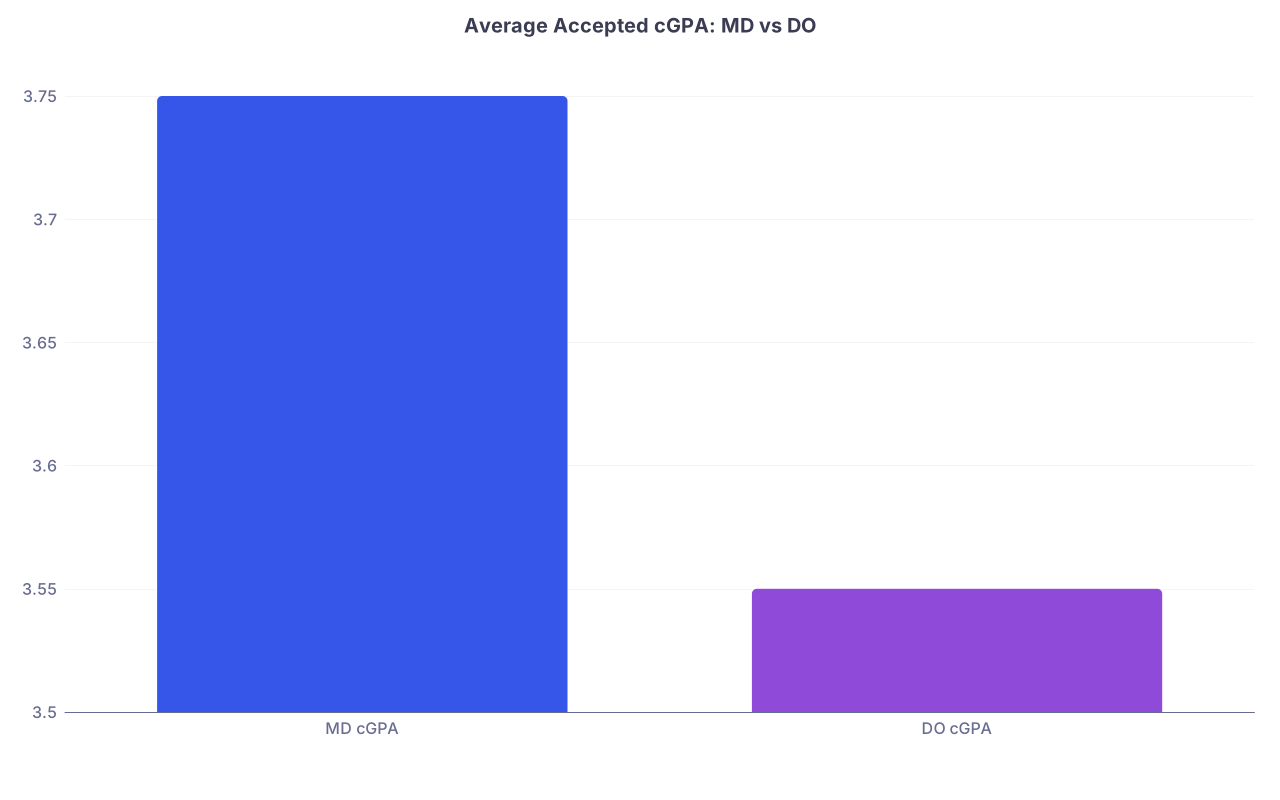
Recent entering classes look roughly like this:
| Category | Value |
|---|---|
| MD cGPA | 3.75 |
| DO cGPA | 3.55 |
Science (BCPM) GPA tends to be similarly spaced, usually around:
- MD matriculants: ~3.7–3.75 sGPA
- DO matriculants: ~3.45–3.50 sGPA
So yes, there’s a gap. About 0.2 GPA points on average.
That’s not nothing. But it’s also not “3.9 vs 3.0.” I’ve seen plenty of DO students with 3.8+ GPAs who ended up in DO schools because of late applications, weaker MCATs, state school bias, or just because they liked a particular DO program.
The GPA data tells you this: the DO pool on average comes from students who either:
- Had modest academic missteps (a rough freshman year, a bad semester, repeat coursework), or
- Came from less traditional backgrounds and took a more winding academic path.
That’s not inferiority. That’s a different filter.
MCAT: The Favorite Blunt Instrument
This is the number people throw around most, often without context.
Recent cycles (rounded):
- MD matriculants: ~511–513 mean MCAT
- DO matriculants: ~503–505 mean MCAT
Eight to ten points sounds huge. Until you recall:
- 510 is around 80th–82nd percentile
- 502–504 is roughly 55th–60th percentile
So yes, the median DO student is often sitting 15–25 percentile points lower than the median MD student on a standardized test.
That does not mean “can’t handle medical school.” It means “had weaker test performance in undergrad.” Some because of true test-taking deficits. Others because they worked full-time, were caregivers, or didn’t burn $3,000 on MCAT courses and UWorld.
Here’s the more honest picture: both MD and DO students, as a group, are drawn from the top slice of undergraduate students. MD takes more from the very top; DO pulls more heavily from the large middle-strong band that MD schools partially ignore.
The Part Nobody Likes: Self-Selection and Second Chances
A lot of the gap isn’t because DO schools “love weak students.” It’s because of how the MD side screens people out before a human even reads their file.
I’ve watched this play out with actual applicants:
3.3 GPA, 514 MCAT, strong upward trend, powerful story.
- Many MD schools: auto-screened or soft-rejected because of that 3.3.
- DO schools: interview, real discussion, eventual acceptance.
3.9 GPA, 502 MCAT, first-generation college, worked nights as CNA.
- Many MD schools: “MCAT too low, reject.”
- DO schools: “Let’s see if this person can grow here.”
That’s not romanticizing DO. It’s describing how they position themselves: more willing to entertain “imperfect profiles,” more forgiving of early academic messiness if there’s evidence of later competence.
So yes, by the time you look at “average MCAT,” MD has consistently skimmed off most of the 515+ crowd. But that’s partly because a ton of 515+ students only applied MD. Self-selection is doing as much as admissions policy.
You can’t compare the outputs without acknowledging the different inputs.
Are DO Schools Lowering The Academic Bar?
Here’s where people really twist the narrative.
The accusation:
“DO schools lower the standards; they’re letting in people who shouldn’t be doctors.”
Reality:
DO schools take more risk on certain metrics and then test whether that risk was justified through board exams and clinical performance. And the outcomes are a mixed bag, not a disaster.
Look at COMLEX Level 1 and 2 pass rates over the last decade:
- Historically: DO schools often report first-time pass rates in the high 80s to low 90s percentile range.
- Many MD schools sit in the low to mid 90s for USMLE Step 1 and 2.
So yes—slightly lower academic profiles entering DO programs tend to translate to slightly lower standardized board performance. That’s unsurprising.
But the key point: the majority of DO students still pass, still graduate, still match. The floor is higher than the stereotype suggests.
If DO schools were truly admitting legions of hopelessly unprepared students, you’d see catastrophic board failure rates. That’s not what the data shows.
Where DO Students Actually Struggle Competitively
Pretending DO vs MD are identical academically is just as dishonest as “DO = dumb.”
Here are the real friction points:
1. Standardized Test Ceiling
On average, DO students have a lower test-taking ceiling. That shows up as:
- Lower average COMLEX and (when they still took it broadly) USMLE scores
- Fewer sky-high outliers
Still plenty of DO students with 250+ USMLE scores existed when everyone took it. I’ve seen them match derm, ortho, radiology, anesthesia at big-name programs. But it’s less common per capita from the DO pool than the MD pool. That matters for hyper-competitive specialties.
2. Specialty Distribution
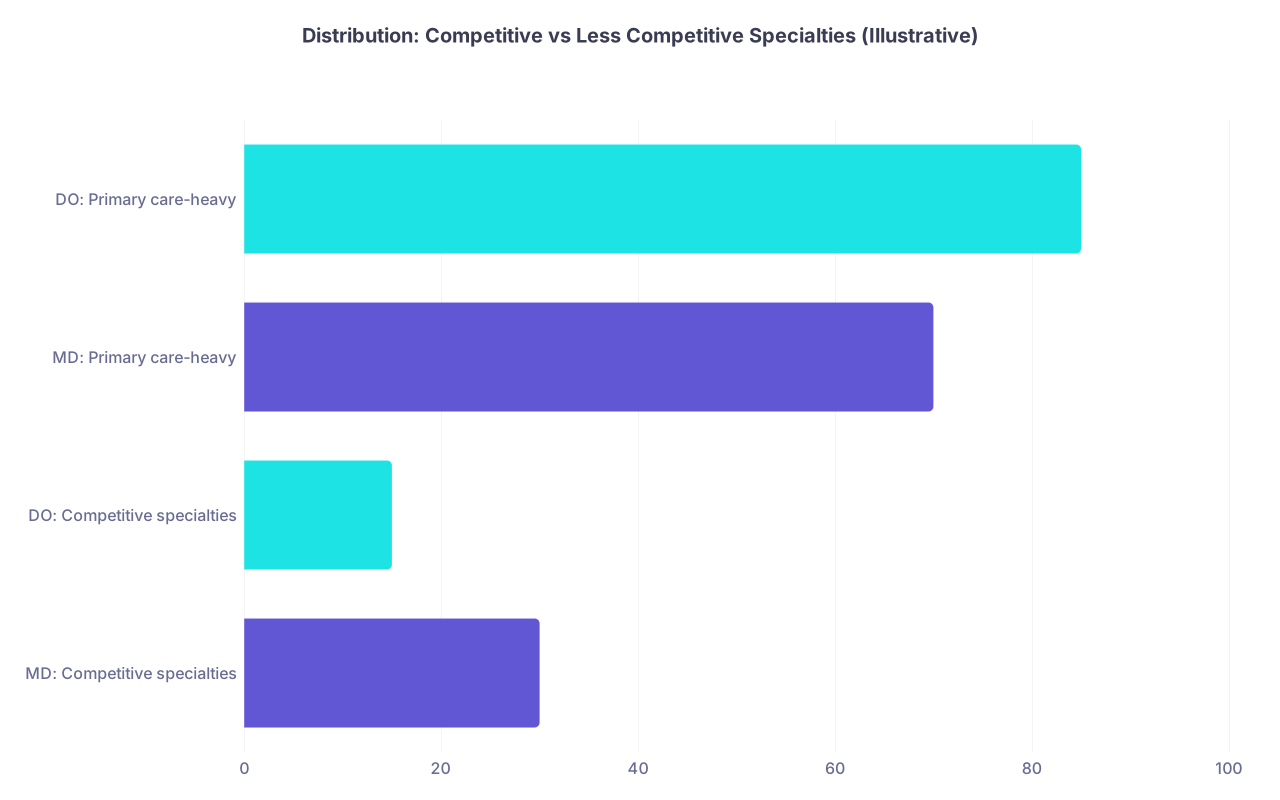
Look at residency match trends:
| Category | Value |
|---|---|
| MD: Competitive specialties | 30 |
| DO: Competitive specialties | 15 |
| MD: Primary care-heavy | 70 |
| DO: Primary care-heavy | 85 |
(Not exact percentages—illustrative of the pattern.)
MD graduates are overrepresented in:
- Derm
- Plastics
- Ortho
- ENT
- Certain academic IM fellowships at big name centers
DO graduates are overrepresented in:
- Family medicine
- Community internal medicine
- Community pediatrics
- PM&R and some IM subspecialties at less name-brand hospitals
Is that purely “academic ability”? No. It’s a cocktail of:
- Historical bias against DOs
- Network differences
- Program director unfamiliarity with COMLEX
- Patchy USMLE participation from DO students
- Real differences in average test scores at the extreme high end
But if you’re honest, you admit this: the DO route makes some doors statistically harder to open, especially at the most prestige-obsessed programs.
Things The “DO = Inferior” Crowd Always Forgets
This is the part people conveniently ignore when they want to brag about their MD acceptance.
1. Overlap at the Individual Level
You cannot look at one DO student and one MD student and say, “The MD one is smarter.” That’s not how distributions work.
There is massive overlap.
I’ve seen:
- MD students with 507 MCATs.
- DO students with 519 MCATs.
- MD students who barely passed Step 1.
- DO students who crushed USMLE and COMLEX and matched academic fellowships.
If you pulled the top 20% of DO students and the bottom 20% of MD students and anonymized them, you’d have a hard time sorting them by credentials alone.
The averages differ. Individuals defy the averages constantly.
2. Non‑Academic Filters Matter
DO schools often give weight to:
- Nontraditional backgrounds
- Life experience (military, EMS, nursing, PA, second-career folks)
- Service orientation and primary care interest
Some DO admissions committees will absolutely admit a 3.4/503 former paramedic over a 3.8/515 with zero real-world experience and a spreadsheet personality. MD schools, especially mid-tier ones chasing rankings, are more enslaved to metrics.
Is that “less competitive academically”? On MCAT alone—yes. On eventual clinical performance? Often no. I’ve watched DO-trained residents run circles around MD peers on the wards because they had five extra years of real work before med school.
For Premeds: How To Interpret This Without Lying To Yourself
If you’re a premed trying to decide where you fit, you need the adult version, not the fan fiction from either camp.
Here’s the blunt breakdown:
If you have 3.8+ GPA and 515+ MCAT, you are statistically in prime MD territory. Going DO by choice is totally fine, but don’t pretend your options are limited. Many DO schools will look at you and know you’re using them as backup.
If you’re around 3.6 GPA and 508–511 MCAT, you’re in the gray zone. Strong MD shot, but not guaranteed. DO schools are very realistic options and often easier to crack, especially if you apply late or have institutional biases working against you.
If you’re in the 3.3–3.5 GPA and 500–505 MCAT range, then yes: DO schools are more receptive. MD schools become highly selective, especially if there are red flags or no strong upward trends.
The myth to kill here:
“DO schools are just MD rejects.”
The more accurate statement:
“DO schools draw from a broader academic range—including many who were rejected by MD schools, plus some who never applied MD at all—and still produce practicing physicians who clear the same licensing bar.”
Those two sentences feel very different. Only one of them respects the data.
What Happens After School: Does It Still Matter?
Here’s where the obsession with “competitiveness” loses steam.
Once you:
- Pass your boards
- Match into residency
- Survive intern year
- Get board-certified
Most patients don’t care if your degree says MD or DO. Seriously. Outside of certain academic or ultra-competitive niches, hiring decisions are more about:
- Training program reputation
- Your references
- Your actual competence and reliability
Are there still biased hospital systems and departments? Yes. Is that bias shrinking? Also yes. MD degree still “travels” more smoothly into certain top‑tier academic roles and hyper‑competitive subspecialties. That doesn’t mean DO grads never get there; it means they take a steeper hill, and fewer choose to climb it.
So if your lifetime goal is Harvard derm or Sloan‑Kettering heme/onc faculty, playing every prestige and statistics card probably matters. MD has a structural edge there.
If your goal is: “Be a well-trained, respected, well-paid clinician in a decent city,” DO vs MD is mostly about your effort, not the letters.
FAQ: Three Questions That Actually Matter
1. If DO averages are lower, will I be behind my MD classmates academically?
Not automatically. You’re not competing against a spreadsheet; you’re competing against the curriculum. If you got into any accredited medical school and are willing to work, you can keep up. Some DO students do struggle more with standardized tests, but many close that gap with better study habits and board prep. The averages do not decide your outcome; your daily output does.
2. Will choosing DO hurt my chances at competitive specialties?
Statistically, yes, compared to going MD with identical stats—because of both bias and board-score distributions. But “hurt” doesn’t mean “destroy.” DO grads still match ortho, derm, anesthesia, radiology, ENT, etc., especially if they have strong scores, research, and strategic applications. You just have less margin for error and fewer doors automatically open.
3. Should I retake the MCAT and chase MD only, or apply broadly with DO included?
If your stats are within realistic MD ranges and you have reason to believe you can significantly improve (not 1–2 points; more like 4–6+), a retake can be reasonable. If you’re already around 503–505 after serious prep, and your GPA is not stellar, spending another year gambling on MD‑only while ignoring DO is usually ego, not strategy. The question isn’t “MD or DO?” It’s “Do you want to be a physician or not—and what trade‑offs are you actually willing to make to get there?”
Key points you should walk away with:
- On average, DO matriculants have lower GPAs and MCATs than MD matriculants—but the overlap is huge, and individual DO students often outperform plenty of MD peers.
- The “less competitive academically” label is an exaggeration built on averages, self‑selection, and MD schools’ heavier reliance on numerical filters, not on any hard evidence that DO students “can’t handle” medicine.
- For your own path, the choice isn’t about defending a tribe. It’s about being brutally honest about your stats, your goals, and whether you care more about letters on your diploma or the actual career you end up living.