DO schools are not “backup” schools. They’re just schools that rejected you more quietly.
That line usually stings. Good. Because the lazy narrative—MD is “real,” DO is “backup”—falls apart the second you actually look at the data, not the premed group chat.
Let me walk you through what’s actually true, what’s flat-out wrong, and what matters for you if you’re trying to become a physician in 2025 and beyond.
Myth #1: “DO schools are easy to get into”
This is the core myth. People toss this around like DO admissions is some open-enrollment night school.
Here’s what the numbers actually say.
| Category | Value |
|---|---|
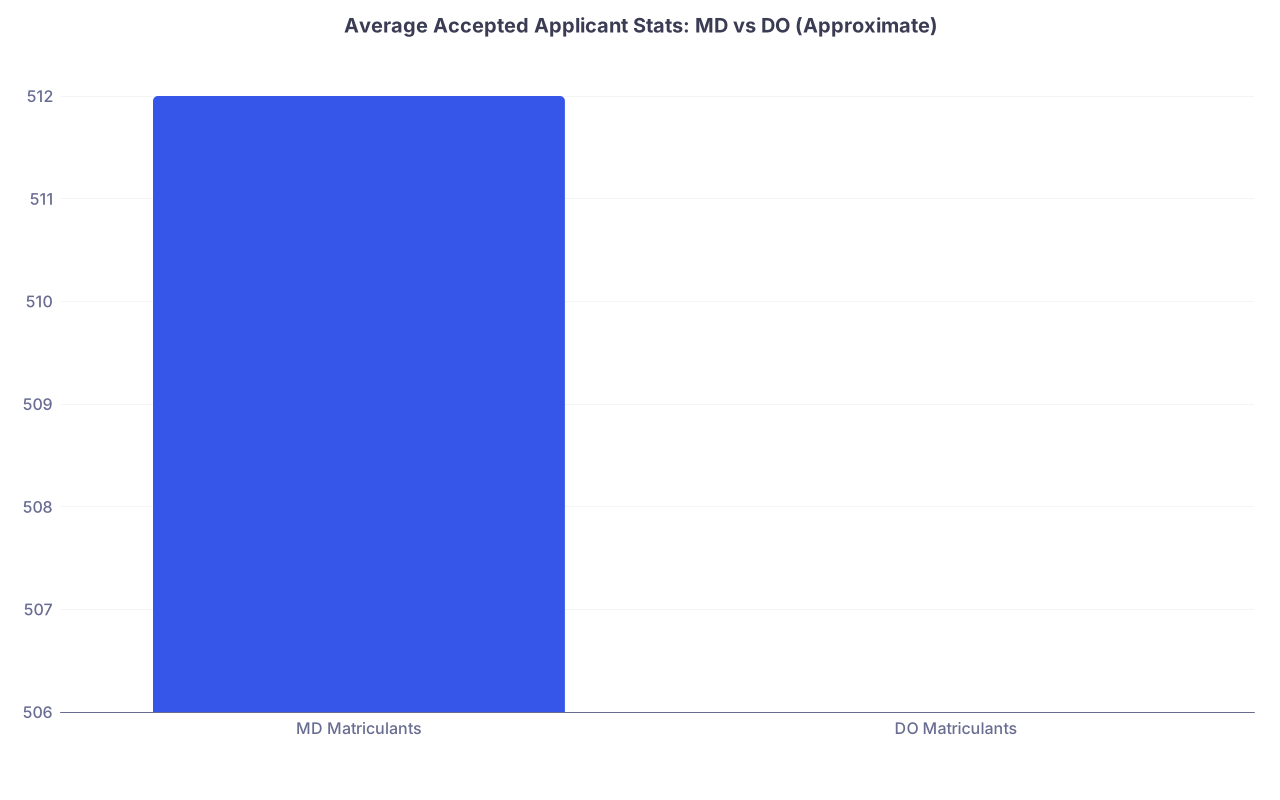
| MD Matriculants | 512 |
| DO Matriculants | 506 |
Those are ballpark recent averages for MCAT among matriculants, not applicants. DO is a bit lower, yes. But:
- 506 MCAT is not “easy”
- ~3.5–3.6 GPA is not “easy”
- And the acceptance rates are not dramatically kinder
Rough shape of the landscape in recent cycles:
- MD acceptance rate (per applicant): ~40–42%
- DO acceptance rate (per applicant): ~35–38%
If DO schools were the “safety” bucket, you’d expect something like 60%+ acceptance. That’s not what’s happening. They’re still rejecting more people than they accept.
What does differ?
- DO schools are more willing to entertain:
- Lower freshman-year GPAs with upward trends
- Nontraditional applicants
- Reapplicants and career changers
- They sometimes place slightly less weight on MCAT obsession and slightly more on:
- Clinical experience
- Holistic review
- Fit with osteopathic philosophy (yes, they actually care if you know what DO means)
“Easier” is the wrong word. “More flexible in who they consider competitive” is closer to the truth.
If your stats are 3.0 and 498, DO is not your safety. It’s just another door that will very likely stay closed unless other parts of your profile are exceptional.
Myth #2: “Schools only take you if you couldn’t hack MD”
I’ve seen this dynamic in actual applicant pools: same applicant, same year, one MD acceptance, one DO acceptance. Or three DO II’s (interview invites) and no MD. Or the reverse.
The idea that the same person can be “good enough” or “not good enough” depending on the letters after the school name is childish. Programs look for different things.
Here’s a dirty secret: some DO schools are more competitive than many lower-tier MD schools for certain profiles.
Examples I’ve actually seen:
Strong DO letters + real buy-in to osteopathic philosophy → rejected by several MDs, accepted at top DO programs like:
- UNECOM
- CUSOM
- ATSU-KCOM
Applicant with 3.8/508, strong research, no DO exposure, generic “I just want to be a doctor” narrative →
Multiple MD II’s, ghosted or waitlisted by several DO schools that clearly prioritized applicants with DO interest, shadowing, and mission fit.
Schools aren’t grading you in a vacuum. They’re grading you against:
- Their mission (primary care vs academic vs rural focus)
- Their regional pipeline (in-state vs out-of-state)
- Their comfort with your stats vs their board pass rates
- Their need for people who actually want them and not “anything I can get”
The “you’re here because you failed MD” narrative mostly comes from:
- Insecure premeds trying to feel superior
- Misinformed family members stuck in 1990
- A few bitter people who didn’t match into competitive specialties and blamed the letters, not their application
Is there a subset of applicants who only apply DO after MD rejections? Of course. There’s also a subset who only went to their MD school after Ivy undergrad rejections. That doesn’t magically define the quality of the program.
Myth #3: “If you want any decent specialty, DO kills your chances”
This one used to have more teeth. Before the single accreditation system, before Step 1 went pass/fail, before DO students routinely matched into derm, ortho, ENT, etc.
Now? The story is more nuanced. Not equal. But not “DO = only FM or IM.”
Let’s be blunt. On average:
MD students still have an easier path into the hyper-competitive specialties:
- Dermatology
- Plastic surgery
- Neurosurgery
- ENT
- Ortho
DO students:
- Do match into these fields—every year
- Just need to be more deliberate: high Step 2, early research, away rotations, strong letters
Here’s where DO genuinely still has a structural disadvantage:
- Fewer home programs in certain competitive specialties → fewer built-in mentors, fewer automatic audition rotation slots.
- Some programs openly “MD-preferred” or historically have taken very few DOs.
But the “no DOs allowed” wall is lower every year. The single ACGME accreditation system merged most residency programs. PDs now pick from one combined pool. What moves the needle:
- Step 2 CK score
- Clinical performance
- Research and letters
- Away rotations and face time
Not three letters after your school’s name.
If you’re DO and want derm at Harvard with zero research, mediocre Step 2, and no home derm program? That’s fantasy. But it would also be fantasy if you were MD at a lower-tier med school with the same profile.
The difference is not “MD vs DO.” The difference is “top 5% applicant vs average applicant in an ultra-competitive field.”
Myth #4: “DO school is my backup because they accept lower stats”
Let’s talk about what “backup” actually means to most premeds:
- “Somewhere I’m almost guaranteed to get in if my top choices reject me.”
That doesn’t describe DO schools. At all.
Most DO schools are:
- Receiving 7,000–12,000+ applications
- Offering maybe 600–800 interviews
- Enrolling 150–300 students
That’s not backup territory. That’s competitive.
What is true:
- DO schools open doors for certain groups MD schools punish harder:
- Upward GPA trend after rough freshman/sophomore year
- Older applicants with previous careers
- Lower MCAT but strong sustained clinical involvement
- Students who clearly understand and value osteopathic principles
If your idea of “backup” is “school that will give me a chance despite early mistakes,” then fine. DO schools are sometimes more forgiving in that sense. But they’re not safety nets. They’re different filters.
| Factor | MD Schools (Typical) | DO Schools (Typical) |
|---|---|---|
| MCAT Emphasis | Very high | High, but slightly more flexible |
| Early GPA Problems | Often heavily penalized | More weight on upward trend |
| Nontraditional Age/Career | Mixed (varies by school) | Often more open and welcoming |
| DO Shadowing / Letters | Rarely required | Often required or strongly preferred |
| Research | Big plus, sometimes expected | Helpful, but less critical at many schools |
| [Commitment to Primary Care](https://residencyadvisor.com/resources/do-vs-md/primary-care-training-pathways-subtle-do-vs-md-differences-in-clinic) | Depends on mission | Strongly valued at many DO programs |
Notice the framing. Different emphasis. Not “good versus bad.”
If you play the DO process like it’s just MD-lite, you’ll get burned. No DO exposure, no DO letters, no understanding of OMM or osteopathic philosophy, and a personal statement that reads like a generic MD one? That’s how you end up “shocked I didn’t get into any DO schools even though they’re easier.”
Myth #5: “Employers and patients think DOs are lesser doctors”
Reality on the ground:
- Most patients have no idea what MD vs DO means
- The ones who care usually care based on your bedside manner, not your initials
- Hospitals care about:
- Board certification
- Residency training
- Clinical competence
- Malpractice record and outcomes
In most parts of the US, DOs:
- Lead hospitalist teams
- Run departments
- Serve as program directors
- Teach at MD schools and DO schools alike
The “DO = chiropractor-lite” nonsense survives mostly among older physicians who trained before DOs were fully mainstreamed and a subset of premeds who have never actually worked with DO attendings.
Legally and practically:
- DOs and MDs:
- Have identical prescribing rights
- Can practice every specialty
- Can be board-certified in the same boards (ABIM, ABS, etc., via ACGME residencies)
Where DOs do have some perception issues:
- Certain academic powerhouse institutions are populated mostly by MD grads (historical inertia).
- Some elite fellowships still have few DO alumni.
But that’s not because DOs are “backup doctors.” It’s because:
- The pipeline from DO → big NIH-funded research labs is narrower
- Fewer DO students chase hardcore academic research tracks in the first place
- Self-selection: applicants who are obsessed with ultra-elite academic careers gravitate MD-only
You want a big academic career with NIH grants at UCSF? MD is the easier route. That’s just honest. You want to be a well-trained internist, EM doc, anesthesiologist, peds hospitalist, etc., in 90% of real-world America? DO vs MD matters less than your training and how good you are.
Myth #6: “If I can get MD, it’s stupid to choose DO”
Now we’re into identity and ego, not just admissions math.
There are legitimate reasons to pick DO even with an MD acceptance:
- You buy into the osteopathic philosophy—whole-person care, prevention, musculoskeletal emphasis—and have actually seen it done well by DO mentors.
- You have scholarship money at a DO program and full price at a mediocre MD program.
- Location: the DO school is in your support network’s city; the MD school is across the country with higher cost of living and worse fit.
- The DO program has a track record and pipeline in what you want (for example: strong EM, primary care, or certain regional residencies).
It’s not “stupid” to choose:
- A DO school with lower debt, closer to home, and strong match outcomes in your field
over - An MD school with just the MD prestige sticker and nothing else going for it
That said, here’s the part too many DO advocates are scared to say out loud:
If everything else is equal—cost, location, curriculum, your interests—and your goals include high-end competitive specialties or powerhouse academic medicine, then yes, picking MD is usually the more strategic move. Not because DO is bad. Because the path is smoother.
But those “everything equal” situations are rare. Real life is messier.
And obsessing over letters while ignoring:
- Cost
- Support
- Clinical exposure
- Match history
…is how people end up “prestige rich and life poor.”
What actually matters for you
Strip the noise away. If your goal is to be a physician, here’s the hierarchy that actually affects your life:
- Get into a solid, accredited medical school where you’ll thrive and not drown in debt.
- Perform well: preclinicals, clinical rotations, Step 2, shelf exams.
- Build relationships: mentors, letters, program directors.
- Align with your career goals: choose rotations and research that match your target field.
DO vs MD affects things, but it’s not 90% of the story. It’s maybe 10–20% depending on how niche and competitive your dream path is.
And if your current plan is:
- “MD or bust” with marginal stats
- Treating DO as “I’ll toss in 1–2 DO schools as backup”
- No DO shadowing or DO letters
- No actual understanding of osteopathic medicine
Then you don’t have a thoughtful strategy. You have an ego problem disguised as a plan.
The bottom line
Let’s boil it down.
- DO schools are not “backup” schools. They’re competitive, just with slightly different levers (more forgiving of nontraditional paths, more emphasis on holistic fit and DO interest).
- Your career ceiling is mostly set by your performance and choices, not the two letters. MD gives some advantages in ultra-competitive academic and subspecialty spaces, but DO grads reach those too—with a more intentional climb.
- Pick the school that maximizes your chances of becoming a good physician with a livable financial and personal life. Not the one that best satisfies a Reddit ranking or your insecure uncle at Thanksgiving.