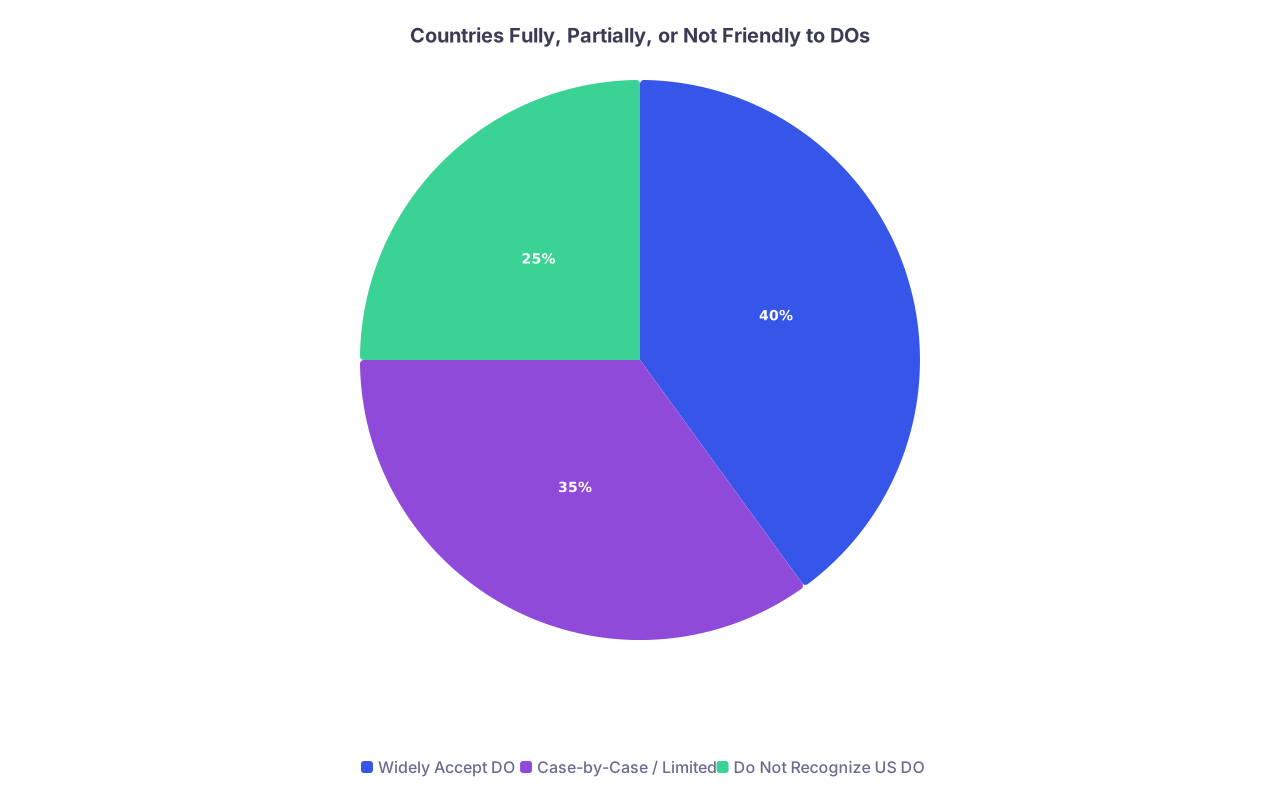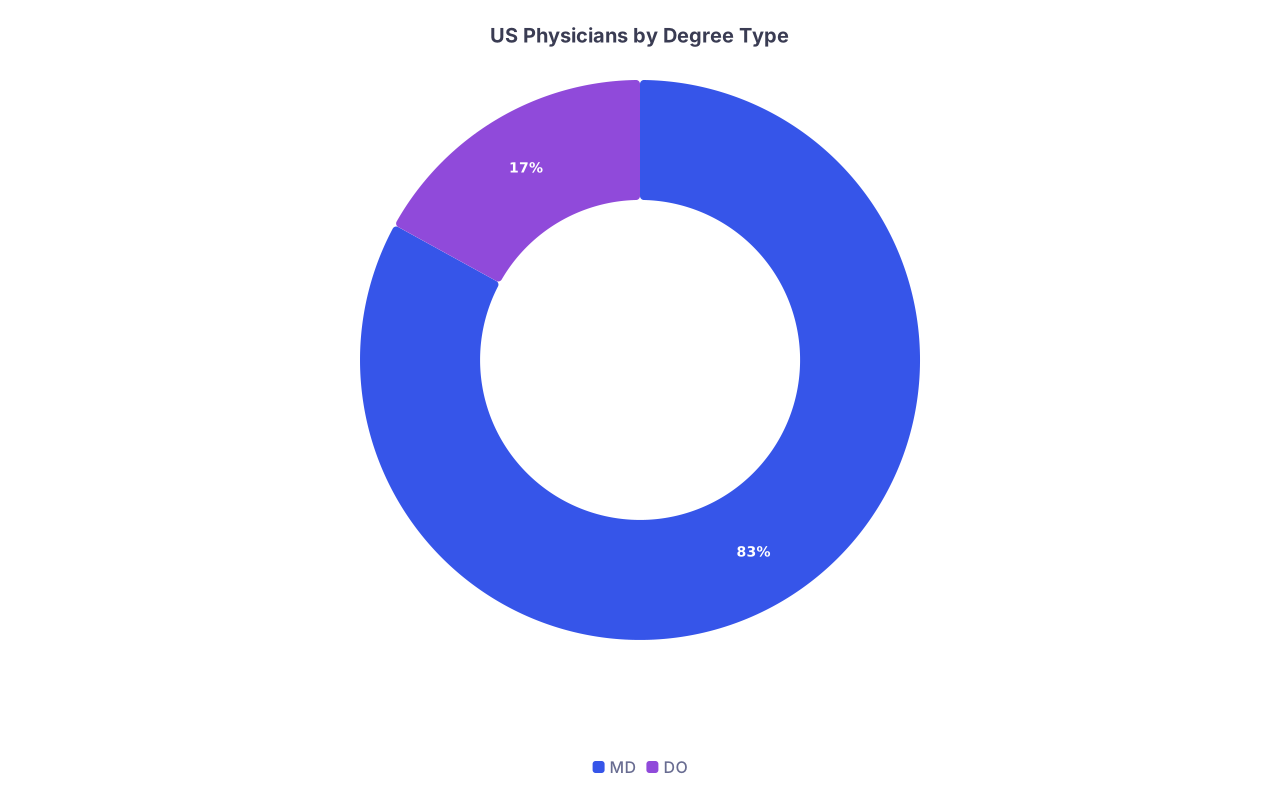
The belief that the MD vs DO distinction is “about to disappear” is wrong. The gap is smaller than it has ever been, but it isn’t going to evaporate. It’s evolving, narrowing, and shifting into fewer but more concentrated pressure points.
If you’re premed or early in med school and people are telling you, “Oh, by the time you apply, DO and MD will be the same,” they’re selling you a comforting story, not reality.
Let’s separate myth from what history and policy actually show.
How We Got Here: The “Merger” Everyone Misunderstands
Most of the “DO = MD soon” optimism comes from one big event: the single accreditation system for graduate medical education (GME).
From 2015–2020, the AOA (osteo accreditor) and ACGME (allopathic accreditor) created a unified system. By July 2020, all residency programs in the U.S. fell under the ACGME umbrella. That felt like unification. People started saying, “There won’t be DO vs MD anymore. Just ‘doctor.’”
That’s not what happened.
Historically, DOs had:
- Separate accrediting body (AOA)
- Separate residency programs
- Separate licensing exam (COMLEX)
- Smaller applicant pool and fewer residency slots
MDs had:
- ACGME accreditation
- USMLE exams
- Larger footprint in academic medicine
The merger changed exactly one of those pillars: residency accreditation. Everything else still exists, and differences shifted into other areas.

| Step | Description |
|---|---|
| Step 1 | Premed |
| Step 2 | LCME MD School |
| Step 3 | COCA DO School |
| Step 4 | USMLE Exams |
| Step 5 | COMLEX Exams |
| Step 6 | ACGME Residencies |
| Step 7 | Practice as Physician |
| Step 8 | MD or DO? |
Here’s the reality post-merger:
- Accreditation for residency is unified.
- Exams are not unified.
- Admissions standards are not unified.
- Match outcomes are not equal across all specialties.
- Public and institutional perception is improved for DOs but not erased.
So if you’re waiting for some magical policy change that snaps DO and MD into one indistinguishable track, stop waiting. That’s not how this has ever worked.
What the Numbers Actually Show: Convergence With Ceilings
Let’s look at actual data rather than vibes.
DO growth is massive. Over the past two decades, osteopathic enrollment has exploded. DOs now make up a large and growing fraction of U.S. med students and residents. They’re not a fringe group on the side anymore.
Yet when you drill into hard outcomes, the story is: “mostly similar, except when it really matters for competitiveness.”
Match Data: Where DOs Still Hit the Wall
The National Resident Matching Program (NRMP) publishes combined MD/DO match data. DO match rates in many fields are now very solid. Family medicine, internal medicine, pediatrics, psych—DOs do just fine and often very well.
But when you ask, “Has the distinction disappeared in the most competitive specialties?” the answer is blunt: no.
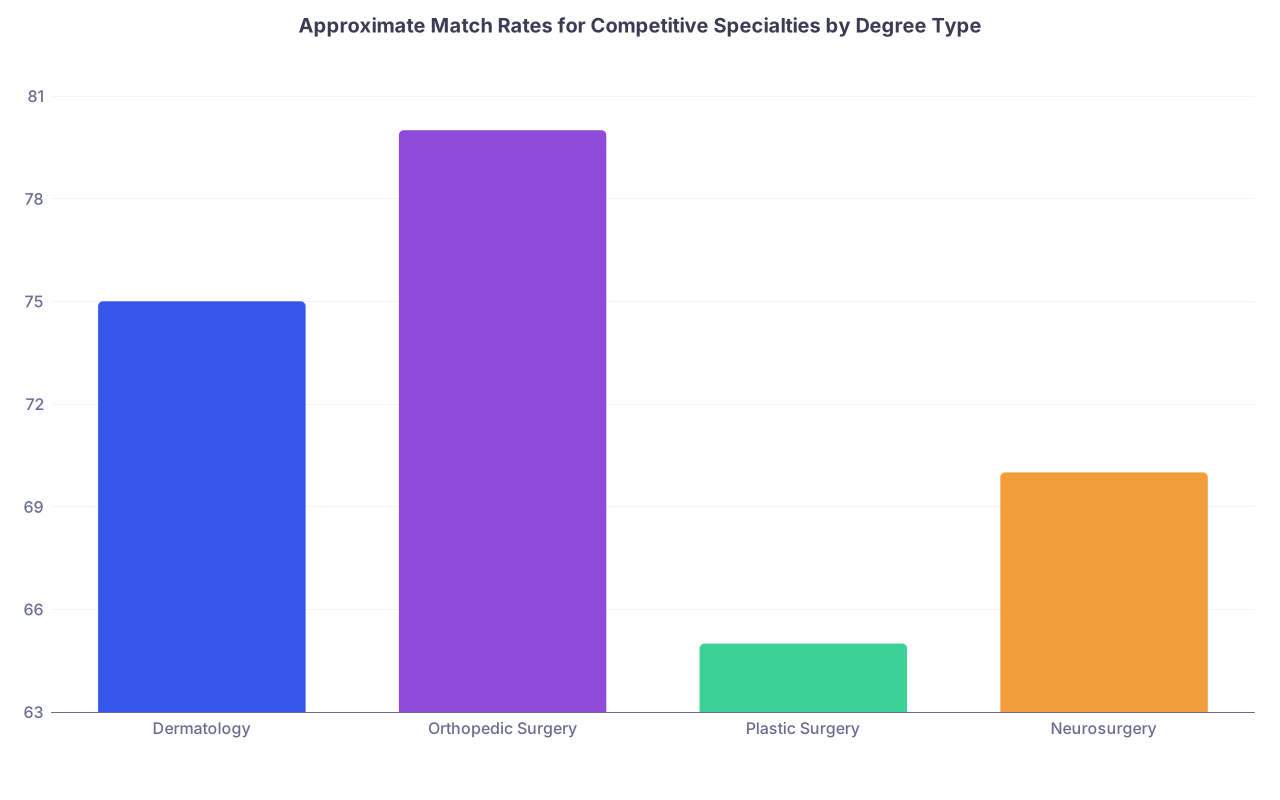
The pattern looks something like this:
| Category | Value |
|---|---|
| Dermatology | 75 |
| Orthopedic Surgery | 80 |
| Plastic Surgery | 65 |
| Neurosurgery | 70 |
Those bars aren’t MD vs DO; they’re a proxy to make a point: high-level match rates are strong overall, but when you subgroup by MD vs DO in these specialties, MDs are still dominant—heavily.
Look at any recent NRMP “Charting Outcomes”:
You’ll see:
- Virtually all DOs matching into ultra-competitive fields either:
- Took USMLE in addition to COMLEX, and
- Had exceptional scores, strong research, and strategic rotations
- Many programs in those fields still strongly prefer or quietly filter for:
- USMLE scores
- MD degree
- US MD schools, particularly for academic programs
So is it possible for DOs to match those specialties? Yes. More than ever.
Has the gap vanished? No. It just moved to the top of the pyramid.
At the broad primary care level, DO vs MD feels less and less important. At the tip of the competitiveness pyramid, it’s still very real.
Licensing Exams: The Quiet Barrier That Won’t Go Away
If you want to understand whether DO vs MD will “disappear,” watch the exams, not the marketing.
- MD students: USMLE Step 1, Step 2 CK
- DO students: COMLEX Level 1, Level 2 CE (and often USMLE Step 1 & 2 as well)
There has been no serious, credible move to replace USMLE and COMLEX with one shared exam. Everyone complains about duplication. No one in power is actually sacrificing their exam system.
The USMLE and COMLEX organizations have entrenched financial and institutional incentives to survive. That isn’t conspiracy. It’s just organizational reality.
Program behavior shows you the rest:
- Many competitive residencies still want USMLE scores even from DOs.
- Some explicitly list USMLE as “required” or “strongly preferred.”
- Others quietly filter by USMLE, and DO students hear it during “off the record” chats on interview day:
- “We pretty much only seriously look at DOs with USMLE scores.”
So DOs end up:
- Taking COMLEX (required for DO licensure) and
- Taking USMLE (to stay competitive in the broader market)
If DO vs MD were truly “disappearing,” you would expect one of three things:
- Major MD schools adopting COMLEX (not happening).
- A unified exam replacing both (also not happening).
- Residency programs fully accepting COMLEX on par with USMLE across the board (absolutely not reality in 2024+).
There’s some progress in COMLEX acceptance, but not enough to erase the practical disadvantage in competitive fields.
Policy signal: the test world says the distinction is here to stay.
Admissions: Not the Same Game, Just the Same Letters
People love to say, “MD vs DO doesn’t matter anymore; they learn the same stuff.” That’s half true.
The core medical science content is overwhelmingly similar. Anatomy, pharm, path, physiology—same organ systems, same diseases.
But admissions standards and applicant pools differ in a very consistent way.
| Metric | MD Matriculants (US) | DO Matriculants (US) |
|---|---|---|
| Median GPA | ~3.7+ | ~3.5–3.6 |
| Median MCAT | ~511–512 | ~505–507 |
| Research-Heavy Applicants | More common | Less common overall |
| School Selectivity Range | Wider Top-Tier Span | Fewer “elite” brands |
These numbers shift a bit year to year, but the pattern holds:
- MD schools, especially mid-to-top tier, have higher median stats and more applicants per seat.
- DO schools often serve as a second-chance or alternate pathway for strong-but-not-elite applicants, career changers, or late bloomers.
That doesn’t mean DO students are “worse” doctors. It means selection and stratification differ at the front door. And that stratification matters downstream whenever filters get tight: competitive residency, academic medicine, certain fellowships.
Will this admissions gap completely vanish? No. DO schools are expanding faster, often in newer markets, many without the research infrastructure of old-line MD schools. The brand and resource gap persists.
The better frame is this: the overlap between MD and DO applicant pools has grown. But the distributions are not identical, and they likely will not be.
Policy and History: Medicine Doesn’t Fully Merge, It Assimilates
Look backward to see forward.
Osteopathic medicine started as a distinct philosophy in the late 1800s, with Andrew Taylor Still railing against the medical practices of his day. Over time, two things happened:
- Conventional medicine got way better.
- Osteopathic medicine moved toward the mainstream.
In the mid-20th century, DOs fought for parity: hospital privileges, prescription rights, recognition in all states. They won those fights, but through assimilation, not by converting MDs to DO thinking.
That pattern still holds:
- Licensing: parity by granting DOs equivalent licenses, not by merging boards
- GME: parity by moving DO residencies under ACGME, not by creating a new joint MD/DO body
- Scope: DOs now practice in all fields of medicine, but with MD-defined language of specialties and training
Which means the future isn’t “MD and DO blend into a new joint degree.” It’s: DOs gain access to the same system and are judged by the same metrics—but with some persistent biases and structural quirks.
Medicine does not like radical structural change. It likes incremental assimilation.
If you’re waiting for Congress or the AAMC or NBOME/NBME to abolish the distinction, that’s not a serious bet.
Where the Distinction Is Fading for Patients and Most Careers
Here’s the part where I’ll be blunt in the other direction:
For most patients, and for many physicians in bread-and-butter specialties, DO vs MD matters very little day to day.
In community practice:
- Many patients have no idea what the letters mean.
- Some think DO = “doctor of orthopedics” or “doctor of oncology.”
- A ton of primary care and hospitalist jobs don’t care about the degree at all once you’re board certified.
Skills, bedside manner, and reputation dominate.
If your career goals are:
- Outpatient primary care
- Hospital medicine
- General pediatrics
- Psychiatry
- Many IM subspecialties (cards, GI, pulm, etc.) if you have strong performance and are willing to be flexible on program prestige/location
Then yes, the MD vs DO distinction is shrinking to a background variable. Your board scores, clinical performance, and residency program are more important than the letters on your diploma.
In that sense, parity has mostly arrived.
The myth is not “DOs can’t be good doctors.” That’s nonsense. The myth is “the system no longer treats MD and DO differently at any meaningful level.” That’s just not true.
The Hidden Areas Where MD vs DO Still Bites
If you’re premed or early med school and you care about:
- Ultra-competitive specialties (derm, plastics, ortho, neurosurgery, ENT, urology, optho)
- Top-tier academic centers
- Heavy research careers, NIH funding, or being on the physician-scientist track
- Certain elite fellowships at name-brand places
Then the degree distinction still shows up in ugly, predictable ways.
Things I’ve repeatedly seen or heard directly from applicants and residents:
- PDs saying outright, “We don’t usually take DOs unless they’re exceptional and have USMLE.”
- Research-heavy departments where every attending and fellow is MD, almost always from MD schools with major NIH dollars.
- DO applicants needing significantly stronger CVs to be seen as equivalent on paper.
Is that fair? No.
Is it changing? Slowly, yes.
Is it disappearing? Not any time soon.
What This Means for You: Strategy, Not Fantasy
If you’re deciding between aiming for MD vs DO, or already leaning DO, stop asking, “Will the distinction disappear before I match?” It won’t, and building your plan on that hope is a mistake.
Ask sharper questions instead:
- Given my stats and timeline, where am I realistically competitive?
- How much do I care about competitive specialties or elite academic programs?
- Am I okay with likely needing to overperform on boards, research, and rotations if I go DO and want a competitive specialty?
- If my path ends in primary care or hospital medicine, will I still be satisfied?
For many students, DO is an excellent path. For some, it’s even the best path, especially if your numbers make MD admission a multi-year gamble yet you’re ready to start training and would be happy in a wide range of fields.
But don’t pick DO under the assumption that, by the time you’re applying to derm or ortho, the playing field will be totally flat. History and policy trends both say: it will get flatter, but not flat.
So, Will DO vs MD Ever Truly Disappear?
No. Not in the way people casually claim.
What’s happening—and will keep happening—is more nuanced:
- Legal and formal practice rights are essentially equal.
- Training accreditation is unified at the residency level.
- Day-to-day clinical work in many fields is indistinguishable.
- Perception gaps and structural disadvantages persist most in:
- Admissions selectivity
- Licensing exam fragmentation
- Competitive specialties
- Academic and research-heavy careers
The distinction is shrinking where the system is commoditized (primary care, hospitalist work, general fields) and staying sharp where prestige, competition, and legacy bias are strongest.
If you’re smart, you won’t base your decision on fairy tales about “no one will care soon.” You’ll look at actual data, your own goals, and how much uphill you’re willing to climb.
Years from now, you won’t be thinking about whether DO vs MD “disappeared.” You’ll remember whether the story you told yourself at 20 lined up with how the system actually works—and whether you planned accordingly.