| Category | Value |
|---|---|
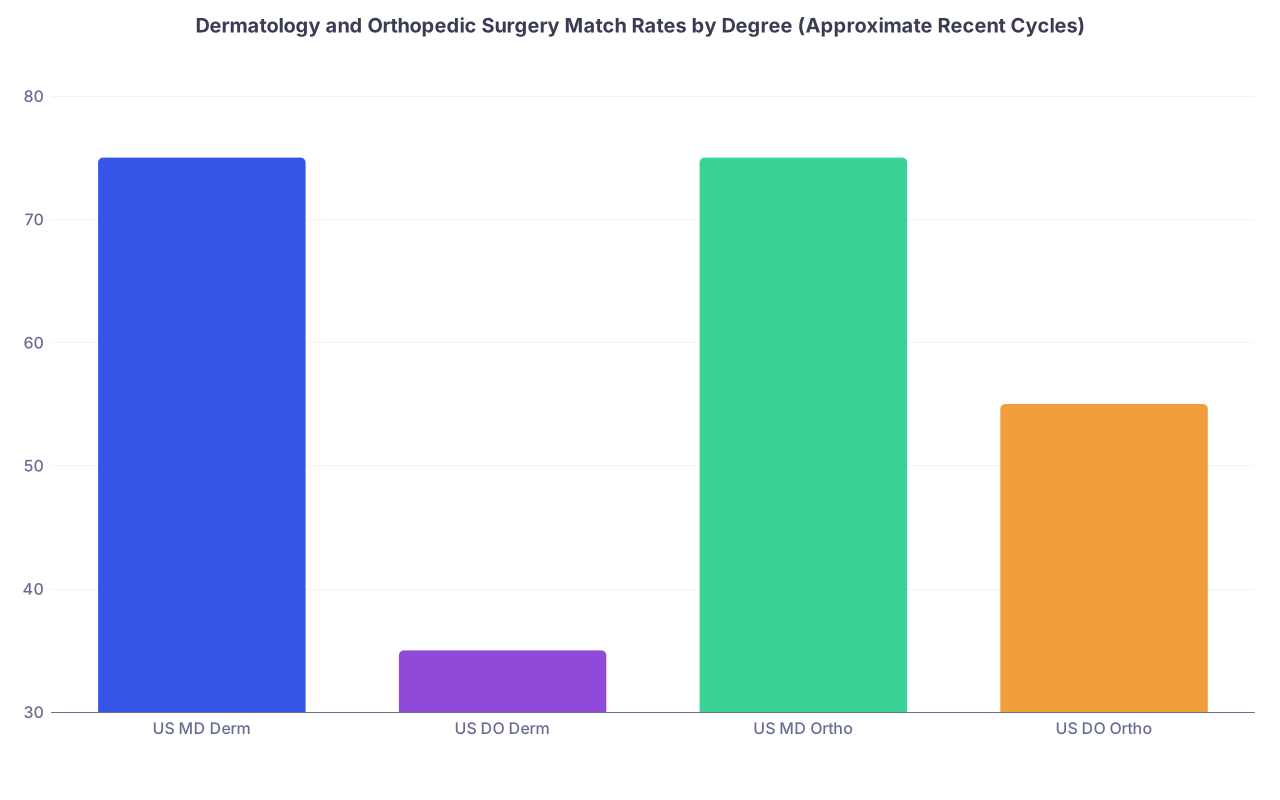
| US MD Derm | 75 |
| US DO Derm | 35 |
| US MD Ortho | 75 |
| US DO Ortho | 55 |
‘DOs Can’t Match Derm or Ortho’ Is Lazy, Outdated Nonsense
The idea that “DOs can’t match dermatology or orthopedics” isn’t just exaggerated. It is wrong. Not “kind of wrong.” Flat-out, numerically, provably wrong.
What is true:
Derm and ortho are brutally competitive. DOs face extra friction. You cannot coast in as a DO with a mediocre record and a nice personal statement.
But the blanket statement “DOs can’t” is what people say when they haven’t read a match report or talked to a single successful DO in these fields.
Let’s go through what actually happens, using data and real patterns—not Reddit folklore.
What the Numbers Actually Show
You don’t have to take my word for it. The NRMP publishes match data every year. The AOA used to publish its own before the merger. Program rosters are public. The receipts are there.
Here’s the broad reality, simplified:
- US MDs match derm and ortho at higher rates than US DOs
- US DOs absolutely do match derm and ortho every single year
- The gap is real—but it’s not a brick wall, it’s a steeper hill
Look at recent cycles (I’m rounding for sanity, but the pattern holds year after year):
Dermatology:
- US MD seniors: roughly three-quarters match
- US DO seniors: about one-third match
Orthopedic surgery:
- US MD seniors: again in the ballpark of three-quarters
- US DO seniors: around half (sometimes a bit below, sometimes above, depending on cycle size and self-selection)
So no, it’s not equal. But “one-third” and “half” are very different from “zero.”
The people who keep repeating “DOs can’t match derm or ortho” are either:
- Quoting pre-2010 gossip and never updated their beliefs
- Using “can’t” to mean “harder and requires very strong stats,” which is a lazy way to talk about risk
You’re not choosing between “possible” and “impossible.” You’re choosing between:
- MD path: wider margins for error, more open doors
- DO path: narrower margins, fewer forgiving programs, more pressure to overperform
That’s the adult version of this discussion. Anything else is fear-mongering.
Why DOs Really Have a Harder Time (It’s Not Magic or Bias Only)
There are a few big, boring structural reasons DOs struggle more in derm and ortho. None of them say “you cannot.” All of them say “you must be more deliberate.”
1. Step 1/Level 1 and the “Old Filter Mindset”
Before Step 1 went pass/fail, a lot of derm and ortho programs filtered hard on:
- USMLE Step 1 score
- “US MD only” checkboxes baked into their historical habits
Post-pass/fail, the focus moved to:
- Step 2 CK
- School reputation and perceived rigor
- Research quantity/quality
- Letters from known faculty
DO students often:
- Took COMLEX only or delayed USMLE
- Went to schools with less flashy research infrastructure
- Had fewer home programs in derm or ortho to advocate for them
That’s not “you’re inferior.” That’s “you start a lap behind in a race that’s already too short.”
2. Fewer Home Derm/Ortho Programs at DO Schools
Home programs are one of the biggest unspoken advantages in competitive specialties.
MD schools are much more likely to have:
- An in-house derm or ortho department
- Built-in rotations, research projects, and mentors
- Program directors who know each other across institutions
Many DO schools:
- Have no derm or ortho residency at all
- Rely on external rotations with limited spots
- Have fewer faculty with national visibility or big-name publications
So an MD student can get:
- Two derm research projects, a poster at AAD, and a letter from the PD—without leaving campus
While a DO student is:
- Cold-emailing 50 departments, begging for an away rotation, and trying to impress in 4 weeks what MD students had 2–3 years to build
Still possible. Just harder logistics.
3. Program Culture and Inertia
Some programs really do prefer MDs. Not always out of malice. Often out of habit.
You’ll see patterns like:
- “We’ve never taken a DO” → translation: “We’ve never seriously considered DOs”
- “We consider DOs who take USMLE” → decent, but still a hurdle
- A handful of programs that are DO-friendly and take multiple DOs regularly
Once a program takes a DO who crushes it, suddenly that “we don’t” turns into “we do if they’re like that person.” I’ve seen this happen more than once. One DO resident changes the entire conversation for that institution.
So yes, bias and inertia exist. But inertia is not the same thing as “no chance.”
Real DO Paths Into Derm and Ortho: What Actually Works
Here’s where people either get motivated or depressed. Your choice.
If you’re a DO aiming at derm or ortho, you do not get the luxury of being average. You have to treat it like a high-performance sport, not a casual elective.
The DOs Who Match Derm Usually Have:
Top-tier board performance
- Historically: Step 1 in the 240s/250s, Step 2 high as well
- Now: Step 2 CK in the competitive MD range for derm (think well above the national mean, not “barely passed”)
- COMLEX scores strong too, but USMLE is still the lingua franca for many programs
-
- Multiple derm-related projects (case reports, retrospective reviews, clinical research)
- Posters or oral presentations at derm meetings
- PubMed-listed authorship helps more than “school poster day”
Strong mentorship and letters
- Letters from dermatologists at academic centers, ideally in the specialty and known to other PDs
- A home or away rotation where they were clearly the top student
Smart away rotations
- Targeting programs that historically interview and actually rank DOs
- Showing up prepared enough to function like a sub-intern, not a tourist
I remember a DO student who matched derm after:
- Doing two research years
- Publishing several papers with a known derm faculty at a big-name MD program
- Crushing Step 2
- Doing away rotations at institutions that had already taken DOs
They didn’t “sneak in.” They were objectively an outstanding applicant by any standard—MD or DO.
The DOs Who Match Ortho Usually Have:
High Step 2 CK and strong COMLEX
- Often 250+ on Step 2 CK, with strong Level 2
- Programs use these to filter relentlessly, especially now that Step 1 isn’t numeric
Real ortho exposure and performance
- Multiple ortho rotations: home (if available) plus 2–3 away rotations where they function as part of the team
- Worked their tail off in the OR and on the floor. The “I’ll stay late and see every consult” type.
Letters that scream “this person is safe in the OR”
- Ortho attendings saying, basically, “I would trust this person with my family member”
- Chair or PD letters with very explicit praise
Physical and personality fit
- Whether you like it or not, ortho still tends to pick people who look like they can handle the grind
- That doesn’t mean you have to be a CrossFit mascot; it does mean you need the energy and presence of someone who can survive trauma call without crumbling
Again: DOs who match ortho don’t look like “borderline” MD applicants. They usually look like strong MD applicants, plus the extra hustle it took to overcome the DO label.
When “DO vs MD” Actually Matters for Derm and Ortho
If you’re premed and you know you’re obsessed with derm or ortho, the MD vs DO question is not trivial. It’s not everything. But it matters.
Here’s the blunt version:
- If you can realistically get into a solid MD program, it will give you smoother access to these fields.
- Choosing DO when you had an MD option and you’re dead set on derm/ortho is adding resistance on purpose.
Scenarios:
You have MD acceptances and DO acceptances, and you’re laser-focused on derm or ortho.
- I’d pick MD 99 times out of 100, unless the MD is extremely weak and the DO has a specific, proven in-house pipeline in your target specialty (rare).
You only have DO acceptances; MD door is closed.
- Then the question is not “MD vs DO.” It’s:
- “Do I take this DO acceptance and plan to overperform?”
- Or “Do I gamble on a reapplication cycle that might go nowhere?”
Matching derm or ortho as a DO is harder, yes. But matching anything is impossible if you never get into medical school.
- Then the question is not “MD vs DO.” It’s:
You think you want ortho or derm as a premed, but you’ve never scrubbed into a case or been in a clinic.
- Then I’d care more about:
- Overall school quality
- Cost, location, personal fit
- You may end up in EM, anesthesia, IM, or psych and be perfectly happy. For those, DO vs MD matters far less.
- Then I’d care more about:
The myth says: “If you want derm or ortho, DO is useless.”
Reality: “If you want derm or ortho, MD is easier; DO is viable but punishing and high risk.”
Not the same thing.
How to Think About This as a Premed or Early Med Student
You need a decision framework, not vibes.

| Step | Description |
|---|---|
| Step 1 | Premed/Early Med |
| Step 2 | Choose best overall school fit |
| Step 3 | Strongly favor MD unless major red flag |
| Step 4 | Take DO & plan to overperform or reapply |
| Step 5 | DO + USMLE + research + away rotations |
| Step 6 | Consider more realistic specialties |
| Step 7 | Derm/Ortho or Unsure? |
| Step 8 | MD acceptance available? |
| Step 9 | Willing to grind hard? |
If you’re realistically eyeing derm/ortho as a DO, your checklist is not optional. It looks something like:
- Take USMLE Step 2 CK (and probably Step 1 during the transition era if still allowed)
- Aim for well-above-average scores, not “just pass”
- Start research early, ideally at a place with academic derm/ortho presence
- Use summers and third-year to build concrete relationships with faculty in the field
- Plan away rotations strategically at programs that have actually matched DOs
- Be honest with yourself around MS3/MS4 if your application is not competitive and adjust specialty plans early enough to match something, not nothing
None of that is “unfair.” It’s just the cost of entry when you start on the DO side.
Two Groups Who Get Burned the Most
I see two types of students who crash hard against this myth/reality divide.
The DO student who believed “hard work is enough” and never looked at numbers
- They skipped USMLE
- They did minimal research
- They loved ortho from one rotation and decided late
- Then they’re stunned when 70+ applications yield 0 interviews
The premed who believed “DOs can’t match derm/ortho so I won’t even try”
- They turned down a DO acceptance thinking they’d get an MD next cycle
- The next cycle never panned out
- They end up not becoming any kind of doctor, while DOs from that same school later match ortho and derm
Both mistakes come from believing absolutes instead of understanding probabilities.
What You Should Take Away
Strip away the drama and the message is simple:
- DOs do match dermatology and orthopedic surgery every year. The myth that they “can’t” is factually false.
- The path is tougher: fewer programs open to DOs, higher performance required, more deliberate planning with exams, research, and away rotations.
- If you have an MD option and you’re dead set on derm or ortho, MD is usually the smarter bet—but a DO acceptance is far better than gambling on fantasies of “next cycle I’ll be MD and everything will be easy.”
You do not beat reality by believing myths—either the doom-and-gloom ones or the “anything is possible if you manifest hard enough” ones. You beat it by understanding the numbers, then deciding if you’re willing to do what the successful outliers actually did.