The loudest voices about DO vs. MD are wrong—and they’re mostly anonymous Reddit accounts who have never hired a physician in their lives.
You’re not crazy if you feel whiplash. One thread says “DO is totally equal now, bro.” The next says “DO is career suicide unless you want family med in rural nowhere.” Both are exaggerations. Both ignore the actual match data, program behaviors, and long‑term outcomes.
Let’s cut through the mythology and look at what really matters if you’re premed or early in med school deciding how worried you should be about the “prestige gap.”
What Reddit Gets Completely Wrong About “Equality”
Reddit loves absolutes. “No difference anymore” vs. “MD or bust.”
Reality is messier.
There are three separate questions people mash together:
Can DOs become licensed physicians in all 50 states and practice independently in almost any specialty?
Yes. That part is settled.Do DO and MD degrees carry identical weight in residency selection across all specialties and programs?
No. Not even close.Does the “prestige gap” matter the same way for every student?
Also no. It depends heavily on your stats, school, and career goals.
The problem is that premeds hear one success story—“my DO friend matched ortho at a university program”—and assume that represents the norm. It doesn’t. It proves possibility, not probability.
What the Match Data Actually Shows (Not the Anecdotes)
Let’s talk numbers, not vibes.
Since the AOA (DO-only) and ACGME (MD) residencies merged into a single accreditation system, we now have unified NRMP data. That’s good, because it exposes how much of the Reddit discourse is fantasy.
Here’s a simplified snapshot of how DO vs. MD applicants compare across a few key specialties in recent NRMP cycles.
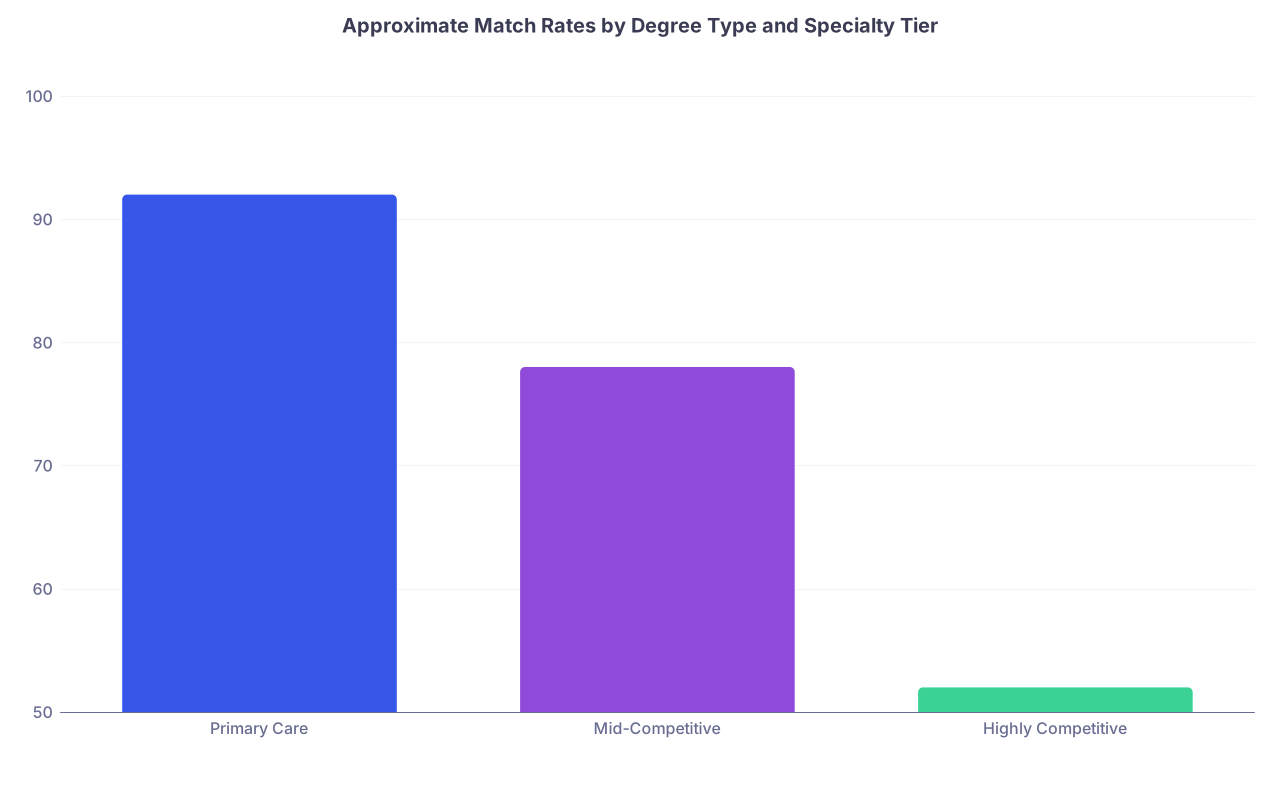
| Category | Value |
|---|---|
| Primary Care | 92 |
| Mid-Competitive | 78 |
| Highly Competitive | 52 |
Those values are blended, but the pattern is consistent year over year:
For primary care–type fields (FM, IM categorical, peds):
DO and MD applicants with similar exam performance have broadly comparable outcomes, especially when you include community programs.For mid‑competitive specialties (EM, anesthesia, psych, OB/GYN):
There’s a real, material gap. DOs match, but at lower rates, and with more self‑selection away from the specialty before they ever apply.For highly competitive specialties (derm, ENT, plastics, ortho, neurosurg, integrated IR, some elite rads programs):
The gap is large. DOs can match, but the bar is significantly higher, the N is small, and institutional bias is still very real.
And here’s the key nuance almost nobody on Reddit talks about: the DO “success stories” in competitive fields are typically:
- From the stronger DO schools
- With top‑end scores and serious research
- Applying very strategically and often broadly
The median DO student is not doing that. The median premed reading those stories assumes they will.
The Hidden Reality of Program Behavior
Ignore what programs say on websites. Watch how they act.
You’ll see phrases like “we welcome DO applicants” and “we consider COMLEX and USMLE equally.” Then you look at their resident roster and see 28 MDs, 0 DOs. That’s your answer.
Some patterns I’ve personally seen reviewing rosters, speaking with residents, and looking at NRMP data over multiple years:
Many elite academic programs (especially in derm, ENT, plastics, ortho, neurosurg, integrated IR) either:
- Have no DOs in the last decade, or
- Have one token DO who had absurd stats and/or did research years with that institution.
Mid‑tier university programs in IM, EM, anesthesia, OB/GYN are mixed. Some are DO-friendly, others quietly filter out DOs or require USMLE despite claiming they don’t.
Community programs are much more likely to be DO-inclusive across the board, and in some regions, DOs are the majority.
The “prestige gap” is least relevant where program fill pressure is high and applicant demand is lower—think community IM in the Midwest. It’s most relevant where programs can be extremely picky and have a long line of high‑stat MD applicants.
USMLE, COMLEX, and the Score Game
Reddit keeps trying to bury this, but PD surveys are blunt: most MD‑leaning programs still prefer USMLE scores, even for DOs.
Step 1 going pass/fail shifted some weight, but not the underlying bias. Programs still want standardized numbers they understand and can compare directly.
Here’s the reality:
A DO student who takes only COMLEX severely limits options, especially at competitive and academic programs. “COMLEX-only” is code at many places for “low priority” or “auto‑screen.”
Programs that “accept COMLEX” often still rank DOs who also have USMLE higher, because they can put their Step 2 CK into the same bins as the MDs.
DO students who crush USMLE Step 2 CK (say, 250+) meaningfully narrow the prestige gap—for themselves. That’s not proof the systemic differences vanished; it’s proof you cleared the higher bar.
So when someone on Reddit yells “No need to take USMLE if you’re DO, waste of time,” what they’re really saying is: “I’m fine closing certain doors and pretending they were never open.”
You do not have to take USMLE as a DO. But if you care about competitive or academic tracks, pretending that’s a neutral choice is delusional.
Where DO vs. MD Matters a Lot vs. Not Much
Let’s stop treating “DO vs. MD” as one single question. The effect size depends on what you want.
Scenarios where the prestige gap is big and stubborn
If your realistic dream is:
- Dermatology
- Neurosurgery
- ENT
- Plastic surgery
- Ortho
- Integrated vascular/IR
- Certain elite radiology or academic anesthesiology programs
Then yes—the DO vs. MD choice can be decisive.
Not because DOs cannot match there. They can. It happens every year. But because:
- The baseline odds are low for everyone
- The applicant pool is stacked with high‑stat MDs from strong research institutions
- Many programs still have either explicit or soft filters against DOs
So as a premed with options, choosing a DO school over a solid MD school when you claim you’re “set on derm” is like voluntarily starting a race 30 meters behind everyone else and swearing “I’ll just run faster.”
Maybe you will. Most don’t.
Scenarios where the gap shrinks dramatically
If your goals live in this zone:
- Internal medicine (especially community or mid‑tier university)
- Family medicine
- Pediatrics
- Psychiatry (with some caution at the most elite academic programs)
- Mid‑tier EM, anesthesia, OB/GYN, PM&R, neurology
Then the prestige gap is much narrower. Not gone—but smaller. In these fields:
- Program fill pressure and service needs are higher
- Many DO grads have historically gone into these areas, so there’s familiarity
- A strong DO student with good scores and solid clinical performance is extremely competitive
This is where Reddit’s “DO = MD” stories usually come from. They just fail to mention the specialty context or the candidate’s stats.
Long-Term Career: Does Anyone Care After Residency?
The myth on the other extreme is: “No one cares DO vs. MD once you’re out.” That’s mostly, but not entirely, true.
Here’s how it actually plays out:
For 90–95% of community clinical jobs, especially in primary care and hospitalist work, no one cares. Employers care about board certification, reputation, and whether you’re pleasant to work with and don’t cause disasters.
Patients almost never know or care. They barely understand what internal medicine vs. family medicine is, much less DO vs. MD.
Where degree can still matter:
- Certain highly academic, research-heavy positions
- Leadership roles in some brand-obsessed institutions
- Niche fellowships or hyper-competitive subspecialties if you’re late-shifting careers
But here’s the catch: those doors are often influenced by the pedigree of your residency and fellowship, which was influenced by DO vs. MD at the front end.
So the prestige gap exerts most of its force early—on entry into competitive residencies and institutions. After that, your training quality and performance matter more. But by then, the tracks have diverged.
The Ugly Role of Bias (Yes, It’s Still There)
One thing Reddit sometimes gets right: there is bias. It’s just not always the cartoonish “we hate DOs” version.
I’ve heard actual PDs—off the record—say things like:
- “Most DO schools have lower average stats, and we’re overwhelmed with apps. We filter somehow.”
- “COMLEX feels like a black box to us. We know what a 250 on CK means; we don’t really know how to compare COMLEX scores.”
- “Historically, the DO applicants we interviewed were weaker overall. So over time the faculty just expect that.”
Is that fair? No. Is it rational from their limited vantage point? Sort of. Is it changing? Slowly, yes, but not uniformly.
The merger of accreditation systems didn’t magically erase decades of separation, different applicant pools, and institutional cultures. It just shoved everyone into one system. Attitudes lag.
So if you’re DO, part of your reality is that you may have to be a little better on paper to get the same look. Denying that doesn’t help you plan.
The Other Thing Reddit Barely Mentions: Within-Track Prestige
Everyone fixates on DO vs. MD and misses a bigger truth: within MD and within DO, the spread is massive.
A strong DO school (PCOM, UIWSOM, CCOM, TCOM, UNE, etc. — there are several) with good match support, hospital affiliations, and a history of placing grads into decent residencies can be a better bet than a brand-new MD school with no match track record, weak affiliations, and chaotic administration.
A top quartile student at a solid DO school who takes USMLE and crushes Step 2, does research, and applies smartly will outperform a bottom-quartile student at a low-tier MD school in many match scenarios.
So the hierarchy is not: MD > DO full stop. It’s more like a messy 3D map of:
- Your school’s reputation and track record
- Your personal performance and exams
- Your specialty choice
- Your geographic preferences
- Your willingness to hustle for research and mentorship
Reddit flattens this to “MD > DO” or “DO = MD” because nuance doesn’t get upvotes. But nuance is where your actual career lives.
How a Premed Should Really Think About DO vs. MD
If you’re premed and staring at multiple options, here’s the blunt version.
No bullets. Just logic.
If you have acceptances to a reasonably established MD school and a reasonably established DO school, and you are not 100% sure you only want primary care, you’d be foolish not to choose the MD. The doors are simply wider. You can always choose primary care later; you cannot always choose neurosurgery later.
If your realistic choices are: DO school or not being a physician at all, and you want to be a physician more than you want an online argument about prestige, then go DO and take your career seriously. Crush your classes. Take USMLE if you care about options. Accept that you’ll work a bit harder to equalize perception in some spaces. Many people do that and have excellent careers.
If you’re early premed, romanticizing derm or ortho without a shred of evidence you can hit top-decile test scores, you’re fighting the wrong battle. The MD vs. DO debate is downstream of your actual academic ceiling and habits. You should be more worried about learning to consistently get A’s in upper-level science and score high on standardized tests. Fail there, and none of this matters.
And if your personality and life goals honestly align with primary care, outpatient psych, or community pediatrics in a region that’s starving for doctors? Then obsessing about DO vs. MD “prestige” is honestly a distraction. In those realities, willingness to practice in less-saturated areas matters more than your initials.
What Data Says vs. What Reddit Claims
So, let’s put it side by side.
Reddit claims:
- “DO = MD now, it’s all merged.”
- “If you’re good you’ll match anything from anywhere.”
- “No one cares about DO vs. MD anymore.”
- “COMLEX is enough, no need for USMLE.”
What the data and actual program behavior say:
- DOs and MDs are both fully licensed physicians. That part is equal. The residency market still treats them differently, especially at the top.
- A great candidate can overcome a lot, yes. But you shouldn’t plan your life assuming you’ll be the outlier.
- Many people in the hiring world don’t care post‑residency. But the funnel into top training undeniably favors MDs.
- COMLEX alone closes doors at the more selective end. Programs and PD surveys keep confirming this, even as websites say pretty words.
The prestige gap is real. It’s smaller than it was twenty years ago. It’s highly specialty-dependent. And it’s absolutely survivable if you play the game with your eyes open.
Do not let anonymous strangers flatten this into a slogan.
The 3 things to actually remember
- DO vs. MD isn’t about “can you be a real doctor.” It’s about your probability of accessing the most competitive specialties and institutions—not the possibility.
- The gap is largest at the top: highly competitive specialties and elite academic programs. It shrinks—not disappears—for primary care and many mid‑tier fields.
- If you choose DO, you’re not doomed. You’re just signing up to be a little better on paper to get the same looks in some spaces. As long as you understand that trade-off, it’s an entirely rational path.