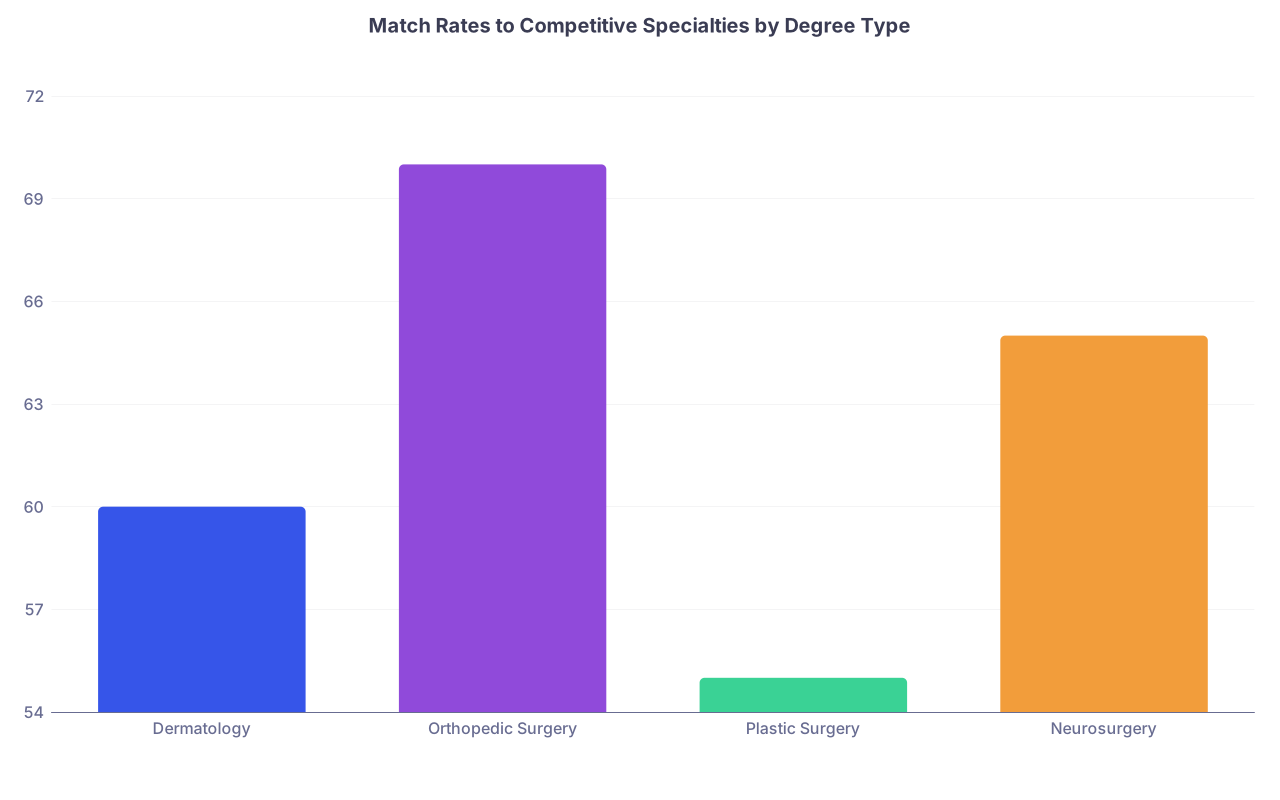
| Category | Value |
|---|---|
| Dermatology | 60 |
| Orthopedic Surgery | 70 |
| Plastic Surgery | 55 |
| Neurosurgery | 65 |
What happens when you realize, in MS3, that dermatology was your dream all along—and your entire path as a DO or MD has quietly made that dream 10x harder?
That is not a hypothetical. I have watched students in both directions do this to themselves:
- The premed who chose a random DO school with no home ortho program… then “discovered” orthopedics late MS2.
- The MD student who thought “competitive specialties are toxic” and coasted… then fell in love with plastics on a sub‑I, with a 230 Step 2 and zero research.
Same mistake. Different letters.
They never matched those fields. Not because DO is “inferior” or MD is “automatically safe,” but because their planning was lazy and their understanding of the DO vs MD landscape was fantasy-level.
Let me walk you through the most common DO vs MD errors around competitive specialties—and how to avoid blowing up your options before you even apply to medical school.
1. Pretending DO vs MD “Doesn’t Matter Anymore” For Competitive Fields
I still hear this line in advising offices and Reddit threads:
“The merger made it all the same now. Programs don’t care if you’re DO or MD.”
Dangerous half-truth.
Where the letters still matter
For primary care? Family med, IM, peds in many regions? Yes, DO vs MD is much less of a barrier than it used to be.
For these? The letters still bite:
- Dermatology
- Plastic surgery
- Neurosurgery
- Orthopedic surgery
- ENT
- Integrated vascular surgery
- Some radiation oncology and ophtho programs
- Top‑tier academic programs in any specialty
Program directors are not shy about it. I have heard:
- “We usually do not review DO applications unless they rotated here.”
- “No DOs have matched here in the last decade.”
- “We strongly prefer MD for research-heavy tracks.”
They will not put that on the website. But the match data and alumni lists make it obvious.
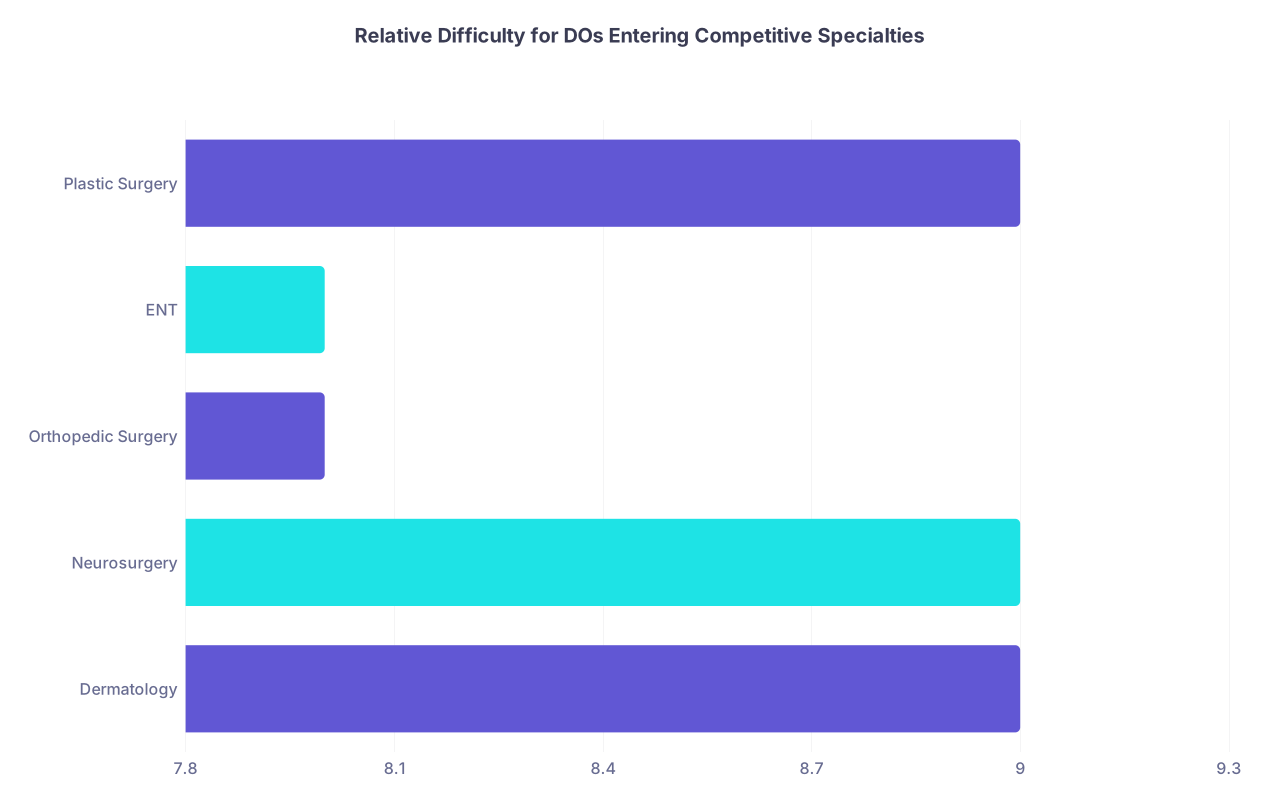
| Category | Value |
|---|---|
| Dermatology | 9 |
| Neurosurgery | 9 |
| Orthopedic Surgery | 8 |
| ENT | 8 |
| Plastic Surgery | 9 |
(Scale: 1 = similar to FM, 10 = brutal uphill as DO.)
The mistake
- Premeds telling themselves: “I’ll go DO and decide later; if I want derm, I’ll just work hard.”
- MD students telling themselves: “I’m MD, so derm/ortho is still possible even if I’m average.”
Reality:
- As a DO, you can absolutely get these specialties. But you need earlier clarity, much higher performance, and smarter strategy.
- As an MD, you are not safe. You just start with a less steep hill. You can still fall off the cliff with mediocre scores and no research.
How to avoid this mistake
Before committing to DO vs MD, do three things:
- Pull actual match lists from 3–5 schools of each type. Look for:
- How many derm/ortho/ENT/neurosurg/plastics per year?
- DO grads in those fields at ACGME programs? How many?
- Look up resident rosters of competitive programs you admire. Count:
- How many DOs vs MDs in the last 5 years?
- Write down your tolerance for uphill battles. Honestly.
- If you know you aim high but hate fighting structural bias, you need to think very carefully about where you enroll.
Do not let someone hand‑wave this away with “it’s all merged now.” That is how careers get boxed in.
2. Choosing a DO School with Zero Infrastructure for Competitive Specialties
I have seen this play out too many times:
Student: “I want ortho or neurosurg.”
Me: “What’s your home program like?”
Student: “My school doesn’t have one. But I’ll just do away rotations.”
That is like trying to get into the NBA when your high school has a gravel court and no coach.
Why “no home program” is a serious red flag
If your medical school—DO or MD—does not have a home department in:
- Ortho
- ENT
- Neurosurgery
- Plastics
- Derm
You lose:
- Built-in mentors to back your application
- Guaranteed audition rotations early
- Departmental research projects that are pre‑vetted
- Strong, personal letters from people known in the field
- A track record that tells programs, “Our school knows how to train for this.”
Yes, away rotations help. But away rotations usually come late (MS4), and are often used by programs to confirm favorites, not discover raw talent out of nowhere.

| Step | Description |
|---|---|
| Step 1 | Select Medical School |
| Step 2 | Early Mentorship |
| Step 3 | Research Opportunities |
| Step 4 | Strong Letters |
| Step 5 | Higher Match Chance |
| Step 6 | Late Exposure |
| Step 7 | Scramble for Rotations |
| Step 8 | Weaker Letters |
| Step 9 | Lower Match Chance |
| Step 10 | Home Competitive Programs? |
The DO-specific trap
Some DO schools are aggressively primary-care focused. That is not evil. It is just misaligned if you want neurosurgery.
Warning signs:
- School marketing dumps “primary care” and “rural service” in every paragraph
- Match lists show 0–1 competitive specialty matches total in the last several years
- No affiliated university hospital or Level I trauma center
- Faculty have limited academic output or national connections in surgical subspecialties
Could you still claw your way into derm from there? Maybe. But you need to understand you are doing it with:
- Fewer research mentors
- Fewer local role models
- Lower institutional credibility
How to avoid this mistake
If you are even considering a competitive specialty:
- Prioritize schools (DO or MD) with:
- Affiliated academic hospital
- Existing residents/fellows in your possible fields
- A history (documented in match lists) of sending people into those specialties
- Call or email current students and ask:
- “Has anyone matched into X in the last 4 years?”
- “Did they get strong support, or did they mostly do it on their own?”
If the answer is a shrug, that is your red flag.
3. Ignoring the Timeline: Late Realization Is Fatal for Many DOs (And Some MDs)
“Wait, I actually love neurosurgery.”
I have heard that at the end of MS2, sometimes mid‑MS3. For an MD student, there is some room to recover. For a DO student aiming at hyper‑competitive ACGME programs, late clarity often means game over.
Why? Because of the timeline.
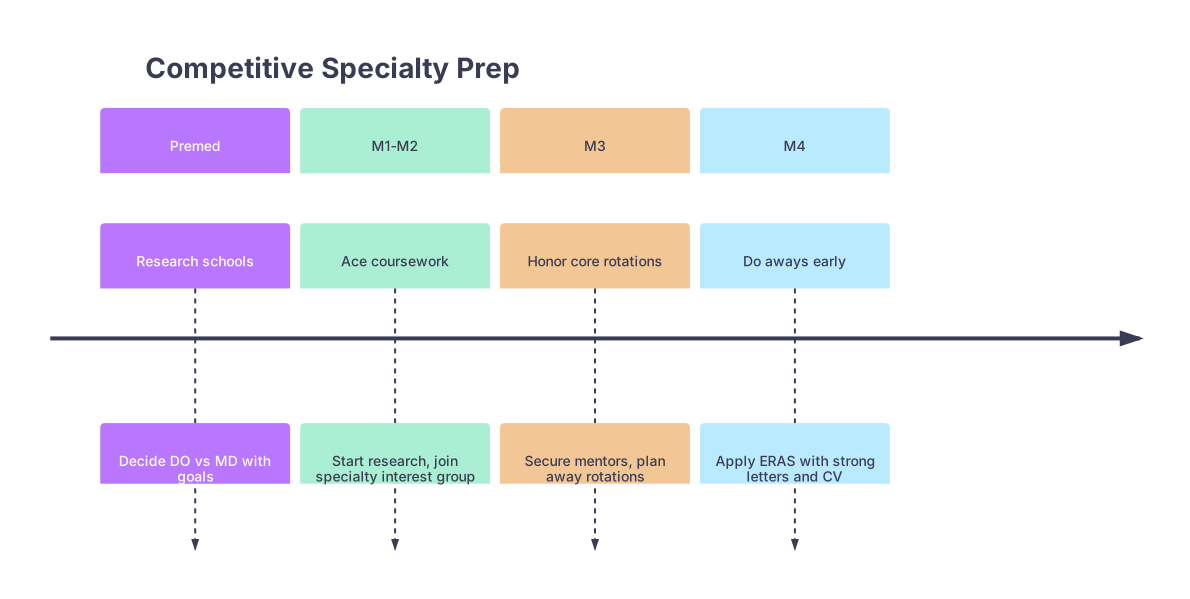
| Period | Event |
|---|---|
| Premed - Research schools | Decide DO vs MD with goals |
| M1-M2 - Ace coursework | Start research, join specialty interest group |
| M3 - Honor core rotations | Secure mentors, plan away rotations |
| M4 - Do aways early | Apply ERAS with strong letters and CV |
What you must have in place early if DO and competitive
By the end of:
Premed / Application year
- Rough sense whether competitive specialties are even on your radar
- Intentionally pick a school that does not kill that possibility
M1
- Connect with at least one faculty in a possible field
- Join the specialty interest group
- Begin some research (case report, chart review—anything)
M2
- Step/COMLEX prep with the expectation you need to crush it
- Maintain or build relationships with mentors; ask directly: “What would I need to be competitive as a DO?”
Early M3
- Aim to honor surgery/medicine rotations
- Lock in away rotations for early M4 at places that take DOs seriously
- Secure at least one strong, field-specific letter by late M3
Most late-deciding students miss 2–3 of these steps. Then they blame the degree. It is not just the letters. It is the timing.
How to avoid this mistake
You do not need to pick a specialty now. But you must:
- Acknowledge that IF you fall in love with a cutthroat field, starting early matters more as a DO than as an MD
- Build a “competitive specialty contingency plan”:
- Keep grades high from day 1
- Treat Step 1/COMLEX 1 (and especially Step 2) like they matter a lot—because they do
- Keep yourself in research and mentorship pipelines that open doors, not close them
4. Misunderstanding Exams: Step vs COMLEX Strategy Errors
One of the fastest ways I have watched DO students self-sabotage: bad exam planning.
I am talking about:
- “I’ll only take COMLEX. Step is optional now.”
- Taking USMLE Step 1 or 2 with minimal prep and posting an ugly score that programs cannot un‑see.
The reality for DOs who want competitive specialties
For hyper‑competitive ACGME programs:
- Many still strongly prefer or effectively require USMLE Step scores
- Some ERAS filters are literally: “show only applicants with Step 1/2 >= X”
- A COMLEX-only application is easier to ignore
DO students who want derm/ortho/neurosurg/ENT/plastics at desirable programs usually need:
- USMLE Step 2 CK at a very high level
- Solid COMLEX scores as well, since DO schools and some programs still care
- No glaring exam failures or big drops
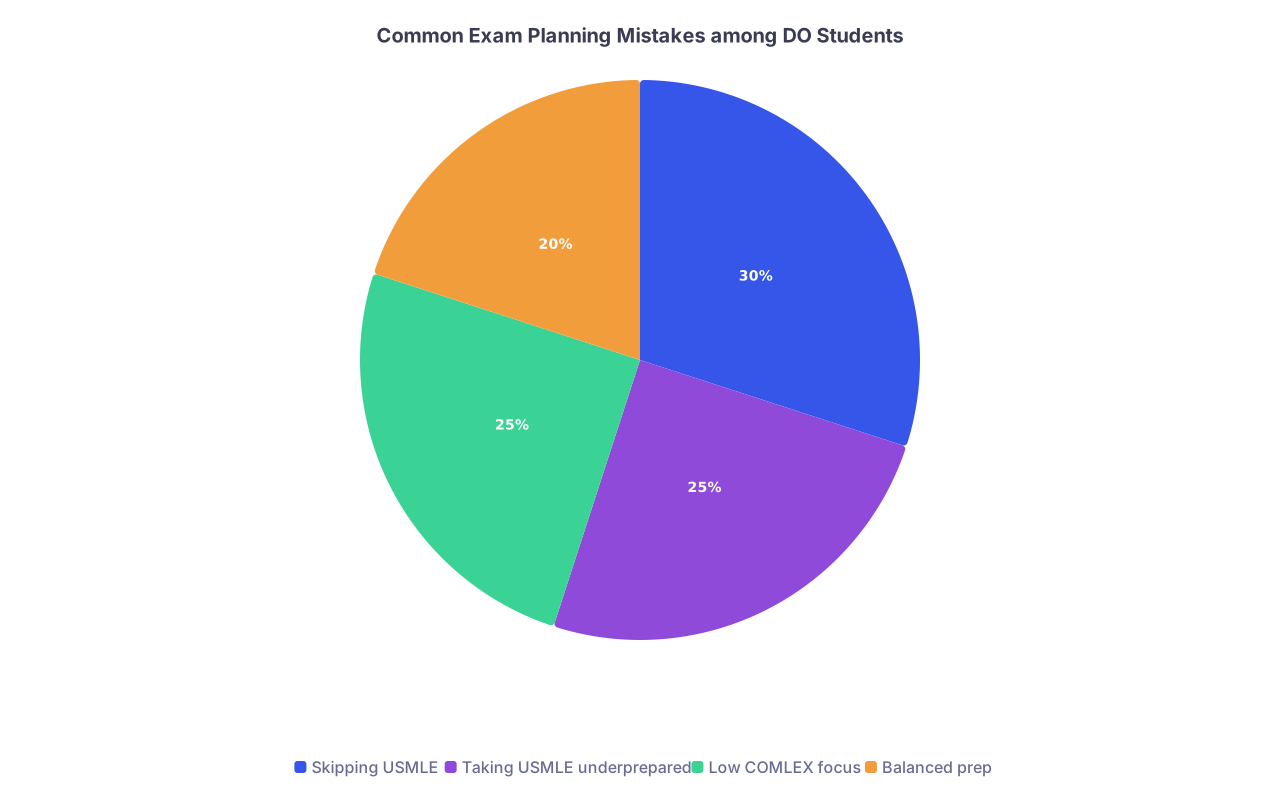
| Category | Value |
|---|---|
| Skipping USMLE | 30 |
| Taking USMLE underprepared | 25 |
| Low COMLEX focus | 25 |
| Balanced prep | 20 |
The two classic mistakes
-
- Believing advisors who say “you don’t need it anymore” without checking target program preferences.
- Later MS3: realizes many desired programs screen heavily by Step 1/2 → options suddenly tiny.
Taking USMLE casually “to keep options open”
- Juggling COMLEX and USMLE without a serious plan.
- Scores end up mediocre; now you are competing with MDs whose Step prep was priority #1 at their schools.
- A weak Step score sometimes hurts more than no Step score at all.
How to avoid this mistake
If you might chase a competitive specialty as a DO:
Early M1: Pull data from target programs
- Do they list “USMLE required” or “USMLE strongly preferred”?
- Check their current resident bios: DOs there—do they have Step scores listed?
Decide intentionally:
- If yes: Treat USMLE as a central exam, not a side quest.
- Build a dual-exam prep plan with someone who has actually done it.
If you commit to USMLE:
- Do not take it until you are ready for a strong score.
- A 240+ Step 2 can open doors. A 210 Step 2 can shut them.
MDs are not immune either. The MD error is laziness: “I’m MD, I can get by with a 225.” Not for derm you cannot.
5. Ignoring Institutional Bias and Geographic Reality
Here is the part people love to deny:
- Some regions are more DO-friendly than others
- Some institutions will say “we consider DOs equally”… and then not rank any
This matters even more if you dream of big-name academic centers.
Geographic patterns you should not ignore
In broad strokes:
- Midwest and some Southern regions: Often more DO-integrated; historic presence of DO schools; many DO attendings.
- Certain coasts and older ivory-tower institutions: Less DO representation; more MD-only faculties; fewer DO residents in elite specialties.
Look at specific programs:
- If a department of dermatology has trained zero DOs in 15 years, that is not a coincidence.
- If a neurosurgery program’s current and past residents are 100% MD from a small list of schools, do not assume “I’ll be the first.”
How MDs screw this up
- MDs at lower-tier schools assuming “I’m MD, so I can crack MGH derm with average stats.”
- Ignoring the fact that those programs strongly favor students from their own pipeline or other research-heavy schools.
How DOs screw this up
- Aiming only at hyper-elite, historically MD-only programs when applying, then acting shocked when the interview pool is empty.
- Not building a realistic list of DO-friendly, regionally appropriate, strong but attainable programs.
How to avoid this mistake
During premed phase:
- Ask each school (DO and MD) for where their students match in competitive specialties, not just what.
- Look at maps of match outcomes. If the school never sends anyone to your target region or level of program, factor that in.
As you move through med school:
- Create a 3‑tier program list:
- “Reach but DO/MD possible” (with at least some DOs or outside MDs in the roster)
- “Realistic strong programs”
- “Safety net programs”
- For DOs, make sure the top tier is not 90% places that have literally never taken a DO in your field.
- Create a 3‑tier program list:
6. Doing “Generalist” CV Building When Your Goal Is Hyper-Specialized
One more painful pattern:
- The DO student aiming for neurosurgery who spends MS1–MS2 doing random outpatient peds shadowing and unrelated QI projects.
- The MD student who thinks being “well-rounded” is enough and never does serious, field-related research.
Competitive specialties do not care that you “love everything.”
They want evidence you can:
- Survive high-intensity training
- Contribute academically
- Stick with a demanding interest over time
- Work with their kind of patients and pathologies
What a misaligned CV looks like
For a hypothetical DO student saying “I want dermatology”:
- Activities:
- Free clinic general primary care
- Some osteopathic manipulative treatment interest group
- One QI project in inpatient medicine
- No derm research, no derm shadowing early, no exposure to complex derm cases
- Letters:
- Generic IM letter
- Family med letter
- One derm letter from a community DO dermatologist who is unknown to academic programs
Then they ask, “Is it because I’m DO?”
Partially. But also because their CV does not scream “I’ve been working toward academic dermatology for years.”
How to avoid this mistake
Do not wait to:
- Align your research with possible competitive fields
- Get at least one long-term mentor in a demanding specialty, even if you are not 100% decided
- Build a narrative that makes sense: “I have been drawn to surgical problem-solving / skin disease / neuroanatomy for a long time, and here is the proof.”
Premeds: you can even start this early. Exposure, shadowing, reading, basic research assistant work. Not because you must decide now, but so that if you do decide later, you already look serious.
7. Premed-Level Myths That Lead You To the Wrong Degree
Let me call out a few lies that sabotage planning:
- “Go DO if you care about patients; go MD if you care about prestige.”
- “If you want surgery, you should avoid DO because DOs can’t be surgeons.”
- “If you are MD, you can always switch into any specialty later if you change your mind.”
All wrong. All harmful.
The truth:
- DOs can and do match into ortho, neurosurg, ENT, derm, plastics. But the barrier and path are different.
- MDs wash out of competitive paths all the time because of weak performance or poor planning.
- Choosing DO vs MD without thinking about your potential ceiling and risk tolerance is reckless.
As a premed, you are allowed to say:
- “I am not sure yet, but I want to keep the door open for something competitive.”
- “I do not want to spend 4 years fighting institutional bias if I can avoid it.”
- “I am okay fighting that battle because of X, Y, Z reasons and I have a plan.”
Just do not say, “It will all work out; it’s the same now.” That is how people get trapped.
FAQ (exactly 5 questions)
1. I am a premed leaning DO but might want a competitive specialty. Is DO automatically the wrong choice?
No. But you must be more deliberate. If you choose a DO school, prioritize:
- Strong hospital affiliations and home programs in potential competitive fields
- A clear history of graduates matching into those specialties
- Advisors and faculty who are realistic about taking USMLE and building a high-octane CV
If you pick a DO school with weak infrastructure and then wake up in MS3 wanting neurosurgery, you will wish you thought harder.
2. I am an MD student at a lower-ranked school. Does that guarantee I can still get derm/ortho if I work hard?
No. Being MD is an advantage, not a magic key. From a lower-ranked MD school, you still need:
- Top-tier Step 2 CK score
- Honors in relevant rotations
- Real research in the field
- Strong letters from known faculty
You avoid some of the structural bias DOs face, but you can still be filtered out easily if your file is average.
3. As a DO, do I really need to take USMLE if I want a competitive specialty?
In most cases, yes, if you want the broadest set of options. Many competitive programs either require USMLE or quietly filter by it. If you aim only at a very specific subset of DO-heavy or COMLEX-friendly programs, you might survive without USMLE, but that is a narrow and risky bet. The worst mistake is taking USMLE “just to see” and scoring poorly. If you take it, you must commit to a strong performance.
4. How early do I need to decide on a competitive specialty?
You do not need a final decision in M1, but you do need:
- Competitive exam preparation starting day one
- Early mentorship and exposure to at least 1–2 demanding fields
- Research habits that can be redirected to a specific specialty as soon as you feel a real pull
For DO students in particular, deciding by early M3 at the latest is usually the cutoff for a realistic, well-supported run at the most competitive specialties.
5. What is one concrete thing I can do as a premed today to avoid a residency goal mismatch?
Pull up match lists and resident rosters. For 3–5 schools you are considering (both DO and MD), and for 5–10 programs in specialties that might interest you, check:
- Do graduates from that school actually end up in those specialties?
- Do competitive programs you admire have DOs in their ranks at all?
- How often?
Then adjust your school list accordingly. Do this before you submit an application, not after MS3.
Open a new document right now and title it: “Residency Ceiling Check”. List your likely specialties, the degree type you are targeting, and 3 concrete steps you must take in the next 12 months to keep those doors open. If you cannot write that list, you are flying blind—fix that today.