It is late June. AMCAS is open, AACOMAS is open, and your MCAT score just posted. Your group chat is blowing up with “I’m applying to 45 schools” and “shotgun everything, it’s all a lottery.” You, meanwhile, have 30 browser tabs open and no clue how many MD vs DO schools you should actually apply to—or which ones.
Here is the problem:
Most premeds either massively over-apply (burning money and energy) or get way too “aspirational” and end up with a top-heavy list that was doomed from day one. Especially when DO vs MD strategy is involved.
Let me be direct: you need a system. Not vibes. Not Reddit anecdotes. Not your roommate’s cousin who “got into Mayo with a 506.”
This article will give you that system.
Step 1: Get Your Realistic Academic Profile on Paper
Before you even say “MD” or “DO,” you need to know exactly what you are selling. No fantasy version. The real one.
Write down:
Cumulative GPA (cGPA) and science GPA (sGPA)
- Use the AMCAS GPA calculator approach (every course, including repeats).
- DO schools (AACOMAS) will historically be more forgiving of grade trends and retakes, but you still need the raw numbers.
MCAT score
- Total and each section. DO schools often care slightly less about perfect section balance, but a glaring 123 will still hurt you.
Key context factors
- State residence
- Undergrad institution type (state flagship, small regional, Ivy, etc.)
- URM status
- First-gen / disadvantaged background (as per AAMC definitions)
- Major red flags: institutional actions, big GPA dips, multiple MCAT attempts
Now classify yourself honestly. I use four buckets for MD and slightly shifted thresholds for DO.
For MD (rough guideline, not absolute):
- Highly competitive:
- cGPA ≥ 3.8, MCAT ≥ 516
- Competitive / solid:
- cGPA 3.6–3.79, MCAT 509–515
- Borderline:
- cGPA 3.4–3.59, MCAT 505–508
- High risk for MD:
- cGPA < 3.4 or MCAT < 505
For DO:
- Strong for DO:
- cGPA ≥ 3.5, MCAT ≥ 505
- Typical DO range:
- cGPA 3.3–3.49, MCAT 500–504
- High risk even for DO:
- cGPA < 3.3 or MCAT < 500
Do not overthink the exact cutoffs. This is not a board exam. You just need a clear sense of which lane you are realistically in.
Now—this is where people mess up—you convert this into your primary target category:
- If you are highly competitive or competitive for MD → MD-heavy with DO as insurance
- If you are borderline for MD, strong / typical for DO → Mixed MD/DO list, with DO as your backbone
- If you are high risk for MD but typical for DO → Primarily DO with a small, carefully chosen MD subset
- If you are high risk even for DO → Harsh truth: you probably need an academic repair plan (post-bacc, SMP) before applying broadly
Step 2: Decide Your MD:DO Ratio Based on Reality, Not Ego
You can absolutely become a competent, successful physician from either pathway. That is not the issue. The issue is odds.
Here is a rough, practical MD:DO application ratio I recommend based on your profile:
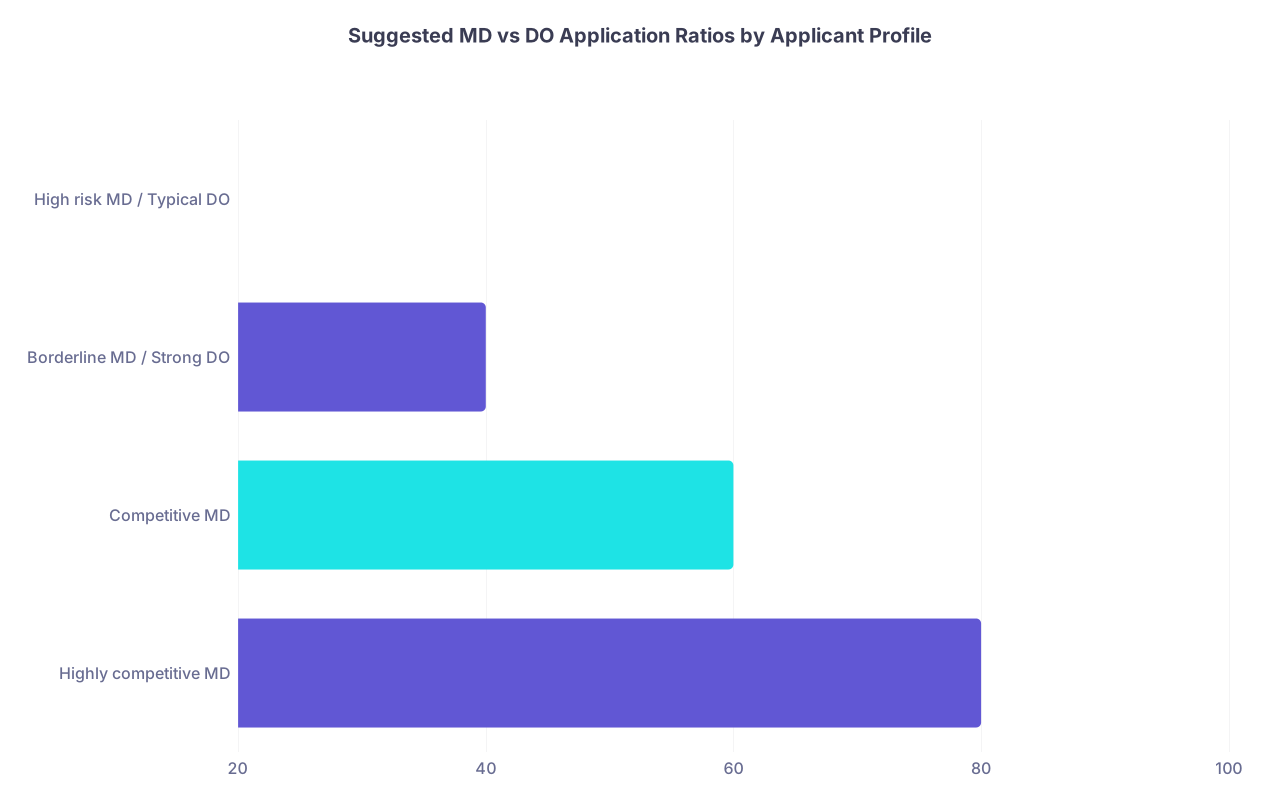
| Category | Value |
|---|---|
| Highly competitive MD | 80 |
| Competitive MD | 60 |
| Borderline MD / Strong DO | 40 |
| High risk MD / Typical DO | 20 |
Interpretation (approximate % of your school list that should be MD):
- Highly competitive MD (≥ 3.8 / ≥ 516):
- 80–90% MD, 10–20% DO (mostly as geographic or timeline insurance)
- Competitive MD (3.6–3.79 / 509–515):
- 60–75% MD, 25–40% DO
- Borderline MD / Strong DO (3.4–3.59 / 505–508):
- 40–50% MD, 50–60% DO
- High risk MD / Typical DO (< 3.4 or < 505 but ≥ ~3.3 / 500):
- 10–25% MD, 75–90% DO
If you are thinking “But I really want MD so I’ll just apply to more MD schools,” stop. That is how you waste thousands of dollars.
Want more MD chances? Improve your profile before applying with a post-bacc, SMP, or MCAT retake. Do not try to brute force bad odds with volume.
Step 3: Set a Realistic Total Number of Applications
There is a point where more schools no longer help. They just dilute the quality of your secondaries and exhaust you.
For most applicants:
MD schools:
- Reasonable range: 15–25
- Beyond 30 MD schools is almost always a sign of poor targeting rather than good strategy.
DO schools:
- Reasonable range: 8–15
- Less if you have strong stats and clear geographic constraints; more if borderline.
Total often lands in the 20–35 schools range, MD + DO combined, for most serious applicants. Yes, that is still a lot. Applications are expensive and exhausting. That is why you are building a targeted list, not a fantasy one.
Example:
Applicant A: 3.72 / 512, CA resident, typical ECs
- MD: 18 schools
- DO: 8 schools
- Total = 26
Applicant B: 3.45 / 503, Midwest resident, non-trad, strong upward GPA trend
- MD: 6–8 schools (mission fit, home state, lower median)
- DO: 14–18 schools
- Total = 20–25
If your plan currently says “45 MD schools, 5 DO schools,” you do not have a strategy. You have panic.
Step 4: Categorize Schools: Reach, Target, Safety (Real Safeties, Not Fantasy Ones)
Both MD and DO school lists need structure, not chaos.
For each category (MD and DO separately), divide schools into:
- Reach – Your metrics are below their typical median or their acceptance rate is brutally low OR mission/region makes it very unlikely.
- Target – You are around their median stats with no major red flags and some mission/geographic alignment.
- Safety – You are clearly above their stats and fit their general profile.
Reality check:
For MD, almost no school is a true ‘safety’ unless you are extremely high stats or have a direct pipeline (your state flagship MD, for example). For DO, strong applicants can have real safeties.
Aim for something like this within each pathway:
MD breakdown (for a competitive applicant):
- 20–30% reach
- 50–60% target
- 10–20% safety-ish (home state, lower median MDs, strong mission-fit)
DO breakdown (for a strong or typical DO applicant):
- 10–20% reach (newer DOs with rising stats, very desirable locations)
- 50–60% target
- 20–30% safety
If your list is 70% reach, you are building a “reapply next year” plan.
Step 5: Filter by Geography and Mission Fit (MD and DO Differ Here)
Now we start removing schools, not adding them.
5.1 Geographic priorities
You are more likely to get into:
- Your in-state MD schools (significant preference in many states)
- DO schools in your home region (not as formal as MD in-state preference, but proximity and ties matter)
Be realistic about:
- Are you willing to live in rural areas for DO schools?
- Are you ready to move across the country with weak regional ties?
- Are there states where you absolutely will not live for 4 years?
Cut schools early that you would not actually attend. “I’ll go anywhere” sounds noble until you realize you hate snow, the nearest airport is two hours away, or you cannot stand being 2,000 miles from family.
5.2 Mission and niche focus
Some schools (MD and DO) are very mission-driven:
- Heavy emphasis on:
- Primary care
- Rural / underserved medicine
- Specific religious alignment
- Osteopathic philosophy and OMM emphasis (for DO)
If you have zero interest in primary care and your entire application screams “derm or bust,” applying to a rural primary-care-focused DO school is not smart. They see the mismatch and move on.
Match your application themes to:
- Community engagement
- Underserved populations
- Rural vs urban preference
- Research vs clinically oriented mission
If your personal statement and activities are built around community clinics, FQHCs, and long-term volunteering, you are a much better fit for mission-heavy schools than the premed who only has lab research and shadowing.
Step 6: Use Data, Not Vibes, to Select Individual Schools
Now the nitty-gritty: picking actual MD and DO schools.
You will need:
- MSAR (for MD) – pay for it; it is non-negotiable if you are applying MD.
- Each DO school’s website + premed forums / advising info (AACOM does not have a perfect equivalent to MSAR, unfortunately, but school-by-school data exists).
Create a simple spreadsheet with:
- School name
- MD or DO
- Median MCAT
- Median GPA
- 10th–90th percentile MCAT and GPA if available
- In-state vs out-of-state acceptance ratios
- Class size
- Location (state, region, urban/suburban/rural)
- Notes: mission, special programs, red flags (e.g., recent probation, instability), COMLEX/USMLE policies (for DO)
You are looking for alignment:
- Your MCAT/GPA should be:
- For target schools: around the median or slightly above
- For safety: clearly at or above the 75th percentile
- For reach: not below the 10th percentile unless there is a strong reason (URM, disadvantaged, exceptional story, strong state ties)
Step 7: Specific Considerations for DO Schools vs MD Schools
MD and DO are not identical in recent history or current realities. Treat them differently when you build your list.
7.1 DO school variability
DO schools vary a lot in:
- Age and reputation (PCOM, MSUCOM, UNECOM vs brand-new schools)
- Clinical rotation quality and stability
- Geographic spread of clinical sites (local vs heavy travel)
- COMLEX pass rates, and whether they support USMLE
When comparing DO options, prioritize:
- Established DO schools with strong clinical networks
- Schools with transparent COMLEX pass rates and decent match lists
- Programs that formally support or at least do not obstruct taking USMLE
For DO-focused applicants, I often recommend:
- Anchor your list with 3–5 well-established DO schools with strong track records
- Then add a mix of regionally convenient and slightly newer schools, but avoid building a list that is only very new, unproven programs
7.2 MD vs DO for future residency goals
You can match into competitive specialties from DO schools. It is just statistically harder, and you will work uphill.
Blunt version:
-
- Derm
- Plastics
- Ortho
- ENT
- Neurosurgery
You should strongly consider:
- Being more MD-heavy if your stats allow
- If DO-heavy or DO-only: plan for A+ performance, USMLE, strong research, and be ready for a harder road.
If you are:
- Open to primary care
- EM, IM, peds, FM, psych, etc.
A DO-heavy or DO-only list is perfectly rational, especially if your stats line up better with DO programs.
Do not pretend specialty preference does not matter at all. It does. It just should not be the only factor.
Step 8: Build the Actual List, Step-by-Step
Let me walk you through a sample build for two different profiles: one MD-leaning, one DO-heavy.
Example 1: MD-leaning mixed list
Profile:
- 3.68 cGPA / 3.62 sGPA
- 511 MCAT (128/127/128/128)
- NY resident
- Strong clinical volunteering, average research, typical shadowing
- Open to IM, EM, maybe cards later
Step A: Set totals and ratio
- Aim: ~22 schools total
- 15 MD
- 7 DO
Step B: Lock in state and regional MD
- NY MD schools where stats are reasonable and OOS acceptance not impossible:
- SUNY Upstate (Target)
- SUNY Downstate (Target)
- Albany (Target)
- New York Medical College (Target)
That is 4 MD already.
Step C: Add mid-tier and lower mid-tier MD with matching stats
From MSAR, select:
- A mix of private and OOS-friendly publics with medians around 510–512. For example:
- Drexel
- Temple
- Jefferson
- Quinnipiac
- EVMS
- Rosalind Franklin
- Oakland Beaumont
Now you are at ~11 MD schools.
Step D: Add a few reaches and a few more targets
Reach-ish MD (one or two):
- Boston University
- Einstein (if mission fit and stats borderline okay)
Another realistic target or two:
- MCW
- Western Michigan
Now you are at around 15 MD schools with a solid target core, a few reaches, a couple of semi-safeties.
Step E: Build DO backbone
Pick 7 DO schools:
3–4 established / regionally good fits:
- NYITCOM
- PCOM
- LECOM (if you accept their structure)
- UNECOM (if Northeast focus)
3–4 additional DO schools with reasonable stats, not excessively new, and acceptable geography to you.
Done. That is a rational, balanced list.
Example 2: DO-heavy list with selective MD
Profile:
- 3.39 cGPA / 3.32 sGPA, strong upward trend (last 60 credits ~3.8)
- 502 MCAT
- Ohio resident, non-traditional, strong clinical experience, full-time MA
- Open to FM, IM, psych
Step A: Set totals and ratio
- Aim: 20 schools total
- 5 MD (carefully chosen, primarily mission/state)
- 15 DO
Step B: MD focus on realistic options only
- State and regionally realistic MDs with lower medians and mission fit for non-trads and primary care:
- Wright State
- NEOMED (if tie to Ohio primary care)
- Possibly one or two Midwest MDs with strong primary care emphasis and non-trad friendly culture
- Maybe one Hail Mary MD if there is a special connection (e.g., your undergrad’s state school with lower MCAT emphasis)
Stop at 5 MD schools. More would just be burning money.
Step C: DO primary list
Anchor with:
- PCOM, MSUCOM, CCOM, DMU, or similar (depending on your geography and willingness to move)
Then fill out to 15 DO schools with:
- Regionally close DOs
- A couple of slightly newer schools if you accept their tradeoffs
- Avoid programs with concerning reports of unstable rotations or poor communication, if possible
This applicant should mentally commit that DO is the likely route and structure their planning around that.
Step 9: Account for Timelines, Secondaries, and Interview Load
There is another piece people forget: you have to survive this process.
If you apply to:
- 30+ MD schools
- 15+ DO schools
…and you actually get a normal number of secondaries back, you are looking at:
- 30–40+ secondary essays due in weeks
- Potentially 6–12 interview invitations if your list was well built and you are competitive
- Real risk of burnout and sloppy, generic essays
So when choosing between:
- “Add 5 more marginal MD schools just in case”
vs - “Use that same time to write excellent, tailored secondaries for 20–25 very well chosen schools”
Always choose the second. Quality beats raw volume.
Phase your list:
- Have a core list you are absolutely committed to (MD and DO).
- Keep 2–4 “optional” schools in reserve that you will only add if early signs (secondaries received quickly, early interview invites) suggest your cycle is going well and you can handle more volume.
Step 10: Common Dumb Mistakes… and How to Avoid Them
I will be blunt. I see the same errors on repeat.
No DO applications “unless I do not get MD”
- That is not a strategy, that is denial. You submit MD and DO in the same cycle. DO is not your backup plan a year later.
Applying to every school in California with a 3.4 / 505 and zero DOs
- California MD schools are brutal, even for strong applicants. Do not build a CA-only fantasy list.
Building a DO list entirely out of very new, unproven schools
- Mix them with solid, established programs.
Refusing to cut schools you would never realistically attend
- If you would never live in rural Appalachia or the Deep South, do not apply to schools there. Be honest.
Ignoring your GPA trend
- If you have a strong upward trend, lean into DO programs that appreciate it. But do not assume it fully cancels a low cGPA for MD.
Using Reddit as your primary strategic guide
- Use it for anecdotes and vibes. Use MSAR and actual school data for decisions.
Step 11: Quick Visual: From Profile to Balanced List
Here is a simple decision flow to sanity-check your plan:

| Step | Description |
|---|---|
| Step 1 | Start: Know GPA & MCAT |
| Step 2 | Set MD:DO ratio ~70:30 |
| Step 3 | Set MD:DO ratio ~40:60 |
| Step 4 | Set MD:DO ratio ~20:80 or DO only |
| Step 5 | Choose total school count |
| Step 6 | Lock in state & regional schools |
| Step 7 | Add targets using MSAR & DO data |
| Step 8 | Add limited reaches |
| Step 9 | Check geography & mission fit |
| Step 10 | Trim schools you wouldnt attend |
| Step 11 | Finalize list & plan for secondaries |
| Step 12 | Competitive for MD? |
If your personal plan does not roughly follow this logic, you are probably either overreaching or over-applying.
Step 12: Sanity Check Against Your Budget
Applications are not free. You must check the financial damage before hitting submit.
Rough cost structure:
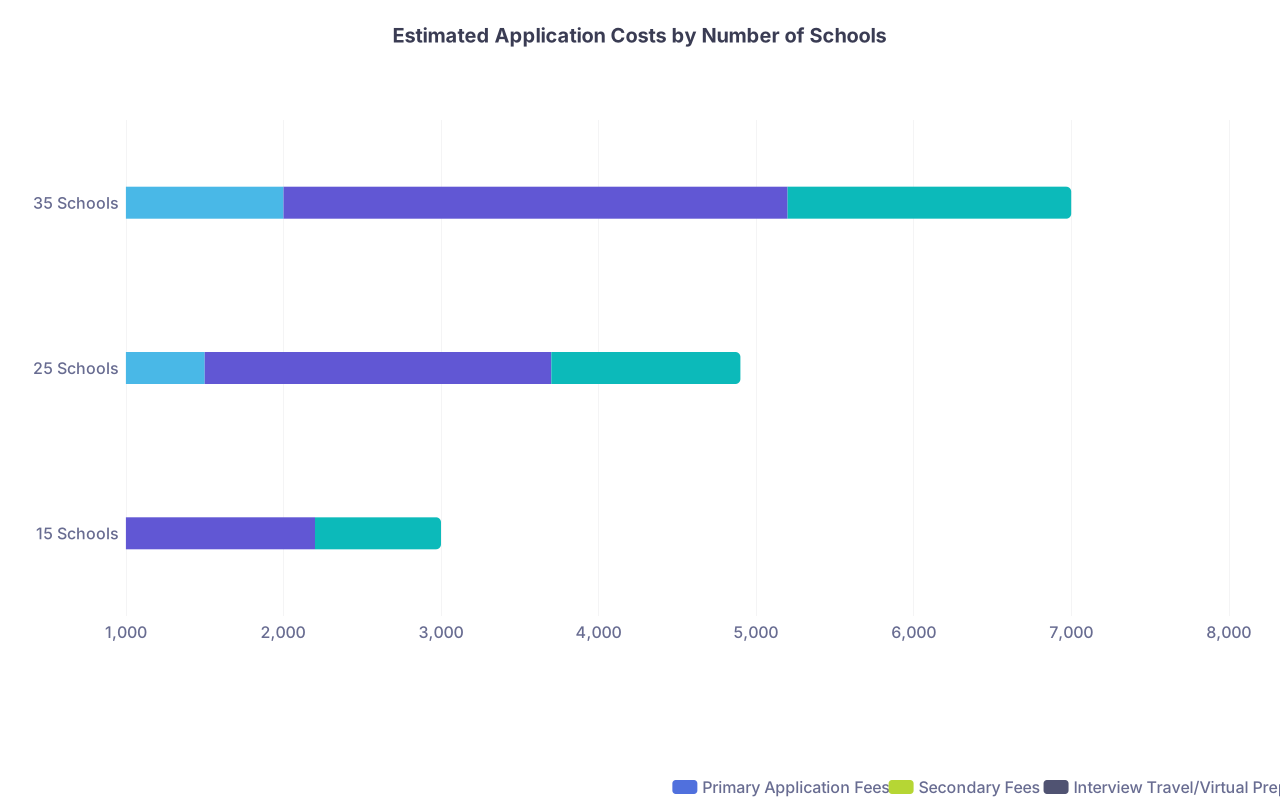
| Category | Primary Application Fees | Secondary Fees | Interview Travel/Virtual Prep |
|---|---|---|---|
| 15 Schools | 1000 | 1200 | 800 |
| 25 Schools | 1500 | 2200 | 1200 |
| 35 Schools | 2000 | 3200 | 1800 |
If you cannot realistically afford the list you just built:
- Do not just cut DOs and keep all the “dream” MDs.
- Trim:
- Overlapping reach schools
- Duplicative schools in regions you are less serious about
- Schools with weaker fit where your odds are marginal anyway
Use the money you save to:
- Apply earlier
- Take a second MCAT if needed
- Travel for key interviews
- Or invest in a structured MCAT or GPA repair strategy if this cycle is not viable
Step 13: What About Reapplicants?
If you are reapplying, you no longer get the luxury of wishful thinking.
You must:
Analyze your last cycle:
- How many interviews?
- MD vs DO breakdown?
- Were you screened out at secondaries?
Adjust aggressively:
- If you got no MD interviews with a broad MD list, you either:
- Need to shift heavily toward DO
- Or fix academics/ECs before reapplying
- If you got no MD interviews with a broad MD list, you either:
Avoid “doing the same thing again but more.”
- More of the same broken strategy will just produce a more expensive rejection.
Your Next Concrete Step (Do This Today)
Open a blank spreadsheet.
Create columns:
- School
- MD/DO
- State
- Median MCAT
- Median GPA
- In-state vs OOS friendliness
- Category (Reach / Target / Safety)
- Why here? (1–2 words: “state”, “mission”, “stats match”)
- Keep? (Y/N)
Then:
- List every school you are currently considering (MD + DO).
- Fill out the stats and basic info for each using MSAR for MD and school sites for DO.
- Label them reach/target/safety.
- Delete or mark “N” for:
- Places you would not actually attend
- Pure fantasy reaches with no special reason
- Redundant options in regions you are not serious about
Do not stop until you have:
- A total MD + DO count that fits your budget and your stamina.
- A rational MD:DO ratio that matches your profile.
- A majority of schools in the target zone, not “maybe they will love my story” zone.
Once that spreadsheet looks brutally honest, then you are ready to start submitting primaries.
Not before.