You are here
You are sitting in a quiet corner of the library. Anatomy notes open. A practice MCAT passage half-finished. And in the back of your mind, a sentence that will not shut up:
“I think I picked the wrong path.”
Maybe you committed hard to MD and now your GPA is bruised and your MCAT is stuck and DO schools suddenly look like the only realistic shot. Or the opposite: you went all in on DO, matched the culture, loved the philosophy, and now people keep telling you, “You know cardiology will be harder as a DO, right?”
Or you are already in medical school, staring at your white coat with the letters “DO” or “MD” stitched on the chest, and you are wondering if you permanently screwed your future specialty options.
Let me be blunt: this feeling is common, and most people handle it badly. They either:
- Ignore it and spiral into quiet resentment, or
- Panic, blow everything up, and make it worse.
You need a third option: fix it methodically.
You are not rewriting your entire life story today. You are making your next 3–5 decisions smarter.
That is what we will do: break down exactly how to evaluate your regret, what is actually reversible, and concrete steps to improve your position whether you are:
- A premed choosing between MD and DO
- A premed who thinks you “screwed” yourself for MD or DO
- A current DO or MD student worried about specialty doors closing
I am going to be direct. Some things are flexible. Some are not. The goal is not to make you feel good. The goal is to give you a realistic path forward.
Step 1: Clarify the regret – what exactly feels “wrong”?
Most people say “I chose the wrong path” when they are really dealing with one of four problems:
- Wrong letters (DO vs MD)
- Wrong competitiveness expectations
- Wrong specialty target
- Wrong school fit (location, culture, support)
You do not fix this by catastrophizing. You fix it by diagnosing the actual problem.
Ask yourself these questions and write the answers down:
If I could snap my fingers and change one thing, what would it be?
- “I wish I had a shot at MD schools.”
- “I want more options for competitive specialties.”
- “I want out of this school; the environment is toxic.”
- “I am not sure I even want to be a doctor anymore.”
Is my regret about perception or outcome?
- Perception: stigma, what family thinks, DO vs MD prestige, “top 20” school obsession.
- Outcome: fellowship chances, location, lifestyle, step exam performance.
What is the actual fear under the regret?
Common ones:- “I will not match where I want.”
- “I wasted years and money on a bad plan.”
- “Everyone else knew what they were doing and I did not.”
Once you have that written down, you can sort yourself roughly into one of these buckets:
- Premed, not yet applied, rethinking DO vs MD path
- Premed, already applied (or committed), panicking about doors closed
- Current DO student, worried you should have gone MD
- Current MD student, wondering if DO might have been less toxic, cheaper, or better aligned
- Someone questioning medicine altogether
Each of these has a different fix protocol.
Step 2: Understand what actually differs between DO and MD
People make bad decisions when they operate on myths. So let us quickly lay out the real differences that matter.
Training and degree
- MD (allopathic) and DO (osteopathic) are both fully licensed physicians in the US.
- Same residency match (NRMP) now. Same board certification structures for most specialties.
- DO schools add osteopathic manipulative treatment (OMT) and more explicit “whole person” philosophy.
Residency competitiveness (where the sting really shows up)
In reality, the letters on your degree start to matter in two places:
- Competitive specialties (derm, plastics, ortho, ENT, neurosurgery, some radiology and anesthesia programs)
- Elite academic programs (branded university hospitals, high-research institutions)
Are there DOs in derm, ortho, plastics? Yes. I have worked with them. But the path is steeper:
- Fewer DOs are interviewed at top programs.
- You have to be near the top of your DO class, crush board exams, and usually have solid research.
On the flip side, many fields are very accessible for strong DO or MD students:
- Family medicine
- Internal medicine (community and many academic programs)
- Pediatrics
- Psychiatry
- PM&R
- Emergency medicine (though this is tightening)
Boards and exams
Historically:
- MD: USMLE Step 1, 2 CK
- DO: COMLEX Level 1, 2, sometimes USMLE as well
Now:
- Many competitive residencies expect DO students to take USMLE Step 1 and Step 2 CK if you want a fair shot at their programs.
In other words: a DO student aiming high will often do more exams, not fewer.
Reality check: doors that are actually closed vs just harder
Permanently closed (for all practical purposes):
- Certain ultra-elite academic tracks are strongly biased toward MD with heavy research backgrounds.
- A few small-niche academic positions where DO representation is minimal.
Harder but very possible:
- Derm, ortho, ENT, urology, neurosurgery, plastics from a DO school.
- Matching highly ranked academic internal medicine with weak board scores (MD or DO).
Open with smart execution:
- Solid community and many academic residencies in IM, peds, psych, FM, PM&R, EM (for now), anesthesia, general surgery (mid-tier).
You are not doomed. But you are not operating in a fantasy world either.
Step 3: If you are a premed before applying – fixing an early regret
You have not applied yet. You are anxious you are locking yourself into the wrong lane.
Good. You actually have leverage right now.
A. Build a realistic MD vs DO strategy based on your stats
Sit down and write three numbers:
- Cumulative GPA
- Science GPA
- Practice MCAT average (from full-length tests)
Now compare them against rough competitiveness bands.
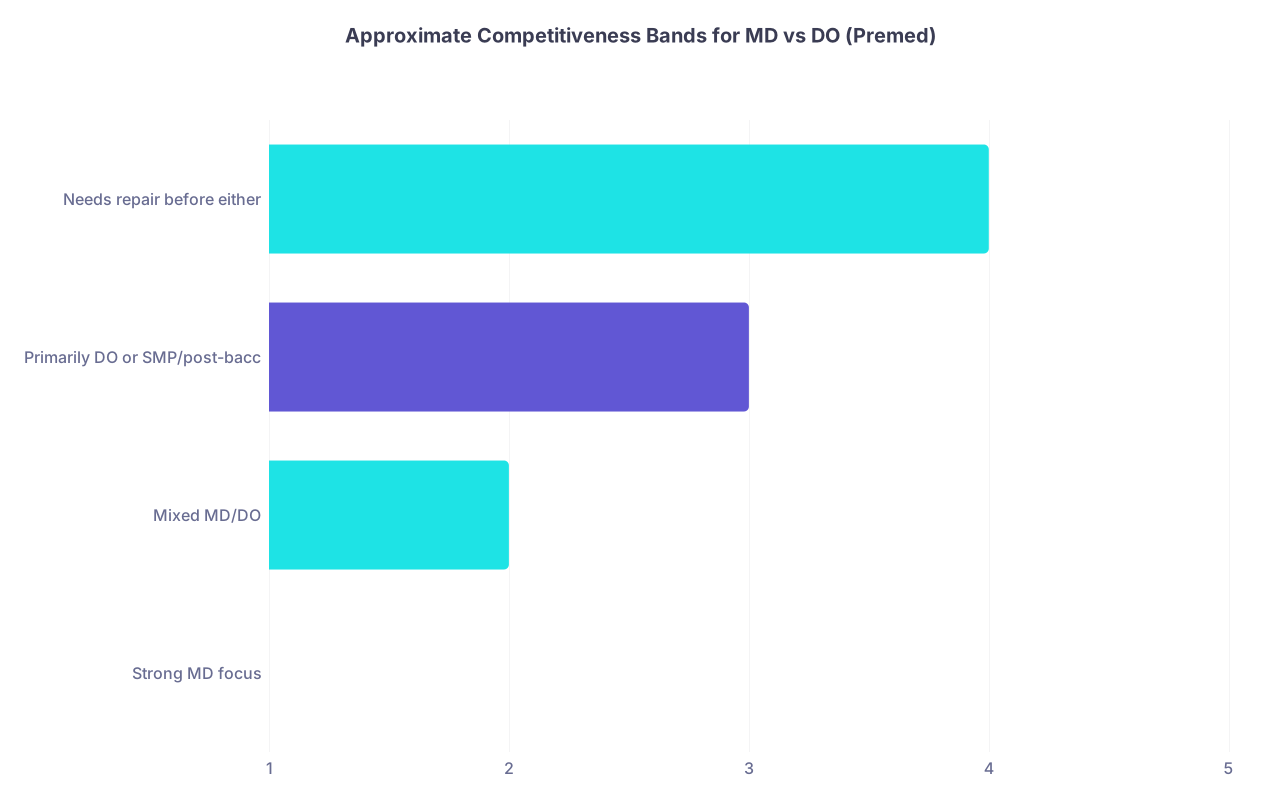
| Category | Value |
|---|---|
| Strong MD focus | 1 |
| Mixed MD/DO | 2 |
| Primarily DO or SMP/post-bacc | 3 |
| Needs repair before either | 4 |
Interpretation (not gospel, but close enough to reality):
- Strong MD focus: cGPA ≥ 3.7, strong upward trend, MCAT ≥ 512
- Mixed MD/DO: cGPA 3.4–3.7, MCAT 505–512, or meaningful red flags but decent trend
- Primarily DO or SMP/post-bacc: cGPA 3.1–3.4, MCAT 500–505
- Needs repair: cGPA < 3.1, MCAT < 500
If you are “Mixed MD/DO” or below and insisting on MD only because of ego or family pressure, you are setting yourself up for a regret cycle: 1–2 failed cycles, massive expense, and then “fine I guess I will apply DO” with resentment.
Concrete fix:
Create three school lists:
- Realistic MD (state schools, mid-tier privates that fit your stats)
- Realistic DO (broad, geographically flexible)
- Reach MD (a few, not 20)
Decide beforehand:
- “If I do not get an MD acceptance by [date], and I get at least one DO acceptance, I will not reapply chasing an MD fantasy cycle. I will commit to DO and then work like my life depends on it to open specialty doors.”
If your numbers are weak:
- Ask: “Do I want to spend 1–2 years repairing my application to strengthen my MD chances, or am I okay with DO now?”
- That is a valid fork in the road. But you do not drift into that decision—you choose it.
B. If you are obsessing about future specialty before you have taken orgo
If your whole “wrong path” fear is “what if I want derm later,” you are solving the wrong problem.
You have two immediate jobs:
- Get the strongest GPA you can
- Score as high as you can on the MCAT
Those two things buy you options later. DO or MD, high numbers make life easier.
Protocol:
- Stop specialty doom-scrolling. No more “DO vs MD ortho match rates” rabbit holes every night.
- Build a 12–18 month plan:
- Specific grade goals this semester
- MCAT study schedule with practice test checkpoints
- Concrete shadowing and clinical exposure with both MD and DO physicians
You do not “regret-proof” your career by thinking your way into the perfect future. You do it by building numbers and experiences that let you pivot.
Step 4: If you are a premed after applying – and panicking
Scenario: You applied mainly DO because you thought MD was out of reach, now you are getting DO interview invites and you are suddenly thinking, “Did I sell myself short?” Or you shotgun-applied MD, got no love, and now you are staring at a DO acceptance wondering if taking it is “settling.”
Here is how to handle it like an adult.
A. If you have a DO acceptance and weak odds of MD
Ask yourself three blunt questions:
- Do I 100% want to be a physician, more than I care about letters?
- Am I willing to work harder as a DO to keep competitive specialties on the table (extra exams, early research, top-of-class performance)?
- Can I live with the small hit in prestige in exchange for starting now and becoming a doctor on time?
If your honest answers are:
- Yes
- Probably
- Yes
Then take the DO seat and stop torturing yourself.
If your answers are:
- I am not sure I want to be a doctor
- I care a lot about having every competitive door open
- I cannot stomach the idea of extra hurdles
Then you have two legitimate options:
- Decline the DO acceptance, commit to 1–2 structured years of reinvention (post-bacc, SMP, higher MCAT, real clinical experience), and reapply with MD as a possibility.
- Or, walk away from medicine and build a different life. Hard, but sometimes correct.
The worst thing you can do is:
- Take the DO spot, resent it, not perform your best, and then blame the letters when you do not match derm or ortho.
B. If you got into both MD and DO and feel weirdly drawn to DO
This is more common than people admit. You visit a DO campus, you like the culture, the students seem less miserable, faculty actually know names… and yet your brain is screaming, “But MD is ‘real doctor.’”
You are not actually choosing DO vs MD. You are choosing:
- A school environment where you believe you will thrive vs
- A school environment with better external prestige
Here is my position: If you are a high performer, you will do well from either. If you are borderline, environment matters more than letters.
Practical comparison exercise:
For each acceptance, rate 1–5 (5 = excellent):
- Student support and advising
- Match history in your target or likely backup specialties
- Clinical sites (hospital quality, location)
- Cost and debt load
- Your gut reaction after visiting or talking to students
Add the scores.
If a DO school beats an MD by 8–10 points in actual livability and match support, taking it is not insane. It is rational. You trade a small prestige hit for 4 years in a place where you are more likely to be top third of the class instead of bottom third.
Step 5: If you are already in DO or MD school and regret is hitting hard
Now we are in the deep water. You have the white coat, you are in the system. Switching is much harder, but not always impossible.
First: figure out if your regret is about medicine or letters/school.
A. If your regret is “I hate medicine”
This is outside DO vs MD, but let me address it briefly.
If you are:
- Dreading every clinical exposure
- Getting no satisfaction from patient care
- Only staying because “I already spent X years and Y dollars”
Then the problem is not MD vs DO. The problem is you locked onto the wrong profession.
Protocol to handle this:
Schedule time with:
- A trusted faculty mentor
- Your school’s mental health services
- A career counselor familiar with non-clinical paths
Give yourself 3–6 months of structured exploration:
- Try different specialties on shadow electives
- Look at MD/DO-adjacent careers (informatics, consulting, pharma, public health)
- See if you hate all of them or just the one environment you are currently in
If you truly hate all of it, earlier exit with a planned pivot is often better than grinding through 7–10 more miserable years.
But if your regret is specifically “I should have gone DO/MD instead,” that is different.
B. If you are a DO student regretting you did not go MD
Common triggers:
- You realize you want derm, ortho, plastics, ENT, or radiology.
- Classmates or online forums tell you “DOs do not match those.”
- You see residency filters saying “MD only” or not “COMLEX-friendly.”
Here is the fix plan.
1. Get hard data, not Reddit noise
Look at:
- Your school’s match list for the last 3–5 years
- NRMP data for your specialty of interest, including DO match rates
- Programs that have actually taken DOs in that specialty
You are looking for examples like:
- “Our school matched 1–2 DOs into ortho each year.”
- “This region has 3–5 programs with recent DO grads.”
If there is zero track record anywhere, pick a new strategy. Wishing will not change a specialty’s DO acceptance culture overnight.
2. Commit to the “max difficulty” route if you stay the course
If you still want a highly competitive specialty as a DO, your path includes:
- Crushing COMLEX and strongly considering USMLE Step 1 and 2 CK (even if optional).
- Early research in that specialty (M1/M2).
- Finding DO-friendly mentors in that field as soon as possible.
- Rotating at programs that actually take DOs.
That is the trade. Harder path, but not impossible.
3. Explore internal transfers cautiously
Transferring from DO to MD is rare and usually not worth anchoring your hopes on. It happens occasionally when:
- A DO school loses accreditation or faces serious instability, and nearby MD schools absorb students.
- Very early in training, with outstanding academic performance, strong reasons, and a willing MD institution.
Do not build your plan around this. At best, treat it as lottery ticket odds.
C. If you are an MD student thinking DO might have been better
I have seen this in two flavors:
- “I chose prestige and now I am drowning in a hyper-competitive, toxic environment.”
- “I actually like the osteopathic philosophy and hands-on approach, and my MD curriculum feels cold.”
Switching MD to DO midstream is extremely uncommon. And frankly, usually not worth it.
Instead, your action items are:
Fix your local environment:
- Identify 1–2 supportive faculty or mentors who are not psychopaths.
- Find a peer group that is collaborative, not cutthroat. Even 2–3 good classmates can change your experience.
Shape your training:
- You can still learn OMT later via courses or CME if it really matters to you.
- Choose electives and mentors who align with the “whole person” approach you want.
The regret here is usually about culture shock, not letters. You fix culture with micro-environment changes, not by burning another 2–4 years switching tracks.
Step 6: Adjusting specialty plans without feeling like you “failed”
A lot of DO vs MD regret is really about specialty FOMO.
You thought you wanted orthopedics. You end up leaning toward PM&R or sports medicine. You feel like you slid down a ladder.
Let me say this clearly: Smart mid-course specialty adjustments are not failure. They are strategic.
Here is a clean way to pivot if you realize your original dream specialty is misaligned with your degree, scores, or life priorities.
A. Use a harsh but useful framework: dream, realistic, safety
For your situation (DO or MD, your current class rank, your board scores), list:
- Dream specialties: Might be possible, but would require top performance and luck.
- Realistic specialties: Fit your stats and degree well.
- Safety specialties: You would respect yourself doing them, and match odds are high if you do your job.
Example for a mid-pack DO with decent but not stellar boards:
- Dream: Ortho, derm
- Realistic: EM (current trend dependent), anesthesia, PM&R
- Safety: FM, IM, psych
Then do the adult thing: pick at least one realistic and one safety specialty that you would not hate.
This is not “settling.” This is building a career instead of gambling everything on a single, overloaded dream.
B. Redirect energy where it pays off
If you shift away from derm to internal medicine:
- Reallocate your research efforts to IM subspecialties.
- Target programs and mentors that match your new goals.
- Stop burning energy obsessing over what might have been.
The earlier you do this, the stronger you look to programs. They can smell people who are “settling” a mile away. They can also recognize someone who has fully committed to a new path and built a coherent application around it.
Step 7: Mental reset and moving forward without bitterness
Regret is sticky. You can do all the logical planning in the world and still feel the sting.
Here is how you clean that up enough to function.
A. Separate choice quality from outcome quality
You might have made the best decision you could with the information you had then. And still wish you had chosen differently now.
That is not failure. That is just how time works.
Ask:
- “Given my GPA, MCAT, finances, and knowledge back then, was my DO/MD choice reasonable?”
- If yes, then stop calling it a “stupid” choice. It was a reasonable choice that led to some constraints. Now you work within them.
B. Stop using DO vs MD as a scapegoat for everything
I have watched students blame their degree for:
- Poor board scores (when they studied poorly)
- Weak applications (no research, no leadership, bad letters)
- Mediocre clinical performance (late, disorganized, disengaged)
Your degree may add friction. It is rarely the main reason you are underperforming.
Do an honest audit:
- Boards: Did you give yourself enough time, enough practice questions, real self-assessment?
- Clinical: Are you reliable, curious, and prepared on rotations?
- Application: Do your letters, research, and experiences show a coherent story?
Fix those first. Only then worry about structural bias.
C. Build a 12–24 month action plan
Regret loves vague futures. You shut it up by giving yourself a concrete plan.
For premeds:
- Target GPA each semester
- MCAT study timeline with test date
- Realistic school list (MD/DO balance based on your numbers)
- Contingency: what you will do if cycle fails
For med students:
- Board exam targets and dates
- Research and mentorship goals (who you will contact, what projects you will join)
- Shortlist of specialties with dream/realistic/safety tiers
- Program types that fit your degree and performance
Put it on paper. Not in your head. Then execute.
Quick recap – what actually matters
You do not undo the past choice. You make the next decisions smarter.
Key points:
- Most DO vs MD regret is about future specialty anxiety, not present reality. So you clarify the exact fear, then decide if it is truly a “door closed” or just “door harder to open.”
- Before you apply or commit, align your MD/DO strategy with your actual stats and timeline. Ego-only decisions create the worst regrets.
- If you are already in school, you win by performing where you are, not fantasizing about a different logo on the diploma. Match lists, mentors, scores, and specialty flexibility matter more than the two letters on your coat.
You are not stuck. You are just early in the story. Now write the next chapter on purpose.