| Category | Value |
|---|---|
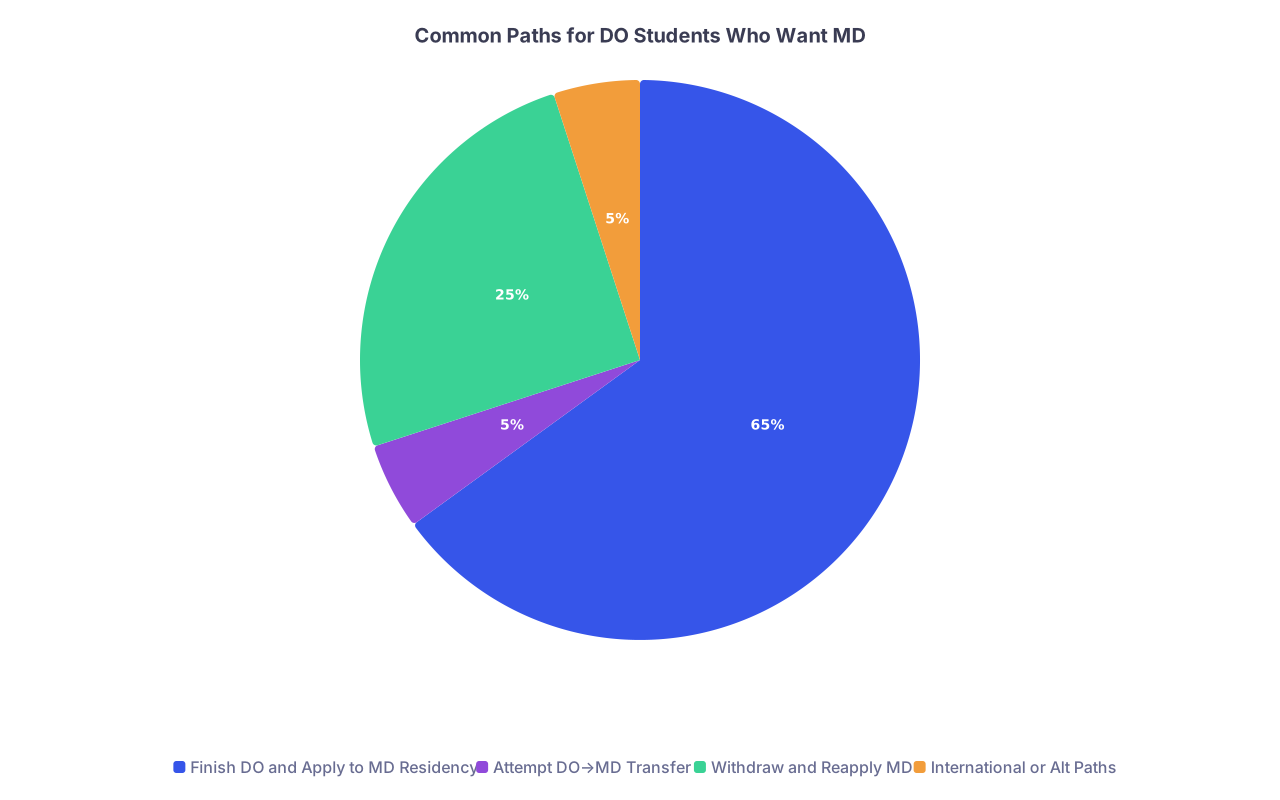
| Finish DO and Apply to MD Residency | 65 |
| Attempt DO→MD Transfer | 5 |
| Withdraw and Reapply MD | 25 |
| International or Alt Paths | 5 |
The worst thing you can do as a DO student who suddenly wants MD is flail around without a clear plan.
You are not stuck. But your realistic options are narrower than the random stories you see on Reddit. Let’s sort out fantasy from actual, executable pathways.
Title: Already Enrolled DO but Want MD? Realistic Options and Transfer Pathways
Step 1: Get Honest About Why You Want MD
If you skip this, you will waste years.
When I talk to DO students in this spot, their reasons usually fall into a few buckets:
Prestige / stigma
- “My family does not respect DO.”
- “Attendings keep asking why I chose DO.”
- “I feel like I settled.”
-
- Gunning for: dermatology, plastics, ortho, ENT, neurosurgery, certain competitive fellowships.
- Worried that DO puts a ceiling on options.
Geographic / program access
- You want a specific academic center that historically favors MDs.
- You want big-name research programs (Mass General, Hopkins, UCSF, etc.).
Mismatch with current school
- You dislike the school’s culture, location, curriculum, or administration.
- You suspect another school (MD or DO) would fit better.
Here is the blunt truth:
- If your main issue is prestige or external validation → transferring MD is rarely worth the risk.
- If your main issue is access to hyper-competitive specialties or big-name academic programs → MD can increase probabilities, but only if you are already performing at a very high level.
- If your main issue is your specific school → a lateral move (DO→DO) is statistically more realistic than DO→MD.
You need a written, concrete answer to:
“What exactly will an MD give me that I cannot get as a DO if I absolutely crush it (top of class, high scores, research, networking)?”
If you cannot answer that precisely, your problem is not your degree. It is clarity.
Step 2: Understand the Reality of DO→MD Transfer
This is where most people are misinformed.
DO→MD transfer in the United States is:
- Rare
- School-specific
- Policy-driven (and policies change)
- Usually limited to early years (M1 or early M2)
- Often only “for cause” (accreditation, school closure, serious personal reasons)
There is no centralized “transfer portal” between DO and MD schools in the U.S. You are building a custom route, program by program.
Typical MD Transfer Requirements (U.S.)
Most MD schools that even consider transfer have conditions like:
- Space available only (someone dropped out, failed out, or expanded class size)
- Same phase of curriculum (you enter as M2 if they have an open M2 seat)
- LCME-accredited source school
- High academic standing (top of class, strong basic science performance, no failures)
- USMLE Step 1 passed, or equivalent board performance, if entering clinical years
Your problem: DO schools are COCA-accredited, not LCME. Many MD programs’ written transfer policies specifically say “only from LCME-accredited schools.” That alone closes most doors.
Are there exceptions? Occasionally. Usually tied to:
- Institutional relationships between a specific DO and MD school
- Special circumstances (school closure, disaster, political reasons, documented discrimination)
Do not base your life on the rumor that “a guy from my cousin’s DO school transferred to [big MD school].” You need:
- Names of schools
- Their current written policy
- Direct confirmation from admissions, not a dean “who knows someone”
Step 3: The 4 Realistic Pathways You Actually Have
You essentially have four major paths. Each has trade-offs.

| Step | Description |
|---|---|
| Step 1 | Currently Enrolled in DO |
| Step 2 | Stay DO, Optimize Residency Outcomes |
| Step 3 | Evaluate MD Transfer vs Reapply |
| Step 4 | Consider DO→DO Transfer or Reapply |
| Step 5 | Targeted DO→MD Transfer Attempts |
| Step 6 | Withdraw and Reapply MD Fresh |
| Step 7 | DO→DO Transfer Attempt |
| Step 8 | Boards, Research, Mentorship, Networking |
| Step 9 | Work, Strengthen Profile, Reapply |
| Step 10 | Primary Motivation? |
| Step 11 | Eligible for MD Transfer? |
Path 1: Stay in DO, Maximize Outcome (Most Rational for Most Students)
If you are already in a reasonably solid DO school, performing well, and not failing courses, this is usually your best move.
Your goal shifts from “change letters” to “make myself indistinguishable from a strong MD applicant on paper and performance.”
Concrete steps:
Crush your preclinical years
- Aim for top 10–20% of your class.
- Avoid any remediation. A single repeated course is a red flag for MD transfers and competitive residencies.
- Treat exams as if they were Step prep.
Standardized exams strategy
- Take USMLE Step 1 and Step 2 if allowed by your school.
- Aim for Step 2 in the 245+ range if you want competitive specialties; 250+ if you are serious about derm, plastics, etc.
- Strong COMLEX scores still matter, but MD programs understand Step better.
Get early specialty exposure
- Shadow or do research in your target field starting M1/M2 summers.
- Get your name on at least 1–2 publications or abstracts if you are residency-competitive-minded.
Network with MD attendings
- Do away rotations at MD-heavy institutions during 4th year.
- Get letters from MD faculty in your specialty of interest.
- Ask them explicitly, “How do DOs match into your program?”
Match strategy
- Apply broadly, including community and academic programs.
- Be realistic. If your stats or profile are mid-range, do not behave like you are matching MGH derm.
Who should strongly consider this path:
- Anyone already in M2 or later.
- Anyone without a pristine academic record.
- Anyone whose main complaint is “I feel weird about the letters.”
Path 2: Attempt DO→MD Transfer (Narrow, High-Risk, But Not Impossible)
This path is only rational if all of the following are true:
- You are early (M1, early M2 at most).
- You are at or near the top of your class academically.
- Your school is stable, but you have compelling reasons to transfer (geography, unique family situation, documented harassment, etc.) or you are willing to lean heavily on “career fit” arguments.
- You understand success probability is low, even with a strong case.
Steps to execute:
Research MD schools with historically flexible policies
- Look up “transfer” page for each LCME-accredited MD program.
- Make a spreadsheet:
- Accepts transfers: Y/N
- Source schools allowed: LCME only vs “other accredited”
- Timing: After M1, after Step 1, etc.
- Space-available basis only? (Usually yes)
Email admissions directly
- Do not ask “Can I transfer?”
- Ask:
- “Do you ever consider transfer applications from COCA-accredited DO schools?”
- “If yes, at what point in training?”
- “What conditions must be met: step scores, curriculum overlap, etc.?”
Assemble your transfer packet Typically includes:
- Current DO transcript (with high performance)
- MCAT scores
- Personal statement explaining:
- Concrete reasons for transfer (not “I just want MD prestige”)
- Geographic or family hardships
- Specific fit with that MD school (curriculum, tracks, research)
- Letters of recommendation:
- Preclinical faculty
- Possibly your dean
- Updated CV (research, volunteering, clinical work)
Timing
- Most transfers happen after M1, before clinical years.
- Some require Step 1; you will not have Step 1 from DO school unless you took USMLE independently.
Decision rules
- Set a clear deadline: “If no MD transfer by X month, I drop the idea and commit fully to the DO path.”
- Do not live in limbo for years.
Who is this actually realistic for:
- Top decile student, early in training, with a compelling narrative and willingness to hear “no” from 95% of schools.
Path 3: Withdraw and Reapply to MD as a New Applicant
This is the nuclear option. It solves the “I really, truly do not want to be a DO” problem but introduces a much bigger one: you are now a re-applicant who left medical school.
MD admissions offices will ask: “Why should we admit someone who already had a medical school seat and walked away?”
You must answer that question convincingly, or you are done before you start.

When is this even worth considering?
- You are very early in M1.
- You have not failed anything.
- Your original MD application was borderline and can now be significantly strengthened (higher MCAT, better GPA post-bacc, major new research, etc.).
- You are fully prepared to sit out at least one full cycle, possibly more.
Hard facts:
- If your original MD application was weak (e.g., MCAT 502, GPA 3.3), simply reapplying with the same stats will not save you.
- Leaving a DO seat with nothing substantial changed will actually make you worse as an MD candidate, not better.
- You will be competing against fresh applicants with no history of abandoning a medical program.
If you choose this path:
Talk to your current DO dean first
- Ask how withdrawal will be documented.
- Avoid “dismissal” or “academic withdrawal” language at all costs.
- Aim for a clean, voluntary withdrawal for personal or career-alignment reasons.
Build a serious improvement plan Over 1–2 years:
- If MCAT < 510, retake with a goal of 515+.
- If GPA is mediocre, add a post-bacc or SMP (special master’s program) with near-4.0 performance.
- Deepen clinical and research experience with clear continuity and responsibility growth.
- Craft a new personal statement that directly but maturely addresses:
- Why you left your DO program
- Why MD now makes more sense
- What you have done since to prove this is not impulsive
Apply strategically
- Target a broad range of MD schools, including those known to consider re-applicants.
- Strongly consider reapplying to DO as backup. Yes, even after you withdrew. Some will still take you.
This path is high-risk, high-cost. Only reasonable if:
- Your long-term regret of “never trying” MD is heavier than the risk of not practicing medicine at all. And you are honest about that trade-off.
Path 4: DO→DO Transfer, Then Focus on Outcomes
Not what you asked for, but it is often the saner middle ground when the real issue is:
- Toxic environment
- Horrible location fit
- Structural problems at your current DO program (new school, unstable rotations, repeated leadership turnover)
DO→DO transfers are still rare, but significantly more plausible than DO→MD in many cases.
Execution is similar:
- Identify DO schools that will accept transfers from another DO program.
- Maintain absolute top academic standing.
- Present a focused, evidence-based rationale:
- Family relocation
- Program instability
- Proven mismatch (e.g., documented non-responsiveness to ADA accommodations)
Once you land at a better-fitting DO program, you drop the identity battle and push your energy into matching well.
Step 4: Reality Check on Competitive Specialties as a DO
You might be thinking: “If I stay DO, am I doomed for anything competitive?”
No. But your margin for error is smaller.
| Category | Value |
|---|---|
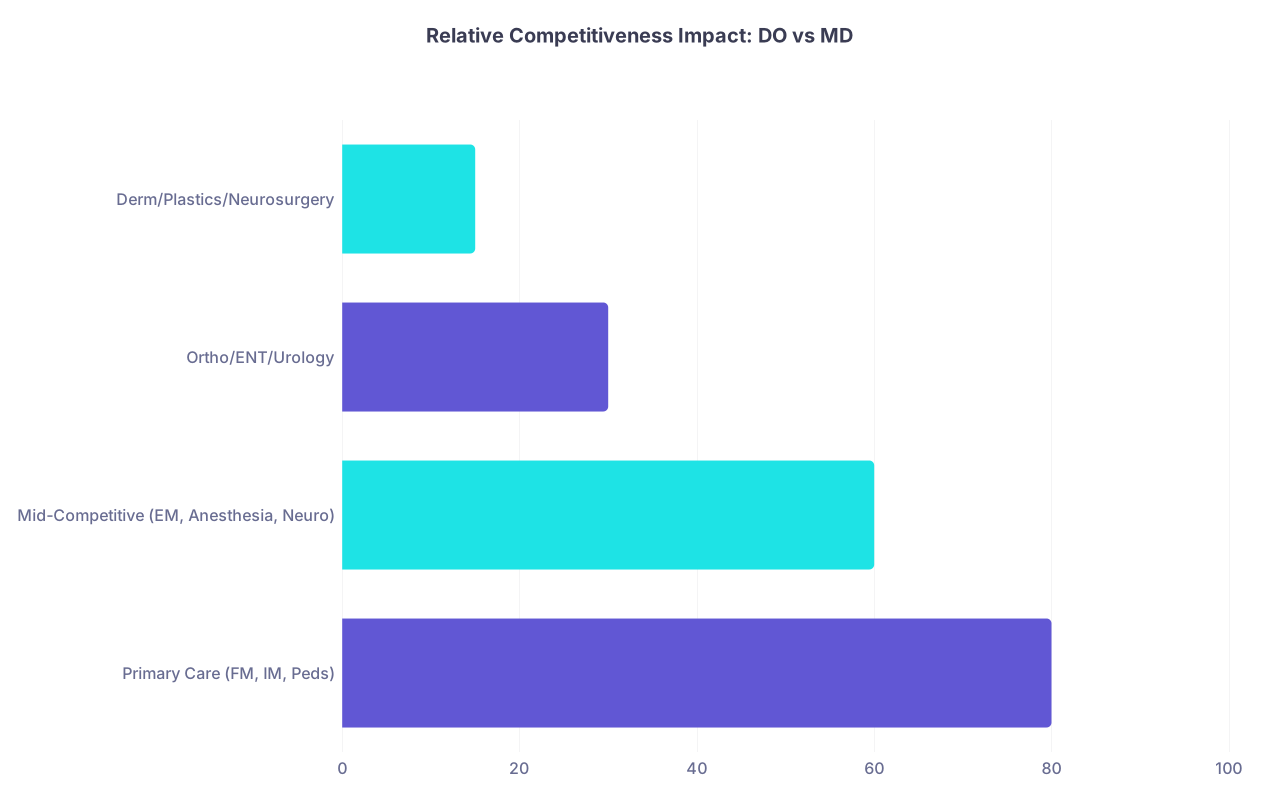
| Primary Care (FM, IM, Peds) | 80 |
| Mid-Competitive (EM, Anesthesia, Neuro) | 60 |
| Ortho/ENT/Urology | 30 |
| Derm/Plastics/Neurosurgery | 15 |
That chart is illustrative, not literal numbers, but the pattern is accurate:
- Primary care: DO and MD on almost equal footing if you pass boards and function well clinically.
- Mid-competitive: DOs match all the time with solid scores and good letters.
- Ortho/ENT/Urology, etc.: DOs match, but the bar is higher and network matters more.
- Derm/Plastics/Neurosurgery: DOs do match, but it is the exception, not the rule. You must be truly exceptional.
If you stay DO and want a competitive field:
- Board scores must be excellent
- Research in that specialty is non-negotiable
- Mentorship from people who match DOs in that field is crucial
- Strategic away rotations are your battlefield
If you are not willing to do those four things ruthlessly, an MD transfer will not save you either. The same work will be required.
Step 5: How to Make a Decision Without Destroying Your Sanity
You do not need perfect certainty. You need a defensible decision that aligns with your risk tolerance.
Use this quick framework:
Question 1: Timeline
- Are you M1? You have the most optionality.
- Are you M2+? MD transfer and withdrawal+reapply become much less rational.
Question 2: Evidence of Competitiveness
- Top 10–20% of your class?
- No failed courses?
- High MCAT originally (510+)?
- Strong pre-med record?
If not, chasing MD primarily for competitiveness is probably self-deception. You need to fix performance first.
Question 3: Personal Non-Negotiables
Write down the following:
- “In 10 years, what do I regret more:
A) Staying DO and never trying MD
B) Trying MD via risky routes and potentially failing, maybe losing medicine entirely”
If the answer is A, you are a high-risk, high-conviction person. Path 2 or 3 might align with your values.
If the answer is B, you are more conservative. Path 1 or 4 is smarter.
Question 4: Input from People Who Matter (And Those Who Do Not)
Whose opinions should matter:
- Trusted physicians who know your academic performance personally.
- Your current dean or academic advisor.
- A residency program director in the field you want.
Whose opinions should not run your life:
- Random med school subreddits.
- Family members who think DO is “less than” but cannot explain basic residency structure.
- Pre-med advisors who have never worked with actual DO students in residency placement.
Concrete Action Plan (Next 30–90 Days)
Here is exactly what I would do if I were you, starting today.
Get hard data on your standing
- Current GPA / class rank.
- Any concerns flagged by faculty.
- Honest feedback from someone who has seen many med students.
Research transfer policies
- Build that spreadsheet for MD and DO schools that even consider transfers.
- Send 5–10 targeted emails to admissions about DO→MD transfer possibilities.
Meet with your DO dean or student affairs
- Ask:
- How do you document withdrawals?
- Do you have alumni who transferred MD or DO→DO? What did their file look like?
- What support do you offer students exploring other paths?
- Ask:
Clarify your non-negotiables in writing
- One page, handwritten if needed.
- Why MD? Why now? What are you willing to risk?
Set a decision deadline
- Example: “By the end of M1 spring, I commit to either staying DO fully or pursuing re-application.”
- No multi-year limbo. It destroys focus and performance.
In parallel: behave as if you are staying DO
- Study like your future depends on it—because it does, no matter which path you choose.
- Join research, find mentors, do not sabotage your current trajectory while you explore options.
FAQ (Exactly 3 Questions)
1. Is it “wrong” to want to leave a DO program for an MD, or will admissions see me as disloyal?
No, it is not morally wrong. But MD admissions will absolutely question your judgment and reliability. They will want to know why you left a guaranteed path to being a physician. If your story sounds like chasing prestige or panicking, you will be screened out. If you can articulate a coherent, mature reason tied to long-term fit, supported by concrete actions (improved scores, additional experience), then they may listen. The bar is high, but not zero.
2. Do any MD schools explicitly accept transfers from DO programs?
Policies change frequently, and many schools either do not publish exceptions or only consider them case by case. Some schools have historically been more flexible when a DO program closes or when there is a compelling personal reason tied to geography or family needs. The only responsible approach is direct contact: email each MD school’s admissions or student affairs office and ask if they have ever accepted a transfer from a COCA-accredited DO program, and under what circumstances. Anything short of that is guesswork.
3. If I stay in my DO program, can I still match into a strong MD residency?
Yes, especially in fields like internal medicine, family medicine, pediatrics, psychiatry, and many mid-competitive specialties. DOs match into excellent academic IM programs, strong anesthesia and EM programs, and even some of the big-name hospitals when they combine high board scores, research, strong letters, and strategic away rotations. The letters after your name matter less than your performance, reputation, and relationships. The limiting factor for most DO students is not the degree; it is inconsistent execution over four years.
Key points to remember:
- DO→MD transfer is rare and should be approached as a long shot, not a plan.
- For most students, staying in DO and performing at a very high level is the most reliable path to a strong career.
- If you are going to chase MD anyway, do it with clear eyes, hard data, and a firm deadline—do not ruin your current trajectory while gambling on a low-odds route.