What if I told you that the average patient you see in clinic couldn’t tell, from your day-to-day medical knowledge, whether you went to an MD or a DO school—and that most of your premed friends arguing about “curriculum differences” are fighting over branding, not reality?
Let’s tear this apart properly.
What DO and MD Schools Actually Have To Teach
Here’s the first myth: that MD schools “focus on real science” and DO schools “focus on alternative medicine.” That line gets repeated in premed group chats like gospel. It is also wrong.
Both MD and DO schools in the United States are accredited to train physicians to the same endpoint: competent, independent practice in any specialty, after residency. To get there, both have to teach you the same core medicine.
The MD schools answer to the LCME (Liaison Committee on Medical Education). DO schools answer to the COCA (Commission on Osteopathic College Accreditation). These aren’t cosmetic bodies. They mandate specific outcomes.
Both types of schools must show that graduates can:
- Understand and apply basic sciences: anatomy, physiology, biochemistry, pharmacology, pathology, microbiology, immunology.
- Take a history, perform a physical exam, generate a differential diagnosis, and create a plan.
- Interpret labs and imaging.
- Communicate with patients and work in teams.
- Understand ethics, systems-based practice, and healthcare disparities.
That’s not optional. If you do not teach that, you lose accreditation.
So what’s the actual difference?
MD programs build toward USMLE Step exams.
DO programs historically built toward COMLEX, and many also prepare students for USMLE.
Notice the direction: both are aiming at standardized exams that test the same clinical science. That alone forces a massive curricular overlap. A DO student taking both COMLEX and USMLE is not studying “alternative cardiology” and “standard cardiology.” It’s cardiac physiology, pharmacology, and pathology. Same drugs, same mechanisms, same treatment guidelines.
Are there presentation differences? Yes. Are they “completely different”? Not even close.
The One Real Structural Difference: OMM/OMT
The only truly consistent curriculum difference is simple: osteopathic schools add a required component that allopathic schools do not—Osteopathic Principles and Practice (OPP) and Osteopathic Manipulative Medicine/Treatment (OMM/OMT).
That’s the extra piece. Not a replacement.
So practically, what does that look like?
At a DO school, you still do:
- Gross anatomy with cadavers
- Physiology with actual equations and mechanisms
- Pharmacology with drug classes, receptors, side-effect profiles
- Path and micro with the same bugs, cancers, and autoimmune diseases
- Clinical skills, standardized patients, OSCEs
On top of that, usually 1–2 half-days per week (first and second year), you add:
- OMM lab: hands-on technique, palpation, musculoskeletal diagnosis
- OPP lectures: osteopathic philosophy, structure-function relationship, cases showing where OMT might be used
Are there DO schools that lean more heavily into OMM than others? Yes. Are there students who think 30% of that content is clinically useful and 70% is “I’m memorizing tender points for an exam and will never use them again”? Also yes. I’ve heard both MD and DO residents say: “We all learned plenty of stuff we rarely touch again.”
But here’s the key bust: OMM is additive. It’s not replacing core internal medicine, surgery, pediatrics, or psychiatry. It’s built over the same foundation every physician needs.
So no, DO and MD curricula are not “completely different.” One is basically “standard med school + an osteopathic track.”
Exams Don’t Lie: What The Test Data Actually Shows
If two curricula were truly “completely different,” you’d see it in performance on common yardsticks.
Let’s look at the reality.
Historically:
- MD students took USMLE Step 1/2.
- DO students took COMLEX Level 1/2; increasing numbers also took USMLE.
Programs watched one thing: can this student pass the same high-stakes exams and perform in the same residencies?
As more DO students took USMLE, something awkward for the “totally different curriculum” narrative happened: they passed. In massive numbers. And their score distributions sat in the same general ballpark as MD students from mid-tier schools.
Not identical, but close enough to prove the main point: DO schools clearly teach the same core medicine, because their students can sit for the same exam and survive it.
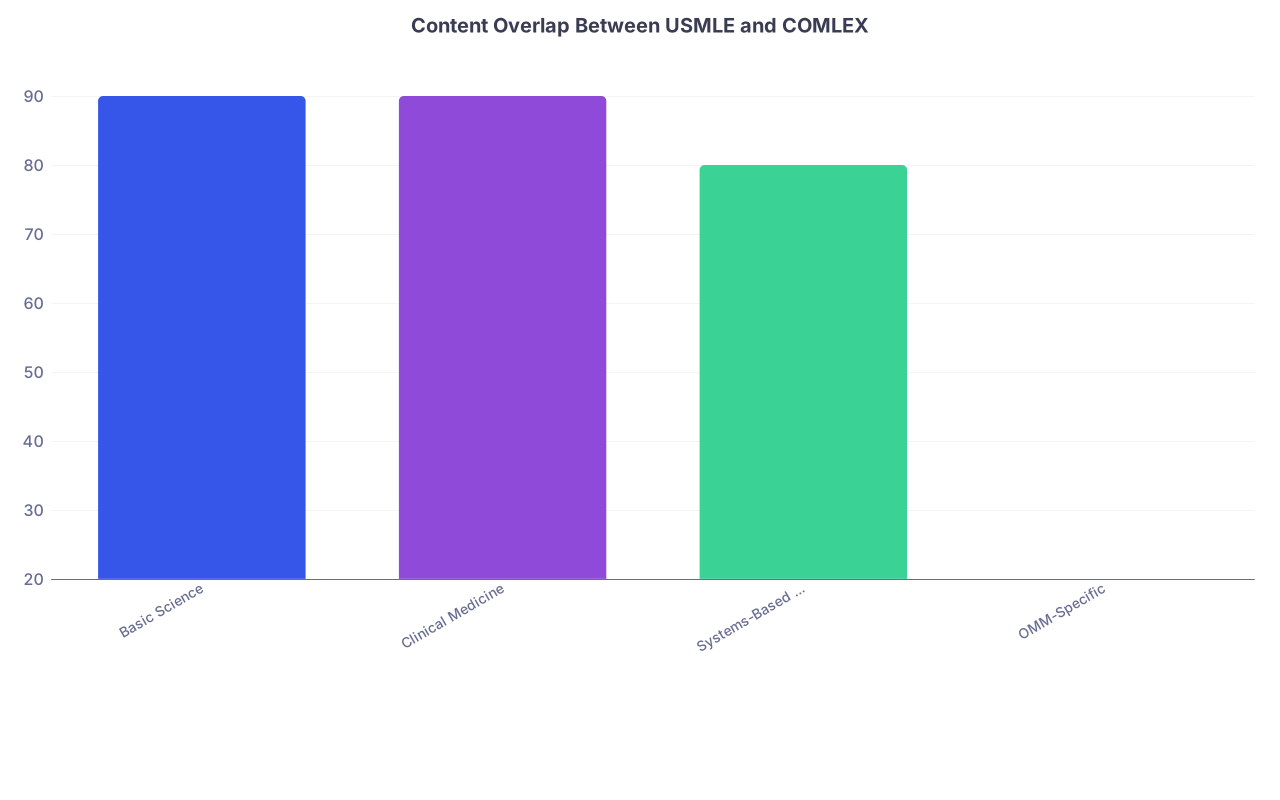
Here’s a rough comparison of what boards are testing:
| Category | Value |
|---|---|
| Basic Science | 90 |
| Clinical Medicine | 90 |
| Systems-Based Practice | 80 |
| OMM-Specific | 20 |
Interpret that the right way: USMLE and COMLEX are largely overlapping in the first three domains—basic and clinical science, systems-based practice. COMLEX adds OMM. USMLE doesn’t. That’s the primary testing difference.
If DO schools were training students with an alien curriculum, their students would crash and burn on USMLE. They don’t. That’s your proof.
Is there some score gap on average between MD and DO students on USMLE? Yes. But that isn’t proof of a different curriculum; it’s mostly selection bias and admissions filtering. MD schools, especially highly ranked ones, pull in applicants with higher GPA/MCAT. Shockingly, they do better on standardized tests. That’s not earth-shattering.
The content? It’s convergent.
Clinical Rotations: Where the “Difference” Mostly Disappears
Here’s where the “completely different” myth collapses entirely: clinical years.
Third and fourth year, your world stops being “MD vs DO curriculum” and starts being “what does this hospital actually let me do on service?”
On rotations, DO and MD students:
- Often share the same clinics, hospitals, and preceptors.
- Present the same patients, write the same notes, get pimped on the same questions.
- Get evaluated on the same basic things: knowledge, work ethic, communication, reliability.
I’ve watched an MD and a DO student both staffed by the same attending. Neither the patient nor the nurse nor the attending cared about their degree while deciding whose plan was better. The attending cared who knew the right dose of vancomycin and who could interpret the EKG.
Want a brutal truth? Plenty of MD students and DO students both look underprepared on their first inpatient medicine month. That’s not because of the letters after their name. It’s because decoding sepsis management at 2am on a call night is hard for everyone.
Where you might see a difference is in how formalized the clinical training structure is:
- Some older osteopathic schools rely more on community hospital rotations, with variable structure.
- Some newer MD schools do the same.
- Some DO schools now have very robust, academic, tertiary-center rotations shared with MD students.
This is program-specific, not degree-specific. The myth that DO students “never see sick patients” and MD students “only see cutting-edge tertiary care” is childish. I’ve seen DO students on trauma surgery at large Level I centers. I’ve seen MD students doing rotations in tiny community sites where the sickest patients get shipped out.
Curriculum differences in the pre-clinical years shrink dramatically once you’re both standing in the same ICU looking at the same ventilator settings.
Where The Myth Actually Comes From
So if the curricula are mostly overlapping, why does the “completely different” idea refuse to die?
A few sources.
First: premed culture. Premeds love binary stories: MD is X, DO is Y. It’s cleaner than dealing with nuance. They repeat half-understood lines from Reddit, YouTube, or a cousin who “heard DOs don’t learn real medicine.”
Second: branding and philosophy. Osteopathic medicine talks loudly about “treating the whole person,” “structure and function,” and “mind-body-spirit.” MD schools rarely use that language anymore, even though most of their good clinicians practice that way in reality. So premeds confuse branding with curriculum content.
Third: OMM skepticism. Some DO students themselves are ambivalent about how much of OMM is backed by high-level evidence in various conditions. Some like it. Some tolerate it. A subset hate it and never use it again after boards. That internal debate leaks into the public and gets exaggerated into “DO = pseudoscience curriculum.” That’s lazy and inaccurate.
Fourth: older history. Decades ago, there really were bigger practical gaps—fewer shared hospitals, separate residencies, less alignment in exams. People are still repeating stories that are 20+ years out of date.
But you’re applying and training now, not in 1980. The single accreditation system for residencies, increasing DO presence in competitive specialties, and widespread USMLE-taking by DO students have forced curricula to converge.
What Actually Matters For You (And What Doesn’t)
If you’re premed or early med school and obsessing about “completely different curricula,” you’re staring at the wrong thing.
Things that matter:
- Can you pass (and ideally excel) on the same standardized exams as everyone else?
- Does your school prepare you realistically for residency expectations?
- Are your clinical rotations solid enough that you’ve actually managed sick patients, not just shadowed endlessly?
- Does the school’s track record in the specialties you’re considering line up with your goals?
Things that do not matter as much as Reddit insists:
- Whether your immunology lecture uses one slightly different classification scheme.
- Whether your anatomy lab is 5 hours a week or 7.
- Whether you spend an extra half-day per week learning OMM in first year.
If you want IM, EM, FM, peds, psych, anesthesia—DO vs MD curriculum will not make or break you. Your step/COMLEX performance, clinical performance, and letters will.
If you want ultra-competitive fields like derm, ortho, plastics, ENT—then yes, the label after your name still influences gatekeeping at some programs. But that’s about bias, connections, and school reputation. Not curriculum content. DO students matching those fields didn’t do it because their curriculum was “completely different.” They did it by mastering the same core medicine and then overperforming on boards and rotations.
The Boring-but-True Reality
Let me put the knife in cleanly.
Are DO and MD curricula identical? No.
Are they “completely different”? Also no. Not remotely.
They are:
- Largely overlapping in basic science and clinical content.
- Structured slightly differently school-to-school, regardless of degree.
- Divergent in one major area: DO schools add OMM/OPP; MD schools don’t.
By the time you’re on the wards, most of what you’re judged on has nothing to do with whether you sat through a lecture titled “Osteopathic Principles” or “Doctoring I.” It’s: do you know the medicine, can you function on a team, and do people trust you with patients.
If your mental model is “MD = real doctor curriculum, DO = alternative doctor curriculum,” throw it out. The data, the exams, and the real-world training do not support that story.
Key Takeaways
- MD and DO programs teach overwhelmingly similar core medical content; the major consistent difference is that DO schools add OMM/OPP, not replace standard medicine with it.
- Clinical years and board exams prove the overlap—DO and MD students are trained to handle the same patients, in the same system, judged by the same standards.