You are a college junior, staring at your spreadsheet of schools. Half are MD, half are DO. You care about academic medicine, teaching, maybe even running a lab. Somewhere in the last week, someone told you: “If you want research or an academic career, you have to go MD. DO will close doors.”
Now you are stuck. Because you actually like osteopathic philosophy. You like the smaller feel of many DO schools. But you do not want to kill your chances at:
- A university-based residency
- A research-focused career
- A faculty appointment at a big academic center
Here is the blunt truth:
You can absolutely build a serious academic and research career as a DO. It is harder on average, the default path is not set up for you, and you cannot coast. But it is doable, and I have seen people do it repeatedly.
This article is the playbook. Not vague encouragement, but what you actually need to do, step by step, from premed through medical school to position yourself as a DO for academic medicine and research careers.
1. Understand the Battlefield: How DO vs MD Actually Plays in Academia
Before you decide how to position yourself, you need to understand what you are up against. Not the Reddit myths. The actual structure.
Where DOs are at a disadvantage for academic tracks
- Brand recognition: Many academic departments are still MD-dominant. Chairs trained in the era when DOs were almost never on faculty. Some still think that way.
- Pipeline: A lot of MD schools have:
- Built-in research years
- Strong NIH funding
- Embedded MD/PhD programs
- Long-standing partnerships with academic residencies
- Research infrastructure:
- Many DO schools are newer, suburban, or community-based
- Fewer full-time research faculty
- Less NIH money per capita
- Fewer “big name” mentors with pull at top residencies
Where DOs absolutely win and can leverage it
- Clinical reps: DO students often get tons of patient contact and hands-on training. That can translate into strong letters and clinical performance.
- Underdog effect: When a DO shows up with:
- Strong USMLE scores
- Multiple posters / publications
- Clear commitment to academics
You stand out more than yet another “standard issue” MD applicant.
- Demand for educators: Academic centers need people who enjoy teaching and can handle service-heavy roles. Many DOs are excellent in that lane and then build research on top.
Let me be clear:
If you want a career where 70–90% of your time is bench research at a place like Mass General, UCSF, or Hopkins, going MD (ideally MD/PhD) is the more rational path.
If you want:
- A university faculty job
- Some protected time for research / QI / education
- A mix of teaching, clinical work, and scholarship
Then DO is absolutely compatible. You just need a more deliberate strategy.
2. Premed Stage: Set Up Your “Academic Identity” Early
You are premed now. This is where most people screw up: they spend all their premed years just chasing an acceptance. You need to use this phase to start branding yourself as “future academic physician” regardless of MD or DO.
Step 1: Get real research experience (not just checkbox shadowing)
Do not confuse “I volunteered in a lab one summer, washing glassware” with “I am building an academic trajectory.”
You want:
- At least 1–2 years of consistent research involvement
- Ideally:
- A poster presentation
- Or a co-authorship (even middle author is fine early on)
Where to find it:
- Your university’s biology/chem/psych departments
- Medical school affiliates (if your college is near one)
- Clinical research programs at hospitals
Your immediate goals:
- Learn basic research methods (stats, study design, data handling)
- Show reliability: same lab, long-term involvement
- Build 1–2 strong relationships with PIs who can later write letters
This does two things for your future DO application:
- Shows DO schools you are serious about scholarship and can handle academic work.
- Gives you a story and skillset you can continue in medical school.
Step 2: Be strategic about where you apply (DO vs MD mix)
If you know you want academic medicine, do not just apply blindly to every DO school on Earth. Some DO schools are far more academically friendly than others.
Look for:
- DO schools with:
- Affiliation with large university hospitals
- Existing research tracks or scholarly concentration programs
- Home residencies in university-linked systems
Pay attention to:
- Where their graduates match:
- How many get academic / university-based residencies?
- Are there grads at places like UPMC, Mayo, Cleveland Clinic, etc.?
- Faculty pages:
- Any NIH-funded faculty?
- Do they publish regularly?
You want a DO school where:
- You can realistically access:
- Research mentors
- Big hospital systems
- Academic-style rotations
If that means you turn down a DO acceptance in a very rural, isolated, community-only environment in favor of a slightly “less shiny” DO school with better academic access? That is the right decision if you are serious about academics.
3. Medical School as a DO: Your Academic Strategy Blueprint
Once you are in a DO program, your default path is not toward academic medicine. Your default is toward solid community practice. You cannot follow the crowd.
Here is the basic framework:
Core priorities you must hit as a DO aiming for academic medicine
- Crush standardized exams (USMLE + COMLEX)
- Build a research portfolio with continuity
- Attach yourself to academic centers, not just community sites
- Network early with university-based faculty in your target specialty
- Show evidence of teaching / leadership
Let’s go one by one.
4. Exams: Why Your Scores Matter Even More as a DO
Whether we like it or not, big academic centers still use board scores as screening tools. As a DO, you need to send a clear message: “I can compete at the MD level.”
Concrete protocol:
- Take USMLE Step 1 and Step 2 in addition to COMLEX.
- Yes, even if your school says COMLEX is enough.
- Many academic residencies still look for USMLE because their filters and historic data are built around it.
- Aim high, not just “pass”:
- You are trying to de-risk your DO degree in the eyes of skeptical programs.
- That means your USMLE scores need to be above average for your chosen specialty, ideally top quartile.
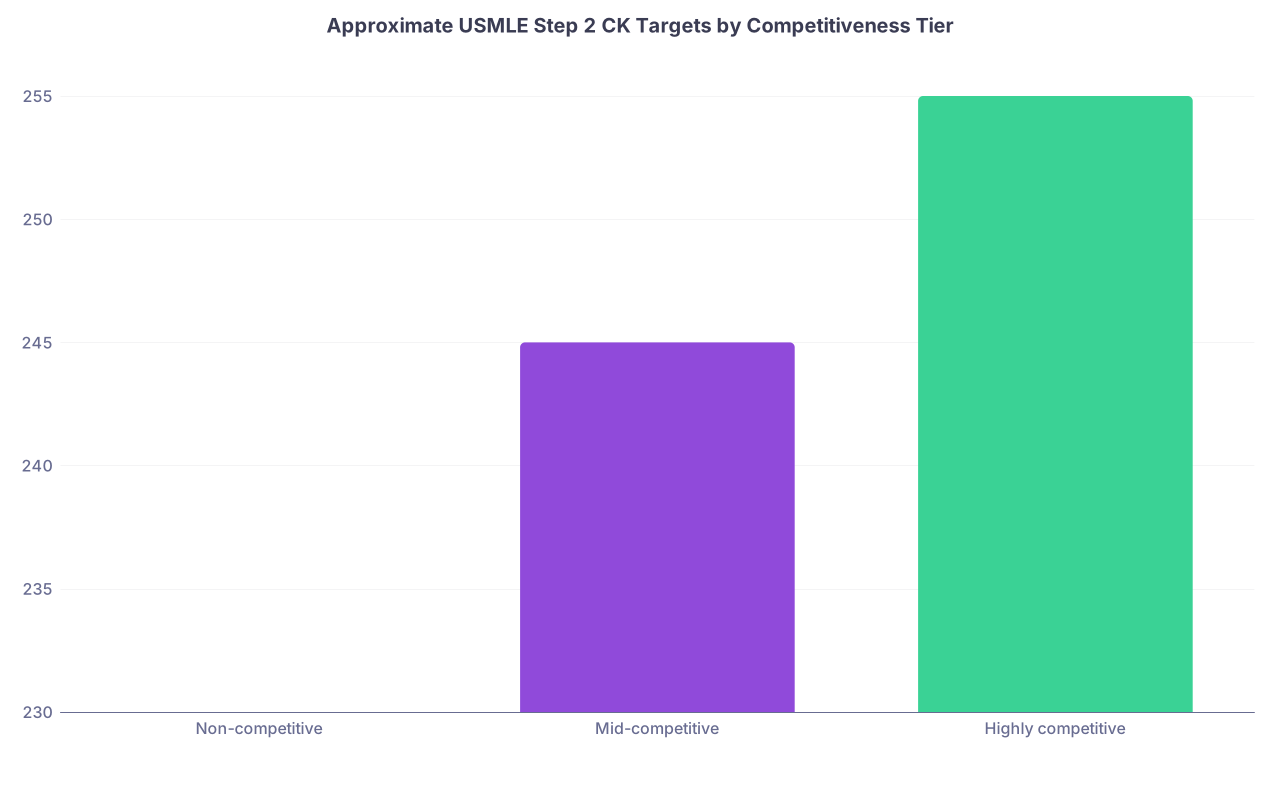
| Category | Value |
|---|---|
| Non-competitive | 230 |
| Mid-competitive | 245 |
| Highly competitive | 255 |
If you want:
- Academic family medicine or pediatrics → 235–245 is competitive
- Academic internal medicine, psych, neurology → 240–250+ is stronger
- Academic derm, ortho, ENT, neurosurgery as a DO → frankly you want 255+ and still need stars to align
Is this fair? No. Is it reality? Yes.
How to prep differently if you are aiming at academic tracks
- Treat Step 2 like your “flagship” academic metric.
- Use question banks aggressively (UWorld, Amboss).
- Start earlier than classmates who are just trying to pass COMLEX.
- Do NBME practice exams, and do not sit for the test until your practice scores are in your target range.
People will complain that this is overkill. Those people are usually not getting academic offers.
5. Building a Research Portfolio as a DO: Tactics That Actually Work
This is the part everyone hand-waves: “Just do research.” Useless advice. Here is what I mean by research that moves the needle for a DO student.
Step 1: Start locally, then expand externally
In preclinical years:
- Identify:
- Any faculty at your DO school with a research track record (even modest).
- Clinical faculty at affiliated hospitals doing QI or clinical projects.
- Approach them with:
- “I am interested in academic medicine and would like to get involved in research or quality improvement. I am willing to do data entry, chart review, or help with literature reviews to start.”
Do not lead with “I want to publish in NEJM.” You need to show you can be useful first.
Your initial goals:
- Get on:
- One QI project
- One case report / case series
- Or a small retrospective study
These are realistic starting points in many DO environments.
Step 2: Use summers and elective time for external research
Most DO schools have less rigid research infrastructure. So you import the research environment from outside.
Targets:
- Summer between MS1 and MS2
- Elective time in MS3/MS4
- Research electives at university hospitals
How to do it:
- Identify academic departments in your target specialty at:
- Nearby MD schools
- Large teaching hospitals
- NIH-funded centers
- Cold email faculty:
- Attach CV
- Brief statement: DO student, interested in their work, willing to help with ongoing projects, flexible, can do remote data work.
- Expect a low response rate. That is fine. You only need 1–2 mentors.
Once in, you become:
- The person who:
- Cleans up datasets
- Writes first drafts of intro/discussion sections
- Helps with IRB submissions
- Builds tables and figures
From this, you want:
- Posters at national meetings
- PubMed-indexed manuscripts
- Strong letters from MD faculty at academic institutions
Step 3: Stack simple wins, do not chase unicorns
You do not need a Nature paper. You need a pattern:
- Multiple small- to medium-scale projects, consistently:
- 2–4 posters by graduation
- 1–3 manuscripts (even if some are case reports or small series)
- Ongoing involvement with one lab or PI
This tells residency programs:
- You know how research works
- You can finish projects
- You are not romantic about it—you can do the unglamorous parts
6. Clinical Rotations: Put Yourself in Academic Rooms, Not Just Community Clinics
Many DO schools rely heavily on community-based rotations. That is fine for most students. It is a problem for you, if you want academic medicine.
Your job is to hack your rotation schedule.
Priority: Secure university-based or large teaching hospital rotations
You need:
- At least some core or elective rotations at:
- University hospitals
- VA academic centers
- Large teaching hospitals with residency programs
Why?
Because this is where:
- Real academic attendings see you work
- You can get letters from people residency PDs actually know
- You observe residents and faculty involved in research
How to engineer this:
- Ask your school early:
- Which sites have residents?
- Which are affiliated with MD schools?
- Which have track records of strong letters/matches?
- Volunteer for those even if:
- Commute is worse
- Hours are harsher
- Grading is tougher
You are not playing for convenience. You are playing for career trajectory.
Away rotations (MS4)
This is absolutely critical for DOs targeting academic residencies:
- Do away rotations at programs you actually want to match at, especially:
- University internal medicine
- Peds
- Psych
- Neuro
- Surgical subspecialties
During these rotations:
- Show up early.
- Read about patients.
- Offer to help with small QI or case reports.
- Meet with the program director briefly to state your interest in academics.
This is where you convert your DO background + exam scores + research into actual offers.
7. Branding Yourself as “Future Faculty”: Beyond Research
Academic careers are not just about research. They are about teaching and leadership. You need to build that identity early.
Teaching
Look for chances to:
- Tutor underclassmen in anatomy, OMM, path, etc.
- Serve as a teaching assistant for labs or small groups.
- Lead peer teaching sessions for COMLEX/USMLE prep.
Academic programs like:
- Applicants who can help teach medical students and residents
- People who already have experience explaining concepts
Leadership and committees
Pick 1–2 things and do them well:
- Curriculum committee
- Research committee
- Student-run journal club
- Specialty interest group leadership
Then act like a resident already:
- Show up
- Get things done on time
- Keep minutes
- Drive small projects to completion
8. Choosing a Specialty and Target Programs as a DO with Academic Ambitions
Not every specialty is the same in how it treats DOs academically.
More DO-friendly for academic careers
- Internal Medicine
- Pediatrics
- Family Medicine
- Psychiatry
- Neurology
- PM&R
- Emergency Medicine (somewhat)
These fields have plenty of DO faculty at academic centers. Many program directors are open to strong DO candidates.
More uphill but not impossible
- General Surgery
- Anesthesia
- OB/GYN
- Radiology
- Pathology
You will need stronger scores and more robust research, but it is not fantasy.
Very steep as a DO aiming for traditional academic “ivory tower” careers
- Neurosurgery
- Orthopedic Surgery
- ENT
- Dermatology
- Plastics
People do it. But I will not pretend it is common. If this is your aim, you must:
- Dominate exams
- Have serious research output early
- Network aggressively
- Accept that odds are not in your favor despite your best work
For most students asking this question, academic internal medicine, pediatrics, psych, or neuro are the realistic and solid lanes.
9. Residency: Turning “Academic Interest” into a Real Career Path
Once you land a residency—ideally at a university or strong teaching hospital—you are halfway there.
Now the mistakes shift. Many DOs get into academic programs and then do not follow through on the academic part.
During residency, you should:
Join or build a “scholarly track” if your program has one.
Attach yourself to 1–2 faculty who publish regularly.
Produce something every year:
- PGY1: case report or poster
- PGY2: small retrospective study or QI project
- PGY3+: manuscript from your project, maybe second project starting
Teach intentionally:
- Lead morning report
- Run simulation or skills teaching for students
- Give noon conferences with decent slides and real prep
Make your career goals explicit:
- Tell your PD and mentors: “I want to stay in academic medicine. I am interested in a faculty role or fellowship at an academic center.”
Academic careers often come from being on peoples’ minds when positions open. Not from random online postings.
10. Alternative Academic Lanes for DOs: Not Just Bench Research
You do not need to be a basic science researcher to have an “academic” career.
Many DOs successfully position themselves in:
- Clinical research:
- Trials, observational studies, outcomes research
- Quality improvement and patient safety:
- Hospital-level QI roles, safety committees, system redesign
- Medical education scholarship:
- Curriculum design
- Evaluation research
- Simulation-based education
These paths are much more available at many institutions and are often more practical for DOs coming from less research-heavy schools.
The formula is the same:
- Show serious engagement
- Produce scholarly output (posters, manuscripts, workshops)
- Get involved in national societies and present your work
11. If You Are Still Premed and Undecided: How to Decide DO vs MD for Academic Aspirations
Let me strip away the noise.
You should heavily favor MD if:
- You are obsessed with bench research or translational lab science.
- Your career goal is 50–80% protected research time.
- You want a major NIH R01-funded career at top 10 research institutions.
- You have the stats to get into mid-to-top-tier MD schools (and ideally MD/PhD).
You can choose DO confidently if:
- You want:
- An academic teaching career
- Some research (clinical/QI/education)
- University-based practice or hybrid academic-community practice
- You are willing to:
- Grind harder to prove yourself with exams
- Actively seek research opportunities
- Plan rotations and networking more aggressively
What you cannot do:
- Choose DO, then follow the average DO student trajectory, and expect MD-style academic outcomes. That is fantasy.

| Step | Description |
|---|---|
| Step 1 | Premed |
| Step 2 | Research Experience |
| Step 3 | Apply to DO Schools with Academic Links |
| Step 4 | DO Matriculation |
| Step 5 | Preclinical: Start Local Research |
| Step 6 | Take USMLE + COMLEX |
| Step 7 | External Research at Academic Centers |
| Step 8 | Clinical Rotations at Teaching Hospitals |
| Step 9 | Away Rotations at Target Programs |
| Step 10 | Match into Academic Residency |
| Step 11 | Resident Research & Teaching Track |
| Step 12 | Apply for Academic Faculty or Fellowship |
FAQ (Exactly 3 Questions)
1. Can a DO become a program director or department chair at an academic institution?
Yes, and many already have. You will see DOs as PDs in internal medicine, EM, family medicine, psych, and more. Chair roles are more MD-heavy, especially at elite institutions, but DOs do reach those positions. The path is the same as for MDs: strong clinical reputation, steady scholarly output, leadership roles, and sustained involvement in the institution. The DO letters on your badge are not the main limiter at that point—your performance over years is.
2. If my DO school has almost no research, is it still realistic to aim for academic medicine?
Yes, but you must treat external opportunities as non-negotiable. You lean heavily on: summer research at nearby MD schools, remote projects with academic mentors, and research electives away from your home institution. Many residents in academic programs came from smaller or less research-heavy schools and built their CV externally. It is more work logistically, but not a dealbreaker.
3. What is the minimum research output I should aim for as a DO who wants an academic residency?
There is no strict minimum, but patterns matter. For a DO aiming at academic IM, peds, psych, or neuro, I would target by graduation: at least 2–3 posters at regional or national meetings and 1–2 PubMed-indexed publications (even if some are case reports or small retrospective studies). More is better, especially for competitive specialties, but a consistent record of completed projects plus strong letters often beats one big fancy project that never got finished.
Key Takeaways
- A DO degree does not block you from academic medicine, but it does mean you cannot coast—you must over-prepare on exams and be intentional about research and rotations.
- Use every stage—premed, DO school, and residency—to build a coherent academic identity: research involvement, teaching, and ties to academic centers.
- Choose your school, specialty, mentors, and rotation sites with one lens: “Does this bring me closer to being the kind of physician a university program would want on faculty?” If the answer is yes, move toward it. If not, adjust.