It is M1 orientation week. You just got your white coat. People are still figuring out where the bathrooms are. And someone has already said it:
“If you want derm or ortho, you probably should’ve gone MD.”
You laugh it off. But it sticks.
Then you Google. You see match stats. Cutoffs. Horror stories on Reddit. Now you are sitting there wondering:
Is this actually possible for me as a DO? Or am I already screwed?
Let me be direct:
You are not screwed. But you cannot play this like everyone else and expect a miracle.
If you want a competitive specialty as a DO (derm, ortho, ENT, plastics, neurosurgery, urology, radiation oncology, competitive anesthesia or EM programs, etc.), you need a deliberate, aggressive, step-by-step plan starting before Day 1 of school and running through graduation.
This is that plan.
Step 1: Get Extremely Clear on the Playing Field
You cannot “work hard and see what happens.” That is how DO students end up shocked in March.
Here is the landscape you are walking into as a DO aiming for a competitive specialty:
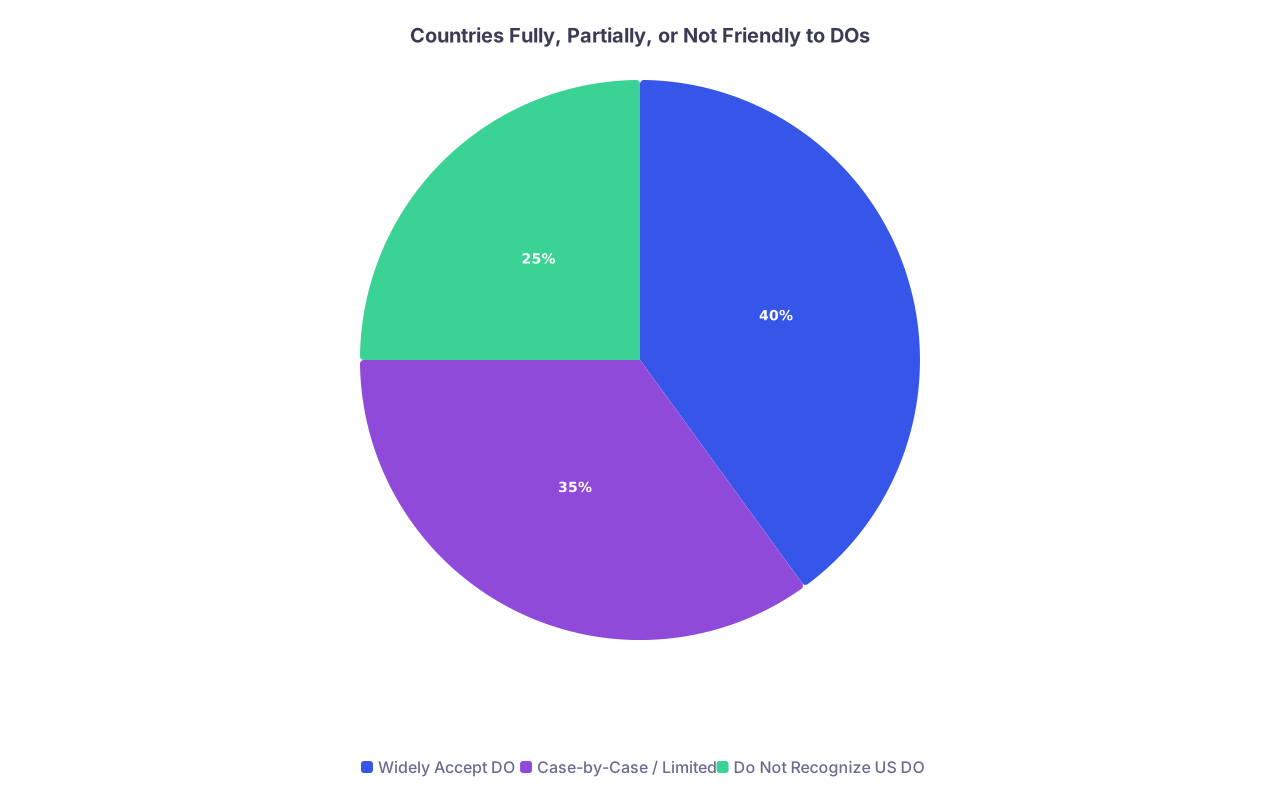
- You are competing primarily in the ACGME (MD-dominated) Match.
- Many competitive programs:
- Still favor MDs.
- Filter out DO applicants by default.
- Expect USMLE Step 2 scores, not just COMLEX.
- DOs do match into derm, ortho, ENT, etc. every year. But they are usually:
- Top of class.
- Strong USMLE scores.
- Solid research with at least one or two publications.
- Good away rotations and strong letters.
- Often with early mentorship and clear planning.
So the rule is this:
As a DO, you do not have room for “average” if you want a very competitive field. You need to be consistently above average across several domains.
Those domains:
- Board exams (COMLEX + USMLE, especially Step 2).
- Clinical performance and letters.
- Research and academic output.
- Networking (mentors, away rotations).
- Strategic applications.
We are going to build you a phase-based plan that starts premed and runs through fourth year.
Step 2: As a Premed – Set Yourself Up Before You Ever Matriculate
If you are still premed, you have more control than you think. You cannot control whether you get into an MD vs DO program. But you can control where, and how strategically you choose.
2.1 Choose the Right DO School
Not all DO schools are equal for competitive specialties. Some are quietly much stronger pipelines than others.
Look for:
- Historic match lists:
Scan the last 3–5 years. Do they place into:- Ortho (ACGME programs, not just small community ones)?
- Dermatology?
- ENT, neurosurgery, urology, plastics, interventional radiology?
- Affiliation with academic centers:
- DO schools tied to large systems (e.g., MSUCOM with Michigan hospitals, PCOM with big northeast systems, TCOM with Texas systems, CCOM with Chicago area hospitals) usually have better access to:
- Research.
- Teaching hospitals.
- Subspecialty mentors.
- DO schools tied to large systems (e.g., MSUCOM with Michigan hospitals, PCOM with big northeast systems, TCOM with Texas systems, CCOM with Chicago area hospitals) usually have better access to:
- USMLE culture:
- Ask current students:
- “Does your school support taking USMLE?”
- “How many people take it?”
- “Are there built-in resources or just ‘do your own thing’?”
- You want a school where taking USMLE Step 2 is considered normal and supported.
- Ask current students:
If you already signed an offer at a weaker school for competitive specialties, fine. You just lost some institutional help. You are not done. But you must compensate with more deliberate planning.
2.2 Enter Medical School With a Rough Specialty Tier in Mind
You do not need to know “I want to be a Mohs surgeon” at 22. But you should roughly know:
- Tier 1 (most competitive): Derm, plastics, ortho, ENT, neurosurg, urology, IR, sometimes optho (SF Match).
- Tier 2 (still very competitive): EM at desirable programs, anesthesia at big academic centers, radiology at top sites, GI/heme-onc down the line via IM.
- Tier 3 (moderate): IM, peds, FM, psych, etc. (some fellowships later can still be highly competitive).
If you are even leaning toward Tier 1 or 2, you must behave like a competitive applicant from Day 1 of M1.
Step 3: M1–M2 – Build the Academic and Test-Score Spine
This is where most DO students aiming high either set themselves up or quietly eliminate themselves.
3.1 Your Core Job in M1–M2
Three non-negotiables:
- Crush your classes – Honors or high pass where graded.
- Prepare for COMLEX and USMLE Step 1/2 from the start – Even with Step 1 now pass/fail, the habits matter.
- Lay early research groundwork in your potential fields.
Everything else (club presidency, over-involved volunteering, random side projects) is secondary if they threaten those three.
3.2 USMLE vs COMLEX Strategy (as a DO Going Competitive)
If you want a competitive specialty, do not play games here.
- Take COMLEX Level 1 and 2 (obviously required).
- Strongly consider USMLE Step 2 CK. Step 1 is now pass/fail, but:
- Many programs in competitive fields still expect or implicitly prefer USMLE.
- Program directors understand USMLE score ranges better than COMLEX percentiles.
- A strong Step 2 CK as a DO is a signal: “I can compete on the same exam as your MD applicants.”
Order of operations usually:
- M2 end: COMLEX Level 1 (and Step 1 if your school supports it and you want the extra practice).
- M3/M4 early: COMLEX Level 2 and USMLE Step 2 CK after you have strong clinical base.
You need to assume:
- For truly competitive specialties, your Step 2 needs to be at or above the MD average for that field. Not DO average. MD average.
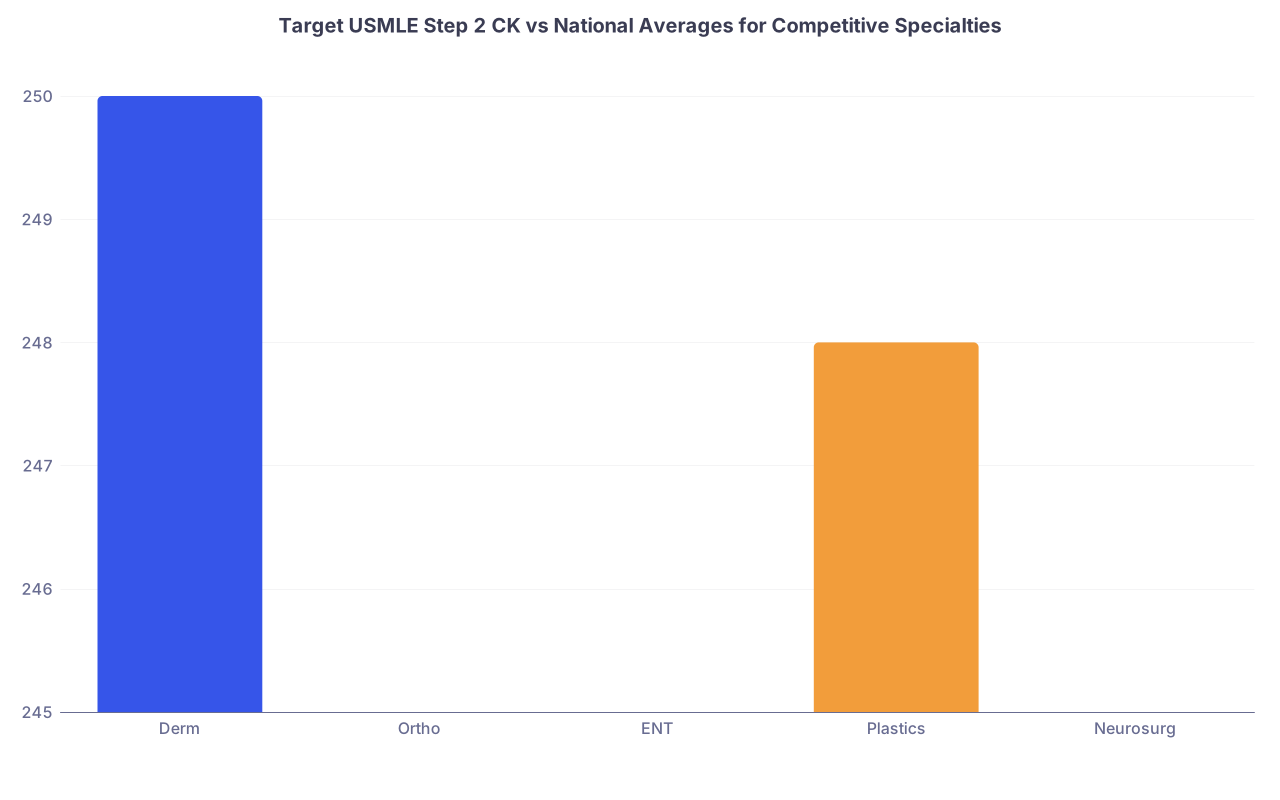
| Category | Value |
|---|---|
| Derm | 250 |
| Ortho | 245 |
| ENT | 245 |
| Plastics | 248 |
| Neurosurg | 245 |
Those numbers move year to year, but the concept stands: you are not aiming for “above 240.” You are aiming to be in or above the interview-worthy range for MD students in that specialty.
3.3 Actual Study Approach for M1–M2 (No Fluff)
Here is a straightforward structure that works for DOs who later match competitively:
Daily (M1–M2):
- Watch or attend required lectures. Do not obsess over every slide.
- Same day:
- Targeted Anki: 30–90 minutes using a vetted deck (AnKing / Lightyear) tied to your boards resources.
- 20–40 board-style questions (COMBANK, UWorld, AMBOSS) focused on systems you are studying.
- Weekly:
- 1–2 hours reviewing weak topics in First Aid / Boards & Beyond / similar.
Do not wait until “dedicated” to see your first board-style question. I have seen that mistake ruin people.
Dedicated period plan (for COMLEX 1 / Step 1):
- 6–8 weeks total.
- 60–80 UWorld questions per day, timed, mixed, plus OMM/DO-specific bank (COMBANK or TrueLearn).
- Daily review of all missed questions; make Anki from your misses.
- 1 practice NBME or COMSAE every 1–2 weeks, adjust plan.
Your goal: not just pass COMLEX. You want to step into clinical years with:
- Strong core knowledge.
- Test endurance.
- A realistic shot at a strong Step 2, which is what will actually be scored.
Step 4: Early Mentorship and Research – Start Before You “Need” It
Waiting until M3 to “get involved in research” for derm or ortho is how you end up with a half-finished abstract and nothing on your CV.
4.1 Find a Real Mentor, Not Just a Name
You want:
- A physician in (or closely related to) the specialty you are aiming for.
- Ideally at a residency program or major hospital with residents.
- Someone who has actually taken DOs seriously before. You can ask directly:
“Have you worked with DO students applying to your specialty before?”
Sources:
- Your school’s clinical faculty directory.
- Alumni lists (DO grads who matched into your field).
- Local academic centers where your school has rotation agreements.
- Specialty interest groups (e.g., AOAO for ortho, AAD for derm, etc.).
Your email to them should not be a pathetic “Hi I’m a student please mentor me.”
Try:
- 3–4 sentences.
- Who you are, your interest, and specific ask.
Example:
“I am an OMS-I at [School], interested in orthopedic surgery. I saw that you are faculty at [Hospital] and work with residents. I am trying to build a realistic pathway toward being a strong ortho applicant as a DO. Would you be willing to meet briefly (20 minutes) to get your perspective on what ortho programs look for and how I can start aligning my early years to that?”
Sit down. Listen. Take notes. Ask direct questions:
- “Do DOs from my school get interviews in your program?”
- “What USMLE/COMLEX scores and research output do you typically see in your matched residents?”
- “What are common red flags?”
4.2 Get Into Research Without Wasting Time
You do not need to cure cancer. But you do need to be academically useful.
Best research targets for DOs in competitive specialties:
- Clinical projects with shorter timelines:
- Retrospective chart reviews.
- Case series.
- Single case reports (fine as starter, not enough alone).
- Quality improvement or education projects that:
- Lead to posters at national or regional specialty meetings.
- Put you in front of faculty and PDs.
You want:
- By end of M3:
- At least 1–2 posters/presentations.
- Ideally 1+ submitted or accepted publication (even as middle author).
Doable if you start M1/M2, work with motivated residents/fellows, and do not flake.
Red flag behavior I see:
- Joining 4–5 projects and dropping 3.
- Insisting on “basic science because it looks better” and then producing nothing.
- Ghosting residents who offered help.
You are better off with 2 finished projects and a PD who knows your name than 8 half-done “works in progress.”
Step 5: Clinical Years (M3) – Build a Reputation and Get Your Letters
M3 is where many DOs trying for competitive fields get quietly disqualified. Not because they are bad, but because they are forgettable.
5.1 Core Rotations: Be the Student Residents Want Back
On any surgical or competitive rotation, your job:
- Show up early. Actually early. Pre-round before rounds.
- Know your patients cold. Vital trends. Labs. Imaging. Plan.
- Be teachable:
- Ask focused, non-Googleable questions.
- Accept feedback without arguing or excuses.
- Be useful:
- Volunteer for consults.
- Help write notes if allowed.
- Stay late when something interesting is happening (case, procedure, rare pathology).
Why? Because the residents and attendings write your letters and later vouch for you.
You need 2–3 strong letters in your specialty or close field. Strong means:
- They remember your name.
- They have specific stories to tell:
- “Stayed late for a complex case.”
- “Took ownership of complex patients.”
- “Strong fund of knowledge comparable to our MD rotators.”
5.2 Protect Your Shelf Performance and Clinical Evaluations
For competitive specialties:
- Clerkship grades and shelves do matter.
Honors or high pass on:- Surgery.
- Internal Medicine.
- Your specialty-specific rotations.
Study style:
- 20–30 UWorld / AMBOSS questions daily targeted to each clerkship.
- Half-day per week reading around your patients using real sources (UpToDate, specialty guidelines).
If your school gives class rank or quartiles, you want top quartile. Minimum top half. Otherwise you are fighting an uphill battle.
Step 6: Step 2 CK and COMLEX Level 2 – Your Make-or-Break Exams
Step 2 CK is now the scored exam that many PDs use as the primary numerical filter.
As a DO going for a competitive field, your Step 2 strategy must be ruthless.
6.1 When to Take Step 2 CK
Best timing for most:
- After:
- Core rotations (IM, surgery, peds, OB/GYN, psych, FM).
- COMLEX Level 2 preparation is well underway.
Typical pattern:
- 4–6 weeks of focused Step 2 prep between end of core clerkships and start of heavy audition rotations.
Combine studying for COMLEX 2 and Step 2 CK, but:- UWorld and NBME → Step 2 style.
- Add COMQUEST/COMBANK for OMM/DO-specific content.
6.2 Score Targeting
You should not “just take it and see.” Work backward.
- Look up NRMP Charting Outcomes data for your specialty.
- Find Step 2 CK mean for matched MD seniors.
- Aim at or above that number as a DO.
If you are scoring far below that on practice NBMEs:
- Delay the exam within reason.
- Consider tightening specialty goals (e.g., from derm to IM + derm-adjacent fellowship like rheum or allergy, or radiation oncology vs derm).
Do not lie to yourself here. Programs will not.
Step 7: Strategic Use of Away Rotations (Auditions)
Away rotations can save you as a DO. Or they can be a massive waste of time and money if you choose badly.
7.1 Goals of an Away Rotation
You do aways to:
- Get interview offers from those sites.
- Get letters from well-known faculty.
- Show that you are:
- Hard-working.
- Normal to work with.
- Capable at the level of MD students.
You do not do aways “just to see what a big city is like” or “because my friend went there.” That is tourist thinking.
7.2 How Many and Where
For very competitive specialties (ortho, derm, ENT, etc.):
- 2–3 aways is typical. Sometimes 1 if you are geographically constrained, 3–4 if trying to overcome weaker board scores.
Target programs that:
- Have interviewed or matched DOs recently. You can check:
- Resident lists.
- Ask current residents or alumni.
- Are mid-tier academic or strong community programs, not just “Top 10 name brand.”
- Are in regions where DOs are historically more accepted (Midwest, South, some East Coast) rather than extremely MD-elitist pockets.
On the rotation:
- Treat it like a 4-week interview.
- Do not complain.
- Do not disappear after 3 pm.
- Say “yes” to cases, consults, tasks.
The unspoken rule:
They are asking one question – “Would I want this person as my resident at 3 am on a bad call night?”
Step 8: Application Strategy – Do Not Be Cute
Applications are where DO students often sabotage themselves by trying to “aim only high” and refusing to build in safety.
8.1 Build a Realistic Program List
You need to:
- Target a mix of:
- Programs that have DOs in current or recent classes.
- Some reach programs (fine).
- Enough “solid but not flashy” programs where your stats are competitive or above average.
- Be honest about your geography flexibility.
If you are dead set on one city plus a hypercompetitive field as a DO, you are stacking restrictions on restrictions. Something will break.
As a rough guide:
- Derm, plastics, ENT, neurosurg, ortho:
- 60–80+ applications not crazy for a DO.
- Anesthesia, EM (still selective programs), radiology:
- 40–60.
Overkill? Maybe. But reapplying or scrambling is worse.
8.2 Personal Statement and Experiences
Skip the poetic nonsense. You are not getting into derm because of a metaphor about skin as “the canvas of the human experience.”
Your personal statement should:
- Clearly state why this specialty.
- Show concrete experiences:
- Specific patients.
- Specific rotations.
- Tangible work you did (research, QI, teaching).
- Implicitly answer:
- Why you are reliable.
- Why you work well in teams.
- Why this field will not burn you out in 6 months.
For DO vs MD bias:
- Do not write a manifesto explaining why DO is just as good.
- Do not apologize for being a DO.
- Let your CV, scores, and letters show you belong. Period.
8.3 Signaling (if applicable)
Some specialties now have formal “signaling” (e.g., ortho, ENT in some cycles):
- Use your highest signals on:
- Programs where you have:
- Done away rotations.
- Strong connections.
- Genuine interest and realistic shot.
- Programs where you have:
Do not waste signals on places that have literally never interviewed a DO.
Step 9: If You Miss the Mark – Pivot Without Imploding Your Career
Not everyone hits derm or ortho on the first try. Or at all. That is reality.
What matters is what you do if the numbers or interviews are not lining up.
9.1 Early Signs You Need a Plan B
Red flags that your initial target might be unrealistic:
- Step 2 CK significantly below MD matched mean for that field.
- No interviews by mid-season in a hypercompetitive specialty.
- Honest feedback from mentors: “I don’t think this will happen for you this cycle.”
You have three options:
- Apply more broadly within your field (community-heavy, smaller markets) and accept a higher risk of not matching.
- Dual-apply:
- Example: Ortho + prelim surgery or transitional year.
- Derm + internal medicine.
- Pivot completely:
- Reassess to something like IM, FM, psych, anesthesia, EM (depending on your profile and what is still realistic).
9.2 Do Not Destroy Your Future to Save Your Ego
I have seen DO students cling to a fantasy and end up unmatched. That hurts more than choosing a less prestigious but still excellent field earlier.
Better moves:
- Match into a solid categorical program in a less competitive field, then pursue a competitive fellowship (e.g., rheum, GI, cards, heme-onc, allergy).
- Or match into a field adjacent to your initial interest:
- Missed derm? Consider rheumatology, allergy/immunology, or complex IM with academic focus.
- Missed ortho? Consider PM&R and pursue MSK/spine, sports medicine.
Your career is 30–40 years. The prestige of the specialty is not what makes or breaks your job satisfaction long term. Fit and environment do.
Step 10: Day-to-Day Operating Rules If You’re Serious
Let me condense this into actual behaviors you follow week in, week out.
During M1–M2:
- Treat studying like a job:
8–10 focused hours on weekdays, half-days on weekends when needed. - Questions and spaced repetition every week, not just before exams.
- One research check-in per month with your mentor or resident.
- Regular email follow-up with mentors: short updates, questions, appreciation.
During M3:
- Rotate → Study → Sleep. Repeat.
- On any rotation near your target specialty:
- Be the first to volunteer.
- Show interest without being a fanboy.
- Collect concrete feedback:
- “Where do you see weaknesses I should work on before applying for [specialty]?”
During M4:
- Treat away rotations like a continuous interview.
- Keep a log of:
- Attending names.
- Cases.
- People who might write letters.
- Apply broadly and early. Do not wait until the last week to upload personal statements or finalize lists.
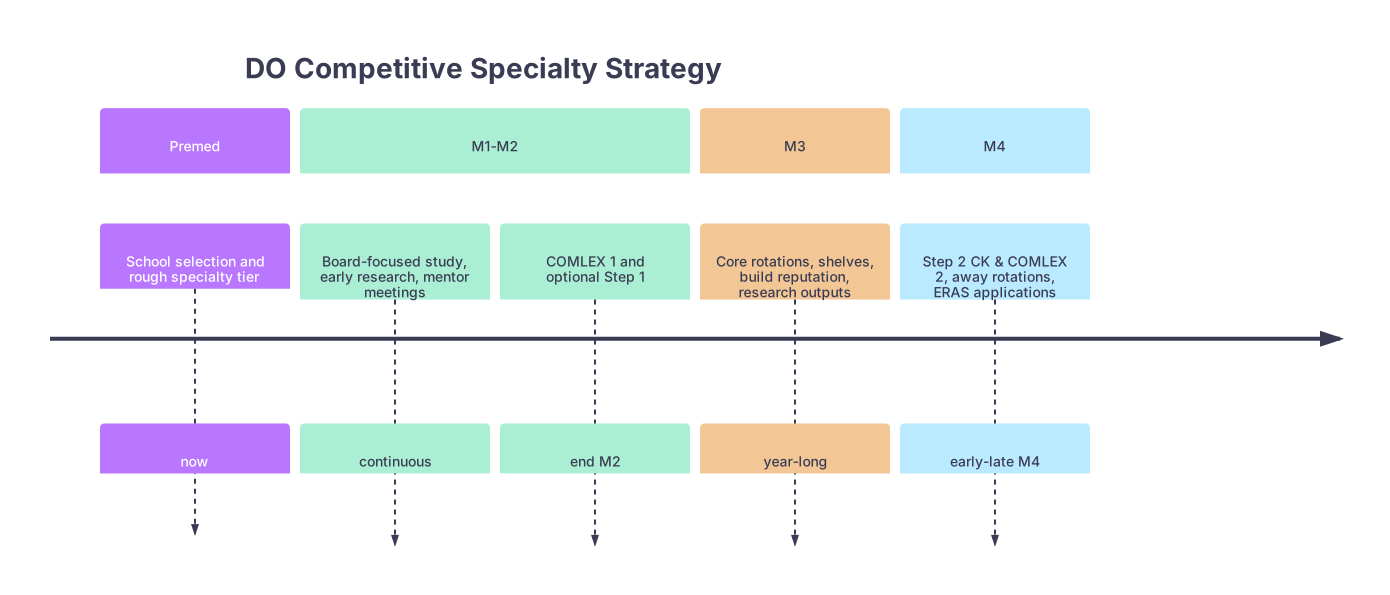
| Period | Event |
|---|---|
| Premed - School selection and rough specialty tier | now |
| M1-M2 - Board-focused study, early research, mentor meetings | continuous |
| M1-M2 - COMLEX 1 and optional Step 1 | end M2 |
| M3 - Core rotations, shelves, build reputation, research outputs | year-long |
| M4 - Step 2 CK & COMLEX 2, away rotations, ERAS applications | early-late M4 |
Final Reality Check
Let me strip this down.
As a DO aiming for a competitive specialty, you need to accept three truths:
The bar is higher for you.
Not fair. Still real. You cannot change the bias. You can outwork it.You must decide early and act consistently.
You do not have the luxury of coasting M1–M2 and “turning it on later.” Your scores, research, and relationships all take time to build.You need both ambition and flexibility.
Aim high with a clear plan: strong boards, serious research, real mentors, smart aways. But be honest enough with yourself to pivot if the numbers and feedback say you should.
If you follow the steps above like a professional, not a tourist, you give yourself a real shot at those “MD-dominated” fields. And even if you pivot, you will land somewhere strong, with options, because you built a serious foundation instead of hoping for a miracle.