If You’re Dual-Applying DO and MD: A Coordinated Application Blueprint
It is late June. AMCAS is finally verified after weeks in the queue. AACOMAS is sitting there half-done in another tab. Your spreadsheet has 40+ schools on it and your brain is running the same loop:
“Am I spreading myself too thin? Am I doing this wrong? Am I going to waste thousands of dollars and still not get in?”
You are not alone. Dual-applying MD and DO is smart when done correctly and a colossal money-fire when done badly. Let’s build you a blueprint so you look like a focused applicant, not someone flailing in every direction.
I am going to walk you through:
- Whether you actually should dual-apply
- How to structure MD vs DO school lists intelligently
- A step-by-step workflow for handling two application systems without dropping balls
- How to write secondaries that are consistent but not copy‑pasted
- How to handle interviews and eventual offers without looking scattered
I will be blunt where needed. There is a right and wrong way to do this.
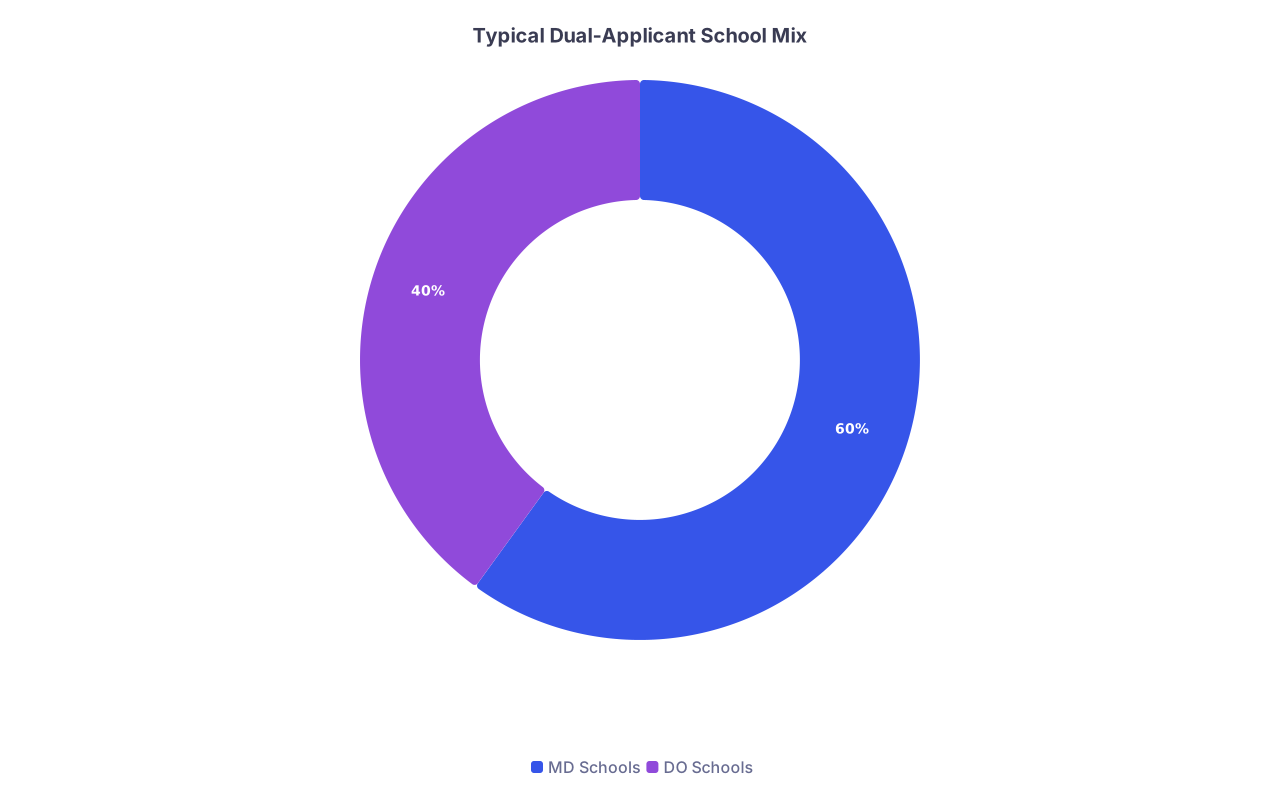
| Category | Value |
|---|---|
| MD Schools | 18 |
| DO Schools | 12 |
Step 1: Decide If You Should Dual-Apply At All
Do not start two application systems just because everyone on Reddit seems to be “doing both.” That is how you end up $5,000 deep with 1 interview.
Ask yourself four hard questions.
1. What are your numbers and trend?
Use this rough grid based on US applicants (not perfect, but close enough to guide strategy):
Strong MD profile (single-apply MD reasonable)
- cGPA ≥ 3.7, sGPA ≥ 3.6
- MCAT ≥ 514
- Upward or stable trend
- Solid ECs with leadership and some research
→ Dual-applying is optional insurance, not mandatory.
Borderline MD / strong DO (ideal dual-apply zone)
- cGPA 3.3–3.6, sGPA 3.2–3.6
- MCAT 504–512
- Upward trend helps a lot
- ECs good but maybe light on research or leadership
→ Dual-applying is strategic, especially if location‑flexible.
Mostly DO (MD only at realistic state/safety programs)
- cGPA 3.0–3.3 (with strong upward trend), sGPA maybe lower
- MCAT 495–503
- Strong clinical, non-trad story, or big upward rescue in post‑bacc
→ Focus DO heavily. Add a few realistic MDs if there is a clear angle (state school, strong mission fit, massive reinvention).
If you are below ~3.0 cGPA or <495 MCAT with no serious reinvention, you should fix your profile first. Throwing two application systems at a weak file does not solve the core problem.
2. How rigid are your location constraints?
Be honest.
- “I must stay in NYC or within 1 hour” = you are not a strong dual‑app candidate unless your numbers are stellar. That kind of geographic rigidity kills options.
- “I prefer a region but I can move for the right school” = dual‑app can work well.
3. What are your career goals?
Some people say this does not matter. They are wrong.
If you are set on highly competitive specialties (derm, ortho, plastics, ENT):
- You can still become these as a DO, but the path is narrower and demands near‑perfect performance later.
- If you are not ready to live with that extra hurdle, you may want to lean MD-heavy or take another cycle to strengthen your MD odds.
If you are aiming for IM, FM, peds, psych, EM, OB, or you just want to be a clinician:
- DO vs MD is much less relevant long‑term.
- Dual-app is often the most rational path.
4. Can you realistically handle the time and cost?
Dual-app means:
- Two primary apps (AMCAS + AACOMAS)
- Often 50+ secondaries combined
- Application + secondary + exam + travel fees that regularly total $3,000–$8,000
If you have:
- Zero saved money
- A full-time job
- No schedule control
Then you need a serious system or you will drown in secondaries and burn out.

| Step | Description |
|---|---|
| Step 1 | Start: Considering Med School |
| Step 2 | Primarily MD, Optional DO |
| Step 3 | Target State MD + Select DO |
| Step 4 | Dual-Apply, DO-Heavy |
| Step 5 | Strengthen Profile First |
| Step 6 | GPA & MCAT Strong? |
| Step 7 | Location Flexible? |
| Step 8 | Upward Trend & Reinvention? |
Step 2: Build a Coordinated MD/DO School List (Not a Random One)
Here is where people mess up. They build one big list of schools they have “heard of” and paste it into both systems. Lazy and expensive.
You need three tiers of lists:
- Must-Apply MD
- Strategic MD
- Core DO
1. Must-Apply MD
These are schools where you have a structural advantage:
- In‑state public MDs
- Schools where your undergrad has a pipeline
- Mission fit is obviously aligned with your story (e.g., strong rural health focus and you grew up in a rural underserved area)
You add these even if your stats are slightly below their median, because the non‑stat factors might push you over the line.
Aim for:
- 4–8 Must-Apply MD schools, depending on your state and profile.
2. Strategic MD
These are schools where your numbers are actually in range, and the school is not fantasy‑level selective.
Look for:
- Median MCAT within 2–3 points of yours
- Median GPA within ~0.1–0.2 of yours
- Reasonable OOS acceptance rate if you are OOS
- Less extreme research focus if your research is weak
Avoid “name-chasing.” If your MCAT is 506, applying to 10 Top‑20 MD programs is a donation, not a strategy.
For many dual‑applicants:
- 8–15 Strategic MD schools is typical.
3. Core DO
DO programs are not backup trash cans. The selective ones are very picky now, especially post‑merger. Treat them just as seriously as MDs.
When picking DO schools, consider:
- Location: Where can you actually see yourself living 2+ years? (Remember some DO schools have significant early clinical time away from the main campus.)
- Rotation quality: Are they scrambling for sites or do they have established hospital partners?
- Residency outcomes: Check where their graduates go. You do not need perfect data, but if 80% go into FM/IM/Peds and nobody matches a competitive specialty, calibrate your expectations.
Most strong dual‑applicants should target:
- 8–14 Core DO schools
- Mix of well‑known (PCOM, UNE, CCOM, etc.) and regional programs
If you are highly competitive for MD, you may only add 4–6 DOs as insurance. Fine.
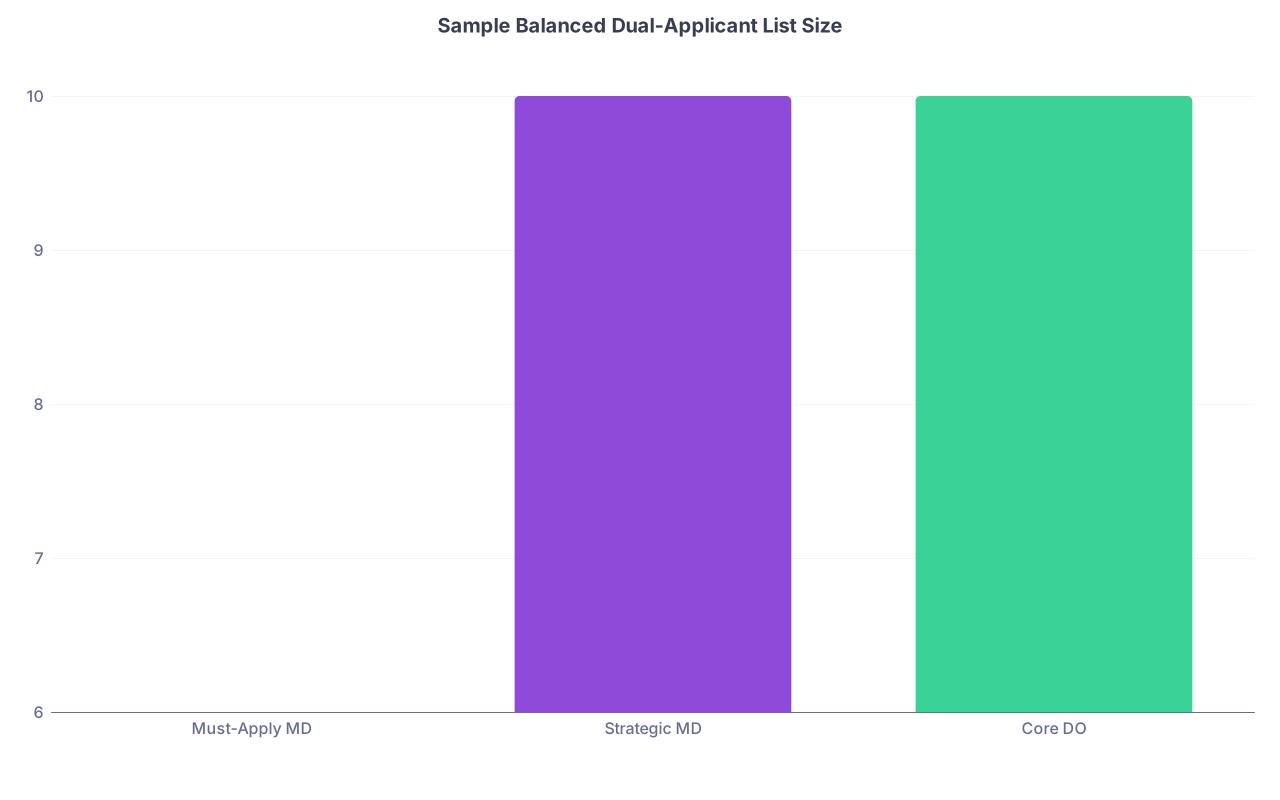
| Category | Value |
|---|---|
| Must-Apply MD | 6 |
| Strategic MD | 10 |
| Core DO | 10 |
Step 3: Sequence and Timing – When to Submit What
You are juggling:
- MCAT timing
- Letters
- AMCAS
- AACOMAS
- Secondaries
You need a sequence. Here is a practical one.
Ideal Timeline (Single Cycle MCAT)
Assume MCAT by late April / early May.
January–March
- Build school list drafts (MD + DO).
- Start personal statement once (you will adapt for DO).
- Identify 3–5 letter writers and actually talk with them.
April–May
- Finish MCAT → get score or at least know your practice score plateau.
- Lock your list “bands” (high‑reach MD, realistic MD, DO core).
- Draft work/activities for both AMCAS and AACOMAS (save offline).
Early June
- Submit AMCAS within first 1–2 weeks it opens.
- Aim to submit AACOMAS within the same rough window or within 2 weeks. They do not have to be same day, but do not delay one by a month.
June–July
- While primaries are verifying, pre-write secondaries based on last year’s prompts (most schools barely change them).
- Sort secondaries by priority: Must-Apply MD and top DOs first.
July–August
- Turn around secondaries in 7 days or less for priority schools, 10–14 days for the rest.
- Maintain a simple but strict workflow (I will give you one in the next section).
September–February
- Manage interview invites, travel, and updates.
- Keep your story consistent across MD and DO interviews.
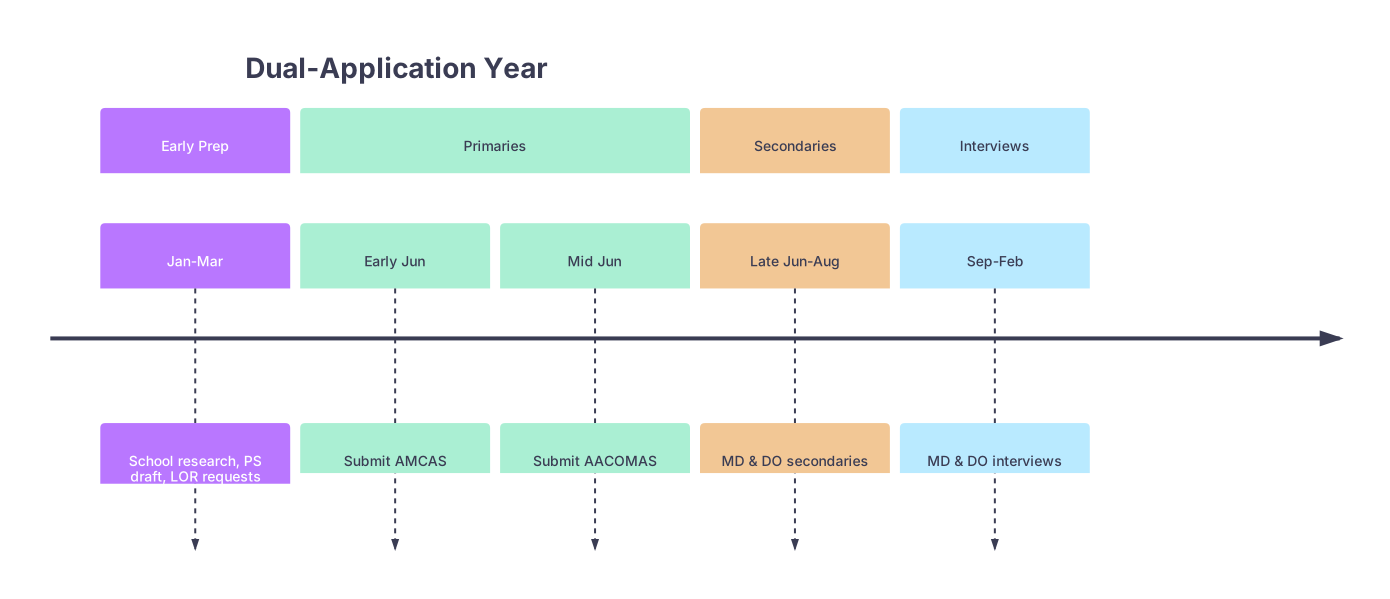
| Period | Event |
|---|---|
| Early Prep - Jan-Mar | School research, PS draft, LOR requests |
| Primaries - Early Jun | Submit AMCAS |
| Primaries - Mid Jun | Submit AACOMAS |
| Secondaries - Late Jun-Aug | MD & DO secondaries |
| Interviews - Sep-Feb | MD & DO interviews |
Step 4: One Core Story, Two Flavors (MD vs DO)
You only have one life story. You are not two different people depending on the letters on the diploma. Your job: build one coherent narrative and learn how to adapt it slightly for MD vs DO audiences.
Core Narrative Components (Same for MD and DO)
You need crisp answers to three things:
- Why medicine at all?
- Why you in medicine (your specific strengths, traits, experiences)?
- What kind of physician you are leaning toward becoming (even if it changes later)?
This goes into:
- Personal statement
- Activity descriptions
- Secondaries about “why medicine / biggest challenge / meaningful experience”
Where to Emphasize Differences
Here is how to “tilt” your content without writing two fake personas.
For MD programs, emphasize:
- Academic curiosity, research, evidence‑based thinking
- Comfort with complexity, systems, and maybe public health / policy
- Any research experience, even if minimal, and what you learned from it
For DO programs, emphasize:
- Whole‑person care, continuity, community relationships
- Your comfort with hands‑on, longitudinal work with patients
- Interest in primary care, rural/underserved, prevention, lifestyle medicine
- Openness to OMM/OMT and the DO philosophy if you genuinely connect with it
You can (and should) mention holistic, patient-centered care in MD apps too. Just do not parrot DO buzzwords in a way that sounds forced.
Personal Statement Strategy
Option A: One main PS for both
- Write a strong “Why medicine” PS that is not MD‑specific.
- For AACOMAS, slightly tweak an extra paragraph or two for DO if needed (depending on word limits).
Option B: Separate DO PS
- If you have deep, genuine exposure to DO (shadowing, mentors, strong interest in OMT), it can be useful to write a distinct DO personal statement or dedicated secondary where requested.
- Only worth it if you can make it authentic, not superficial.
Do not invent a sudden lifelong passion for OMT if your only exposure is one shadowing afternoon.
Step 5: A Realistic Workflow for Handling Two Sets of Secondaries
You will not “just write them as they come” unless you enjoy panic and missed deadlines. Build a system.
Step 5A: Centralize Everything
Create a master spreadsheet with columns:
- School name
- Type (MD/DO)
- In-state / OOS
- Secondary received date
- Secondary due date / recommended timeline
- Prompt 1 (word limit)
- Prompt 2 (word limit)
- Status: Not Started / Drafted / Edited / Submitted
- Priority: High / Med / Low
You update this daily when things are busy. Yes, daily.
Step 5B: Build a Reusable “Essay Bank”
Most secondary prompts are recycled into a few buckets:
- “Why our school?”
- “Why DO medicine?” (for DO schools)
- Diversity / adversity
- Most meaningful experience
- Future goals / specialty interest
- Ethics or challenge scenario
Write core versions of each 3–4 major themes in a separate doc:
- 500–600 word “adversity/diversity” story
- 400–500 word “most meaningful clinical experience”
- 300–400 word “community service and impact”
- 400–500 word “future goals / type of physician you want to be”
- 400–500 word “Why DO / osteopathic philosophy” (for DO secondaries)
Then, when prompts show up, you adapt and trim instead of starting from scratch 40 times.
Step 5C: Prioritize Your Response Order
When you are dual‑applying, some schools matter more than others. Treat them that way.
Top priority
- In‑state MDs
- Top‑choice geographic DO schools
- Any school that sent you an invite early (they are actually interested)
Middle
- The bulk of your strategic MDs and DOs
Low
- Schools you added “just in case” or that are attached to high fees with poor fit
Turnaround goals:
- Top priority: submit within 3–5 days
- Middle: within 7–10 days
- Low: within 10–14 days or not at all if you are drowning and they are genuinely low yield
If you fall behind, you cut from the bottom. Do not tank quality across the board just to send everything.

Step 6: DO vs MD Letters, Experiences, and OMM
You do not need “MD letters for MD” and “DO letters for DO” in every case, but you do need to be thoughtful.
Letters of Recommendation
MD programs typically want:
- 2 science faculty
- 1 non‑science / humanities / PI
- Optional: 1–2 clinical or character letters
DO programs often like (and some prefer):
- One letter from a DO physician
- Or at least a physician letter, MD or DO, if DO letter is not required
Here is the fix:
- Scan each DO school’s requirements early.
- If DO letter is recommended but not required and you truly cannot get one, you are usually fine.
- If DO letter is required, actually get one – shadow a DO and ask for it early. If that is impossible, drop that school from your list. Do not gamble on them “overlooking” it.
Experiences and OMM Exposure
You do not have to pretend you are obsessed with OMM. But for DO schools, you cannot sound like you discovered the word “osteopathic” yesterday.
Bare minimum:
- Shadow at least one DO for 20–40 hours if you are serious about DO programs.
- Ask them directly how they apply osteopathic philosophy in day‑to‑day practice (hint: it is usually more holistic thinking than constant OMT).
- If you see OMT used, note a specific patient example to reference in secondaries or interviews.
You can then honestly say:
- You sought out DO shadowing
- You saw concrete differences in how that doctor approached patients (time spent, focus on function, preventive orientation, etc.)
- You are interested in learning OMM to expand your toolkit, especially in X context (sports med, chronic pain, etc.)
That is believable. And it sounds like you know what you are signing up for.
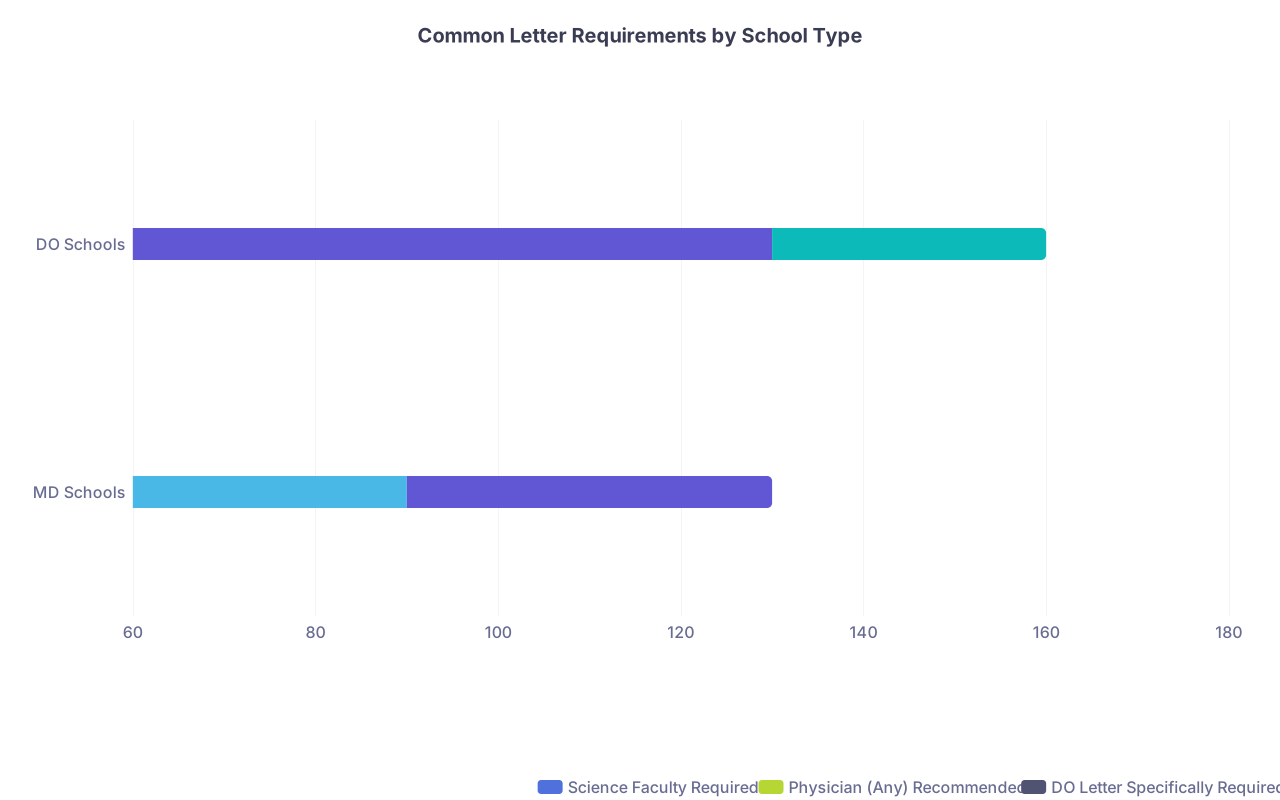
| Category | Science Faculty Required | Physician (Any) Recommended | DO Letter Specifically Required |
|---|---|---|---|
| MD Schools | 90 | 40 | 0 |
| DO Schools | 60 | 70 | 30 |
Step 7: Handling Interviews and Offers Without Looking Disorganized
You made it to the fun part. Now you need to avoid sounding like a different human being at each program.
Before Interviews: Tighten Your Talking Points
Create a one-page “interview brief” for yourself:
- 3 key stories that show who you are (clinical, service, personal challenge)
- 2–3 reasons per school why you are specifically interested in them
- A clear, honest answer to: “Why MD?” and “Why DO?” separately
Your “Why DO?” answer should not be “because DO schools are slightly easier to get into.” Say that in your head, not out loud.
During Interviews: Be Consistent, Not Robotic
For MD interviews:
- Lean a bit more on research, academic fit, and systems-level interests.
- Still emphasize patient-centeredness; do not swing full lab‑rat.
For DO interviews:
- Lean more into holistic care, community, longitudinal relationships, prevention.
- If you have any specific DO mentors, mention them by name and story.
Stay away from bad lines like:
- “MD or DO, I do not care which, I just want to be a doctor.”
- This sounds directionless and dismissive of each profession’s identity.
A better framing:
- “I applied to both MD and DO schools very intentionally. I see myself in a patient-driven, community‑focused career, and I am especially attracted to [this school] because…”
Tailored. Thoughtful. Not flippant.
When Offers Come In: Decision Framework
If you get:
MD and DO acceptance:
- Weigh location, cost, clinical rotation quality, residency outcomes, and family/life factors.
- If all else equal and you are uncertain about specialty, MD slightly simplifies certain very competitive paths.
Multiple DO acceptances, no MD:
- This is still success. Choose the DO program that offers:
- Best rotation infrastructure
- Strong board prep support
- Solid match outcomes in the specialties you are considering
- This is still success. Choose the DO program that offers:
Waitlists vs one DO acceptance:
- If that DO school is decent and your stats were already borderline, locking in a seat is usually wiser than gambling on multiple waitlists.
- If your numbers are strong and you applied late, a wait‑and‑see strategy with a reapp next year is more defensible.

Step 8: Common Dual-Applicant Mistakes (And the Fix for Each)
Let me save you from the usual landmines.
Mistake 1: Copy‑pasting MD content to DO secondaries with zero adaptation
- Problem: You look like you do not understand or care about osteopathic medicine.
- Fix: Keep a dedicated “Why DO / osteopathic philosophy” essay and customize at least one secondary per DO school to reference OMM or whole‑person training explicitly.
Mistake 2: Spraying 40 MD apps and 3 DO apps “as backup”
- Problem: All‑or‑nothing MD strategy with token DOs → often ends as nothing.
- Fix: If you bother with DO at all, commit to a realistic number (8–12 for most borderline MD candidates). Align it with your academic profile instead of treating DO as afterthought.
Mistake 3: Terrible timing – early DO, late MD (or vice versa)
- Problem: You are super early for one pool and buried in the other, cutting your chances in half.
- Fix: Submit both primaries in the early window (June) and handle secondaries in an integrated system. Do not treat them as two unrelated cycles.
Mistake 4: Mixed or contradictory narratives
- Problem: MD apps sell you as a future physician‑scientist, DO apps sell you as uninterested in research and only wanting small rural practice. Adcoms see the dissonance when they look at your broader file.
- Fix: One core identity. You can emphasize different pieces, but they should not contradict. “Clinically driven but research-literate” plays in both worlds.
Mistake 5: Not tracking expenses and overextending
- Problem: You burn through savings or credit, then cannot afford flights for interviews.
- Fix: Before submitting secondaries, set a hard budget ceiling and a rough cost per school. If the math requires trimming 5–10 schools, trim them before you pay, not after.

FAQ (Exactly 4 Questions)
1. Do I hurt my chances at MD schools by also applying to DO schools?
No. MD schools do not blacklist you for applying DO. They usually do not care, and often do not know unless you volunteer it in an interview. What does hurt you is a scattered or inconsistent narrative. Focus on building a coherent story, not hiding the fact you dual‑applied.
2. How many schools should I apply to if I am dual-applying?
For a typical borderline MD / competitive DO applicant:
- 14–20 MD schools (mix of in‑state, realistic, and a few reaches)
- 8–14 DO schools (well‑researched, not random)
If your stats are stronger, you can scale this down. The limit should come from budget and your ability to produce high‑quality secondaries, not from some magic universal number.
3. Is a DO letter of recommendation absolutely required for DO schools?
Some DO schools require it; others “prefer” it. If it is listed as required and you cannot get one, remove that school from your list. Do not assume they will waive it. Where it is only recommended, a strong physician or clinical letter from an MD is often acceptable, but real DO exposure still strengthens your file.
4. If I get into a DO school early, should I withdraw from all MD schools?
Not automatically. If you would genuinely prefer MD at certain programs and you applied with a realistic shot, it is reasonable to stay in the MD pool for that cycle. However, once you are sure you will attend the DO school (for example, after finances or personal factors are clear), you should withdraw from other schools promptly out of professionalism.
Key takeaways:
- Dual‑applying only works if your MD/DO lists are built intentionally around your stats, story, and geography, not brand names.
- One core narrative, two reasonable emphases: academic/research tilt for MD, holistic/community tilt for DO. Stay consistent.
- Treat DO programs as real options, not last‑minute backups, and manage your secondaries with a disciplined system or the process will run you instead of the other way around.