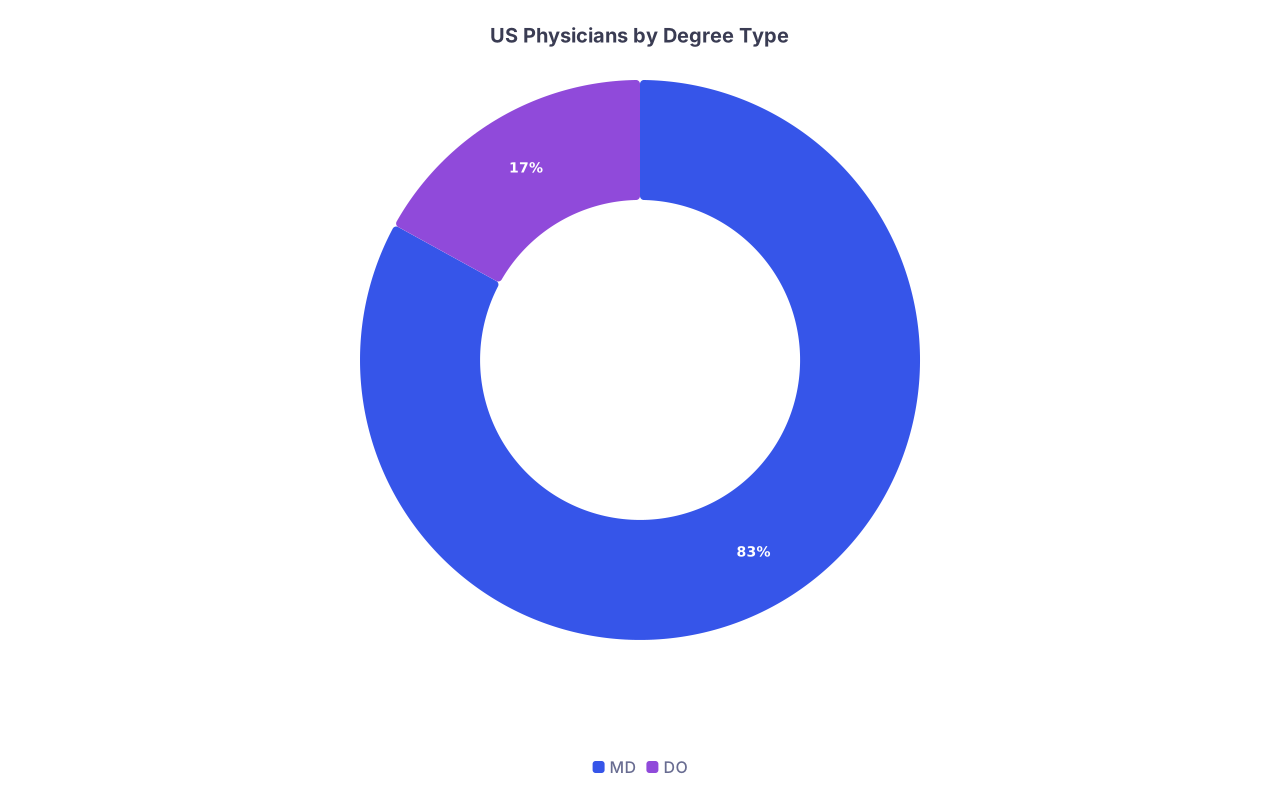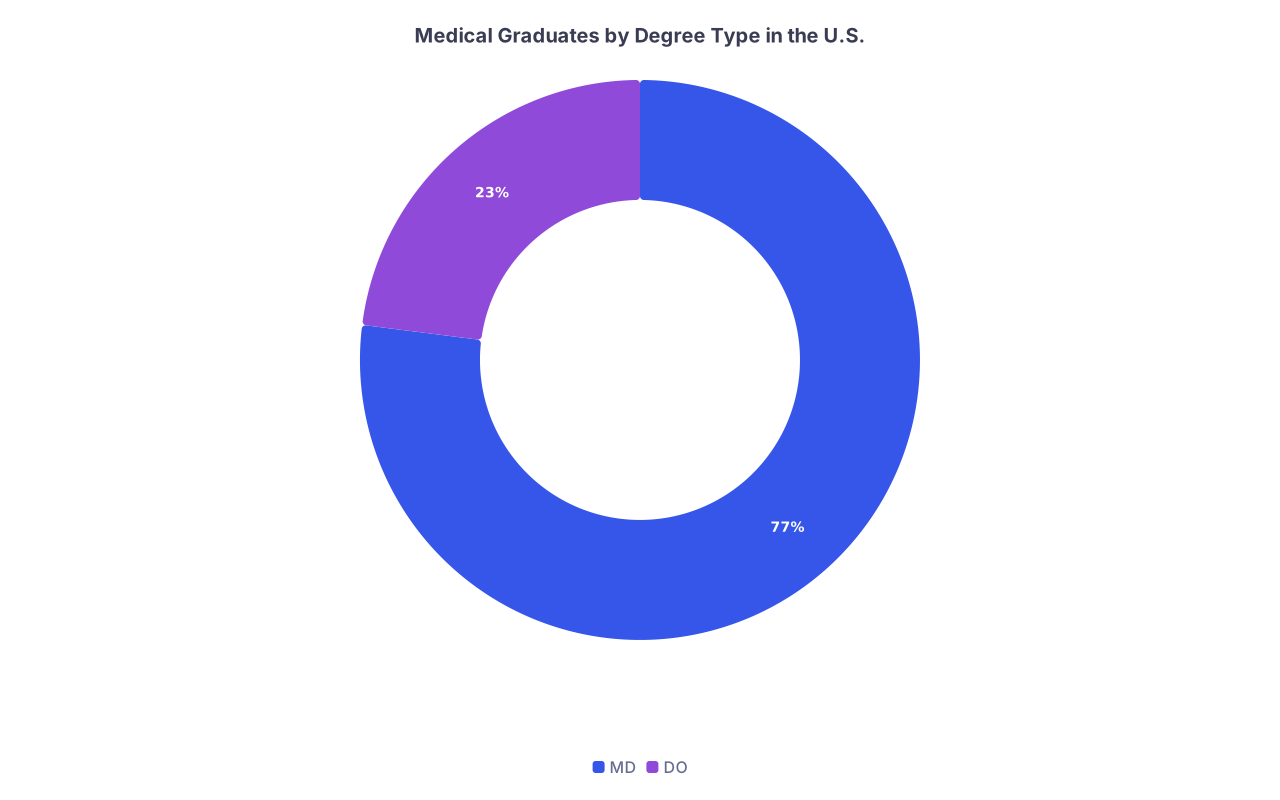
| Category | Value |
|---|---|
| MD | 77 |
| DO | 23 |
The biggest mistake premeds make about geography is assuming “a medical degree is a medical degree” and location will sort itself out. It will not. Especially when you ignore how DO vs. MD interacts with where you train and where you want to end up.
If you underestimate geography limits now, you can quietly box yourself out of entire regions and specialties later. No one warns you about this on Reddit acceptance threads. I will.
The geography myth that gets DO and MD applicants burned
The dangerous narrative goes like this:
- “If I get in anywhere, I’ll go. I just need a seat.”
- “Once I have ‘MD’ or ‘DO’ after my name, I can move wherever I want.”
- “Residency programs only care about scores and letters, not where I went to school.”
Wrong, wrong, and still wrong.
Program directors care a lot about:
- Where your school is located
- Where your clinical rotations are
- What region your school typically feeds into
- Whether your degree (MD vs. DO) is common and recognized in their area
They care so much that entire swaths of programs simply do not seriously consider:
- Caribbean grads
- DO graduates for certain hyper-competitive academic programs
- Applicants from unfamiliar schools outside their region
Does that mean “DOs cannot match X” or “out-of-region MDs are doomed”? No. But if you plan badly, you will make your life unnecessarily hard.
Most of the pain comes from one blind spot: not planning geography and degree type together.
How geography interacts differently for DO vs. MD
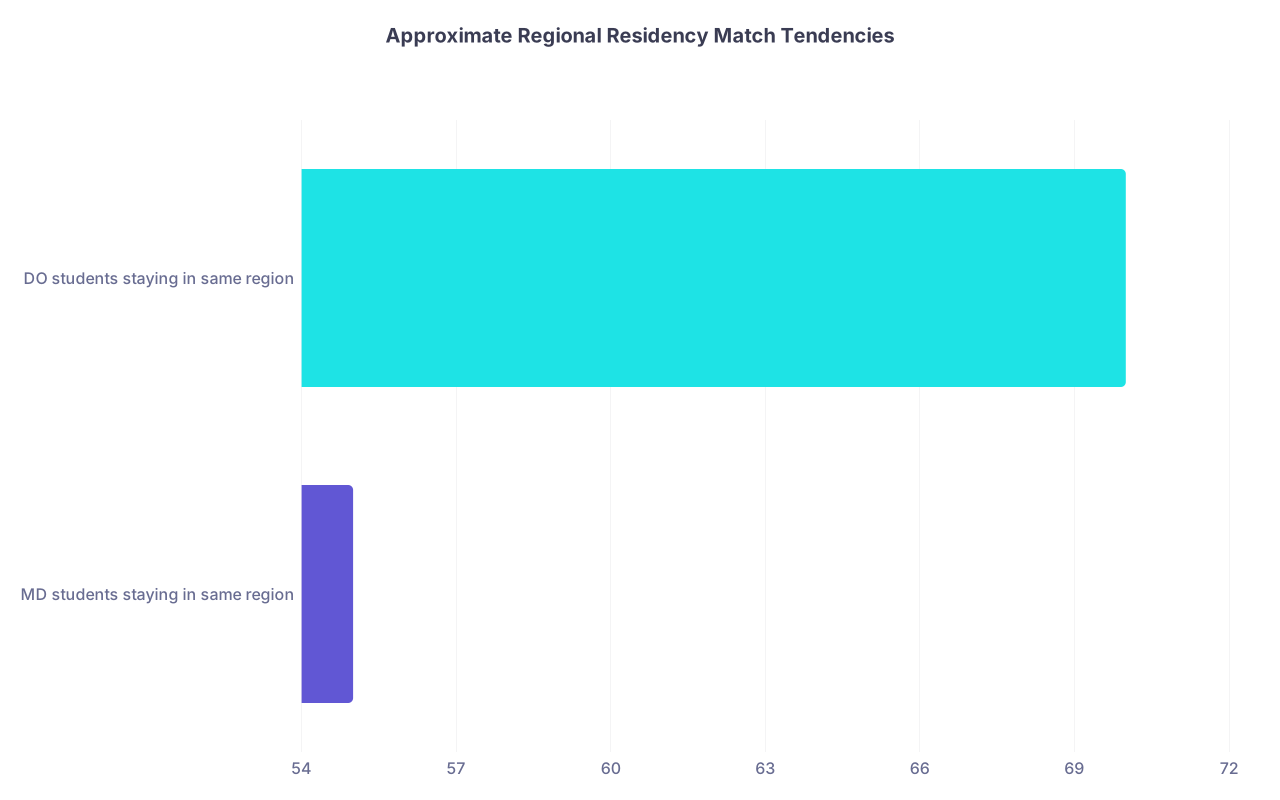
| Category | Value |
|---|---|
| MD students staying in same region | 55 |
| DO students staying in same region | 70 |
You cannot treat DO and MD geography the same way. I have watched students do that and then spend M4 crying over their match list.
MD geography reality
For U.S. MD students, geography is “sticky but negotiable.”
Patterns I see repeatedly:
- MD schools often have strong regional pipelines. Northeast MDs feed Northeast residencies. Texas MDs feed Texas.
- Moving regions is absolutely possible, especially to large cities and big academic centers.
- Program directors nationwide are comfortable with LCME-accredited U.S. MD schools, even if they have not seen that specific school before.
Translation: As a U.S. MD student, you still benefit from going to school in or near the region you want to end up in. But if you want to move after med school, the system is built to make that reasonably doable.
DO geography reality
For U.S. DO students, geography is “sticky and sometimes rigid.”
Hard truths:
- A lot of DO schools are heavily regional. Their hospital partners, alumni, and reputation are strongest within a few states.
- Many competitive academic programs (especially in coastal cities) see very few DO applicants from out of region. When they do, it often requires top-tier scores, research, and networking.
- Some programs are DO-friendly, some are DO-neutral, some are effectively DO-avoidant, no matter what their website says. Guess which ones you naturally rotate at? Usually the friendly ones near your school.
So a DO student in the Midwest or South who says, “I’ll just match in Boston or San Francisco later” without a plan is playing with fire. Not impossible. Just much harder than their MS1 self understands.
Mistake #1: Choosing “any” acceptance without mapping the residency pipeline
This is the classic premed move:
You get into:
- School A: A DO program in the Midwest, strong primary care ties, most grads stay in the region.
- School B: An MD program in a different state, moderate reputation, more nationally dispersed match list.
Your dream: West Coast academic anesthesiology or emergency medicine.
What too many students do: panic-accept the first offer, tell themselves “I can always go anywhere after,” and never seriously study the match data.
They discover the reality during M4 when:
- Their school’s match list shows almost no one going to their dream region or specialty.
- Away rotations options in that region are limited or brutally competitive.
- Their letters come from people with zero pull in the programs they care about.
The fix is simple but almost no one does it early:
- For every school you are considering, pull 3–5 years of match lists.
- Count how many graduates go:
- To your desired region
- Into your desired specialty
- Into recognizable academic programs vs. mostly community or local sites
- Look for patterns, not one-off successes. “One student matched derm at Penn” is not a pathway. It is an outlier.
If you see that a school sends 80–90% of its grads to the same 3–4 states, assume you are likely to end up there too unless you massively outperform your peers.
Mistake #2: Ignoring rotations when you think about “location”

| Step | Description |
|---|---|
| Step 1 | Choose MD vs DO & School Location |
| Step 2 | Clerkship & Core Rotations Region |
| Step 3 | Who You Work With |
| Step 4 | Letters of Recommendation |
| Step 5 | Residency Interviews Region |
| Step 6 | Match Location |
Students talk about medical school location like this:
- “I do not want to live in the Midwest.”
- “I want to be near family.”
- “I love cities. I hate snow.”
All fair. But the more dangerous part is not where you live. It is where you rotate.
Here is what you risk if you ignore clinical geography:
- DO schools with widely scattered, less controlled rotation sites. You might end up spending M3–M4 in random community hospitals with minimal academic presence. Great for some careers, terrible if you want to impress competitive urban programs elsewhere.
- Limited access to major academic centers. If your school does not have built-in rotations at university hospitals in your target region, you will depend on away rotations. Which are finite, selective, and not guaranteed.
- Weak local network. If all your rotations are in small towns 5 hours from any major academic center, you are not building relationships where you want to match.
MD programs are not immune to this, but DO students are hit harder because:
- Many DO schools are newer and rely on affiliating with scattered community sites.
- Some DO schools lack strong home residency programs in competitive specialties.
- “Name recognition” of the sites on your CV matters more when your degree itself is less familiar in certain regions.
You avoid this mistake by asking blunt questions before you commit:
- Where are core rotations? Exact hospitals and cities, not vague regions.
- Are there built-in rotations at major academic centers? Where?
- What percentage of M3/M4 students leave the immediate area for rotations? Is that supported or discouraged?
If the answer to most of those is hand-wavy, that is a red flag. Especially if you are DO and aiming for a non-primary-care specialty in a big city.
Mistake #3: Assuming you can “flip coasts” without intentional strategy
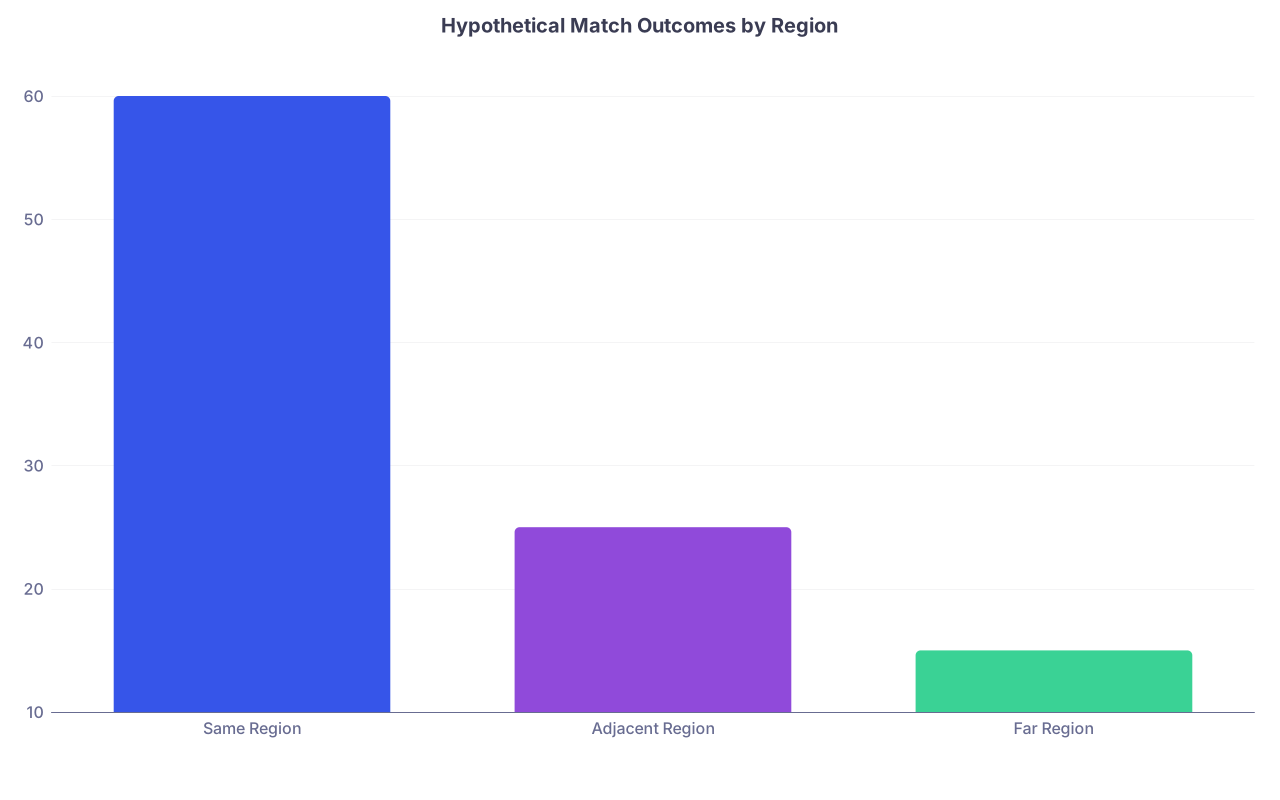
| Category | Value |
|---|---|
| Same Region | 60 |
| Adjacent Region | 25 |
| Far Region | 15 |
You start med school in:
- New England but dream about West Coast
- Midwest but dream about NYC/Boston
- South but dream about Chicago
MD students can sometimes wing this and still land decently, especially with average-strong scores and decent research. DO students doing the same thing? Much more likely to end up close to where they trained.
Big mistakes here:
- Never building any connection to your target region until ERAS
- Not budgeting for away rotations in that region
- Not tailoring your research or mentors to have any ties there
- Failing to understand which specialties are regionally competitive (for example, California EM, anesthesia, derm, ortho, radiology, plastics can be punishingly selective for out-of-region DOs)
If you are DO and want to flip coasts or move into a hyper-competitive urban market, you must:
- Score high on COMLEX and usually USMLE (if still available for your cohort)
- Get strong letters from recognizable names or known programs in your target region
- Do away rotations strategically and early
- Apply widely and realistically (lots of DO-friendly programs + some reach)
For MD students, you still need a plan, but the system is less hostile to out-of-region movement. For DO students, treating this casually is a setup for disappointment.
Mistake #4: Not accounting for DO recognition differences by region
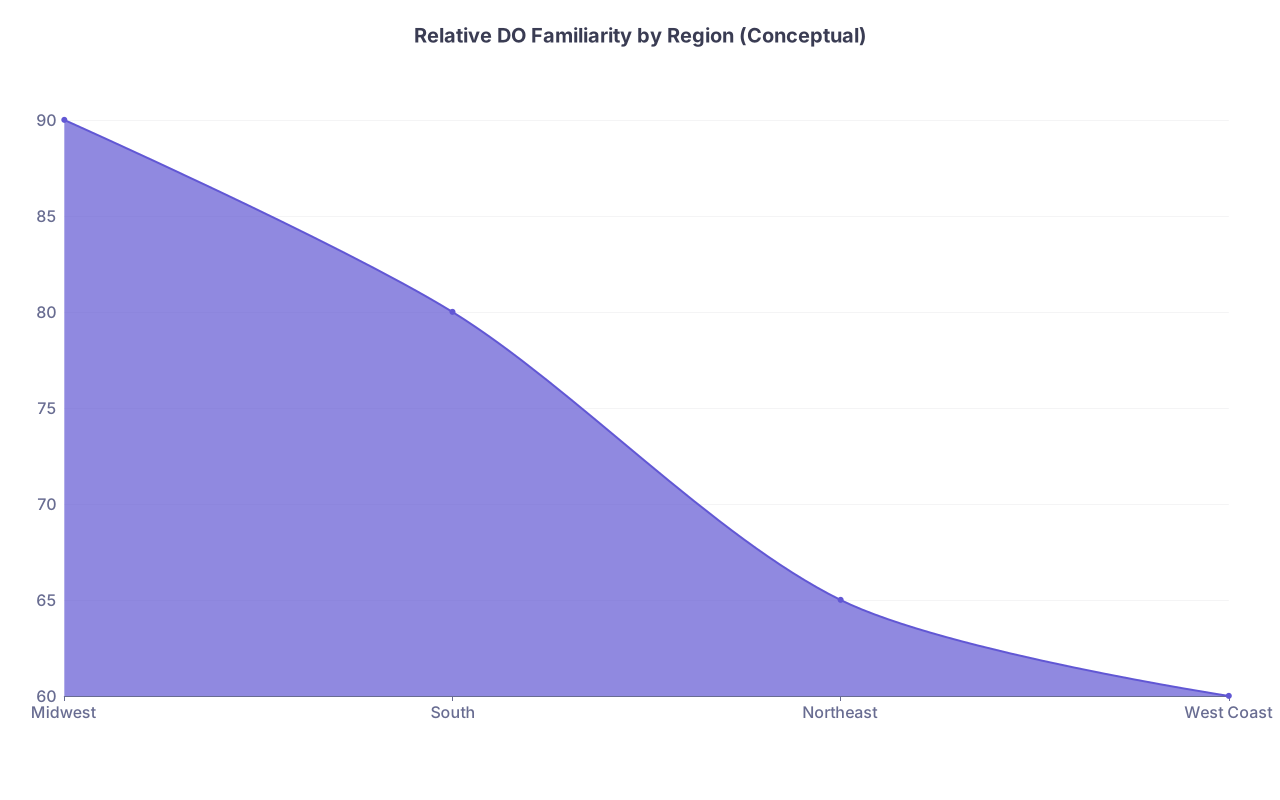
| Category | Value |
|---|---|
| Midwest | 90 |
| South | 80 |
| Northeast | 65 |
| West Coast | 60 |
Here is something people pretend does not matter: DO degrees are not equally normalized everywhere.
In many parts of the Midwest and South, DOs are deeply integrated. Tons of attendings are DOs. Community hospitals and even some academic centers are DO-heavy or DO-equal.
In certain elite coastal areas, especially older academic institutions:
- Fewer DO faculty in leadership
- Fewer DO residents historically
- Less familiarity with your schools and rotation sites
No, this does not mean “DOs cannot match there.” They can. I have seen it. But when you are competing for 6 categorical spots at a big-name Boston or San Francisco program and 80% of their residents are from top-30 MD schools, you are swimming upstream.
Common error: A premed from New England insists on DO in the Midwest “because cost / acceptance” and assumes they will “definitely” come back for residency in Boston at a Harvard/BU/Tufts affiliate. They have never once looked at those programs’ current resident lists.
What they usually see M4:
- Those programs have 0–1 DOs in the entire residency, sometimes none.
- The DOs who do make it in have exceptional stats, research, or direct mentorship ties.
- Their own school has sent maybe one grad there in ten years.
You avoid this by:
- Checking resident rosters for your target programs before you commit to a distant DO school.
- Not lying to yourself. If a program has almost no DOs, treat it as a high-risk reach, not a likely home base.
- Considering whether a U.S. MD school, even lower-ranked but in your dream region, gives you a more realistic path than a DO school far away with no history in that area.
Mistake #5: Believing “I’ll just switch specialties if geography is bad”
Here is a quiet disaster scenario:
- You go to an out-of-region DO school with weak ties to where you actually want to live.
- You get interested in a moderately competitive specialty (EM, anesthesia, rads, gas, etc.).
- Your school mostly places grads into primary care locally.
- You start hearing: “If it doesn’t work out, you can always pivot to family or IM near home.”
This sounds like a safety net. It is not. It is a trap built on:
- Assuming those backup spots in your home region will always be open to you
- Ignoring that even for “less competitive” specialties, programs still have strong local pipelines
- Forgetting that switching specialties late collapses your geography options further, because you lack targeted letters and rotations
If your true non-negotiable is geography (for family, partner, kids, or sanity reasons), it is dangerous to anchor your entire plan on a specialty that is hard to get in that region for your degree type.
Sometimes the smarter move is:
- Choose a school that fits your geographic goal first, then optimize specialty within that region.
- Or, if you really want a competitive specialty, accept that you may need to live where that specialty is most DO-friendly and abundant, even if that means being away from home longer.
What you should not do is pretend you can optimize both geography and competitiveness with no trade-offs. There are always trade-offs.
How to choose DO vs. MD and school location without sabotaging your future

Here is the practical, unromantic checklist I wish more applicants used.
Step 1: Decide what matters more: region or specialty (you cannot always max both)
Rank these honestly:
- I must end up in or near [city/region] long-term.
- I care most about keeping competitive specialties open (ortho, derm, rads, anesthesia, EM, surgery subs).
- I care most about cost and support, even if it narrows my geography.
You can absolutely care about more than one, but you need a hierarchy. Otherwise, every acceptance looks “fine” until M3, when the trade-offs hit you all at once.
Step 2: For each school (DO and MD), map three things
Match geography:
- Where do most grads match? States and cities, not just region names.
- Are there meaningful numbers in your target region?
Match specialties:
- How many grads per year go into your tentative interests?
- In what types of programs (university, community, hybrid)?
Rotation footprint:
- Exact list of core and elective hospitals
- Which region(s) they are in
- How many are true academic centers vs. small community sites
If a school refuses to share this or glosses it over, that is your warning sign.
Step 3: Adjust expectations by degree type
For U.S. MD schools:
- More flexibility to move regions later
- Stronger baseline acceptance across academic programs
- Still need to respect regional pipelines, but less boxed in
For U.S. DO schools:
- Heavier weight on regional strength and DO-friendliness of target areas
- Need higher stats / stronger profiles to cross into DO-light academic programs in distant regions
- Much more dependent on where rotations and affiliated residencies are located
If you are DO and dead-set on a competitive specialty in a specific coastal city, you need a ruthlessly honest evaluation of whether any students like you have ever done that from that school. If the historical answer is “no,” assume it is not an accident.
Common red flags you should not ignore

When comparing DO vs. MD options and locations, watch for:
- A DO school whose match list is extremely local and mostly primary care, but whose admissions office keeps promising, “You can go anywhere!” without data.
- An MD school far from your target region with virtually no graduates matching back where you want to live.
- Any school that cannot clearly describe where your M3/M4 rotations will be or keeps saying “we’re expanding” but has nothing concrete.
- Programs in your dream city or specialty that have nearly zero DOs in current or past resident classes.
None of these are automatic deal-breakers. But if more than one applies, you are stacking risk.
The bottom line you do not want to learn the hard way
You are not just choosing DO vs. MD. You are choosing:
- Networks vs. isolation
- Familiar region vs. uphill relocation battle
- Realistic specialty options vs. dreamboard fantasy
The worst part? Most students do not realize they made the wrong bet until 3–6 years later, when they are scrambling for residencies they never actually had a strong shot at from where they started.
You can absolutely build a great career as a DO or MD, from almost any region. But only if you stop treating geography as an afterthought and start treating it as part of the strategy.
Do not tell yourself “I’ll figure it out later.” Later is when the system stops being flexible.