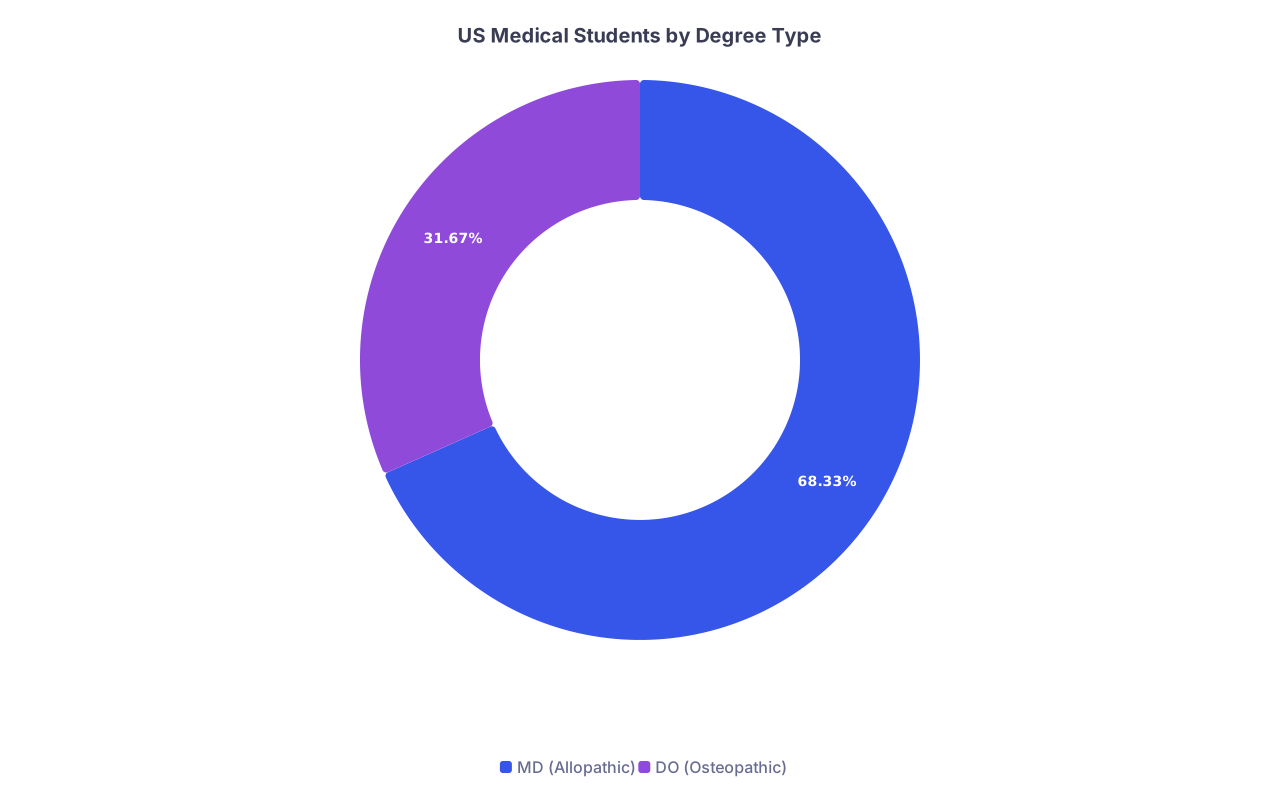
| Category | Value |
|---|---|
| MD (Allopathic) | 82000 |
| DO (Osteopathic) | 38000 |
Telling yourself “DO and MD are basically the same” is how premeds back themselves into miserable corners.
They’re similar. They’re converging. But they are not interchangeable for every person, every specialty, and every long‑term plan. Pretending they are is lazy thinking disguised as “being open‑minded.”
Let me be very clear:
The mistake is not choosing DO.
The mistake is choosing DO (or MD) while blind to the differences that will actually matter to you.
You are the one who pays for that, not the Reddit thread that told you “it doesn’t matter anymore.”
Let’s walk through the real pitfalls so you don’t wake up as an M3 thinking, “I wish someone had warned me.”
Mistake #1: Treating DO vs. MD Like Different Logos on the Same Product
The most dangerous simplification I hear is:
“Residency is single accredited now. DO and MD are the same. Just get in somewhere.”
Wrong. That’s not how this works.
There’s one accreditation system (ACGME), yes. But the paths into that system are not identical.
Here’s where people fool themselves:
- They assume any US med school guarantees the same residency options.
- They think board scores are all that matter now.
- They underestimate how subtle bias shows up in selection committees.
I’ve watched this scenario play out more than once:
- Strong premed—3.5+ GPA, ~507 MCAT.
- Gets into a newer DO school and waitlisted at multiple MD schools.
- Everyone says “why wait? DO and MD are the same now.”
- They want a surgical subspecialty but figure they’ll “just crush boards.”
- Fast forward to M4: decent scores, decent evals, but they’re competing against MD students from well-known institutions for tiny numbers of spots. Doors that would be half-open from a mid‑tier MD school are now barely cracked.
Could they still match? Absolutely. Many do.
Was the path equally wide from day one? No.
The red flag mindset:
“If I’m good enough, it won’t matter where I go.”
The reality:
If you’re good enough, you can overcome a lot. But stacking extra obstacles for no reason is a terrible strategy. Especially in medicine, where everything is already hard and your future self will be exhausted.
Mistake #2: Ignoring How School Reputation Still Quietly Shapes Your Options
No, program directors don’t sit there reciting U.S. News rankings. They do something more practical and more dangerous: they lean on familiarity.
They know:
- The MD schools they’ve recruited from for 10+ years
- The DO schools whose students have been strong on their service
- The schools where past residents struggled
They do not evaluate every school from scratch for each application cycle.
Here’s what goes wrong when you pretend “all DO = all MD = all the same”:
- You apply to a brand-new or lower‑performing DO school with:
- No match history in your desired specialty
- Weak hospital affiliations
- Limited home rotations in competitive fields
- You comfort yourself: “It’s still a US med school. Once I’m in, I’m set.”
Then MS3 hits, and you discover:
- Your school has zero home program in your top specialty
- Prior grads in that specialty = 1 or 2… total
- PDs in competitive programs haven’t heard of your school at all
You’re not doomed. But you’ll be fighting uphill.
Do not make the mistake of comparing:
- Your best DO acceptance
to - Some imaginary “generic MD school”
Compare actual schools, side by side, on things that matter:
- Match lists (for the last 3–5 years, not one cherry‑picked year)
- Home programs in competitive specialties
- Average board performance and support systems
- Hospital networks and teaching sites
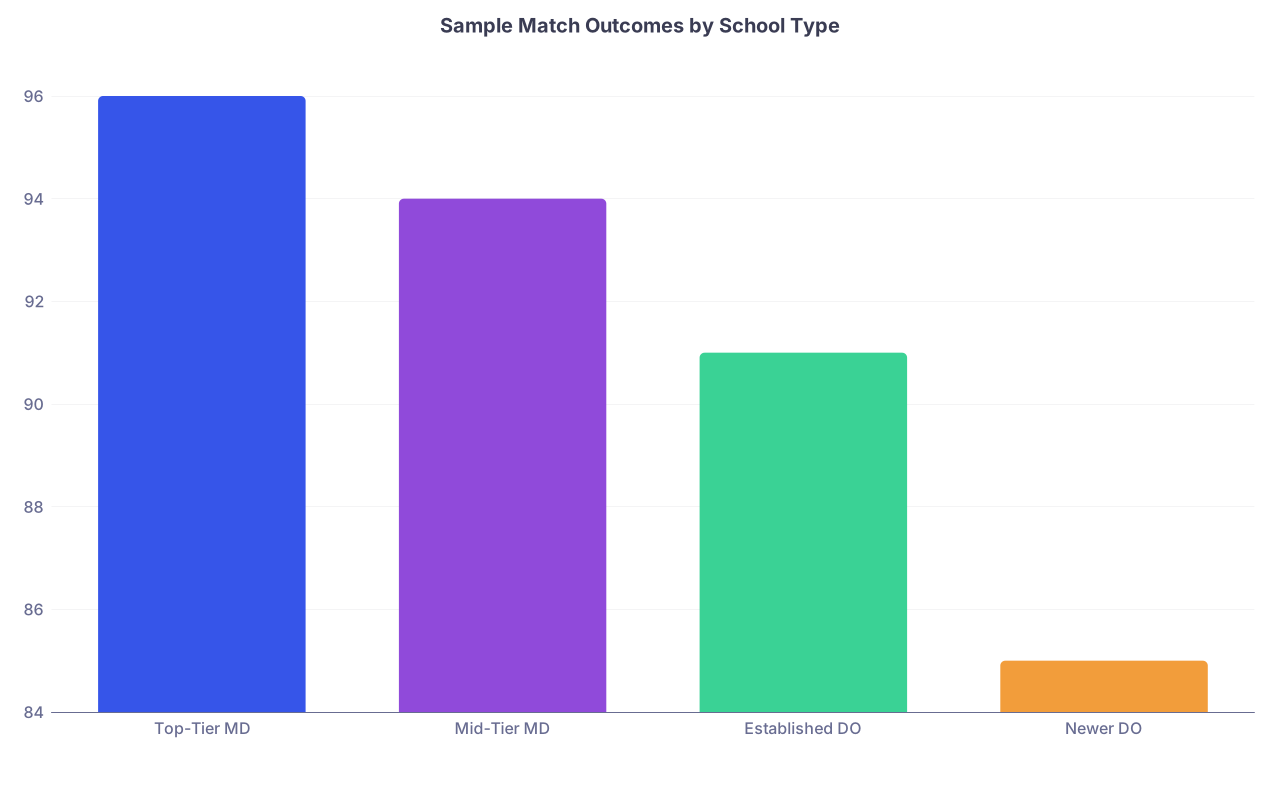
| Category | Value |
|---|---|
| Top-Tier MD | 96 |
| Mid-Tier MD | 94 |
| Established DO | 91 |
| Newer DO | 85 |
Those are illustrative numbers, but the pattern is real: variance exists within MD and within DO. Lumping each into one uniform category is how you overlook red flags.
Mistake #3: Waving Away Specialty Competitiveness “Because It’ll Work Out”
I’ve heard this line in advising offices too many times:
“If you want derm or ortho, just be top of your class. DO vs. MD won’t matter.”
That’s encouraging. It’s also incomplete to the point of being misleading.
Here’s what you have to understand:
- Some specialties still take very few DOs relative to their total spots.
- Lack of DO representation often means:
- Program leadership trained only MDs
- DO applicants are rare, so they default to what they know
- You’re asking those programs to go against their historical patterns—and against a flood of MD applicants from name‑brand schools.
Look at any recent NRMP “Charting Outcomes” and you’ll see it plainly:
Certain specialties remain brutally competitive for DOs, even with strong scores.
Common trouble spots for DO applicants:
- Dermatology
- Plastic surgery
- Neurosurgery
- Some orthopedics programs
- ENT, urology, certain competitive radiology spots
Does that mean “DOs can’t match those specialties”? No. They clearly can. They do every year.
But here’s the mistake:
Choosing a school assuming every door will be equally open before you have any real sense of what specialty you’ll want.
The dangerous thought pattern:
- “I don’t know what I want, but probably something competitive.”
- “DO and MD are the same now, so I’ll just decide later.”
Translation: “I’m making a high‑stakes decision blind and hoping the system will be fair.”
Be honest with yourself:
- If you already know you’re drawn to highly competitive fields, you cannot afford to be casual about school choice.
- If you’re unsure, at least prefer schools that maximize optionality—robust match lists, strong hospitals, and known track records.
You don’t need to obsess about prestige. But pretending every path is identical? That’s how you quietly eliminate options you haven’t even discovered yet.
Mistake #4: Underestimating Cultural and Curriculum Differences
“Same thing, different letters” completely ignores the experience of being a DO vs. MD student.
Common blind spots:
- Osteopathic Philosophy and OMM
DO schools aren’t just MD schools with a few extra labs.
You’re signing up for:- Required training in osteopathic manipulative medicine
- Extra practical exams, extra content, extra time
- A mindset that emphasizes holistic, musculoskeletal, and primary‑care oriented approaches (even if you end up in a subspecialty)
Some students love this. Others realize in M2 that they have zero interest in manipulation and resent the time sink.
- Time and Bandwidth
You’ll be juggling:- Standard med school curriculum
- OMM labs and exams
- Board prep for COMLEX (and likely USMLE if you want maximum flexibility)
That’s extra testing, extra studying, extra logistics. If you pretend “it’s all the same,” you won’t plan for that extra load. You’ll just be perpetually behind and annoyed.
- Culture & Identity
In some regions and systems, DO is completely normalized. You’ll work with DO attendings, DO chiefs, DO hospital leadership.
In others, you’ll still encounter:- “So what’s a DO again?” from patients
- Mild skepticism from older MD faculty who never worked with DOs
- Occasional condescension from peers who don’t know what they’re talking about
If you walk in expecting zero difference, those moments will blindside you and drain you.
None of this is a reason to avoid DO. But it is a reason to go in with open eyes, not with “doesn’t matter, same thing.”
Mistake #5: Not Planning Board Strategy Around Your Degree Choice
Board exams are where the “they’re the same anyway” myth really hurts people.
Typical DO student mistake fueled by oversimplification:
- “I’ll just take COMLEX. Programs understand it now. Same thing.”
Then M3 comes. They decide they want a moderately or highly competitive specialty or a specific geographic region… and discover:
- Many programs informally prefer or require USMLE
- Some don’t know how to interpret COMLEX scores at all
- Others do, but they’re comparing your score against a pile of USMLE Step 2 scores
Now they’re:
- Scrambling to take USMLE later than ideal
- Juggling rotations and Step prep
- Competing with MD students who took USMLE on a cleaner timeline
Flip side mistake for MD students:
- Assuming all DO‑heavy programs will view them the same as DOs just because “single accreditation.”
- They ignore that some osteopathic programs still favor DOs who took COMLEX and align with their philosophy.
Again, this is about strategy, not superiority.
If you choose DO, you need to decide early:
- Will you take both COMLEX and USMLE?
- If yes, what’s your timeline?
- Does your school provide USMLE support, or will you be largely on your own?
If you choose MD:
- Are you okay potentially missing out on some historically DO‑heavy opportunities that may favor DO grads?
- Do you actually understand what those opportunities are?
Oversimplifying DO vs. MD leads to sloppy board planning. Sloppy board planning wrecks options.
Mistake #6: Letting Ego or Stigma Drive You—in Either Direction
There are two ego traps here, and both are dumb.
Trap 1: “I’m too good for DO”
I’ve seen stellar premeds tank a cycle because:
- They refused to apply DO
- They overreached with MD lists
- They ended up with zero acceptances, then spent another year “fixing” a perfectly decent application
Why? Because they bought into the idea that DO is “less than,” not just “different.”
Result:
- Delayed career
- Extra cost
- No meaningful gain in actual long‑term options
If your numbers, state, and school list make you a realistic candidate for DO but a marginal MD candidate, you’re playing chicken with your own future by ruling DO out completely “on principle.”
Trap 2: “I’m above prestige; I don’t care about letters”
This one sounds enlightened:
“I don’t believe in hierarchies. I’ll just go where I’m accepted. DO/MD, whatever.”
Nice sentiment. But if you use that to avoid doing real research on outcomes, match lists, and curriculum, it becomes self‑sabotage disguised as virtue.
You should care about:
- Residency prospects
- Training environment
- Support systems
- Clinical exposure
Not because you’re obsessed with status, but because these things shape:
- Your daily stress
- Your ability to match into a field you don’t hate
- The competence and confidence you carry into practice
Saying “they’re the same anyway” is often just an excuse not to think deeply.
Mistake #7: Failing to Align Your Personality and Values With the Training Model
Some of you will genuinely thrive in a DO environment. Some of you will hate it. Same for MD.
If you ignore the differences, you’ll likely pick based on:
- First acceptance
- Location
- A random advisor’s bias
- Something you saw on TikTok
Better approach: ask yourself blunt questions.
You might be more aligned with a DO program if:
- You like hands‑on, manual skills and patient interaction
- You care a lot about primary care, community medicine, or broad generalist training
- You value a formalized emphasis on holistic patient care
- You’re okay with an extra layer of curriculum (OMM) and the exams that go with it
You might lean MD if:
- You know you want heavy research exposure or academic medicine
- You’re already eyeing more competitive subspecialties
- You prefer not to carry the added complexity of dual board systems
- You want the widest name recognition with minimal patient explanation overhead
Notice what I didn’t say:
I didn’t say DO = primary care only, MD = specialties. That’s lazy and false.
But if you pretend the models are identical, you’ll ignore how your own temperament fits—or clashes—with your program’s culture.
A Simple Sanity Check Process (That Most People Skip)
If you want to avoid the “they’re the same anyway” trap, run every school—DO or MD—through a basic filter.

| Step | Description |
|---|---|
| Step 1 | Have any acceptances? |
| Step 2 | Deep dive MD programs |
| Step 3 | Deep dive DO programs |
| Step 4 | Head-to-head comparison |
| Step 5 | Weigh match lists & board support heavily |
| Step 6 | Prioritize flexibility & broad outcomes |
| Step 7 | Check match, boards, hospitals |
| Step 8 | Multiple school types? |
| Step 9 | Career goals known? |
For each school (not each degree type), ask:
What do their last 3–5 match lists actually look like?
- Any representation in fields you might care about?
- Any geographic alignment with where you want to end up?
How is their board support?
- Average COMLEX / USMLE scores?
- Dedicated resources? Structured prep?
What’s their clinical network?
- Strong teaching hospitals?
- Home programs in your maybe‑specialties?
What are recent students saying?
- Talk to actual MS2–MS4s, not just admissions.
- Ask: “What’s one thing you wish you’d known before choosing this school?”
Then, and only then, compare across DO vs. MD. Not abstractly—concretely.
The Bottom Line: DO vs. MD Is Not a Moral Question. It’s a Strategic One.
The people who get burned are almost never the ones who knowingly choose DO or MD after real research.
The people who get burned are the ones who:
- Use “they’re the same anyway” as an excuse to stop thinking
- Rely on vibes, anecdotes, or single Reddit comments
- Assume the future will be as forgiving as the stories they cherry‑picked
You don’t need to worship prestige. You don’t need to fetishize letters after your name.
But you do need to:
- Respect how the system currently works
- Be honest about your ambitions and uncertainties
- Choose a path that doesn’t quietly lock doors you might want open later
FAQ (Exactly 3 Questions)
1. If I’m not sure what specialty I want, is DO a bad choice?
No. DO can be an excellent choice if the specific school gives you flexibility: solid match outcomes across multiple fields, strong hospitals, and good board support. The problem isn’t “choosing DO while undecided.” The problem is choosing any school—DO or MD—without looking at actual match lists and the school’s track record in a variety of specialties.
2. Should every DO student take USMLE in addition to COMLEX?
Not automatically, but many should seriously consider it. If you’re aiming for a competitive specialty, a competitive region (like big coastal academic centers), or you simply want maximum flexibility, USMLE Step 2 in particular is often expected or strongly preferred. You don’t decide this in M3. You decide early, build it into your study plans, and make sure your school has the resources to support you.
3. Is it ever smart to turn down a DO acceptance and reapply MD only?
Sometimes, yes. If your stats, school list, and realistic chances suggest you could reasonably land at MD programs that materially expand your options—especially for very competitive specialties or specific academic careers—it can be rational to reapply. But that’s a calculated risk, not a default move. You should base it on hard data (past cycles, advisor input, your full profile), not just “I don’t want to be a DO.”
Open a blank document right now and list every school you’re considering—DO and MD. For each one, write down three things: recent match list patterns, board score support, and hospital affiliations. If you can’t fill those in, that’s your assignment this week: get those answers before you let yourself say, even once more, “They’re the same anyway.”