The way OMM is examined at DO schools and the way MSK is tested at MD schools might as well be two different species of assessment. Pretending they are “basically the same” is how students get blindsided on exams and in OSCEs.
Let me break this down specifically.
You are really asking two questions:
- What exactly do DO programs test when they say “OMM”?
- What exactly do MD programs test when they say “musculoskeletal”?
And then: how do those two ecosystems overlap, and how are they totally different?
1. What OMM Is Actually Testing In DO Programs
Forget the brochure language about “holism” for a second. On exams, OMM becomes extremely concrete. There are specific cognitive and psychomotor targets.
Think of OMM assessments in three layers:
- Written / computer-based (COMLEX style)
- Practical / skills (lab practicals, OMM OSCEs)
- Integrated clinical reasoning with OMM baked in
1.1 Cognitive Targets in OMM Exams
Written OMM questions are not just “what’s the name of this technique?” That is the kindergarten level. Real testing focuses on:
Somatic dysfunction diagnosis
Pattern recognition, positional descriptors, and associated findings.You will see stems like:
- “T4 is found to be rotated left and sidebent right and is worse in extension. Diagnose.”
- “A patient with inhalation dysfunction of rib 6 on the left — which muscles are used during the corrective muscle energy technique?”
You must be fluent in:
- Fryette mechanics (Type I vs II, neutral vs flexed/extended)
- Positional notation (T4 N RrSl vs T4 F RrSr, etc.)
- TART findings (tissue texture, asymmetry, restriction, tenderness)
- Acute vs chronic tissue texture differences (boggy vs ropy, warm vs cool, etc.)
Technique selection and sequencing
Given a specific dysfunction and clinical scenario, you decide:- Which technique class is most appropriate (HVLA, ME, FPR, BLT, Still, counterstrain, myofascial, etc.)
- Which segment or rib to treat first (key rib concept; area of greatest restriction)
- Which contraindications matter (e.g., HVLA in osteoporosis, cancer, RA in cervical spine, severe OA, etc.)
Mechanism and physiologic effects
You are expected to know:- How muscle energy uses the Golgi tendon organ and post-isometric relaxation
- How counterstrain ties into gamma gain / muscle spindle theory
- How lymphatic techniques affect venous/lymph return and immune function
- Sympathetic vs parasympathetic levels for organs (T1–T5 heart/lungs, T10–L2 pelvic organs, OA/AA/C2 for vagal influence, etc.)
Integrating OMM with systemic disease
This is where COMLEX questions live:- COPD patient with flattened diaphragms → what rib or spinal areas benefit from OMM?
- Post-op ileus → which autonomic levels do you target? Which technique might help?
- Pregnant patient with low back pain → safe OMM choices? Positioning?
OMM written exams are disproportionately heavy on segmental diagnosis + correct technique combo. You are punished hard for sloppy thinking here.
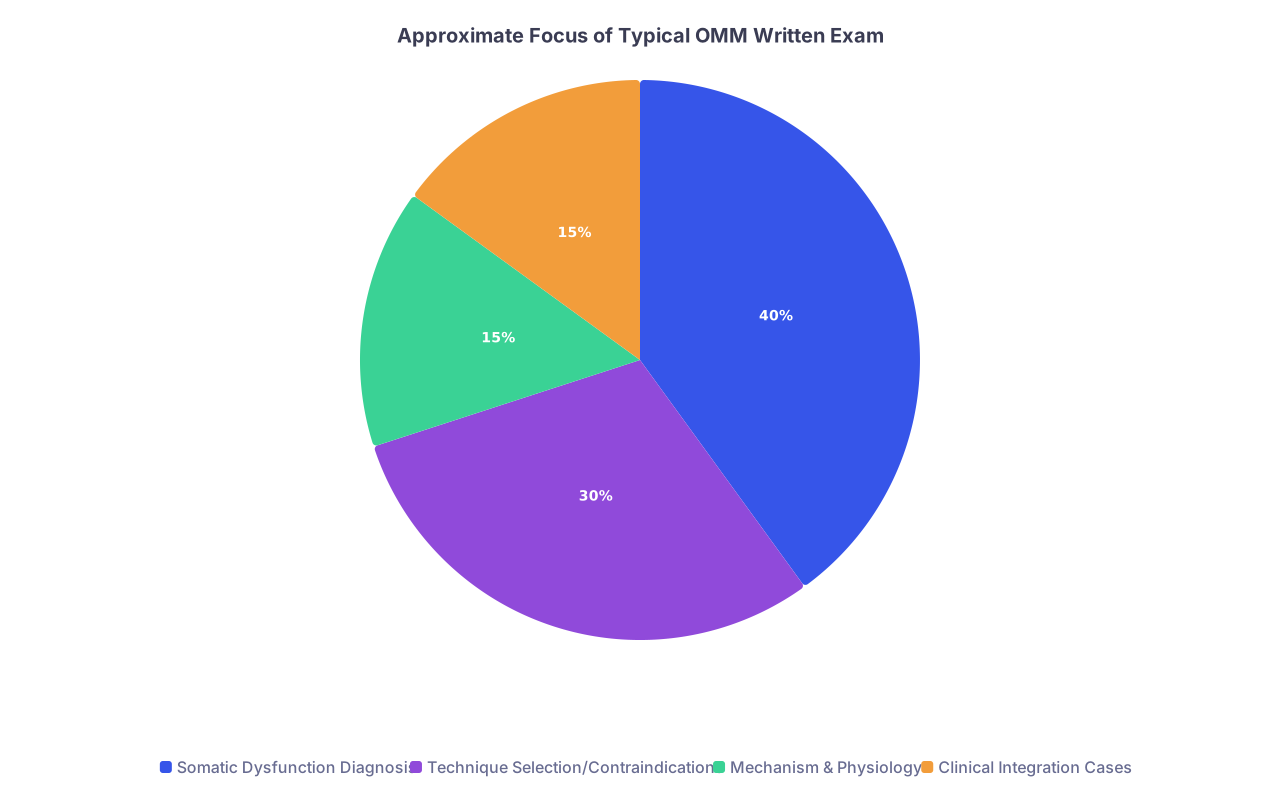
| Category | Value |
|---|---|
| Somatic Dysfunction Diagnosis | 40 |
| Technique Selection/Contraindications | 30 |
| Mechanism & Physiology | 15 |
| Clinical Integration Cases | 15 |
1.2 Practical OMM Testing: How It Actually Feels
Lab practicals in OMM are where many students realize this is not optional garnish.
What they test:
Diagnosis with your hands
- Palpating landmarks accurately: TPs, SPs, sacral sulci, PSIS, ASIS, costal angles, transverse processes in the neck
- Diagnosing:
- Segmental dysfunction (e.g., T5 F RrSr)
- Rib dysfunction types:
- Pump handle vs bucket handle vs caliper
- Inhalation vs exhalation dysfunction
- Sacral diagnoses (unilateral flexion, unilateral extension, torsions, etc.)
- Innominate rotations, shears
You are graded on:
- Correct diagnosis
- Proper patient positioning
- Proper physician positioning and hand placement
- Safe handling of spine/ribs
Execution of specific techniques Commonly tested:
- HVLA for thoracic or lumbar segments
- Muscle energy for:
- Cervical segments
- Thoracic/rib mechanics
- Pelvis (innominate rotations, shears)
- Counterstrain:
- Identifying tender points accurately
- Correct positioning (often very precise)
- Myofascial release, soft tissue
- Lymphatic techniques:
- Thoracic inlet
- Thoracoabdominal diaphragm
- Pedal pump, thoracic pump
The grading rubric will include:
- Verbalization of diagnosis
- Indication for chosen technique
- Listing contraindications
- Demonstrating each step in the correct order
Time pressure + OSCE integration OMM OSCE scenarios often look like:
- “You have 10 minutes with this patient with acute thoracic strain. Perform an appropriate structural exam and demonstrate one treatment technique.”
- “Explain what you are doing to the patient, including expected post-treatment soreness and self-care.”
You are not just being tested on hands. You are being tested on whether you can function as a DO who can justify the use of OMM in real encounters.
2. How MD Programs Test Musculoskeletal Systems
Now flip to the MD side.
Most MD curricula do not have a separate “manual medicine” discipline. MSK is wrapped into:
- Anatomy
- Physical diagnosis
- Orthopedics/rheumatology teaching
- Clinical skills OSCEs
The targets are different. Less philosophy, more “Can you localize the lesion and pick the right test or imaging?”
2.1 Cognitive Targets in MD MSK Exams
Typical written MSK testing in MD programs focuses on:
Anatomy and biomechanics
High-yield patterns:- Which nerve root/terminal nerve innervates which muscle or cutaneous area
- Attachments and actions of key muscles (e.g., rotator cuff, hip abductors, quadriceps, hamstrings)
- Ligament function (ACL vs PCL; UCL at elbow; deltoid ligament vs lateral ankle ligaments)
Questions like:
- “A football player sustains a valgus force injury to the knee. Which structure is most likely injured?”
- “Injury to which nerve results in foot drop?”
Injury mechanisms and clinical presentations
You are expected to know:- Common sprain/strain patterns
- Fracture patterns (Colles, Smith, Monteggia, Galeazzi, hip fracture vs dislocation patterns)
- Typical exam findings in:
- Rotator cuff tear vs impingement vs adhesive capsulitis
- ACL vs PCL vs collateral ligament injuries
- Carpal tunnel vs ulnar neuropathy vs radiculopathy
Special tests and their interpretation
Slightly different flavor than OMM:- You must know:
- What the test is doing (e.g., anterior drawer stressing ACL)
- What represents a positive test
- Sensitivity/specificity in a general sense (which test rules in or out something better)
- Examples:
- Neer/Hawkins for impingement
- Empty can/Jobe for supraspinatus
- Phalen/Tinel for carpal tunnel
- FABER/FADIR for hip/SI pathology
- Spurling for cervical radiculopathy
- You must know:
Rheumatologic and systemic MSK conditions
MD assessments lean heavily on:- RA, SLE, spondyloarthropathies, gout, OA
- Septic arthritis, osteomyelitis
- Back pain red flags (cauda equina, malignancy, infection)
- Workup algorithms (when to order MRI, when to tap a joint, when to refer urgently)
The emphasis is: localize, categorize, investigate, manage. Not “treat with hands,” but “decide what workup and management is appropriate.”
2.2 Practical MSK/Physical Exam Testing In MD Programs
Where OMM practicals are technique-heavy, MD MSK practicals are generally exam-heavy.
What gets tested:
Basic MSK exam components
- Inspection: symmetry, swelling, deformity
- Palpation: tenderness, step-offs, effusions, warmth
- Range of motion:
- Active vs passive
- Measuring or at least estimating (goniometer at some schools)
- Strength:
- Manual muscle testing (0–5 scale)
- Neurovascular:
- Distal pulses, cap refill, sensation in dermatomes or peripheral nerve distribution
Joint-specific special tests OSCE stations will usually ask you to examine:
- Shoulder:
- ROM + Neer, Hawkins, drop arm, empty can
- Knee:
- Lachman, anterior/posterior drawer, valgus/varus stress, McMurray
- Hip:
- FABER, straight leg raise, log roll
- Wrist/hand:
- Phalen, Tinel, Finkelstein, grind test for thumb CMC OA
You are graded on:
- Proper positioning of patient and examiner
- Hand placement
- Doing the maneuver safely and correctly
- Interpreting the result aloud
- Shoulder:
Back and neck exam MD programs consistently test:
- Inspection and palpation of spine
- ROM
- Straight leg raise (sciatic nerve)
- Spurling test (cervical radiculopathy)
- Reflexes (patellar, Achilles, biceps, triceps)
- Sensory testing in dermatomes
No one is asking you to treat L5 with HVLA. They want to know if you can find an L5 radiculopathy and not miss cauda equina.
3. Structural vs Functional: The Philosophic Split That Drives Testing
The assessment difference is not accidental. It reflects two different core lenses.
3.1 OMM = Functional + Somatic + Autonomic
OMM sees the musculoskeletal system as:
- A dynamic functional system that can be dysfunctional even without structural damage
- A major interface with the autonomic nervous system
- A tool for influencing lymphatic and circulatory function
So DO exams will ask:
- “Which spinal level corresponds to sympathetics for this organ?”
- “Which Chapman point correlates with this condition?”
- “Which rib is the key rib in this group dysfunction, and how does that relate to the patient’s respiratory complaint?”
This leads to exam emphasis on:
- Palpatory diagnosis of motion and tissue behavior
- Knowledge of autonomic and lymphatic influence
- Technique-driven therapeutic decision making
3.2 MD MSK = Structural + Pathologic
MD programs emphasize:
- Structural pathology: ligament tears, fractures, nerve compressions, inflammatory joint disease
- Objective, imaging-correlated findings
- Biomechanics and evidence-based special tests
So MD exams focus on:
- “Which ligament is torn given this exam and MRI?”
- “Which physical exam maneuver best confirms your suspected diagnosis?”
- “What is the next appropriate step in management?”
Both care about anatomy and basic exam skills. Only one tests your ability to feel and treat subtle motion dysfunctions as a major competency.
4. How High-Stakes Exams Reflect This: COMLEX vs USMLE
You cannot talk about assessment without talking boards.
4.1 COMLEX (DO) Musculoskeletal/OMM Flavors
On COMLEX Level 1 and 2, you will see:
Pure OMM questions:
- “A patient with T9–T12 dysfunction and RUQ pain… which autonomic findings are most likely?”
- “In treating an exhalation dysfunction of ribs 6–9 with muscle energy, which muscle group should be engaged?”
Hybrid MSK + OMM questions:
- Trauma case with rib fracture and underlying pulmonary issue, asking about both structural injury and OMM options
- Back pain cases with red flags, then a second-order question about safe OMM or when to avoid it
COMLEX expects you to:
- Use OMM as a legitimate part of management
- Understand contraindications and risk
- Recognize somatic dysfunction as a key clinical clue, not just fluff
4.2 USMLE (MD) MSK Flavors
USMLE Step 1/2 (and MD-school-style exams modeled off them) emphasize:
- MSK anatomy tied to neurologic deficits:
- “Patient cannot abduct arm beyond 15 degrees → which nerve?”
- Classic ortho/rheum vignettes:
- “30-year-old with morning stiffness improving with activity, DIP sparing, RF positive… next step?”
- Evidence-based use of special tests:
- “Which physical exam finding is most specific for an ACL tear?”
USMLE does not care if you know how to diagnose L1 F RrSr by palpation. It cares if you know how to handle cauda equina and hip fractures by algorithm.
5. Direct Comparison: OMM Exams vs MD MSK Exams
Let me put the contrasts side by side, because this is where premeds and early med students get confused.
| Dimension | DO OMM Exams | MD MSK Exams |
|---|---|---|
| Primary Goal | Diagnose and treat somatic dysfunction; integrate autonomics & lymphatics | Diagnose structural pathology; guide workup and management |
| Cognitive Emphasis | Fryette mechanics, segmental diagnosis, OMM technique selection, autonomic levels | Anatomy, biomechanics, injury patterns, special tests, imaging and treatment algorithms |
| Practical Skills | Palpatory diagnosis, HVLA/ME/counterstrain, soft tissue, lymphatic techniques | Joint-specific exam, ROM, strength, special tests, neuro exam |
| Clinical Integration | Use OMM in back pain, respiratory, GI, post-op care, pregnancy | Use exam + imaging to manage sports injuries, fractures, arthritides, radiculopathies |
| Assessment Style | Many OMM-specific questions + integrated systems questions on COMLEX and school exams | MSK questions interwoven with neuro, rheum, ortho on USMLE and school exams |
Big takeaway: DO = extra layer, not replacement. You still get tested on “standard” MSK medicine, but you also carry the entire OMM apparatus on top.
6. What This Means For You As A Premed Or Early Med Student
You are likely trying to decide:
- “If I go DO, what extra exam burden do I take on?”
- “If I am MD, how much am I missing by not learning OMM?”
Let me be blunt.
6.1 If You Go DO: Your Exam World Is Bigger, Not Easier
You must master everything your MD peers do plus:
- Somatic dysfunction theory
- Palpatory diagnostic precision
- A repertoire of named techniques
- The ability to justify these in clinical reasoning
The students who struggle in DO school are often the ones who try to:
- Treat OMM as an elective side-hobby
- Cram OMM the way they cram pharmacology
That fails because:
- OMM practicals are motor skill assessments. If you have not done the reps with your hands, you cannot fake it. The faculty see through “YouTube-level” technique.
- OMM written exams are pattern-heavy. If you do not build a solid mental framework for spinal/rib/pelvic diagnoses, everything blurs together during testing.
From a preparation standpoint before you even start:
- Get comfortable with 3D anatomy. Spine, ribs, pelvis, sacrum, and major muscular attachments.
- Learn to think in motion and planes:
- Flexion/extension
- Sidebending
- Rotation
- Coupled motion in spine
Those who do this early do dramatically better on early OMM exams and later on COMLEX.
6.2 If You Go MD: You Still Need A High-Level MSK Exam Skillset
There is a myth that MD schools underteach MSK. That used to be more accurate. It has improved but remains uneven.
What is non-negotiable:
- Competence in:
- Knee, shoulder, ankle, spine exam
- Basic neurologic exam
- Recognizing emergencies
If you want to be strong in MSK as an MD student:
- Invest in physical exam practice early. Use classmates as practice patients. Get feedback from residents who do ortho, EM, FM, PM&R.
- Do not skip the “boring” anatomy. That is what your orthopedics shelf and Step 1/2 questions lean on.
You will not be tested on HVLA, but you will be tested — heavily — on whether you recognize the ACL tear and not call it a meniscal injury.
7. Overlap and Mismatch: Where DO and MD Worlds Cross
Here is where it gets interesting.
7.1 Shared Ground
Both DO and MD students are tested on:
- Core anatomy of the MSK system
- Joint-specific physical exam maneuvers
- Back/neck pain evaluation and red flags
- Sports injuries and overuse syndromes
- Ortho/rheum basics
DO students simply have two layers:
- Layer 1: The same MSK exam MDs must master
- Layer 2: OMM-specific diagnosis and hands-on treatment
7.2 Mismatch That Causes Confusion
I have watched plenty of DO students fail in this exact way:
- They get very good at diagnosing “L5 N SlRr” and doing HVLA.
- Ask them which special test to use for a suspected meniscal tear? Silence.
- Ask them what imaging is indicated first-line for low back pain with no red flags? Guesswork.
They over-invest in OMM at the expense of bread-and-butter MSK medicine.
On the MD side:
- I have watched MD students nail every special test for the shoulder.
- Put their hands on a patient’s thoracic spine? They are lost.
- Any subtle appreciation of rib motion, diaphragmatic restrictions, or autonomic patterns is nonexistent.
They can order MRIs and injections, but cannot think in terms of function and subtle restriction.
Best clinicians — in any degree — blend both worlds. Even if formally assessed differently.
8. How To Prepare Smartly (Premed + Early Med)
Let me give you something actionable, depending on where you are.
8.1 As A Premed Deciding DO vs MD
Ask yourself:
Do I like the idea of manual, hands-on diagnosis and treatment as a core skill set?
If yes, DO makes sense. Understand it comes with real exam demands. This is not “shampoo and scalp massage.”Am I willing to put in regular physical practice time, not just reading?
Because for OMM, you have to schedule:- Weekly hands-on practice
- Repeated pattern drills (diagnosing segments, ribs)
- Technique repetition until it is smooth enough for a practical
Do I see value in autonomic/lymphatic thinking?
If you roll your eyes whenever someone mentions vagal tone or lymphatics, you will hate parts of OMM.
If the answers are mostly yes, DO is a good fit. If you want a more straightforward exam path focused on traditional MSK + internal medicine + surgery, MD may be cleaner.
8.2 As An Early DO Student
Concrete exam prep strategy:
- Build a grid for spinal diagnosis:
- Cervical: typical patterns + OA/AA special rules
- Thoracic: Type I vs II, rib associations
- Lumbar: Fryette mechanics and common dysfunctions
- Make a ribs chart:
- Upper ribs (pump-handle), mid (mixed), lower (bucket-handle)
- Exhalation vs inhalation dysfunction patterns
- Key rib rules and which muscles to recruit in ME
- For each technique family (HVLA, ME, counterstrain, FPR, BLT, lymphatic), write:
- Indications
- Major contraindications
- Core steps
- Example case
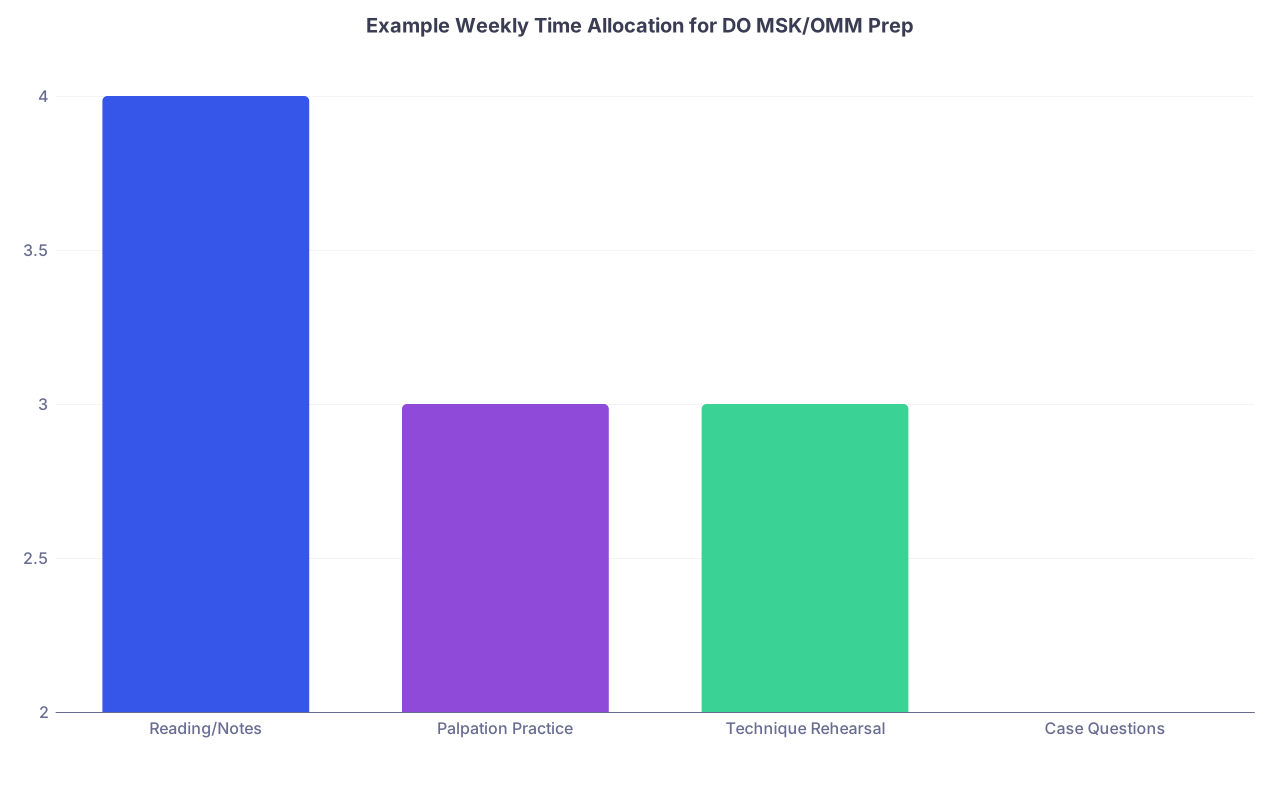
| Category | Value |
|---|---|
| Reading/Notes | 4 |
| Palpation Practice | 3 |
| Technique Rehearsal | 3 |
| Case Questions | 2 |
High performers keep OMM lab notes, immediately translate them into checklists, and rehearse with peers well before practical week. They also use COMLEX-style question banks early so the written piece never falls behind.
8.3 As An Early MD Student
Do three things aggressively:
Own your anatomy.
Not just memorizing names, but:- Knowing function
- Predicting deficit patterns from injury
- Connecting structures to clinical maneuvers
Treat MSK physical exam like a language.
Don’t just watch attending demonstration once and move on. You should:- Physically practice each joint exam multiple times
- Say out loud what you are testing and what a positive signifies
- Watch high-quality videos to refine your form
Use practice questions as a map.
If you keep missing:- Nerve injuries
- Fracture names and associations
- Rheumatologic pattern recognition
Then go back to targeted resources and plug those holes systematically.
9. The Bottom Line: Two Different Skill Profiles
OMM exams and MD MSK exams are not “harder vs easier.” They are different bets on what a physician should be able to do with the musculoskeletal system.
To close this cleanly:
DO/OMM assessment loads you with an extra, very real competency: palpatory diagnosis and manual treatment, integrated with autonomics and lymphatics. You are tested on techniques, tissue findings, and using your hands therapeutically.
MD/MSK assessment prioritizes anatomical precision, injury mechanisms, special tests, and treatment algorithms. You are tested on localizing structural pathology, ordering the right studies, and knowing guideline-based management.
The smartest students, regardless of pathway, steal from both worlds. They learn rock-solid MSK exam and structural reasoning, and they respect functional, hands-on approaches rather than dismissing them as fluff.
If you understand these differences now, you can prepare deliberately instead of discovering them the hard way halfway through second year.