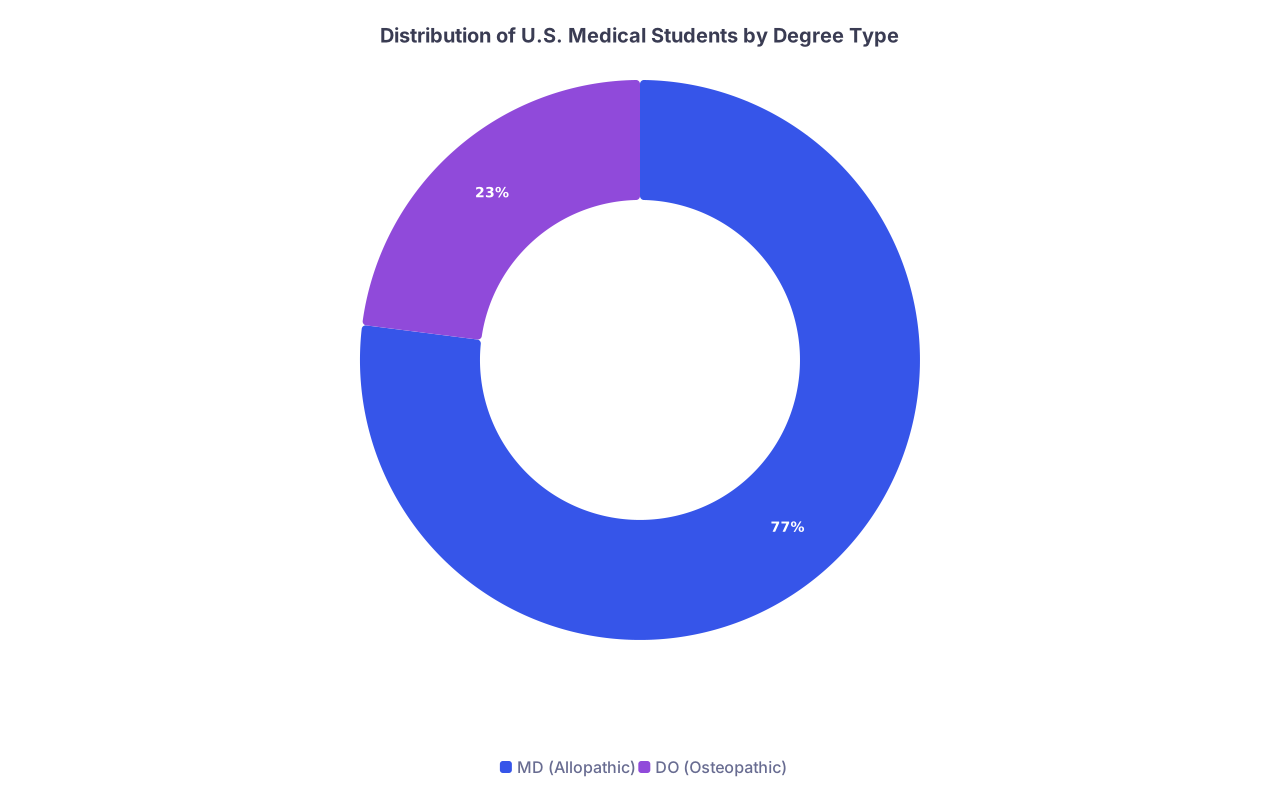
| Category | Value |
|---|---|
| MD (Allopathic) | 77 |
| DO (Osteopathic) | 23 |
Most premeds misunderstand the real educational gap between DO and MD schools—and it shows in how they talk about anatomy, MSK, and pain.
Let me be direct: the difference is not “MDs are science-based and DOs are holistic.” That line is marketing fluff. The real split is in how early, how often, and how physically you are forced to understand the human body as a moving, hurting, dysfunctional system—especially the musculoskeletal system and pain.
If you want to know how DO vs. MD schools actually teach anatomy, MSK, and pain from the ground up, you have to look at the day-to-day: labs, small groups, exams, and what is considered “core” vs “optional.”
I will break this down like you are deciding between two very real first-year schedules. Because you are.
1. The Starting Point: Philosophy That Actually Shows Up in Class
Forget the slogans. Watch what gets built into required contact hours.
MD (allopathic) schools are built historically around:
- Pathology
- Pharmacology
- Organ systems
- Diagnostics and management
DO (osteopathic) schools add a second layer on top:
- Somatic dysfunction
- Structure–function relationships
- Hands-on diagnosis and treatment of MSK and some autonomic issues (OMM/OMT)
People love arguing about “philosophy,” but here is where it actually bites:
- At a typical MD school, anatomy = “learn it so you can interpret imaging, do procedures, and understand pathology.”
- At a typical DO school, anatomy = “learn it so you can palpate it, move it, treat it, and then also interpret imaging, do procedures, and understand pathology.”
That extra layer changes how they teach:
- Same spine anatomy.
- Different questions:
- MD: “Which nerve root is compressed in this disc herniation case?”
- DO: “Which vertebral segment has a somatic dysfunction pattern causing this radiculopathy—and what motion restriction would you feel?”
Both are legitimate. One is more palpation-driven and explicitly movement-based from day one.
2. Anatomy: Same Cadavers, Different Expectations
You will dissect (or at least prosect) a human body at most MD and DO schools. The gross anatomy content is far more similar than premed Reddit wants to admit.
The meaningful differences are in:
- How often anatomy gets tied to physical exam and palpation.
- How MSK anatomy is revisited and used in labs over and over vs. treated as “we did MSK in Block 1.”
MD Anatomy: Heavy Front-Load, Strong Imaging Tie-In
Pattern I have seen repeatedly at MD schools:
Gross anatomy block (or integrated in systems)
- Cadaver lab 2–4 days per week for several months early on.
- Emphasis: landmarks for surgery, nerves and vessels, relationships you will see on CT/MRI.
- Assessment: written NBME-style exams + lab practicals (tags on cadavers, imaging questions).
Clinical skills / physical exam course
- You learn inspection, palpation, range of motion, special tests.
- Landmarks are used, but often at a surface level: “Find the acromion, the medial epicondyle, the ASIS.”
- MSK often gets 1–2 sessions per region.
Integration with MSK path
- In MSK/rheum block, anatomy is revisited through pathology: fractures, OA, RA, tendon injuries, etc.
- Focus: imaging, pathophysiology, treatment guidelines.
Everything is rigorous. But palpation accuracy and segment-level understanding of spine motion are rarely center stage. If you are good at MSK exam, it is often because you cared and hunted the skill, not because the curriculum forced it down your throat.
DO Anatomy: Same Content, But Anatomically Aggressive with Palpation
In DO schools, the anatomy content itself is not “lighter” or “alternative.” You still:
- Dissect or work with prosections.
- Memorize branches, foramina, innervations, dermatomes, myotomes.
- Learn imaging correlations.
The difference is the constant push to connect anatomy with:
- Palpable landmarks
- Joint motion
- Fascial planes
- Tender points and trigger areas
- Autonomic ganglia and viscerosomatic reflex zones
Typical DO pattern:
Gross anatomy + OMM from week 1
- Anatomy lab during the day.
- OMM lab that same week: “Here is C5 on the cadaver. Now let us go upstairs and palpate C5 on your partner. Here is how sidebending/rotation feels. Here is how dysfunction is named.”
- You do this across spine, ribs, pelvis, extremities.
Anatomy exam content expanded
- You may get questions like:
- “A patient has a T6 somatic dysfunction. Which organ system is most likely affected through viscerosomatic reflexes?”
- “Somatic dysfunction at which rib levels might you expect in a patient with asthma?”
- You will absolutely be asked to identify structure + motion + dysfunction pattern.
- You may get questions like:
Repetition across the 1st–2nd years
- Spine and pelvis anatomy do not just live in Block 1. They are dragged into:
- OMM labs
- Practical exams
- Clinical case discussions involving pain and autonomic symptoms
- Spine and pelvis anatomy do not just live in Block 1. They are dragged into:
This is not “better” in a universal sense. But if you care about MSK and pain, DO curricula tend to force deeper anatomical embodiment. You are basically graded on whether the anatomy made it into your hands.
3. Musculoskeletal (MSK): Where the Gap Starts to Open
Let me break this one very specifically, because this is where you feel the largest day-to-day difference.
Both MD and DO schools cover:
- Joint anatomy: shoulder, hip, knee, spine, etc.
- Common pathologies: sprains, fractures, OA, RA, low back pain, radiculopathy.
- Imaging: X-ray, CT, MRI basics.
- Management: NSAIDs, PT, injections, surgery, red flag recognition.
The divergence is in exam depth and time on pure MSK assessment.
MD-Side MSK Training
Most MD schools:
- Give you an MSK/rheum block (4–8 weeks).
- Include:
- Pathophys of OA, RA, spondyloarthropathies.
- Orthopedic injuries and sports med basics.
- Approach to back/neck/shoulder/knee pain.
- Emergency MSK (compartment syndrome, open fractures, etc.).
MSK physical exam teaching often looks like:
- A sequence of standardized sessions: “knee exam,” “shoulder exam,” “back exam.”
- You learn maneuvers: Lachman, McMurray, Neer, Hawkins, Spurling, straight leg raise.
- You practice on classmates or standardized patients, maybe 2–3 hours per joint.
Then you are evaluated with:
- OSCE stations with 10–15 minute knee/back/shoulder encounters.
- Written exams that focus highly on pattern recognition and guidelines:
“Best initial imaging in atraumatic low back pain with red flags is…?”
The key thing: intensive repeated practice of nuanced palpation for dysfunction (tissue texture, segmental motion) is usually absent. If you get it, you got lucky with a sports med attending or elective.
DO-Side MSK Training
In DO school, MSK is not a “block.” It is a spine that runs through the entire preclinical curriculum.
You get:
- OMM lab every week (or close to it) through first year, often well into second year.
- Each lab has:
- Anatomy review.
- Palpatory assessment.
- Motion testing.
- Diagnosis of somatic dysfunction.
- Treatment techniques (muscle energy, HVLA, counterstrain, myofascial release, etc.).
Typical progression:
Early months:
- Learn surface landmarks: spinous processes, transverse processes, sacral base, PSIS, ASIS, rib angles.
- Learn what “neutral, flexed, extended, rotated, sidebent” feel like in the spine.
Later months:
- Integrate with clinical pain complaints:
- “This patient has right-sided low back pain after lifting. What lumbar motion pattern do you expect? What muscles are hypertonic? Which techniques could you use?”
- Every region—cervical, thoracic, lumbar, ribs, pelvis, sacrum, extremities—gets separate evaluation + management.
- Integrate with clinical pain complaints:
Assessments are more physical:
- Practical exams where faculty watch your hand placement, motion testing, and treatment.
- You must:
- Identify a dysfunctional segment or region.
- State the diagnosis in osteopathic terms (e.g., “L4 FRS right”).
- Demonstrate a treatment safely and correctly.
This is real pressure. DO students know the “I thought I was on T5 but faculty said I was on T7” humiliation well.
The takeaway:
- MD students: solid theoretical MSK + basic exam. Depth depends heavily on self-driven interest and electives.
- DO students: forced, graded, continuous MSK exam and treatment learning, whether you feel like being “hands-on” or not.
4. Pain: Pharmacology vs. Body-as-Source and Body-as-Treatment
If you care about pain medicine, read this part twice.
Both MD and DO schools:
- Teach pain pathways, nociceptors, CNS modulation.
- Cover acute vs chronic pain.
- Teach pain meds: NSAIDs, acetaminophen, opioids, adjuvants (TCAs, SNRIs, anticonvulsants).
- Address opioid crisis, risk mitigation, and guidelines.
The difference is orientation:
MD Pain Training: Systems, Drugs, Red Flags
Pain education in MD curricula tends to be:
- Neuro and psych heavy:
- Central sensitization.
- Neuropathic vs nociceptive pain.
- Pain catastrophizing, mood disorders involvement.
- Pharm heavy:
- Opioid mechanisms, receptors, tolerance, dependence.
- Non-opioid options and stepwise approaches.
- Systems heavy:
- Back pain algorithms: imaging criteria, PT referrals, injection timing.
- Postoperative pain control protocols.
Where MSK and pain intersect:
- Mechanical low back and neck pain get time.
- Exam focus: red flags (cancer, infection, cauda equina).
- Management: PT, core strengthening, NSAIDs, maybe injections or surgery if needed.
- Non-procedural manual approaches (chiro/OMT/massage) often appear as “adjunctive” lines in a slide deck rather than reproducible skills.
A very good MD school will expose you to:
- Pain clinics.
- Interventional pain procedures.
- Multidisciplinary pain boards.
But these are electives, not core. Most MD grads are much stronger in pharmacologic and guideline-based pain management than in physical/manual contributors to pain.
DO Pain Training: Add a Mechanical + Autonomic Layer
DO schools teach all of the above—but overlay it with:
- Somatic dysfunction as contributor to pain:
- Muscle hypertonicity
- Joint restriction
- Fascial tension
- Postural imbalance
- Viscerosomatic reflexes:
- Chronic organ pathology → predictable segmental changes → referred or localized back pain.
- Autonomic balance:
- Sympathetic vs parasympathetic tone influencing pain, vasodilation, visceral function.
In practice, this looks like:
A patient with chronic right upper quadrant pain:
- MD curriculum: gallbladder, liver, peptic ulcer, imaging, labs.
- DO curriculum: all of the above +
“Check T5–T9 on the right, rib dysfunction, diaphragm motion, myofascial restrictions. Some of this pain may be perpetuated via somatic dysfunction.”
A patient with chronic low back pain:
- MD: red flag screening, PT referral, analgesic ladder, imaging when indicated.
- DO: the same foundation +
“Diagnose segmental dysfunction, sacroiliac contributions, psoas involvement, evaluate gait, leg length inequality, and potentially treat with OMT as part of the plan.”
Is every DO graduate outstanding at pain management? No. Some barely pass OMM and never use it again. But every DO graduate:
- Has spent years being forced to think about non-pharmacologic mechanical inputs to pain.
- Has at least baseline competence to evaluate and treat some MSK pain with their hands.
The pain gap is not mystical. It is structural. MD schools prioritize pharmacologic and procedural pain management. DO schools add manual structure-function management on top.
5. Concrete Timeline: Your First Two Years, Side-by-Side
Let me sketch how the early years actually feel.
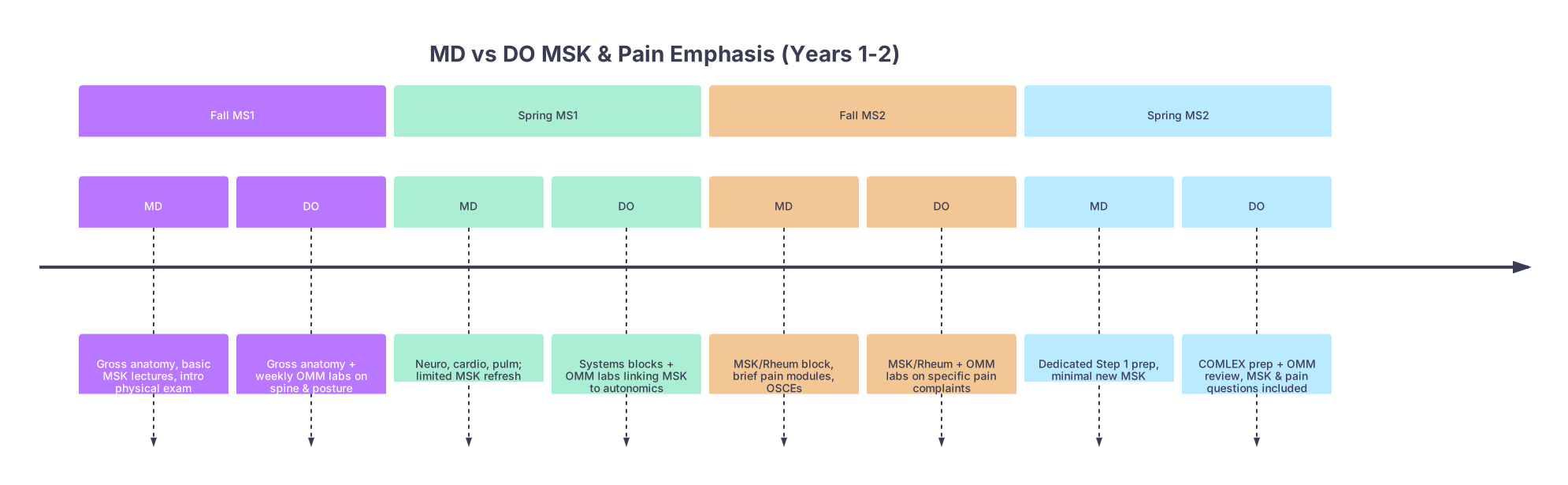
| Period | Event |
|---|---|
| Fall MS1 - MD | Gross anatomy, basic MSK lectures, intro physical exam |
| Fall MS1 - DO | Gross anatomy + weekly OMM labs on spine & posture |
| Spring MS1 - MD | Neuro, cardio, pulm; limited MSK refresh |
| Spring MS1 - DO | Systems blocks + OMM labs linking MSK to autonomics |
| Fall MS2 - MD | MSK/Rheum block, brief pain modules, OSCEs |
| Fall MS2 - DO | MSK/Rheum + OMM labs on specific pain complaints |
| Spring MS2 - MD | Dedicated Step 1 prep, minimal new MSK |
| Spring MS2 - DO | COMLEX prep + OMM review, MSK & pain questions included |
Now, imagine an exam scenario.
MD School Second-Year MSK/Rheum Exam
Question styles:
- “60-year-old with knee pain, medial joint line tenderness, mild effusion, X-ray shows joint space narrowing.” Diagnosis? Next best step?
- “Patient on chronic opioids presents with signs of misuse.” Management per guideline?
Practical:
- OSCE knee exam station: demonstrate inspection, palpation, ROM, basic stability tests.
- Communication: explain plan, reassure, maybe answer a basic PT-related question.
DO School Second-Year OMM + MSK Exam
Question styles:
- “Patient with chronic low back pain, exam reveals L4 FRS right. Which motion is restricted?”
- “Viscerosomatic reflex pattern for chronic GERD is most likely at which vertebral levels?”
Practical:
- Identify a dysfunctional cervical segment and name it using Fryette mechanics.
- Perform muscle energy on a posterior innominate rotation.
- Treat a rib inhalation dysfunction contributing to thoracic pain.
- Explain how this may reduce pain through mechanical and neurologic mechanisms.
You can see the text vs hands contrast. Both are demanding. They are just aimed at slightly different toolkits.
6. How This Shows Up in Clinical Rotations
The question I get from premeds: “Will this matter on rotations and residency?”
Yes. But not in the way Instagram tells you.
On Rotations
MD student on IM or FM:
- Very solid with meds, guidelines, and diagnostic workup.
- MSK exam quality highly variable—depends on their own interest and mentors.
- Pain plans heavy on:
- Optimize non-opioids.
- PT.
- If needed: imaging, referrals, injections, surgery.
DO student on IM or FM:
- Same basic knowledge + extra language around somatic dysfunction.
- Often more comfortable:
- Palpating spine and pelvis.
- Doing quick MSK assessments.
- Offering simple OMT if the team allows.
The real separator: DO students who lean into their training can frequently:
- Improve a patient’s neck or back pain at bedside with simple techniques.
- Use OMT as a non-opioid, non-procedural adjunct—especially in primary care or rural settings.
In Residency
Once you hit residency:
- The MD vs DO label matters less than your skills and reliability.
- But your baseline comfort with MSK and pain does carry over.
I have seen:
- DO residents in FM, EM, PM&R becoming the unofficial “MSK person” or “OMM person” on the team.
- MD residents who are phenomenal at MSK because they:
- Did sports med research.
- Chose electives in ortho, PM&R, pain.
- Practiced relentlessly.
So the real truth:
- MD path: You must choose to become strong in MSK and pain. The curriculum gives you a solid theoretical base, but hands-on mastery is self-driven.
- DO path: You are dragged through MSK and pain-related hands-on work whether you like it or not. What you do with that after graduation is up to you.
7. If You Are a Premed Deciding Between DO and MD
Strip away the prestige noise. Ask yourself:
Do I actually care about touching patients to diagnose and treat MSK and certain pain conditions?
- If yes, DO schools formalize that skill set more aggressively.
- If not, MD may feel more aligned with how you want to practice.
How much do I want manual tools vs relying heavily on:
- Medications
- Injections
- Surgery
- PT referrals
Can I handle extra lab time and practical exams?
- DO schools add:
- Weekly OMM labs.
- Extra practical exams.
- Extra content on COMLEX about OMT and somatic dysfunction.
- That is on top of the same general medical content MD students see.
- DO schools add:
One mistake I see: strong premeds who pick MD “because of competitiveness” even though they are deeply interested in MSK, sports, primary care, and pain. They later realize they have to reconstruct hands-on MSK training from scratch in residency or fellowship.
Another mistake: applicants who choose DO only as a “backup” and resent the OMM load. They fight the curriculum and graduate with mediocre OMT skills and a chip on their shoulder. Bad combo.
Choose based on:
- How you like to think about the body.
- How you want to interact with patients.
- How interested you are in physically assessing and treating pain.
8. Data Snapshot: Where MSK & OMT Actually Live
To make this less abstract, here is the structural tilt.
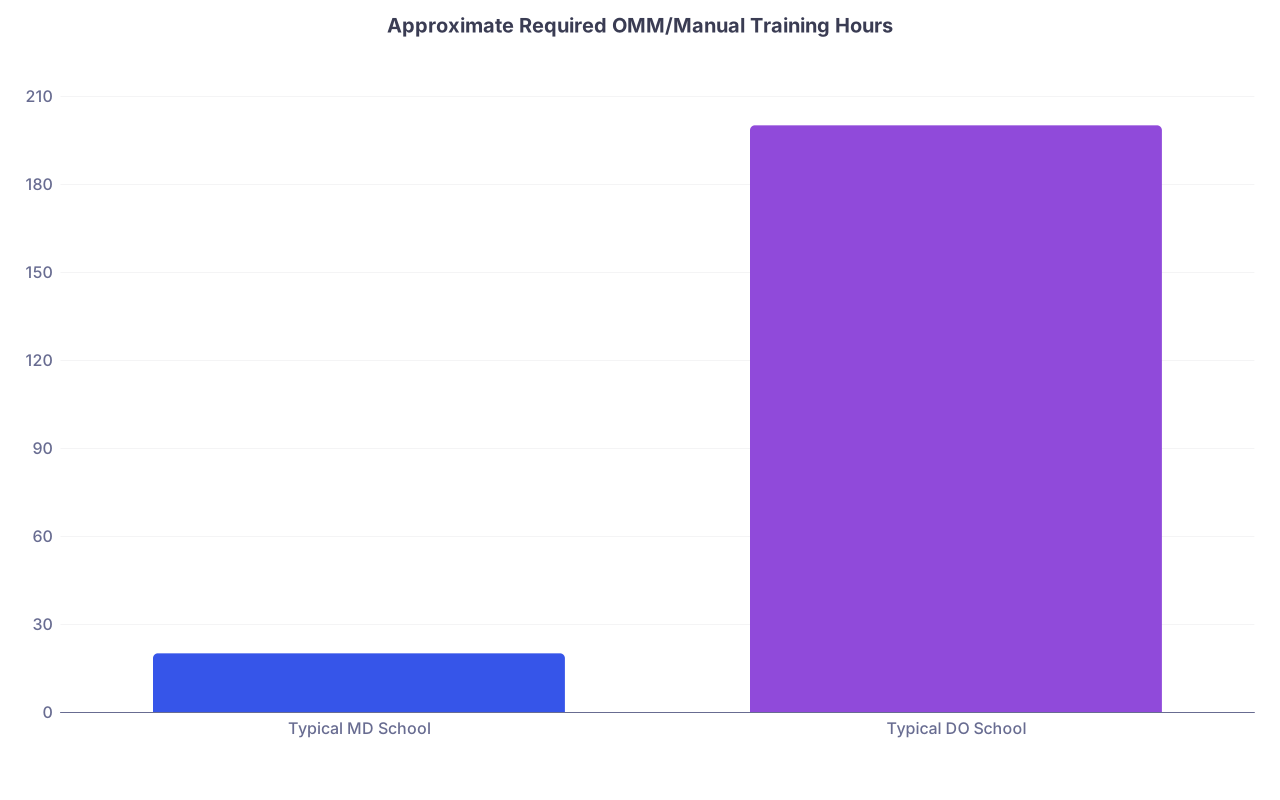
| Category | Value |
|---|---|
| Typical MD School | 20 |
| Typical DO School | 200 |
Those ~20 hours at MD schools might come from:
- A few MSK exam workshops.
- Occasional electives or interest group sessions.
Those ~200+ hours at DO schools come from:
- Weekly OMM labs for 1–2 years.
- Required practicals.
- Integrated OMM case discussions.
You can absolutely out-train that gap as an MD if you go all-in on MSK in residency and beyond. But you will do it later, when time is tighter and the stakes are higher.
FAQs (Exactly 6)
1. Do MD schools teach anything equivalent to OMM/OMT?
Not in a systematic, required way. Some MD schools offer electives in manual medicine, sports medicine, or integrative health, and a few have DO faculty who informally teach OMT-like approaches. But there is no standardized, tested, longitudinal manual medicine curriculum across MD programs the way there is OMM in DO schools.
2. If I go DO, am I locked into primary care or MSK-heavy fields?
No. DO grads match into every specialty: surgery, radiology, anesthesiology, EM, derm, you name it. Your OMM background may matter a lot in FM, IM, EM, PM&R, sports, and pain. In fields like pathology or radiology, it is mostly background knowledge unless you choose to use it indirectly (better 3D understanding of structure, for instance).
3. Will an MD be worse at treating back and neck pain than a DO?
Not automatically. An MD who cares about MSK, does sports med or PM&R electives, and trains under strong attendings can be superb at MSK and pain. The difference is that a DO is forced to learn hands-on evaluation and treatment of MSK and certain pain patterns as part of the core curriculum. MDs who are good at it made it a priority on their own.
4. Does COMLEX really test anatomy, MSK, and pain differently than USMLE?
Yes. COMLEX includes specific OMM/OMT content: somatic dysfunction diagnosis, Fryette mechanics, viscerosomatic reflexes, and integration of OMT into pain and MSK management. USMLE focuses on anatomy, neuro, pharm, and path without explicit OMT questions. Both exams test anatomy and MSK disease; only COMLEX adds the osteopathic manipulative layer.
5. If I am squeamish about touching people, should I avoid DO schools?
Honestly, yes. You will be in lab every week, touching classmates, practicing techniques, and getting graded on it. You can improve comfort over time, but if the idea of regular palpation and manual treatment feels fundamentally wrong for how you want to practice, MD is probably a better fit.
6. Can an MD learn OMT later if they regret not going DO?
They can learn manual medicine, but not become a DO. There are post-graduate courses in various manual techniques (muscle energy–like methods, myofascial techniques, manipulative approaches) open to MDs. Some MDs train with DO colleagues and adopt elements of OMT. But the systematic, 2-year, graded OMM curriculum is unique to DO education. If you are sure you want that depth from day one, DO is the cleaner path.
Key takeaways:
- Anatomy content is similar across DO and MD, but DO programs relentlessly connect it to palpation, motion, and manual treatment.
- MSK and pain in MD schools are more pharm- and guideline-centric, while DO schools add a structured, graded manual and somatic dysfunction layer.
- If you want your hands to be a core diagnostic and therapeutic tool for MSK and pain, DO training builds that from the ground up; MD training requires you to construct it later by choice.