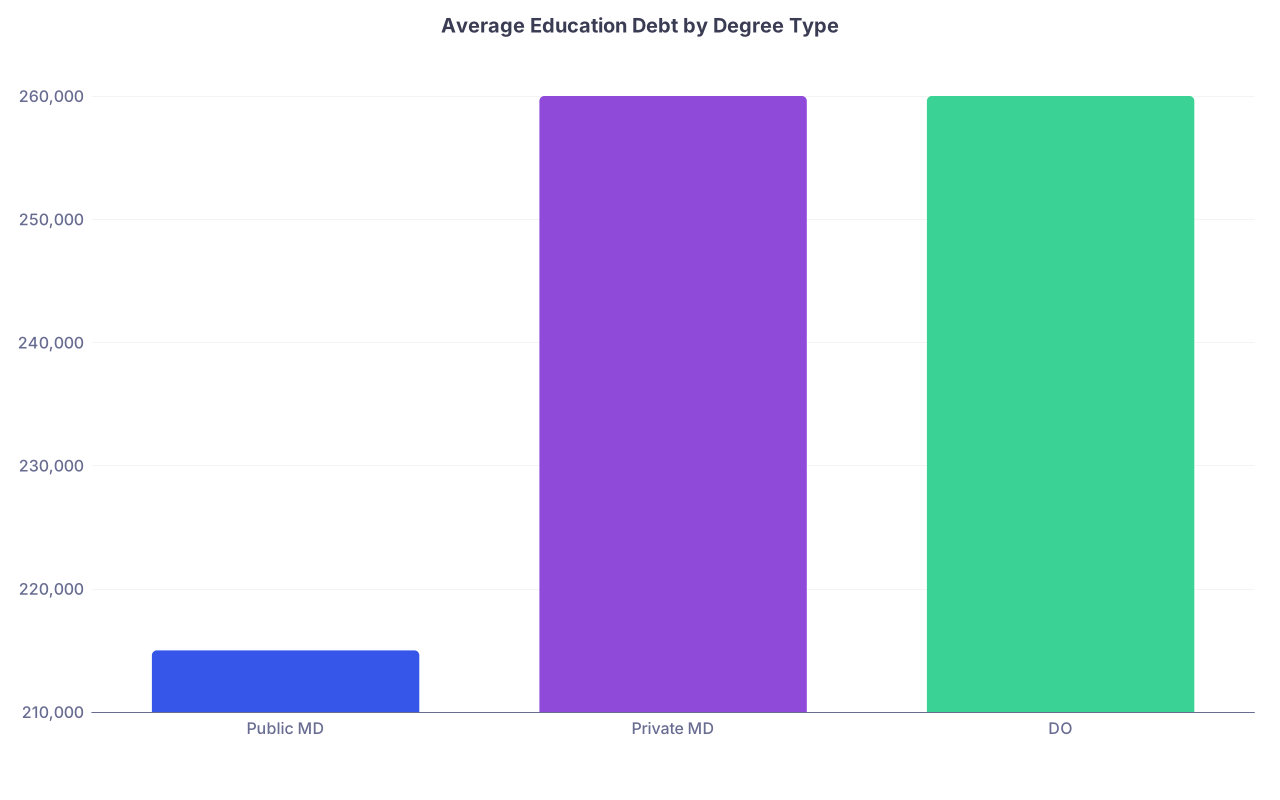
| Category | Value |
|---|---|
| Public MD | 215000 |
| Private MD | 260000 |
| DO | 260000 |
The feel‑good narrative that “all doctors do fine financially” is dangerously incomplete. The data show huge variance in debt burden, payback time, and long‑term ROI between MD and DO paths, especially once you factor in specialty outcomes and residency bottlenecks.
You want numbers. Let’s build the numbers.
1. Baseline Cost: What MD vs DO Actually Costs
Forget “expensive vs more expensive” language. We can put brackets around this with current data and realistic living costs.
1.1 Tuition and Fees: MD vs DO
Recent AAMC and AACOM data, plus typical budget line items, put you roughly here for 4 years of med school (excluding interest):
| Degree Type | School Type | Tuition & Fees (4 yrs) | Living / Other (4 yrs) | Total Cost of Attendance |
|---|---|---|---|---|
| MD | Public (IS) | $165,000–$190,000 | $120,000–$160,000 | ~$285,000–$350,000 |
| MD | Private | $230,000–$260,000 | $140,000–$180,000 | ~$370,000–$440,000 |
| DO | Mostly Private | $220,000–$260,000 | $130,000–$170,000 | ~$350,000–$430,000 |
The pattern:
- Public MD is usually the cheapest.
- Private MD and DO are in the same ballpark on sticker price.
- Living costs are the quiet killer. A “cheap” school in a high‑COL city can end up more expensive than a pricier school in a low‑COL region.
1.2 Actual Debt at Graduation
Now, what students actually carry when they walk at graduation (principal only, not yet capitalized interest):
Recent aggregates (rounded):
- Median MD debt (all schools, indebted grads only): about $215,000
- Median MD debt at private schools: closer to $250,000–$260,000
- Median DO debt: commonly reported in the $250,000–$280,000 range
Let’s lock in a modeling baseline:
- Scenario MD: $220,000 principal at graduation
- Scenario DO: $260,000 principal at graduation
We will use those two numbers throughout for apples‑to‑apples ROI modeling.
2. Income: MD vs DO by Specialty – The Real Money Driver
The degree letters do not directly determine your paycheck. Specialty choice does. But your degree does affect your probability distribution across specialties.
2.1 Median Physician Incomes by Category
Using recent MGMA/Medscape‑style data (rounded, U.S., pre‑tax, attending level):
- Primary care (FM, IM general, peds): $250,000–$280,000
- “Middle” specialties (hospitalist, psych, EM, anesthesia, OB/GYN): $300,000–$420,000
- High‑end procedural (ortho, neurosurg, cardiology, GI, derm, rad onc): $500,000–$800,000+
To avoid fake precision, I will define three working income tiers:
- Tier 1 (Primary Care): $260,000
- Tier 2 (Mid‑range): $350,000
- Tier 3 (High‑end): $550,000
Now overlay that with MD vs DO specialty placement realities.
2.2 Match Outcomes: Where MDs and DOs Actually Land
The NRMP data show consistent patterns:
- MD grads dominate the most competitive specialties (derm, plastics, ENT, neurosurg).
- DO grads are more concentrated in primary care and less represented in top‑paying subspecialties.
- DO match rates into competitive specialties have improved, but they are still lower than MD match rates, especially from newer or lower‑reputation DO schools.
Let’s build a simplified distribution for typical outcomes. Not perfect. But directionally accurate.
Assume among graduates who complete training:
MD outcome mix (very rough modeling):
- 35% Tier 1
- 40% Tier 2
- 25% Tier 3
DO outcome mix:
- 55% Tier 1
- 35% Tier 2
- 10% Tier 3
Now compute weighted expected income:
For MD:
- 0.35 × 260k = 91k
- 0.40 × 350k = 140k
- 0.25 × 550k = 137.5k
- Weighted MD income ≈ $368,500
For DO:
- 0.55 × 260k = 143k
- 0.35 × 350k = 122.5k
- 0.10 × 550k = 55k
- Weighted DO income ≈ $320,500
So, the data model says:
- Expected attending income MD vs DO gap ≈ $48,000 per year.
That does not mean any individual DO cannot match a derm spot and make $700k. It means if you look at the cohort as a whole, the income curve skews higher for MD.
3. Payback Time: How Fast Can You Kill the Debt?
Here is the question you actually care about: how long until this debt stops controlling your life?
We need to define:
- Interest rate: assume 6.5% blended (after med school, consolidation, some federal profile).
- Repayment strategy: “aggressive but human” – 15% of gross income to loans during residency, 20% of gross as attending.
- Residency length:
- Primary care: 3 years
- Mid‑range: 4 years
- High‑end: 5–6 years (I will model as 5)
And we must not forget: interest accrues during residency and often capitalizes once.
To visualize increasing debt during training:
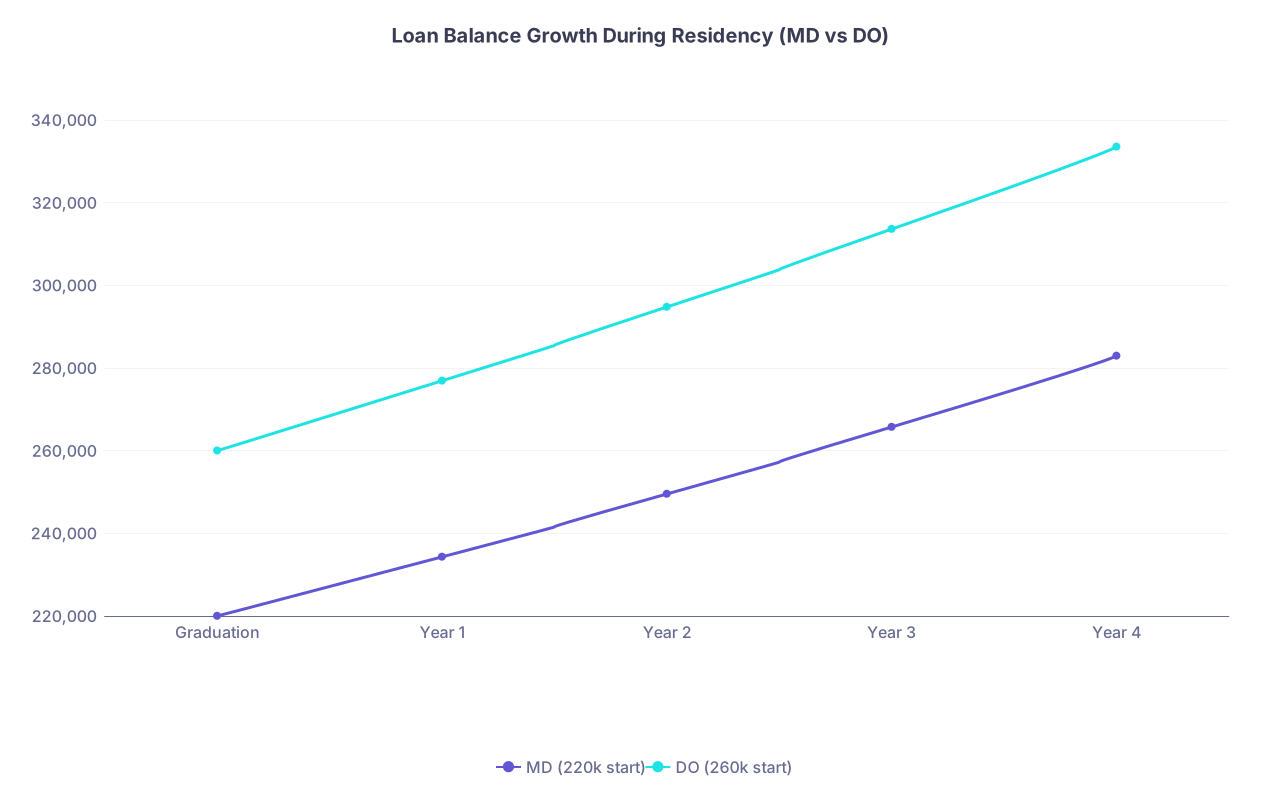
| Category | MD (220k start) | DO (260k start) |
|---|---|---|
| Graduation | 220000 | 260000 |
| Year 1 | 234300 | 276900 |
| Year 2 | 249525 | 294755 |
| Year 3 | 265720 | 313610 |
| Year 4 | 282935 | 333520 |
(The compounding is approximate, assuming limited residency payments that barely dent principal.)
3.1 Residency Income and Payments
Use typical PGY salaries:
- PGY1: ~$62,000
- PGY2: ~$65,000
- PGY3: ~$68,000
- PGY4: ~$71,000
- PGY5: ~$74,000
If you commit 15% of gross to loans:
- Year 1: 0.15 × 62k ≈ $9,300
- Year 2: 0.15 × 65k ≈ $9,750
- Year 3: 0.15 × 68k ≈ $10,200
- Year 4: 0.15 × 71k ≈ $10,650
- Year 5: 0.15 × 74k ≈ $11,100
Total paid over 3‑year residency ≈ $29,250
Over 4 years ≈ $39,900
Over 5 years ≈ $51,000
Most of that is interest service. Principal moves very little.
3.2 Scenario Modeling: Primary Care
Let us model MD vs DO both becoming primary care physicians.
Assumptions:
- 3‑year residency
- Debt at graduation: MD $220k, DO $260k
- Interest 6.5%
- 15% of resident income to loans, then 20% of attending income
- Attending salary: $260k
At the end of 3‑year residency, approximate remaining balance:
- MD: starting 220k grows roughly to ~280k despite residency payments
- DO: starting 260k grows roughly to ~330k
Now as an attending:
- 20% of 260k ≈ $52,000 per year for loans.
We now solve “years to payoff” with a standard amortization assumption.
Use rough amortization formula behavior:
- Debt D
- Monthly payment P = 52,000 / 12 ≈ 4,333
- Monthly interest rate r = 0.065 / 12 ≈ 0.0054167
For MD case: D ≈ 280,000
Using typical amortization logic, 4,333/month at 6.5% pays off ~280k in about 7.5–8 years.
For DO case: D ≈ 330,000
Same payment 4,333/month at 6.5% covers a larger principal; payoff closer to 9.5–10 years.
So from graduation:
- MD primary care: 3 years residency + ~8 attending years ≈ 11 years to zero
- DO primary care: 3 years residency + ~10 attending years ≈ 13 years to zero
Debt‑free age if you start med school at 24:
- MD: ~24 + 4 (school) + 11 ≈ age 39
- DO: ~24 + 4 + 13 ≈ age 41
Not catastrophic. But not short.
4. Scenario Modeling: Higher‑Paying Specialties
Now run the same MD vs DO comparison for mid‑income and high‑income paths.
4.1 Mid‑Range Specialty (Hospitalist, EM, Anesthesia‑type Income)
Assumptions:
- Residency 4 years
- Attending salary: $350,000
- Debt at graduation: MD 220k, DO 260k
After 4‑year residency, ballpark balances:
- MD: ~300–305k
- DO: ~355–360k
As an attending:
- 20% of 350k ≈ $70,000 per year → $5,833/month.
Approximated payoff time:
- MD: 305k with 70k/yr at 6.5% → ~6 years
- DO: 360k with 70k/yr at 6.5% → ~7.5 years
From graduation:
- MD mid‑range: 4 + 6 ≈ 10 years
- DO mid‑range: 4 + 7.5 ≈ 11.5 years
Debt‑free age (starting med school at 24):
- MD: 24 + 4 + 10 ≈ 38
- DO: 24 + 4 + 11.5 ≈ 39.5
The income jump shrinks the gap a bit, but DOs still drag extra principal plus accrued interest.
4.2 High‑End Specialty (Procedural, $550k+ Range)
Assumptions:
- Residency 5 years
- Attending salary: $550,000
- Debt at graduation: MD 220k, DO 260k
After 5‑year residency, ballpark balances:
- MD: ~320k
- DO: ~380k
As an attending:
- 20% of 550k ≈ $110,000 per year → $9,167/month
Now at that payment:
- MD: 320k principal → payoff ≈ 4 years
- DO: 380k principal → payoff ≈ 4.5–5 years
From graduation:
- MD high‑end: 5 + 4 ≈ 9 years
- DO high‑end: 5 + 5 ≈ 10 years
Debt‑free age:
- MD: 24 + 4 + 9 ≈ 37
- DO: 24 + 4 + 10 ≈ 38
At this level, the debt is an annoyance, not a life sentence.
5. Long‑Run ROI: Lifetime Earnings Minus Cost
Short‑term debt stress matters, but for ROI you care about cumulative net earnings:
- Lifetime income (career length ~30 years as attending)
- Minus education cost + financing drag
I will construct three simplified career paths for comparison:
- MD, “average” outcome mix (weighted 368.5k income)
- DO, “average” outcome mix (weighted 320.5k income)
- DO, “top‑decile outcome” (assume Tier 2/3 heavy: 20% PC, 50% mid, 30% high → ~412k income)
We also assume:
- 3–6 years of residency depending on specialty; use an average of 4 years for cohort modeling.
- Start school at 24, graduate at 28, complete residency at 32.
- Attending career from 32 to 62 (30 years).
5.1 Approximate Lifetime Gross Earnings
Simple multiplication:
- MD average: 30 × 368.5k ≈ $11.06 million (attending only)
- DO average: 30 × 320.5k ≈ $9.615 million
- DO top‑decile: 30 × 412k ≈ $12.36 million
Add residency income (~4 years × median 68k ≈ 272k) for all three — negligible compared to millions but we can be consistent:
- MD gross career ≈ 11.33M
- DO average ≈ 9.89M
- DO top‑decile ≈ 12.63M
Now subtract rough cost of med ed including interest drag.
5.2 Total Education Cost with Interest
If you stretch loans over ~10 years with interest at 6.5%, total paid is roughly 1.3–1.4× principal. I will use 1.35× as a middle‑of‑the‑road factor.
- MD principal baseline: 220k → total paid ≈ 297k
- DO principal baseline: 260k → total paid ≈ 351k
So difference in lifetime dollars spent on loans: ~54k more for DO, on average.
Add the lost investment opportunity of those payments and the spread grows, but let us keep it simple.
5.3 Lifetime Net Earnings (Crude ROI)
Subtract education cost:
- MD average: 11.33M – 0.297M ≈ 11.03M
- DO average: 9.89M – 0.351M ≈ 9.54M
- DO top‑decile: 12.63M – 0.351M ≈ 12.28M
Two key results:
- Average MD vs average DO gap ≈ $1.5M+ in lifetime net income.
- A DO who matches into high‑paying fields can out‑earn the average MD by a full million or more.
So the degree letters tilt the odds. They do not lock the outcome.
To visualize the distribution impact:
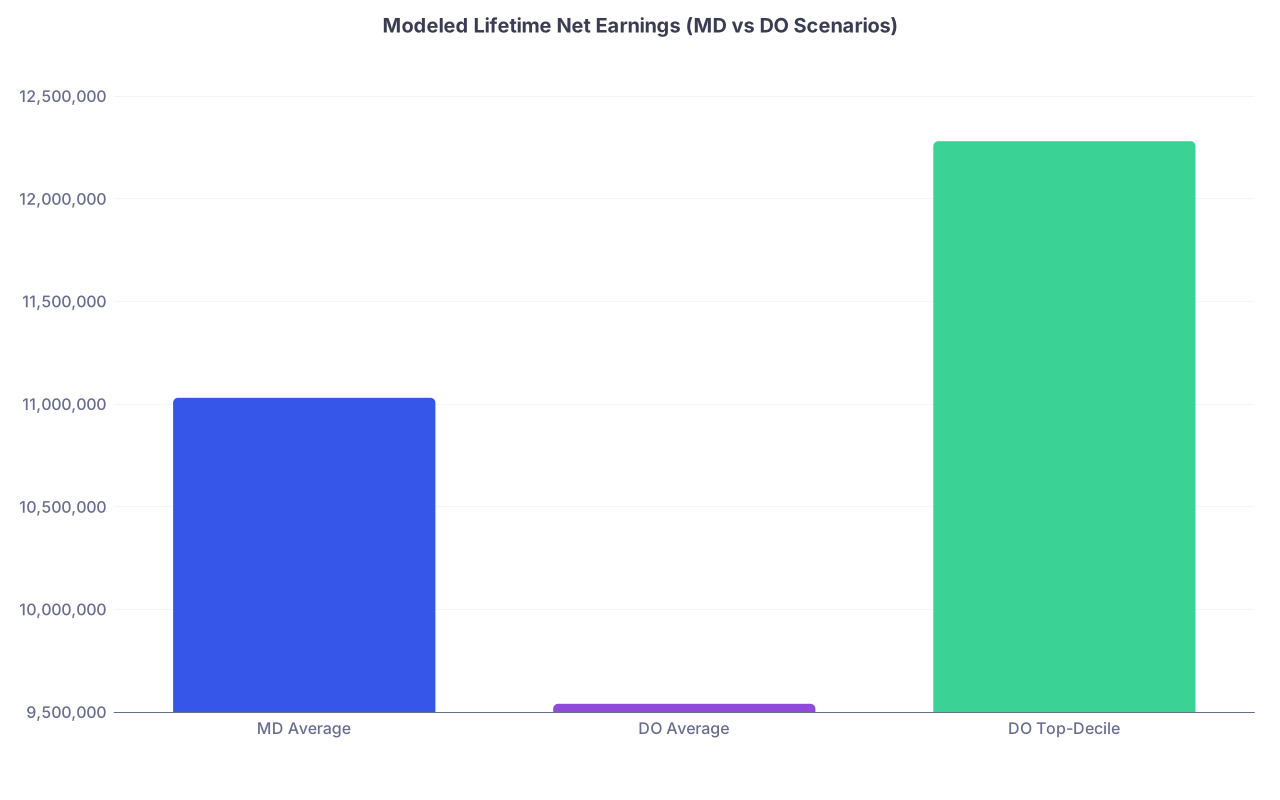
| Category | Value |
|---|---|
| MD Average | 11030000 |
| DO Average | 9540000 |
| DO Top-Decile | 12280000 |
6. Program Selection: Where the DO vs MD ROI Flips
The common mistake is treating “MD > DO” as an absolute. The reality is more conditional:
- A cheap, reputable DO program vs an expensive private MD program can flip the ROI.
- Conversely, a strong public MD at in‑state tuition obliterates most DO options on cost‑benefit grounds.
6.1 Comparing Concrete Pairings
Take two sample options:
Offer A: In‑state public MD
- 4‑year cost of attendance: $300k
- Expected principal at graduation after savings/scholarships: $200k
Offer B: Private DO
- 4‑year COA: $410k
- Expected principal at graduation: $275k
You already see the problem. DO is carrying $75k more principal, which compounding will inflate.
But flip the example:
Offer C: High‑priced private MD in major coastal city
- COA: $450k
- Grad principal: $310k
Offer D: Lower‑cost DO in midwestern town
- COA: $340k
- Grad principal: $230k
Now the DO is 80k ahead on principal at graduation. With interest that can easily become a six‑figure advantage.
ROI is not “MD vs DO.” It is “specific MD vs specific DO vs your realistic specialty trajectory.”
7. Risk: The New Wildcard – Not Matching or Not Completing
This is where the DO vs MD conversation gets uncomfortable, and where many premeds are in denial.
Residency slots are not expanding fast enough relative to graduates. Competition is tightening, particularly for less established DO schools and for IMGs.
Here is what the data show:
- NRMP match rates for U.S. MD seniors remain high (~92–94% overall).
- U.S. DO seniors match slightly lower (~89–91%), and specialty mix skews to primary care.
- Unmatched rates are low in percentage terms but devastating individually. Non‑match plus six figures of debt is the worst‑case ROI.
Represent the match risk visually:
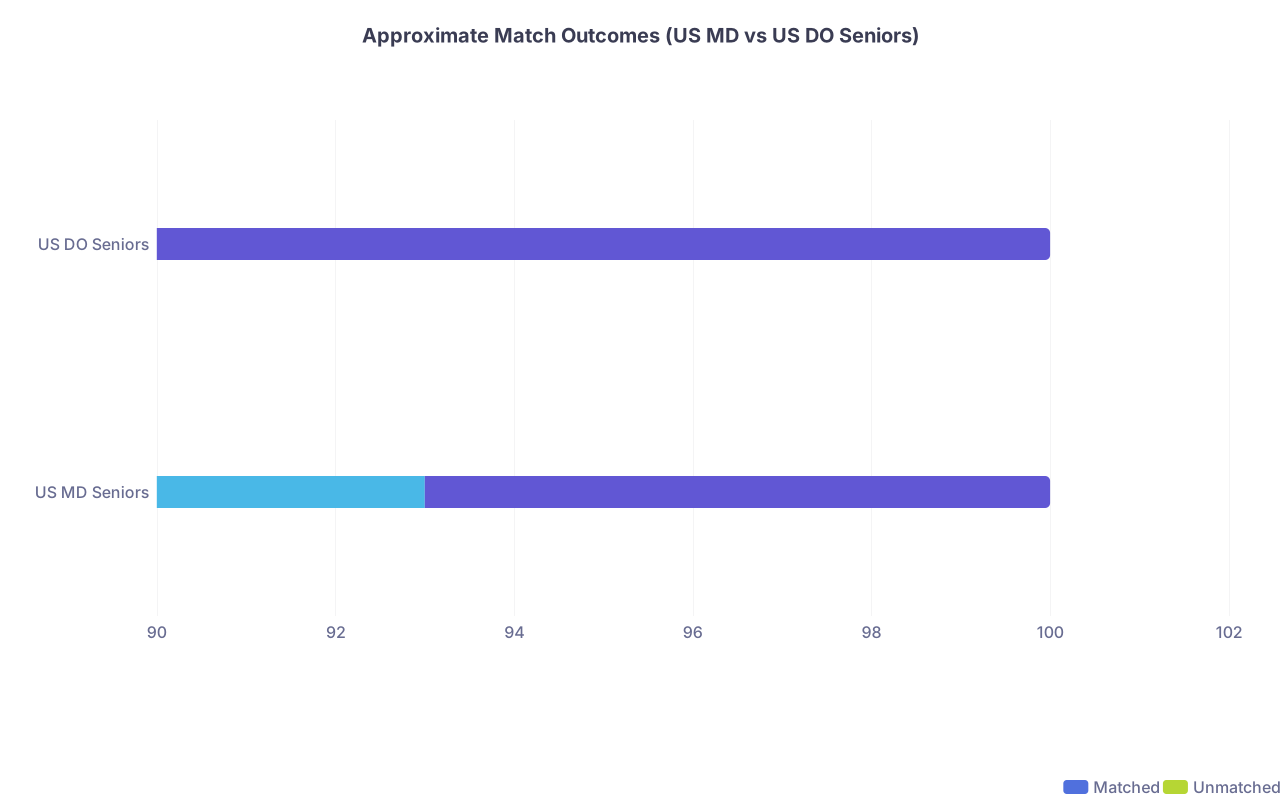
| Category | Matched | Unmatched |
|---|---|---|
| US MD Seniors | 93 | 7 |
| US DO Seniors | 90 | 10 |
That 3‑point gap is not trivial if you are in the marginal group. It means DO carries:
- Slightly higher probability of no residency.
- Higher concentration in lower‑paid specialties when matched.
This risk is where an expensive DO program without strong match support becomes very hard to justify.
8. Practical Decision Rules: Turning Data into an Actual Choice
Let me be blunt. This is how I would think about it if it were my money and my 20s on the table.
8.1 When MD is Clearly Higher ROI
- You have an affordable in‑state public MD acceptance.
- Your DO options are all private, high tuition, weaker match lists.
- You are even mildly interested in competitive specialties or high‑end subspecialties.
Quantitatively:
If the MD program will leave you with ≤$220k principal and the DO would leave you ≥$260k, default to MD unless there is some truly unusual factor.
8.2 When DO is Financially Rational or Even Better
- The DO program is substantially cheaper on total cost of attendance (≥$50k principal difference in your favor).
- The school has strong historical match performance in your target region/specialty.
- You are realistically primary‑care focused, or you are willing to grind at top‑5% level for competitive specialties.
If you can walk out of a DO program with ≤$200k principal and your alternative is a coastal private MD at ≥$280k, the modeled ROI often shifts in favor of DO, especially if you end up in a mid‑range specialty anyway.
8.3 The Red‑Flag Situation
- DO school with high tuition (40k–60k+ per year),
- Weak or unknown match list,
- Minimal support structure,
- And your stats are borderline for Step/Level performance.
Statistically, that is where you risk:
- High six‑figure debt
- Below‑average shot at competitive specialties
- Slightly higher non‑match risk
The expected value there can be negative compared to alternative careers with lower training cost.
FAQ (Exactly 3 Questions)
1. Is the MD degree always a better financial decision than DO?
No. The MD degree generally gives you better odds at higher‑paid specialties and slightly lower non‑match risk, which pushes expected income higher. But if your MD option is a very expensive private school and your DO option is significantly cheaper with solid match outcomes, the DO can produce equal or better ROI. The correct comparison is not “MD vs DO” in the abstract. It is “this specific MD at this cost and match profile vs this specific DO at this cost and match profile, given my realistic specialty odds.”
2. How much more debt is “too much” for a DO program?
From a numbers standpoint, once your projected principal at graduation starts creeping above $300,000, the risk–reward balance deteriorates fast, especially for DO where the probability of ending up in primary care is higher. At 6.5% interest, a $320k–$350k starting balance can easily cost you $450k+ over the life of the loans. If the school also has weaker match results, that combination is financially dangerous. I would be very cautious about any DO program where your individualized budget model shows >$275k in principal at graduation.
3. If I want a high‑paying specialty, should I avoid DO entirely?
Not automatically. There are DO graduates in ortho, derm, radiology, and other high‑end fields. But the data show clearly: your probability of landing those spots is lower from many DO schools than from strong MD programs, especially if your board scores are just “average.” If your stats are already borderline and you are dead‑set on a highly competitive specialty, then a lower‑cost, reputable MD program is typically the more rational bet. If you are a top student willing to out‑perform your peers and the DO school has a track record of placing grads into those fields, DO can still work, but the onus is on you to be in the top slice of that distribution.