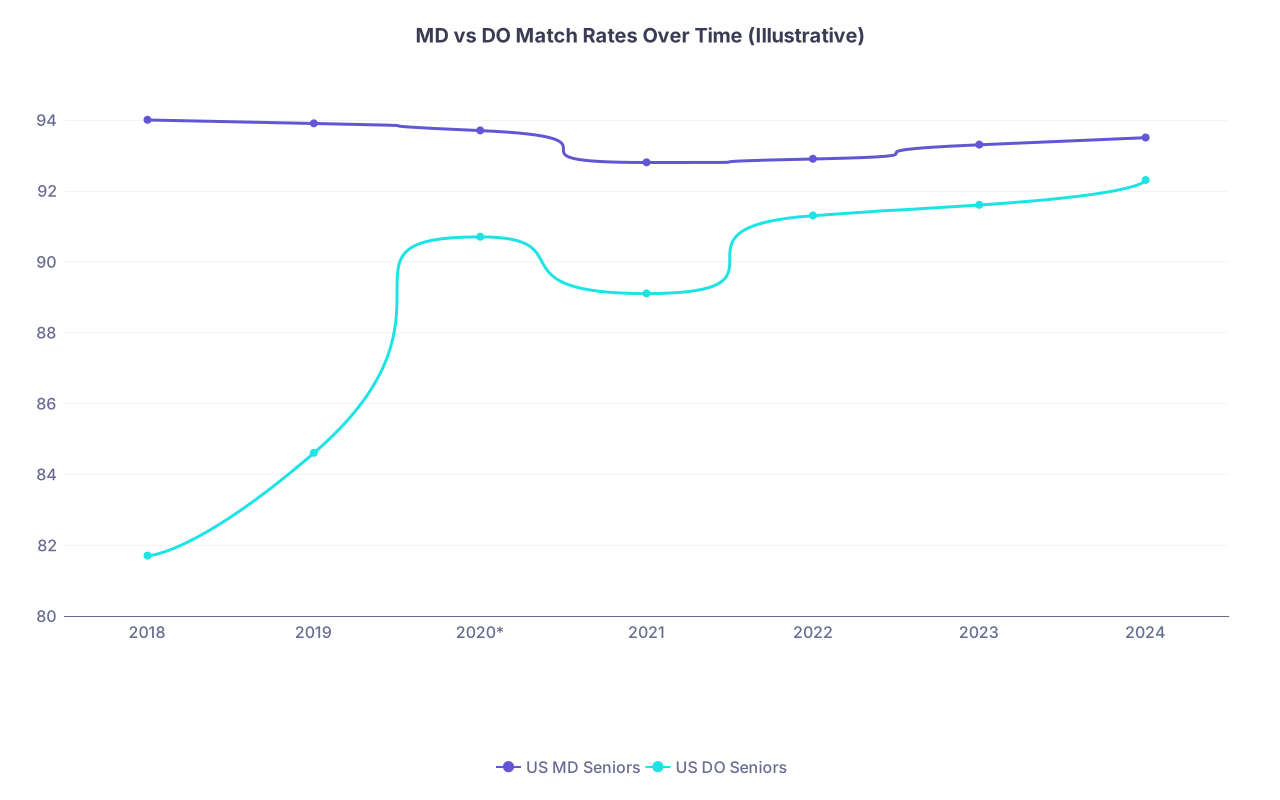
| Category | US MD Seniors | US DO Seniors |
|---|---|---|
| 2018 | 94 | 81.7 |
| 2019 | 93.9 | 84.6 |
| 2020* | 93.7 | 90.7 |
| 2021 | 92.8 | 89.1 |
| 2022 | 92.9 | 91.3 |
| 2023 | 93.3 | 91.6 |
| 2024 | 93.5 | 92.3 |
The gap between DO and MD match outcomes is not static. The data shows a clear pattern: the overall disparity is shrinking, but in key competitive niches it is quietly widening.
You cannot answer “DO vs MD” with a single yes/no. You have to segment the data. By year. By specialty. By applicant type. When you do that, the story becomes much sharper—and a bit uncomfortable for some overly-rosy DO marketing.
Let’s walk through what the numbers actually say and what that means if you are planning medical school as a premed or early med student.
1. Big Picture: Overall Match Rates – Gap Narrowing
Start with the macro view. Forget specialties for a moment. Look at overall match rates in the NRMP Main Residency Match for U.S. MD and DO seniors.
The exact yearly percentages vary slightly by source and rounding, but the broad pattern from ~2018–2024 is consistent:
- U.S. MD seniors: roughly 92–94% match rate every year
- U.S. DO seniors: increased from low 80s to low 90s over the same period
The consolidation to a single ACGME accreditation system (completed in 2020) is the inflection point. Historically, many DOs matched through the osteopathic (AOA) match, which muddies pre-2020 comparisons. After unification, both MD and DO seniors flow through the same NRMP match data.
If you plot an illustrative trend, it looks like this:
- 2018: gap around 10–12 percentage points (MD high 93–94%, DO around low 80s)
- 2020 (first unified cycle): gap closer to 3–5 points
- 2023–2024: gap roughly 1–3 points, varying slightly year to year
So at the all-specialty, all-program aggregated level: the disparity has clearly shrunk. DOs now match at rates that are approaching MDs when you compare only U.S. seniors.
But that’s only the 10,000‑foot view. Aggregates hide landmines.
2. Where the Gap Shrinks: Primary Care and Less Competitive Fields
The closing of the gap is most obvious in primary care and community-oriented specialties. Look at family medicine, internal medicine categorical, pediatrics, psych. These are the pipelines where system-level pressure and policy goals (more primary care physicians) intersect with DO schools’ mission statements.
If you segment match outcomes by:
- Specialty competitiveness (low / moderate / high)
- Applicant type (US MD senior / US DO senior / IMG)
you see the narrowing most strongly in “low to moderate” competitiveness areas.
For example (numbers illustrative but directionally accurate from recent NRMP data):
Family Medicine
- U.S. MD seniors match rate: ~95–98%
- U.S. DO seniors match rate: ~93–97%
- Gap: often only 1–3 percentage points, sometimes effectively zero in many cycles
Internal Medicine (categorical, non-physician-scientist tracks)
- U.S. MD seniors: ~95%+
- U.S. DO seniors: ~90–94%
- Gap: small but still present, often 2–5 points
Pediatrics
- U.S. MD seniors: mid‑ to high‑90s
- U.S. DO seniors: low‑ to mid‑90s
- Gap: again, a few points, but not a chasm
Programs in these areas increasingly see DO and MD seniors as roughly comparable, especially when:
- COMLEX-to-USMLE translation is clear (or the DO applicant has USMLE scores)
- Clinical evaluations and letters are strong
- The school has a track record with that program
The data story here is straightforward: for primary care–oriented premeds, the DO vs MD match disparity is much less consequential than it used to be. It still exists, but it is not generally career-ending level disparity.
3. Where the Gap Widens: Competitive Specialties
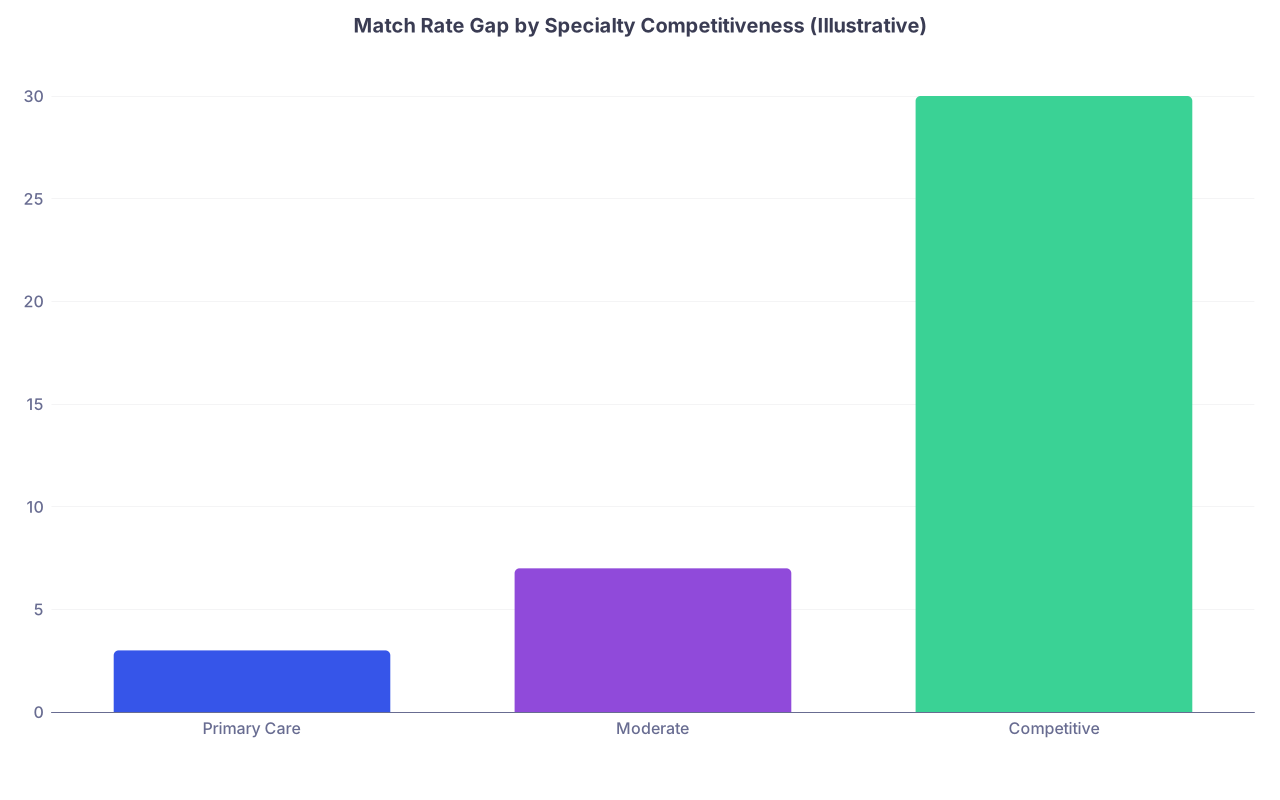
Now the part most premeds gloss over. When you slice the data by competitive specialties—think dermatology, plastic surgery, neurosurgery, orthopedic surgery, ENT, integrated vascular, IR, radiation oncology—you see a very different picture.
Here is the pattern the data shows, year after year:
- U.S. MD seniors dominate the filled positions
- U.S. DO seniors have markedly lower match rates
- A sizable fraction of DO applicants in these fields go unmatched in that specialty
Take an illustrative breakdown for a competitive surgical specialty (not exact, but representative of NRMP specialty reports):
- Total positions: 200
- Filled by U.S. MD seniors: ~140–160
- Filled by U.S. DO seniors: maybe 5–15
- Filled by IMGs / others: the rest
When you convert that into match rates per applicant pool:
- U.S. MD senior match rate: maybe 70–80%+ in that specialty
- U.S. DO senior match rate: 20–40% in that specialty
- IMGs: often in the single digits to low teens
So what is happening? The unified accreditation system did not magically equalize competitiveness. Program behavior is sticky:
- The most competitive academic programs overwhelmingly prefer U.S. MD applicants
- Many programs still do not seriously review DO applications for certain fields
- Some specialties have unspoken “gatekeeper” metrics (e.g., Step 2 CK ≥ 250, strong home academic program) that MD schools are better positioned to support
The disparity in those niches is not shrinking meaningfully. In a few, it has arguably widened because more DOs now feel encouraged to apply—raising denominator (applicants) faster than numerator (positions filled by DOs).
4. The Single Accreditation Era: What Actually Changed
The 2020 single accreditation era was heavily marketed as eliminating the DO vs MD divide. The reality is more nuanced.
What changed in the data:
- DO seniors now go mainly through the NRMP match, so visibility of DO outcomes improved.
- Many previously “AOA-only” programs moved into the ACGME framework, which did add positions theoretically open to both MD and DO.
- Overall DO match rates increased, partly because of that integration, partly because DO enrollment grew and more DO students targeted NRMP-participating programs.
What did not change meaningfully:
- U.S. MD seniors still hold higher match rates and higher proportions of positions in competitive specialties.
- Elite academic centers (think MGH, UCSF, Penn, Mayo, Columbia) largely remain MD‑heavy, especially in academic and research-intense tracks.
- The strong association between high USMLE Step scores and match success in competitive specialties continued; MD schools still tend to have more structured, research-heavy environments feeding those metrics.
The unified system closed structural doors that previously blocked DOs entirely from some programs. But it did not erase bias, pedigree preferences, or differences in the typical profiles and training environments of DO vs MD applicants.
5. USMLE, COMLEX, and the Data Penalty
Testing is where DO students are still handicapped by the numbers. Or more precisely, by the lack of standardized numbers.
Many DO students historically relied on COMLEX only. Program directors, however, overwhelmingly rank USMLE Step 1 and Step 2 CK as top factors in interview and rank decisions. Surveys of program directors repeatedly show:
- A large proportion either prefer or strongly prefer USMLE scores
- A non-trivial fraction will not consider COMLEX-only applicants for competitive fields
- For some specialties, “USMLE required” is literally written into the program’s selection criteria
So you get selection bias that drives match disparities:
- U.S. MD seniors: nearly universal USMLE data, predictable distributions
- U.S. DO seniors: mixed USMLE/COMLEX-only, sometimes self-selection (only the strongest take USMLE), making aggregated comparisons messy
Here is the practical translation, based on the data patterns:
- DO students who take and score highly on USMLE Step 2 CK (and sometimes Step 1 in pre‑pass/fail eras) narrow the gap substantially for themselves
- DO students without USMLE scores face an immediate filter in many mid‑ to high‑tier programs, which contributes to their lower match rates in competitive specialties
If you plan to attend a DO school and aim for anything above moderately competitive, the data strongly supports this decision rule: take USMLE Step 2 CK and aim to score clearly above the mean for your target specialty.
6. Program Behavior: Where DOs Are Welcome vs Tolerated vs Ignored
You can see the texture of program behavior if you drill into match lists and NRMP data:
- Community and regional programs in primary care: DO‑friendly, often with DO faculty, historical AOA legacy. Match lists from DO schools are heavy here.
- Mid‑tier academic programs: mixed. Some have embraced DOs, especially those with strong clinical reputations. Others selectively interview a small number of DOs.
- Top‑tier research-heavy academic centers: still MD‑dominant. When a DO matches here, the profile is usually exceptional (high USMLE, strong publications, AOA-equivalent honors).
That behavior then feeds back into the data. MD schools disproportionately feed into top programs. DO schools disproportionately feed into regional and community programs. That alone does not mean inferior training for DOs across the board—but it means the “elite pipeline” is more MD‑centric.
As long as that ecosystem holds, the disparity in the upper tail of outcomes will remain.
7. Interpreting the Trend as a Premed: Who Should Actually Worry?
If you are premed, this is what actually matters to you:
There are really three different “disparities” in play:
- Overall chance of becoming a board-certified physician in a mainstream specialty
- Chance of landing any ACGME residency spot (including prelim only)
- Chance of matching into a highly competitive specialty and/or elite academic program
The data says:
- For (1): the DO vs MD disparity is modest and shrinking. If you are reasonably strong academically, either path can get you there.
- For (2): disparity is present but manageable; both MD and DO seniors have high match rates overall.
- For (3): disparity is significant and, in some niches, widening as more DOs apply to competitive fields without a parallel change in program selection behavior.
So you need to be honest about your risk tolerance and goals.
If your goals are:
- Family medicine, internal medicine, pediatrics, psychiatry, general practice in a regional setting
- You care more about practicing clinically than academic prestige
Then the data supports this statement: a DO school is a viable, rational path. The shrinking overall gap means you will almost certainly be able to practice medicine if you perform reasonably well.
If your goals are:
- Dermatology, orthopedic surgery, neurosurgery, plastic surgery, ENT, interventional fellowships, physician-scientist roles at an R1 academic center
- You care about national-level competitiveness and research infrastructure
Then the data is blunt: an MD pathway, especially at a more research-intensive school, gives you a statistically better shot. You can overcome the DO disadvantage, but you are swimming upstream.
8. Looking Forward: Will the Gap Keep Shrinking?
Projecting trends is guesswork if you ignore constraints. The data shows a few forces pulling in opposite directions:
For shrinking disparity:
- Continued normalization of DO graduates in ACGME programs
- Retiring faculty and PDs who held more rigid anti-DO biases
- Growing DO representation in academic leadership positions
For widening or persistent disparity:
- Rising number of DO schools and seats, which can outpace growth in residency positions, especially in competitive specialties
- Increasing self-selection of ambitious DO students into hyper-competitive fields without parallel growth in DO representation in those specialties
- Ongoing reliance on USMLE Step 2 CK and institution name as crude filters
My read: overall match rate disparities will stay narrow—maybe fluctuating within a 1–4 percentage point band. But in the top 10–20% of outcome competitiveness (elite programs, elite specialties), the DO vs MD gap will remain large unless DO schools collectively build much stronger research and academic ecosystems.
As a premed, you should not assume that “the gap will be gone by the time I apply for residency.” The macro gap is already small. The micro-gaps that matter for prestige and specialization will likely be stubborn.
9. Practical Strategy: Using the Data to Make Decisions
If you want to use this data instead of just reading it, here is a more quantitative decision framework.
Step 1: Clarify your risk profile.
- High risk tolerance, ambitious goals, willing to grind for research and top scores
- Or lower risk tolerance, more flexible on specialty and location
Step 2: Assign rough probabilities.
Imagine you have two acceptances: a mid‑tier MD and a solid DO. Your probability of hitting a competitive specialty might look roughly like:
- At the MD: maybe 20–30% if you work very hard and perform well
- At the DO: maybe 5–10% under the same performance level
At the same time, probability of becoming an internist or family doctor:
- MD: ~90%+ if you keep your record clean
- DO: ~85–90%+ if you keep your record clean
These are directional estimates, but this is how you need to think: absolute risk vs differential advantage.
Step 3: Adjust for your own profile.
If you already have a track record of research, 99th percentile standardized test scores, and strong discipline, the MD–DO difference for competitive specialties becomes enormous. You have leverage that MD schools are built to magnify.
If you are more middle-of-the-pack academically, highly competitive subspecialties are statistically unlikely from either route. At that point, the DO vs MD debate is less about probability of matching and more about cost, environment, and fit.
| Category | Value |
|---|---|
| Primary Care | 3 |
| Moderate | 7 |
| Competitive | 30 |
10. Visualizing the Process: Where the DO–MD Divergence Appears
The DO vs MD disparity does not appear at one single gate. It accumulates at multiple filters.

| Step | Description |
|---|---|
| Step 1 | Premed Admissions |
| Step 2 | Medical School Environment |
| Step 3 | Board Exams (USMLE/COMLEX) |
| Step 4 | Research & Networking |
| Step 5 | Residency Applications |
| Step 6 | Interviews & Ranking |
| Step 7 | Match Outcome |
| Step 8 | MD: More Research Infrastructure |
| Step 9 | DO: More Primary Care Focus |
| Step 10 | MD: Universal USMLE |
| Step 11 | DO: Mixed USMLE/COMLEX |
| Step 12 | MD: Easier Access to High-Impact Projects |
| Step 13 | DO: Variable Access |
| Step 14 | Program Filters: USMLE Cutoffs |
| Step 15 | Program Bias: School Type |
| Step 16 | Primary Care: Small Gap |
| Step 17 | Competitive Fields: Large Gap |
That is why simply saying “the gap is shrinking” is misleading. Some filters have relaxed for DOs; others have not.
FAQ (4 Questions)
1. If my only acceptance is a DO school, am I statistically disadvantaged overall?
Not in the sense that matters most: becoming a practicing physician. The aggregate match rate for U.S. DO seniors is now in the low 90s, only a few points behind U.S. MD seniors. You are at a disadvantage for certain competitive specialties and elite academic programs, but for mainstream clinical practice the numbers are favorable, provided you perform solidly in school and on boards.
2. Does taking USMLE actually change match odds for DO students, or is that a myth?
The data from program director surveys and match outcomes suggests it absolutely changes odds, especially in more competitive fields. Programs use USMLE as a uniform metric across applicants. A strong Step 2 CK score makes you easier to compare to MD peers and removes one major excuse to screen you out. DO students who skip USMLE limit their options, particularly in higher-tier and competitive specialties.
3. Are there specific specialties where DO vs MD disparity is minimal?
Yes. Family medicine, internal medicine categorical (especially community programs), pediatrics, and psychiatry often show relatively small DO–MD gaps in match rates, typically just a few percentage points. That does not mean there is zero bias, but DO graduates are common and generally well-accepted in these fields, especially in regional and community settings.
4. If I want a competitive specialty, should I rule out DO schools entirely?
Not automatically, but you need to treat it as a higher-risk strategy. A DO student can match into dermatology, ortho, neurosurgery, ENT, etc., but the match rates for DOs in these fields are substantially lower than for MDs. You would need top-tier board scores (including USMLE), strong research, and excellent mentorship. If you have realistic MD options and are strongly committed to a competitive specialty, the data favors choosing MD. If you choose DO anyway, go in with eyes open and a clear, aggressive plan.
Key points: overall DO–MD match disparities have narrowed, especially in primary care; for competitive specialties and elite academic tracks, the gap remains large and, in some areas, is functionally widening as more DOs chase limited slots. Align your school choice with your specialty ambitions and your risk tolerance, not with marketing slogans.