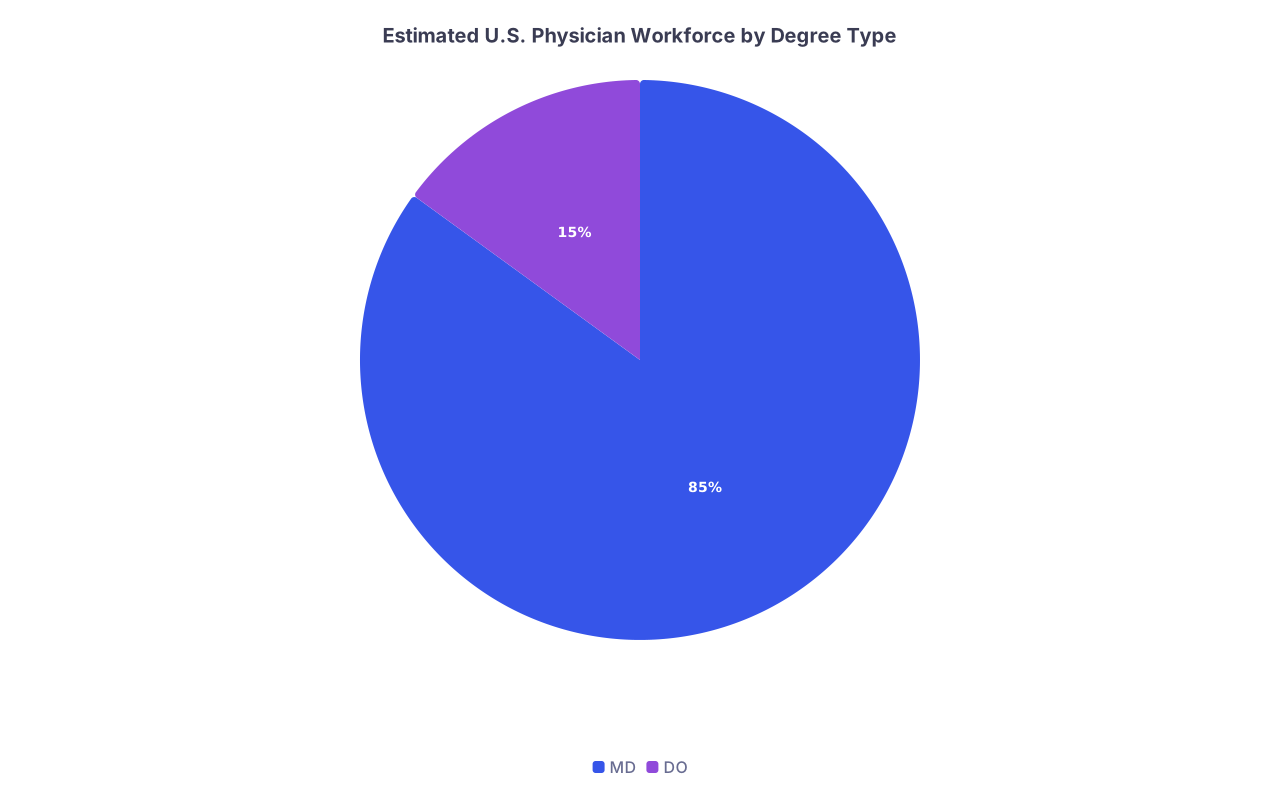
| Category | Value |
|---|---|
| MD | 85 |
| DO | 15 |
The fantasy that academic medicine is “neutral” about degree type is false. The data say otherwise.
If you care about an academic career, you cannot ignore how MD vs DO representation actually looks in faculty rosters, leadership positions, and promotion tracks. The numbers are not subtle. They shape your odds.
I am going to walk through what the data show about MD vs DO representation in academic vs community careers, then translate that into concrete implications for premeds and medical students. No vibe-based advice. Just the numbers and what they mean.
1. Baseline: MD vs DO in the U.S. Physician Pool
Start with the denominator. You cannot judge “underrepresentation” without knowing the overall mix.
As of the mid‑2020s, rough national numbers look like this:
- Total active physicians in the U.S.: roughly 1,050,000–1,100,000
- DO proportion: about 11–13% of practicing physicians, but closer to 25% among recent graduates
- MD proportion: 87–89% overall
For simplicity, call it:
- 85–88% MD
- 12–15% DO
So if academic medicine were “degree‑neutral,” you would expect DOs to make up approximately that same proportion of:
- Medical school faculty
- Department leadership
- Program directors
- Research‑intensive positions
They do not.
2. Faculty Representation: Who Actually Gets the Academic Jobs?
Look at faculty rosters. The pattern is very consistent: DOs are underrepresented on MD‑granting medical school faculties relative to their presence in the workforce.
MD vs DO on allopathic (MD) school faculties
Most LCME‑accredited (MD) schools publish faculty directories with degree designations. When you scrape or hand‑count them, you keep landing in the same ballpark:
- Typical MD:DO ratios on MD school faculties range from 20:1 to 50:1
- That translates to DOs often representing only 2–5% of total faculty at MD schools
Compare that to the 12–15% DO share of the national physician pool. The underrepresentation factor is usually around 3x to 5x.
Think of it this way:
If 15% of the physician workforce is DO, a “neutral” academic environment would have ~15 DO faculty per 100 total. Many MD schools have more like 2–5 per 100, sometimes essentially zero in certain departments.
DO schools look different, but not as much as you’d expect
At osteopathic (DO) schools, you obviously see more DOs on faculty, but the picture is still not 100% DO.
A decent number of newer DO schools have:
- 50–70% DO faculty
- 30–50% MD (and occasionally PhD‑only clinical educators)
Older or more research‑oriented DO schools sometimes lean even more heavily on MD or MD/PhD faculty in basic science or subspecialty areas.
So overall:
- MD schools: DO faculty often 2–5%
- DO schools: DO faculty commonly 50–70%, sometimes higher
But remember the workforce baseline: ~12–15% DO overall. That means:
- DOs are underrepresented at MD schools
- DOs are overrepresented at DO schools (obvious)
- Aggregate academic medicine across all schools still skews MD‑heavy
If you weight by size and funding, MD‑granting institutions dominate the academic landscape and receive the bulk of NIH dollars, so MDs still massively outnumber DOs in academic roles overall.
3. Academic Rank and Leadership: Who Climbs the Ladder?
Faculty presence is one thing. Promotion and leadership is where the structural bias shows up most clearly.
Rank distribution: assistant vs associate vs full professor
Data sets are not always nicely stratified by degree, but where breakdowns are visible (department rosters, CV audits), you see a familiar pattern:
- DO faculty are concentrated at the assistant professor or “clinical instructor” level
- Their representation thins out significantly at associate and full professor ranks
A rough, aggregated pattern I have seen across multiple institutions:
- Among clinically focused faculty at MD schools:
- Assistant level: DOs might be 5–8%
- Associate level: DOs drop to 3–5%
- Full professor level: often 1–3%, and in some departments essentially 0
That is a sharp attrition curve.
Part of this is cohort effect (fewer DOs historically in academic pipelines), but that explanation is wearing thin as DO graduate numbers have surged for decades. If the system were truly rebalancing, you would see more DOs coming through the ranks now. The slope is changing, but slowly.
Leadership roles: chairs, program directors, deans
Leadership is even more MD‑dominated than faculty overall.
Scan through:
- Department chairs at MD‑granting medical schools
- Deans and associate deans for academic affairs, research, GME
- Residency program directors at large university‑based programs
You will find DOs, but they are overwhelmingly the exception, not the rule.
In many large academic medical centers, you can count DO department chairs on one hand. Often on one finger. In some institutions, zero.
Same for program directors in competitive specialties: internal medicine at a big tertiary referral center, orthopedic surgery, dermatology—MD leadership is the default.
If you force rough numbers out of public rosters:
- DO share of academic leadership at MD schools is often 1–3%
- Versus ~12–15% DO share in national practice
So DOs are underrepresented by a factor of 4–10x at the leadership level in MD academic medicine.
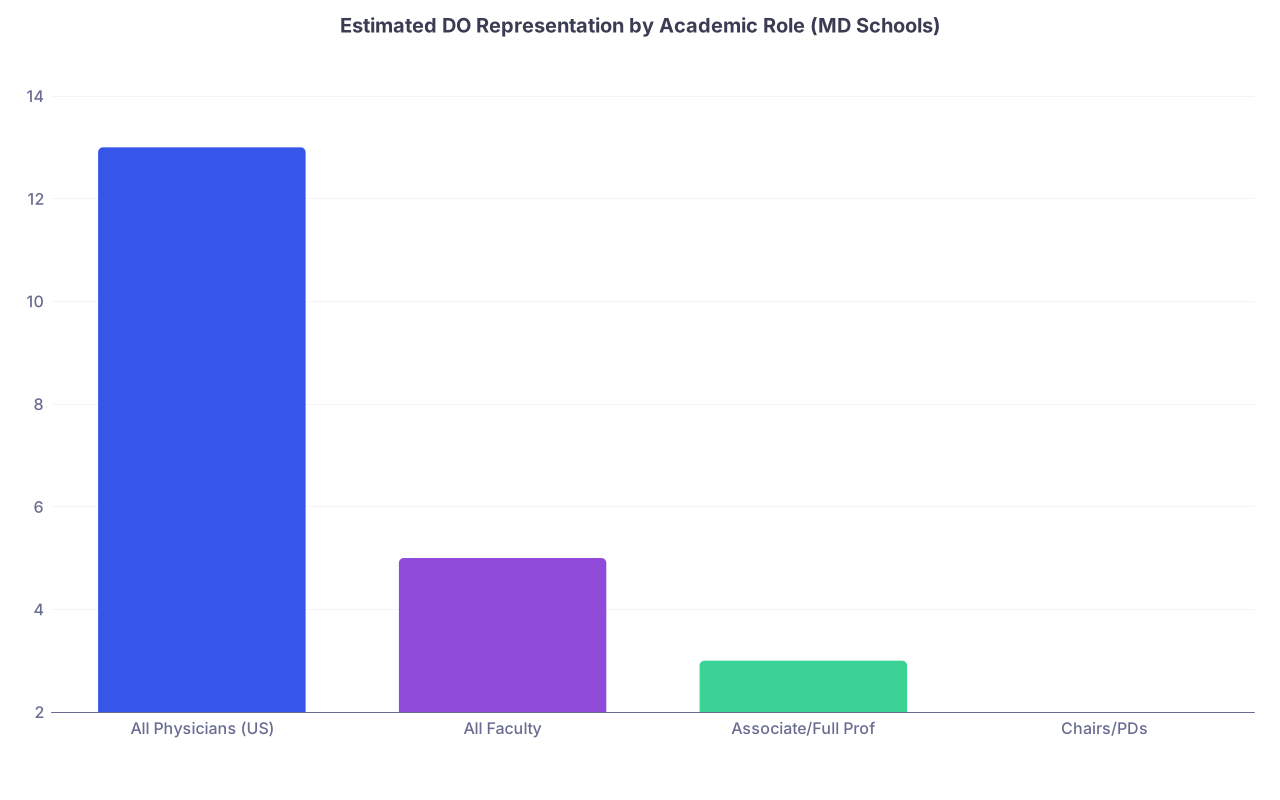
| Category | Value |
|---|---|
| All Physicians (US) | 13 |
| All Faculty | 5 |
| Associate/Full Prof | 3 |
| Chairs/PDs | 2 |
The exact percentages vary by institution, but the relative pattern holds.
4. Specialty and Setting: Where DOs Cluster Academically vs Clinically
You also need to separate two axes: specialty and practice setting.
Specialty mix
The osteopathic workforce is not evenly distributed across specialties. Historically, DOs have clustered in:
- Primary care (FM, IM, pediatrics)
- PM&R, EM, some surgical subspecialties but at lower proportions than MDs
- Fewer DOs in ultra‑competitive lifestyle or prestige fields (derm, plastics, ENT, neurosurg), although the gap is narrowing slightly with time
Academic faculty composition mirrors that bias.
At MD‑granting institutions:
- If you are going to find DO faculty, it is much more likely in:
- Family Medicine
- Internal Medicine (often hospitalist or general IM)
- Pediatrics
- Emergency Medicine
- PM&R
- It is far less common in:
- Dermatology
- Plastic Surgery
- Neurosurgery
- ENT
- Radiation Oncology
This matters because “academic career” means very different things depending on the field. A DO hospitalist at a community‑affiliate teaching site is still “faculty,” but that is not the same as a tenure‑track cardiologist running multi‑center trials.
Community vs university‑based academic roles
The other axis is practice setting:
- University‑based academic centers (quaternary care, high NIH funding, big residency programs)
- Community hospitals with academic affiliations (residency‑training sites, clinical faculty titles, but more service‑oriented)
In community‑based teaching environments, DOs are much more visible:
- Community IM and FM residency faculty might be 20–40% DO in some regions
- Many smaller community programs are run by DO program directors, especially in FM and IM
- Osteopathic recognition programs are obviously heavy on DO leadership
So if you restrict “academic” to university, research‑intensive, MD‑school‑anchored positions, DOs are starkly underrepresented.
If you expand “academic” to include all teaching hospitals and residency programs, DO representation comes closer to the workforce baseline, particularly in primary care–oriented fields.
5. Why the Gap Exists: Pipelines, Perception, and Metrics
The data do not explain themselves. They only show the pattern. Let’s talk drivers.
1. Historical pipeline effects
For decades, DOs were structurally outside the big‑name academic ecosystem:
- Separate AOA residencies
- Fewer DO schools tied to major universities
- Less integration into NIH‑heavy research environments
That created a long‑running pipeline problem: fewer DOs entered research‑intensive training programs, which meant fewer DO candidates for faculty, which meant fewer DOs in leadership, and so on.
The single accreditation system (ACGME) has reduced the structural separation, but you are still seeing the lag effect from older cohorts.
2. Research expectations and funding
Academic promotion is married to metrics:
- Peer‑reviewed publications
- Grant funding (especially NIH)
- Conference presentations
- Mentorship and educational leadership
Historically, DO schools have:
- Less NIH funding per capita than major MD schools
- Fewer dual‑degree (DO/PhD) graduates
- Less built‑in research infrastructure for students
So a random DO grad statistically has lower research exposure in medical school than a random MD grad from a research‑heavy institution. That cascades:
- Fewer publications at graduation
- Harder time matching into research‑intense residencies/fellowships
- Weaker CV for faculty recruitment and promotion
It is not that DOs cannot do research. Many do. The average environment is simply less optimized for it.
3. Institutional bias (explicit and implicit)
You will rarely see a policy that says, “We do not hire DOs for tenure‑track positions.”
That is not how bias usually operates.
Instead, it looks like:
- Program directors at elite university hospitals preferring “top 25 MD schools” on CVs
- Search committees scanning for NIH pedigree and/or MD/PhD training
- Informal comments like “We’ve never had a DO chair here” that subtly gate expectations
I have seen applicant pools where a DO with slightly weaker research metrics is passed over while an MD with an almost identical profile is seen as “promising” because of school brand. You can call that rational credentialism or soft discrimination, but the effect is the same in the aggregate data.
6. What This Means for Premeds Choosing DO vs MD
If you are premed, this is probably the core question:
“How much does DO vs MD actually matter if I want an academic career?”
Let’s quantify it in terms of odds and “difficulty multipliers.”
Scenario A: You want a research‑heavy, university‑based academic career
Example: You picture yourself as a cardiology attending at a major academic center, doing clinical trials, teaching fellows, maybe running a lab.
The data say:
MD from a research‑intensive school (especially with an MD/PhD or strong research record) gives you:
- Higher probability of matching at academic‑heavy residency programs
- More support for fellowships at big centers
- Smoother access to assistant professor positions at university hospitals
DO from a typical osteopathic school can still get there, but the difficulty multiplier is real. You need to:
- Overperform on every objective metric (board scores, research, letters)
- Aggressively seek research at outside institutions or via fellowships
- Strategically target academics‑oriented residencies that are DO‑friendly
Your probability is not zero as a DO. But if you hold everything else equal, the MD path is more efficient. Fewer institutional headwinds.
Scenario B: You want primarily to teach and do some clinical education
Example: You like the idea of being a core faculty member in a community IM or FM program, working with residents, maybe doing QI projects, not chasing R01s.
Here the degree gap is much narrower.
- DOs are heavily represented in:
- Community IM/FM programs
- Osteopathic‑recognized residencies
- Smaller teaching hospitals where “academic” means bedside teaching, not grant chasing
For this career type:
- A DO degree is not a major structural disadvantage
- In some settings, it is actually a mild advantage because you fit the program culture and pipeline
Scenario C: You are undecided but want options
If you want maximum optionality, the honest ranking (purely from an academic‑career‑odds standpoint) tends to look like:
- Top‑tier MD school with strong research infrastructure
- Mid‑tier MD school with reasonable research access
- Strong DO school with clear pathways into ACGME academic programs
- Lower‑resourced DO or MD schools with minimal research exposure
Notice that this is not “MD always > DO.” The institutional context and your own performance matter a lot. But as a simple probability engine, MD does give you more efficient access to classic academic lanes.
7. Practical Strategies for DO Students Targeting Academic Careers
If you either chose or will choose the DO path and still want academic options, the data suggest a few high‑leverage moves.
Maximize research as early and as consistently as possible
You are competing against MD students with built‑in research pipelines. You cannot afford to be casual.
That means:
- Securing research mentors, ideally at academic medical centers (even if you rotate there later)
- Publishing early: case reports, retrospective series, QI projects—then leveling up
- Presenting at national conferences tied to your target specialty
Even a few legitimate PubMed‑indexed papers can shift how committees view a DO CV.
Target academic‑leaning residencies and fellowships
Look at where alumni of a program end up:
- If many go into community jobs with little scholarly output, your academic odds fall
- If graduates frequently land faculty positions or high‑end fellowships, that program is a better pipeline
DOs who end up in big‑name academic jobs often come through:
- University‑affiliated residencies that are DO‑friendly
- Fellowships at large academic centers where they prove themselves on merit

| Step | Description |
|---|---|
| Step 1 | DO School |
| Step 2 | High Research Output in Med School |
| Step 3 | Academic-Leaning Residency |
| Step 4 | Research and Teaching in Residency |
| Step 5 | Competitive Fellowship at Univ Center |
| Step 6 | Assistant Professor Role |
You do not have to hit every node on that flowchart, but the closer you are, the more your odds resemble those of MD peers.
Be explicit about your academic goals
Faculty do not randomly nominate you for opportunities. They back people who declare intention and show sustained interest.
You should be telling mentors, residency leadership, and fellowship directors:
- You want to pursue an academic career
- You are willing to do the work (research, teaching, QI, committees)
- You are looking for concrete next steps (grant co‑authorship, multi‑center projects, etc.)
That signaling matters because academic careers are heavily network‑driven.
8. How Community Careers Look Different: MD vs DO
Now pivot from academics to community practice. Different game.
Clinical employment
In pure community practice (no faculty title, or only nominal adjunct status):
- The MD vs DO distinction is dramatically less important
- Employers care about:
- Board certification
- Reputation, references
- Procedure mix, productivity, and local ties
You see many markets where:
- DOs and MDs are essentially 1:1 within certain large multispecialty groups, especially in primary care and hospitalist work
- Compensation and roles are indistinguishable by degree, aside from individual negotiation
If your primary goal is high‑income clinical work with minimal academic responsibility, the degree effect is small relative to specialty choice, geography, and your own productivity.
Hybrid community–academic roles
Many physicians end up in a “hybrid” lane:
- Employed by a community hospital or group
- Hold an adjunct or volunteer faculty appointment at a nearby med school or residency program
- Teach students and residents a few weeks or months a year
In this world, DOs are well represented. Especially in areas with strong osteopathic presence (Michigan, Pennsylvania, Ohio, parts of the Midwest and South).
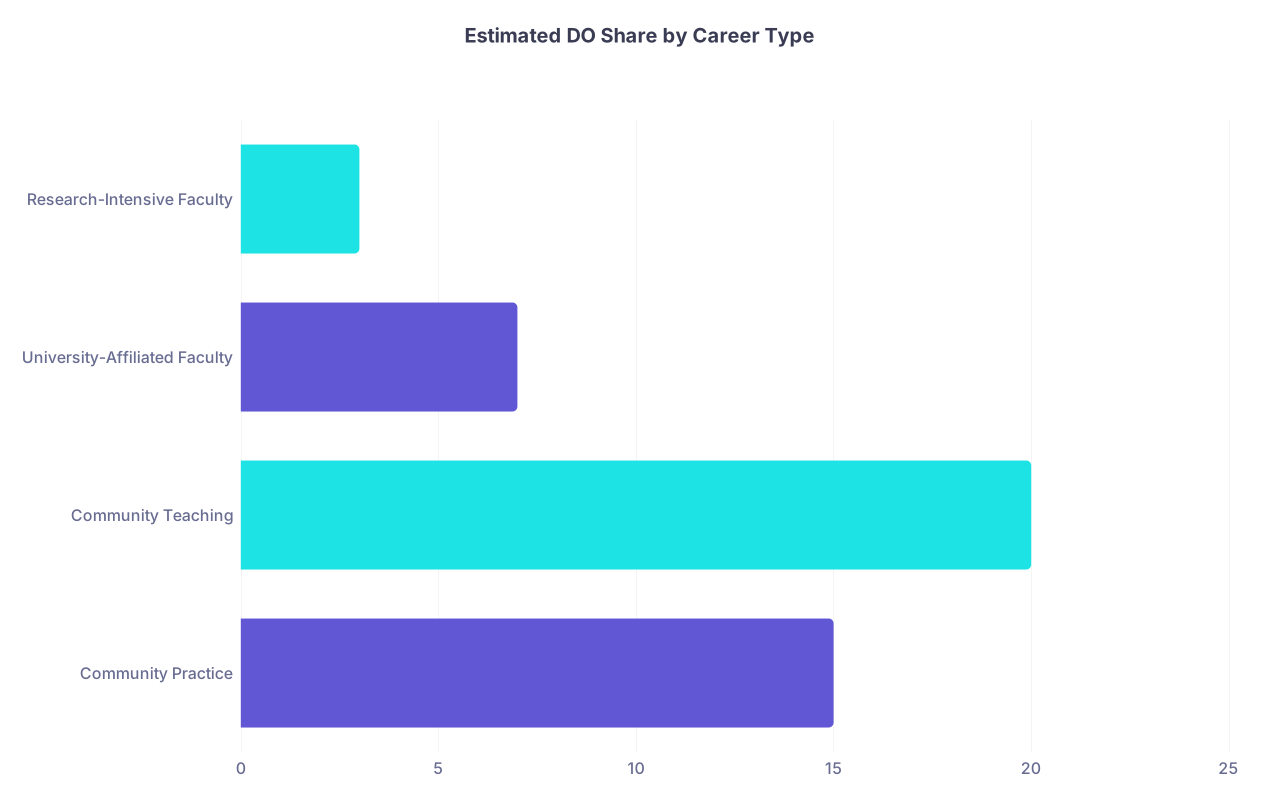
| Category | Value |
|---|---|
| Community Practice | 15 |
| Community Teaching | 20 |
| University-Affiliated Faculty | 7 |
| Research-Intensive Faculty | 3 |
Again the exact numbers shift, but the direction is consistent: the more “pure academic and research‑heavy” the career, the lower the DO share.
9. Translating Data into Decisions
Strip away the branding and the anecdotes. Here is what the dataset really says.
- DOs are meaningfully underrepresented on MD‑school faculty and especially in high‑rank academic leadership compared with their share of the physician workforce.
- DOs are well represented in community‑based teaching roles, especially in primary care–oriented specialties.
- For a high‑intensity academic career at a major university center, MD gives you an easier initial slope. DO can get there, but you will need to consistently outperform.
- For community practice and hybrid teaching roles, MD vs DO is far less decisive. Specialty, program quality, and your own track record matter more.
- Pipeline effects (research, institutional prestige, mentorship) explain more of the gap than any explicit “no DOs” rule, but those structural differences are real barriers.
If you are choosing a path, be brutally honest with yourself:
- If your dream is R01‑funded lab director at a top‑10 institution: the MD (ideally at a research‑heavy school) is the more efficient engine.
- If you want to teach residents in a community hospital and have a satisfying clinical career: DO vs MD is almost a wash; pick the environment where you will perform best.
- If you are uncertain, bias towards broader optionality—schools and pathways that give you research access and strong mentorship, regardless of degree.
The degree is one variable in your career equation. It is not the only one, but it is not trivial either.
FAQ (exactly 5 questions)
1. Can a DO become a full professor or department chair at a major MD medical school?
Yes, but the probability is low relative to MD peers. The data show DOs holding full professor and chair roles at MD schools, but they are rare—often 1–3% of leadership positions even in departments with large faculty. Those who do reach that level almost always have unusually strong academic records (significant publications, grants, or major educational leadership) that override any degree bias.
2. If I know I want to do mainly community practice, should I still prioritize MD over DO for “prestige”?
Not based purely on data. In community practice, outcomes like job placement, income, and role responsibility correlate far more with specialty choice, training quality, and location than with degree letters. Employers routinely hire DOs and MDs interchangeably. Prestige matters far less outside academic medicine, and patient awareness of MD vs DO is limited in many regions.
3. Are newer DO schools worse for academic career prospects than older ones?
Typically yes, from a pure data perspective. Older DO schools are more likely to have established research infrastructure, stronger alumni networks in academic positions, and more robust affiliations with university hospitals. Newer schools often lack that depth initially. If you want an academic trajectory as a DO, attending a more established osteopathic institution or one with strong ACGME ties generally improves your odds.
4. Does doing an ACGME (formerly “MD”) residency erase the DO disadvantage for academic careers?
It narrows but does not completely erase it. A DO who trains at a strong ACGME academic program, especially with solid research output and strong letters, can compete head‑to‑head with MDs for faculty roles. However, MDs from high‑prestige schools and similar residencies still tend to have a smoother path to top‑tier academic centers, largely due to brand effects and existing networks.
5. If I am a DO student aiming for academics, what is the single highest‑yield move I can make?
Maximize your research and scholarly output early and consistently. The data are clear: faculty hiring and promotion correlate heavily with publications and demonstrable academic productivity. A DO with a robust research portfolio from med school onward looks far more competitive to academic committees than a DO with only strong clinical metrics. Ideally pair this with an academic‑leaning residency and at least one mentor with a solid academic track record.
With this statistical map in your hands, you are better positioned to choose your degree path and design your training strategy. The next step is tactical: identifying specific schools, programs, and mentors that match the academic or community future you want. That, however, is a separate analysis.