
It’s 8:15 am in a cramped conference room. Coffee cups, half-eaten muffins, and a stack of applications in front of a residency selection committee. On the projector: your ERAS file. Someone scrolls to your letters.
And then you hear it.
“Two DO letters and one MD. Interesting.”
Half the room glances up. One faculty member leans back and says, “Do we have any sense of how strong this DO attending is?” Another asks, “Anyone know this MD letter writer?”
This is where the real sorting happens. Not on Reddit. Not in advising office platitudes. In that moment, when a group of jaded faculty, a program director, and a couple of overworked residents decide how seriously they’re going to take the people who vouched for you.
Let me walk you through what actually happens behind those doors with DO vs. MD letters — both for med school admissions and residency selection — and how you should be playing this game from the premed stage forward.
First, the ugly truth: not all letters are read equally
I’ve watched this pattern repeated in MD programs, DO programs, and mixed environments.
Even before content, the room silently does a quick mental calculation:
- Who wrote this?
- Where are they from?
- How “big” is their name?
- Is this letter coming from an MD or DO, and how does that fit with the culture of this place?
Nobody says it on your interview day. They say it in selection meetings.
Let me be direct:
The DO vs. MD on the signature line doesn’t matter as much as you think in some rooms, and it matters more than you think in others. The trick is knowing which rooms you’re aiming for and aligning your letter strategy early.
How med school admissions actually treat DO vs. MD letters
Premeds get this wrong constantly because they only hear the official line: “We accept letters from both MD and DO physicians.”
That’s technically true. But not the whole story.
MD schools
At most MD schools, the unofficial hierarchy in the committee’s mind looks something like this:
- Letter from an MD academic physician at a known teaching hospital → taken very seriously.
- Letter from a community MD physician → variable, depends on how it’s written.
- Letter from a DO physician in a field related to your interest → fine, sometimes valued, sometimes ignored.
- Letter from a DO primary care doc you shadowed for 2 afternoons → background noise unless it’s exceptional.
Here’s what I’ve heard in real meetings at MD schools:
“Good clinical letter, but it’s from a small DO practice. Any academic letters?”
“This is a very strong DO internal medicine letter — and from [name of major academic center that employs DOs]. That’s legit.”
The bias is not “DO bad, MD good.” It’s “academic, known, detailed letters beat vague community fluff.” MD vs. DO becomes a lazy proxy only when they don’t recognize the writer or setting.
DO schools
At DO schools, the logic flips slightly:
They still love MD letters, especially from academic centers. But they pay extra attention to DO letters that demonstrate you understand osteopathic practice, philosophy, or at least that you chose to work with DO mentors intentionally.
I’ve watched DO admissions say:
“He has two MD letters but no DO letter at all for a DO school application? That tells me something about where his head is.”
Or: “Strong MD research letter, but this DO family medicine letter really shows patient care skills. I like this combination.”
For DO schools, not having any DO letter at all can quietly hurt you, even if nobody writes that in your rejection email. They read that as either ignorance or lack of genuine interest.
Residency selection: where DO vs. MD letters really get weaponized
For residency, selection committee dynamics get harsher.
Picture a mid-tier university internal medicine program. Mixed DO and MD residents, mostly MD faculty. On the spreadsheet: Step scores, grades, school pedigree, and then “letters: MD/MD/DO” or “letters: DO/DO/DO”.
Here’s how it plays out:
MD-heavy university programs
Harsh but real: some MD-dominant university programs quietly downgrade applicants whose letters are all from small DO community hospitals, especially if they don’t know any of the writers.
I’ve heard variations of:
“All three letters from the same small osteopathic community site. No academic voices. Hard to gauge how they’ll do here.”
“Any MD or academic letters? No? Maybe keep them in the middle pile.”
If you’re a DO student applying to an MD-heavy program, they’re not upset that your letters are from DOs. They’re uneasy if:
- All letters are from people they’ve never heard of.
- None are from a teaching hospital, university affiliate, or recognizable training environment.
- The letters read generic: “hard worker, pleasure to work with, will be an asset…”
Now compare that to a DO student whose letters look like this:
- Letter from a DO hospitalist at a large teaching hospital, who mentions supervising multiple schools’ students and compares you favorably.
- Letter from an MD subspecialist at a university affiliate, who details specific complex patients and your role.
- Home DO program letter that outlines your performance across services.
That applicant gets a very different discussion in the room.
DO programs and community programs
At DO-heavy or community-based programs, the DO/MD distinction is less of a status marker and more of a cultural signal.
If you’re applying to a DO program with no DO letters, expect unspoken skepticism. They’ll read it as: “You’re aiming for MD and using us as the backup.”
At community programs, MD vs. DO on the letterhead matters much less than:
- Does the writer actually know you?
- Do they describe real clinical situations?
- Do they compare you to other students/residents they’ve worked with?
I’ve seen a DO letter from a gritty community EM doc absolutely crush some bland MD academic letters. Why? It actually said something:
“On one brutal night, we saw 38 patients in 8 hours. This student stayed late, ran 4 full patient encounters independently, and managed difficult families with maturity I usually see in interns by December.”
That sort of detail makes the MD vs. DO line almost irrelevant.
The hierarchy inside a selection meeting: what carries weight
You want the internal truth? In selection meetings, the actual ranking of letter strength usually goes:
- Known strong letter writer (MD or DO) with a reputation for being accurate and specific.
- Academic physician (MD or DO) at a teaching hospital who clearly evaluated you over time.
- Program director or clerkship director letters with specific comparative language.
- Community physician letters that are detailed and honest.
- Vague, over-the-top “best ever” letters from anyone — MD or DO — that sound fake.
- Shadowing letters, “observership” letters, or letters from physicians who barely saw you work.
Where MD vs. DO sneaks in is as a shortcut when people are tired and don’t know the writer. If they see “MD, Associate Professor, [known university]” they assume a certain baseline. If they see “DO, small private practice, no affiliation listed,” they don’t have that frame.
So your job is to stack the deck so nobody has to guess.
How to plan your letter strategy from premed through med school
If you’re premed and you’re smart, you start thinking about this early.
As a premed
For MD schools:
- Get at least one science faculty letter and one from a physician who actually knows you. MD is helpful here, especially if they’ve taught or mentored students before.
- Having a DO letter is fine; it will not hurt you at MD schools if the content is strong. It just shouldn’t be your only clinically meaningful letter for most MD schools.
For DO schools:
- You should have at least one DO letter. Not negotiable if you’re serious.
- That DO letter needs to show more than “they shadowed me for 3 afternoons and seemed nice.”
- DO admissions committees use these letters to separate “I’m genuinely interested in osteopathic medicine” from “I just want more seats to apply to.”
If you know you’re DO-leaning, do yourself a favor and build a real relationship with at least one DO physician early.
As an MD student
If you go to an MD school and you’re even vaguely considering applying to DO-friendly specialties or DO programs (or you’re in a place with lots of DO faculty), here’s what I’d do:
- Get strong letters from MD academic physicians in your chosen specialty. Those carry everywhere.
- If there’s a respected DO in your department or hospital, a letter from them is a bonus, not a downgrade. Committees notice DOs who’ve succeeded in MD environments.
- Don’t waste a letter slot on a random DO shadowing letter when you could have a heavyweight MD academic letter. That’s just bad strategy.
As a DO student
This is where it really matters.
If you’re a DO student, your letter strategy will make or break you at many MD-heavy programs.
For competitive or MD-dominant fields (EM, anesthesiology, some IM, surgery, etc.):
You should be aiming for this mix, ideally:
- At least one MD letter from a recognized teaching hospital or university affiliate in your specialty.
- At least one strong DO letter from someone who knows you well and works in a serious clinical environment.
- A home institution letter or department chair letter that situates you relative to your peers.
What I’ve watched program directors say:
“This DO student did an away month with us, got an MD letter from Dr. X who we trust, and another great DO letter from their home program. I’m comfortable ranking them high.”
Versus:
“All their letters are from small osteopathic community sites we’ve never worked with, and no one we know has seen them in our type of environment. I’m nervous.”
Same board scores. Same grades. Different letter strategy. Completely different rank outcome.
What actually gets said about DO vs. MD letters in selection meetings
Let me give you a few actual-style fragments from real committee conversations (paraphrased, but you’ll get the idea):
About a DO letter in an MD program:
- “This DO cardiologist is at [big teaching hospital]. I know him, he’s not someone who inflates. If he says this student is top 10%, that means something.”
- “This DO letter is very generic: ‘hard-working, compassionate.’ No real specifics. I don’t learn anything.”
About an all-MD letter set for a DO school applicant:
- “Strong MD letters, but no DO letter? I’m not convinced they’ve actually committed to osteopathic training.”
- “They clearly had access to physicians, but didn’t bother finding a DO at all. That bugs me.”
About DO-heavy letters for an MD university program:
- “Three DO letters, all from the same community hospital I’ve never heard of. Anyone know this place?”
- “If they want academic medicine, I wish they had at least one letter from a more rigorous teaching site.”
About mixed MD/DO letters for a DO student applying broadly:
- “I like that they have both MD and DO letters and that the stories line up — both talk about the same strengths. That’s reassuring.”
Patterns repeat. People are more consistent than they think.
How to choose letter writers strategically (not emotionally)
Students pick letter writers emotionally: “They were nice to me” or “I liked their personality.”
Selection committees value something different:
- Do they actually evaluate trainees regularly?
- Do they compare you to other students or residents?
- Do they describe real clinical scenarios?
- Do they have a recognizable institutional affiliation?
- And yes, sometimes: are they MD or DO, and how does that signal fit with your application story?
If you have to choose between:
- A DO you shadowed for 30 hours, who likes you but barely saw you function.
- An MD who directly supervised you on an inpatient rotation for 4 weeks, in your specialty of interest.
Take the MD. Every time. Shadowing letters carry almost no weight in selection meetings.
If you have to choose between:
- A DO core faculty who supervised you for an entire month, at a solid teaching site.
- An MD private-practice doc who saw you twice and promises to “write a great letter.”
Take the DO. Substance beats letterhead.
The smart long game: position yourself to not have to choose between bad options. Get onto services where faculty — MD or DO — actually see you work and are known in their spheres.
How DO vs. MD letters look on the projector
You should know how your profile appears in the room. Strip away the noise and your application looks something like this on a quick-glance spreadsheet:
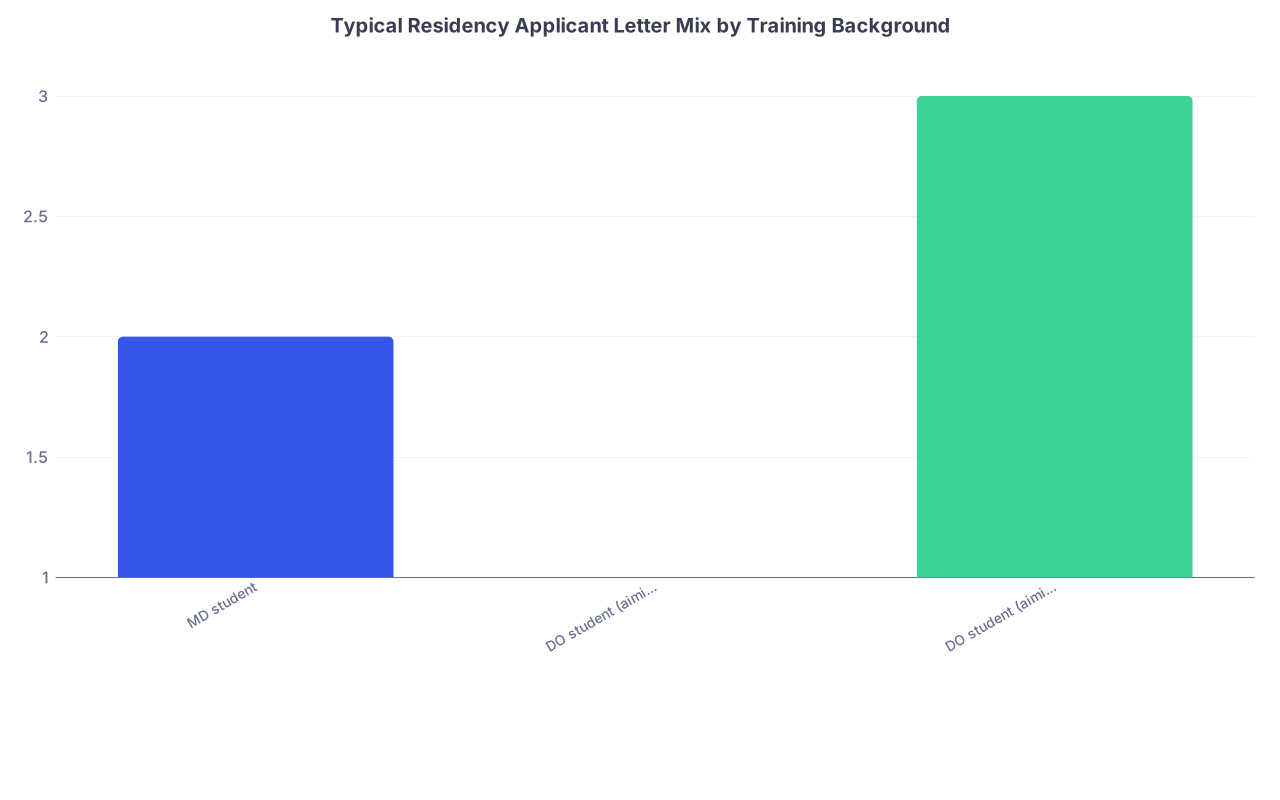
| Category | Value |
|---|---|
| MD student | 2 |
| DO student (aiming MD programs) | 1 |
| DO student (aiming DO/community) | 3 |
People scan: three letters. Source, degree, institution.
An MD student might show:
- MD, Associate Professor, University Hospital – Internal Medicine
- MD, Assistant Professor, VA Medical Center – Cardiology
- PhD, Associate Professor – Research mentor
A DO student aiming at MD programs might show:
- MD, Assistant Professor, University Affiliate – Subspecialty
- DO, Core Faculty, Osteopathic Teaching Hospital – IM
- DO, Program Director, Home Institution
A DO student only aiming at DO/community programs might show:
- DO, Community Hospitalist – Local Hospital
- DO, Clinic Preceptor – Community Clinic
- DO, Core Faculty – Home Program
None of these patterns are “wrong.” But they’re interpreted differently. You want to choose the pattern that aligns with your actual target.
What you should be doing differently starting now
If you’re early:
Stop thinking of DO vs. MD letters as a philosophical issue and start thinking of them as a targeting problem.
If you want MD academic programs someday, you must get at least one or two letters from people in those environments. Doesn’t matter if you’re DO or MD.
If you’re serious about DO schools or DO residencies, you need at least one DO letter that:
- Shows actual clinical exposure.
- Indicates you understand and respect osteopathic training.
- Comes from someone who has seen many students and can compare you.
And across all this, you should be ruthless about one thing: don’t collect weak letters just to “have a DO” or “have an MD.” A mediocre letter from the “right degree” hurts you more than a strong letter from the “other” degree.

| Step | Description |
|---|---|
| Step 1 | Start: Identify Targets |
| Step 2 | Prioritize MD academic letters |
| Step 3 | Secure at least one strong DO clinical letter |
| Step 4 | Choose writers who directly supervised you |
| Step 5 | Confirm they can write a strong, detailed letter |
| Step 6 | Provide CV, personal statement, talking points |
| Step 7 | Follow up and track letter status |
| Step 8 | Applying MD schools only? |
| Step 9 | Applying DO schools or DO residencies? |

FAQ: DO vs. MD Letters of Recommendation
1. Will a DO letter hurt me at an MD residency program?
Not by itself. A DO letter from a respected clinician at a real teaching hospital is taken seriously. What hurts you is having only letters from unknown, small DO community sites with generic praise and no MD or academic voices at all, especially if you’re chasing competitive or academic MD programs.
2. Do I absolutely need a DO letter to get into a DO medical school?
If you’re serious about DO schools, you should assume yes. Some schools list it as “recommended,” but behind closed doors, lack of any DO letter is often read as lack of genuine interest in osteopathic training. One strong DO letter plus solid academic letters is the safer play.
3. As a DO student, how many MD letters do I need for MD programs?
For MD-heavy programs, I’d aim for at least one MD letter in your specialty from a teaching hospital or university-affiliated site, ideally two if you can do it without sacrificing quality. The rest can be strong DO letters from faculty who know you well. Quality and setting matter more than the exact count.
4. Are shadowing letters from MDs or DOs worth anything?
Almost never. Committees glance at them as “character references” at best. They carry almost no weight in ranking decisions. A shadowing letter — DO or MD — will never beat a detailed evaluation from someone who supervised you directly in a real clinical or academic setting.
Two things to walk away with.
First, stop obsessing over the letters’ suffixes and start obsessing over the writers’ credibility and what they actually say about you. MD vs. DO is secondary to specificity, setting, and reputation.
Second, if you’re DO-leaning or a DO student, you can’t afford to be naive. You need both: a real DO mentor who can vouch for you, and at least one MD or academically rooted letter if you’re stepping into MD territory. Plan that blend early, or you’ll be trying to fix it when it’s already too late.