| Category | Value |
|---|---|
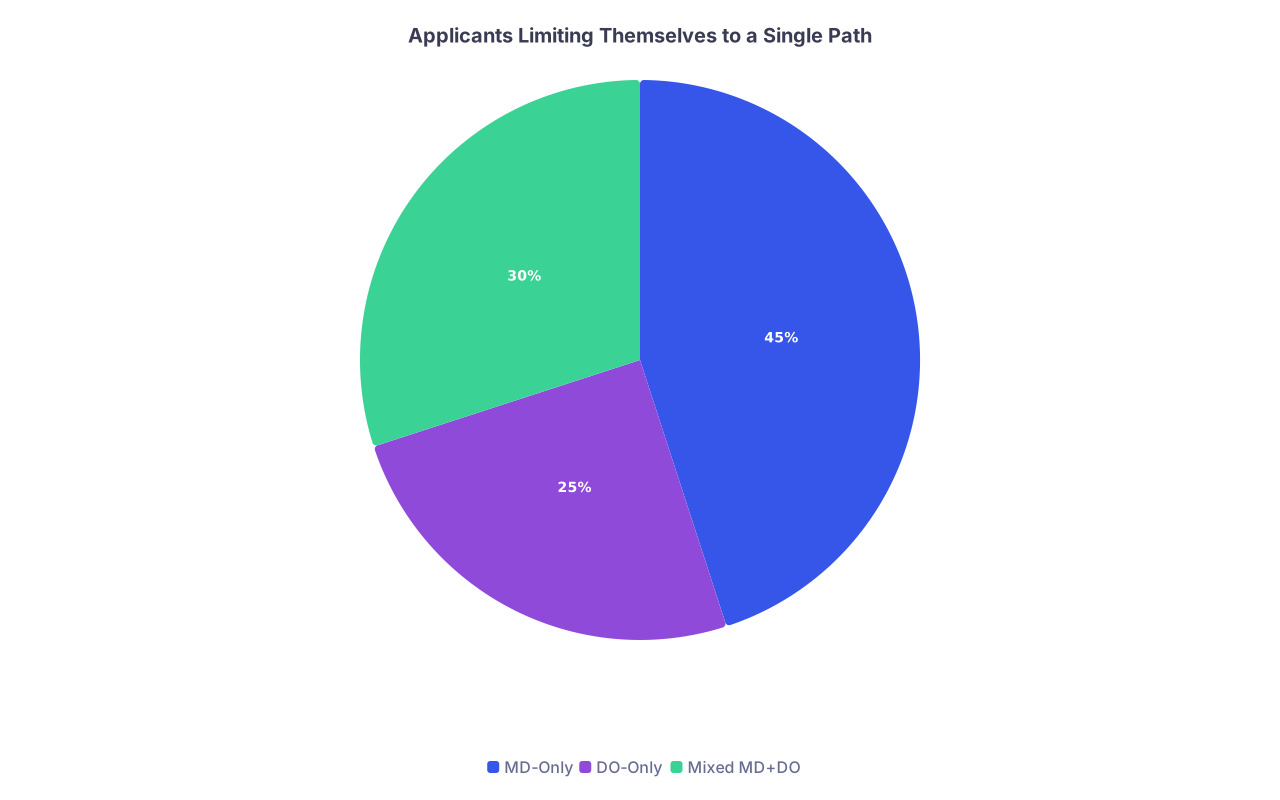
| MD-Only | 45 |
| DO-Only | 25 |
| Mixed MD+DO | 30 |
Applying to Only One Track: DO vs. MD Risk Management Failures
It is late August. You are refreshing your email every 10 minutes, waiting for secondaries or interview invites. Your AMCAS is in. Or your AACOMAS is in. One of them. Not both.
Your classmates are comparing school lists. Someone says, “Yeah, I applied to 18 MD and 8 DO just in case.” You stay quiet because you went “all in” on one track. You told yourself it was a statement of confidence. Or identity. Or “fit.”
What you actually did was make a classic risk management mistake.
I have watched this movie more times than I care to admit:
- 3.6 GPA, 510 MCAT, applied only MD → zero MD interviews, never bothered with DO → reapplicant.
- 3.3 GPA, 502 MCAT, applied only DO but only to 4 “local” schools → shut out → angry and confused.
- Strong applicant on paper but applied MD-only in California or Texas → no acceptance → gap year they did not plan or budget for.
The common thread: people treated DO vs. MD like a personality test instead of a logistics and odds problem.
Let us walk through the biggest mistakes people make when they apply to only one track – and how to not be one of them.
Mistake #1: Treating DO vs. MD as an Identity, not a Strategy
The first mistake is emotional. And it is brutal.
You start to think:
- “I am an ‘MD-level’ applicant. Applying DO feels like admitting failure.”
- “I am committed to OMM and holistic care, so DO is the only path that fits me.”
- “If I just focus on MD and show commitment, it will work out.”
No. That is not how admissions works. The committees are not rewarding you for tribal loyalty. They are ranking risk: academic, professionalism, board pass risk, yield protection, mission fit.
The identity trap
I have seen people fall into two extreme versions:
MD-only pride
- Strong premed culture at your school worships US News rankings.
- You hear phrases like “backup DO” or “I’d rather reapply than go DO.”
- You start thinking DO = consolation prize.
DO-only idealization
- You shadowed one excellent DO who changed your life.
- You buy into the philosophy so hard that MD feels “less holistic.”
- You decide applying MD would be “inauthentic.”
Here is the problem: medical admissions is not designed to match your worldview. It is a sorting algorithm with numbers, filters, and institutional goals. Whether you are idealistic or snobbish does not change your probabilities.
The rational approach: treat DO and MD as two highly overlapping paths to the same endpoint (full, licensed physician) with different:
- Admissions thresholds
- Culture and branding
- Geographic clustering
- Long-term bias pockets (still real in some competitive specialties, improving but not gone)
Ignoring one entire pathway because of identity is reckless. It is like investing your entire savings in a single stock because you like the CEO’s TED talk.
Mistake #2: Misreading Your Competitiveness and Over-Believing Anecdotes
Another classic failure: bad self-assessment.
Everyone has heard a version of this:
- “My friend got into [solid MD school] with a 3.5 and 508, you’re fine.”
- “You have a 3.8, you do not ‘need’ DO.”
- “DO schools are easy to get into, you will get one for sure.”
Most of that advice is garbage. Outdated. Or missing key context (URM status, institutional tie, state school advantage, postbac linkage, family connections).
Look at where you actually sit
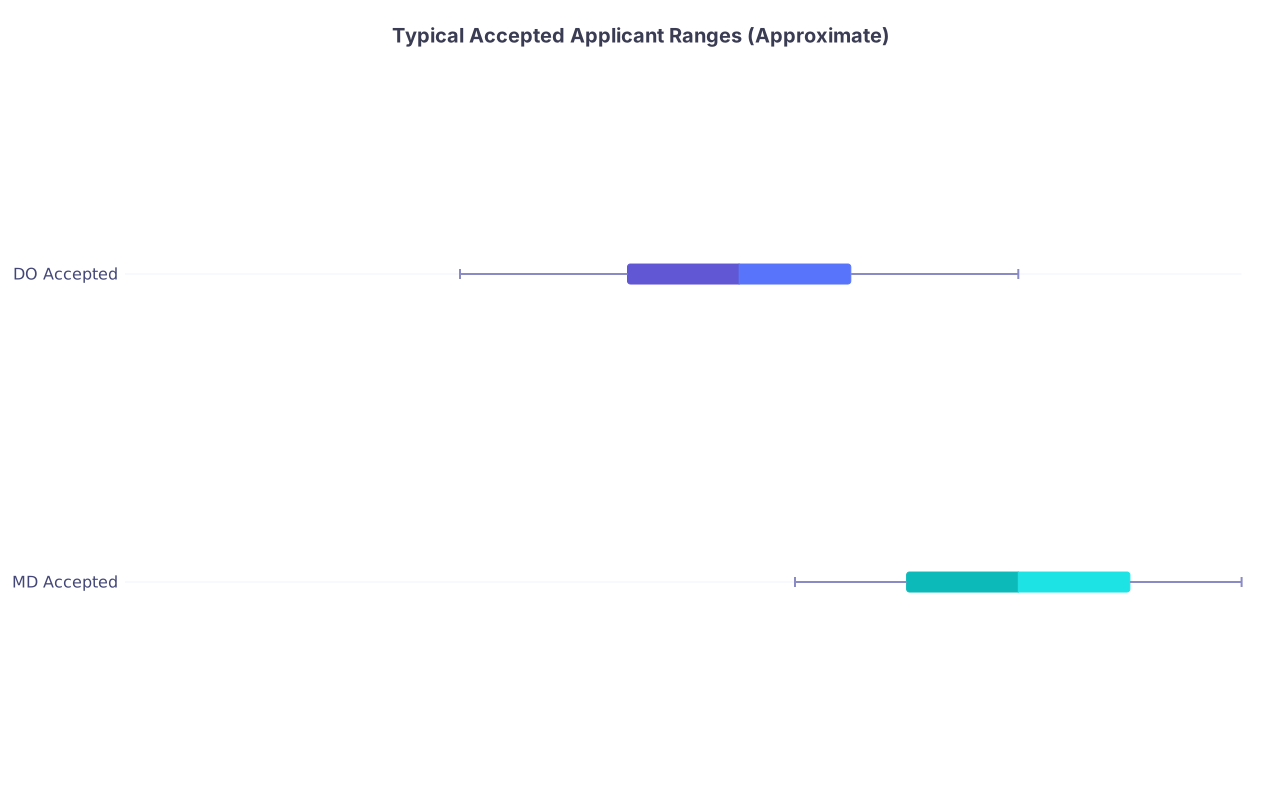
At least anchor yourself to real distributions, not vibes.
| Category | Min | Q1 | Median | Q3 | Max |
|---|---|---|---|---|---|
| MD Accepted | 3.6 | 3.7 | 3.8 | 3.9 | 4 |
| DO Accepted | 3.3 | 3.45 | 3.55 | 3.65 | 3.8 |
If you are:
- 3.9 / 520: you are competitive broadly MD. Not invincible. But strong. DO is optional, not mandatory.
- 3.6 / 510: competitive in many MD pools, but not safely above. DO should be on the table if geography and cost allow.
- 3.3 / 502: MD is not impossible, but the odds are ugly. DO should not be your backup; it should be part of your primary plan.
The mistake is this: seeing yourself as the exception to the numbers. “Sure, my stats are below median, but my story is unique.” Everyone thinks that.
Risk management means you plan for the version of you that is average, not the version that wins the lottery.
Do not confuse possibility with probability
You can absolutely get into MD with below-average stats if:
- You have a strong upward trend.
- You crush your MCAT relative to GPA or vice versa.
- You are mission-fit at a particular school.
- You belong to an underrepresented group or bring a sought-after background.
But you should not build your entire app strategy on being the elegant exception. That is not strategy. That is hope dressed up as narrative.
Mistake #3: Ignoring Scenario Planning (What If This Fails?)
One of the ugliest conversations I have over and over:
October. No II’s. MD-only applicant. They say, “If this does not work, I’ll just apply again next cycle. I am not interested in DO.”
Sounds brave. It is not. It is badly thought out.
Here is what they are not accounting for:
- Lost income from an extra gap year.
- Worsening recency of coursework and clinical work.
- Being a reapplicant, which some schools actively screen against.
- Psychological burnout from living “in limbo” another 12–24 months.
If you are not actively okay with:
- Possibly applying 2–3 cycles.
- Tackling a postbac or SMP to salvage GPA.
- Relocating to a new state for a career pivot later if you flame out.
Then you had no business going one-track-only without a backup.
Map out your paths before you apply
Put this on paper. Literally.

| Step | Description |
|---|---|
| Step 1 | Start Cycle |
| Step 2 | High risk of shutout |
| Step 3 | Moderate risk |
| Step 4 | Risk distributed, higher odds |
| Step 5 | Plan for reapp cycle, extra years |
| Step 6 | Some safety but not guaranteed |
| Step 7 | Best balance of risk vs options |
| Step 8 | Single Track or Dual? |
| Step 9 | Stats at or above MD medians? |
| Step 10 | Applied broadly 15+? |
If you pick MD-only or DO-only, you must be brutally honest:
- What will I do if I get no acceptance?
- What changes can I realistically afford (financially, emotionally, geographically) for a second attempt?
- How much time am I willing to lose?
Skipping this thought process does not make you “committed.” It just makes you exposed.
Mistake #4: Underestimating DO Schools’ Selectivity (or Overestimating It)
People screw this up in both directions.
The “DO is easy” myth
I still hear, “I’ll just apply DO as backup, those are easy.”
No. Modern DO schools are not safety nets for unprepared applicants. Some have entering classes with stats overlapping mid-tier MD programs. And many screen ruthlessly for mission fit, region, and professionalism.
Common crash-and-burn pattern:
- 3.1 GPA, 495 MCAT, shadowed nothing, minimal clinical. Applies to 5 DO schools. Assumes they are entitled to an acceptance because “they are DO.”
- Ends cycle with no IIs.
- Calls the process “unfair” instead of admitting their profile was not competitive.
On the flip side:
The “DO is pointless if you want competitive specialties” myth
This is another overcorrection that keeps strong applicants from applying DO at all.
Yes, for certain ultra-competitive specialties (derm, plastics, some ortho programs), DOs can face extra bias. But not everywhere. And not always.
What I have actually seen:
- Solid DO students match EM, anesthesia, IM, peds, psychiatry, FM, OB/GYN, neurology with no drama.
- DO grads in cardiology, GI, critical care, heme/onc from solid community and some academic paths.
- The limiting factor was almost always board scores, research, and networking. Not the letters “DO.”
If you are obsessed with one of the 2–3 hyper-competitive specialties and nothing else would make your life worth living, fine. You might strategically bias toward MD. But most applicants are not that narrow once they hit clinical years.
The mistake is using exaggerated worst-case DO stories as justification for ignoring an entire training path that would make you a fully licensed physician.
Mistake #5: Overconcentrating on One Geography or Culture
Applying to only one track often pairs with another bad habit: geographic or cultural tunnel vision.
- “I will only go to school in California / New York / Texas.”
- “I will only go to a school with X religious or cultural profile.”
- “I need to be driving distance from family.”
Then on top of that, you limit to MD-only or DO-only.
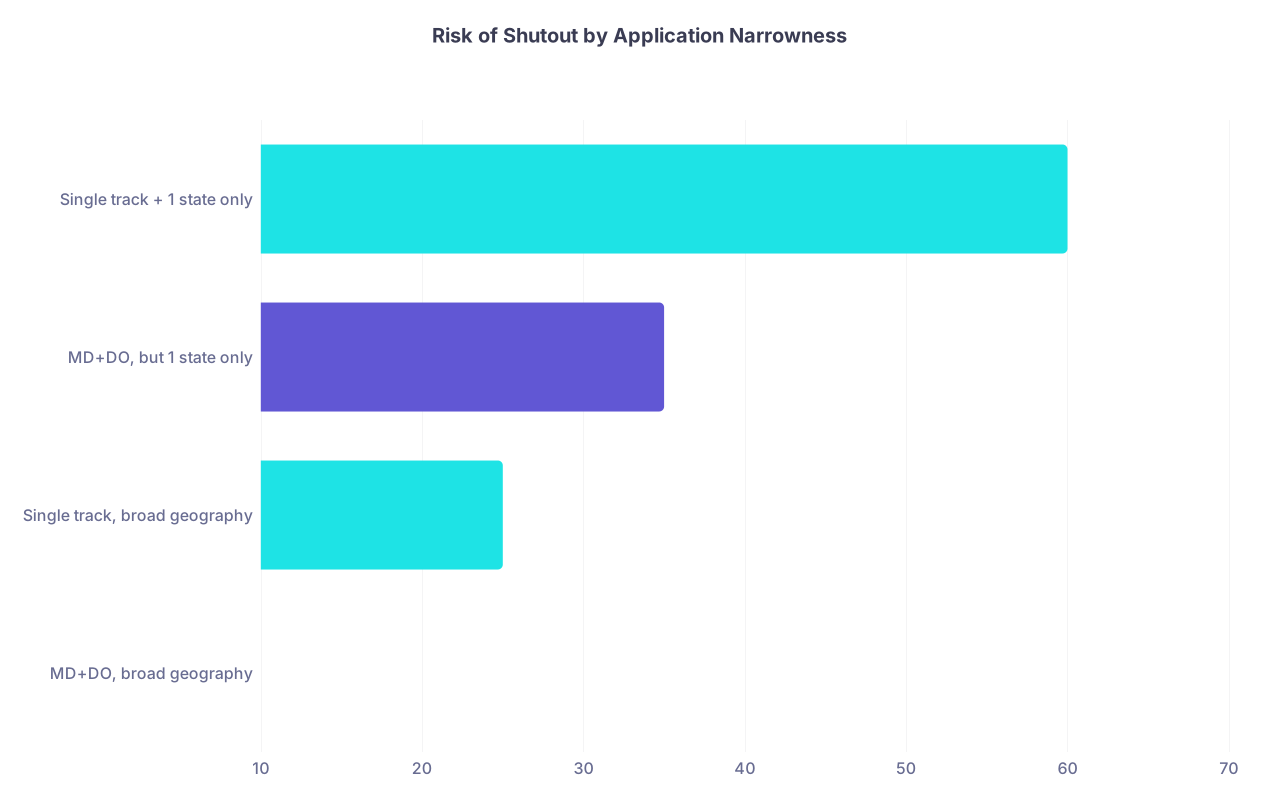
At that point, your risk of total rejection shoots through the roof.
| Category | Value |
|---|---|
| MD+DO, broad geography | 10 |
| Single track, broad geography | 25 |
| MD+DO, but 1 state only | 35 |
| Single track + 1 state only | 60 |
I have seen people do:
- Only California MD.
- Only Texas MD.
- Only one or two DO schools in their driving radius.
That is not strategy. That is magical thinking.
If you are serious about becoming a physician, you need to separate:
- Preferences (it would be nice to stay near home)
- Requirements (I must be safe, not in debt beyond reason, and able to complete the training)
Comfort is not a requirement. It is a benefit. When you treat it like a requirement, you restrict options so hard that a single-cycle shutout becomes likely.
Mistake #6: Not Understanding How DO and MD Timelines and Logistics Differ
Another way people mismanage risk: they do not understand how the timelines and mechanics differ between MD and DO.
Common blunders:
- Submitting AMCAS in June but waiting until September or October to submit AACOMAS “if MD does not work out.”
- Never taking the extra time to get a DO letter of recommendation, then scrambling too late.
- Ignoring the fact that some DO schools historically interviewed later or had rolling patterns that could have been backups if used correctly.
I have seen people apply like this:
- June: AMCAS to 25 MD schools.
- October: No IIs. Panics. Suddenly decides “Ok, I will do DO after all.”
- Submits AACOMAS in late October with no DO letter, recycled essays, no apparent DO exploration.
- Wonders why almost nothing happens.
If you are going to use DO as real risk management, not a last-minute panic button, then:
- Prepare your DO letter early (shadow a DO, get a real letter, not some generic paragraph).
- Write secondary-style content that shows you actually know the difference in philosophy and training. Not a copy-paste.
- Submit AACOMAS in a timely way, not months after MD.
Waiting to see if MD rejects you before even touching DO is like waiting to start your fire insurance only after your kitchen is already in flames.
Mistake #7: Ignoring Financial Risk of Reapplication vs. Dual-Track Application
I rarely see premeds do actual math here.
They will say:
- “I do not want to ‘waste’ money applying DO.”
- “I will save money by only applying to MD this year.”
Then I watch them pay for:
- Multiple cycles of primaries and secondaries.
- An SMP or postbac because they closed off DO options when they still could have gotten in.
- Another year of rent, food, lost opportunity cost.
Look at the rough tradeoff:
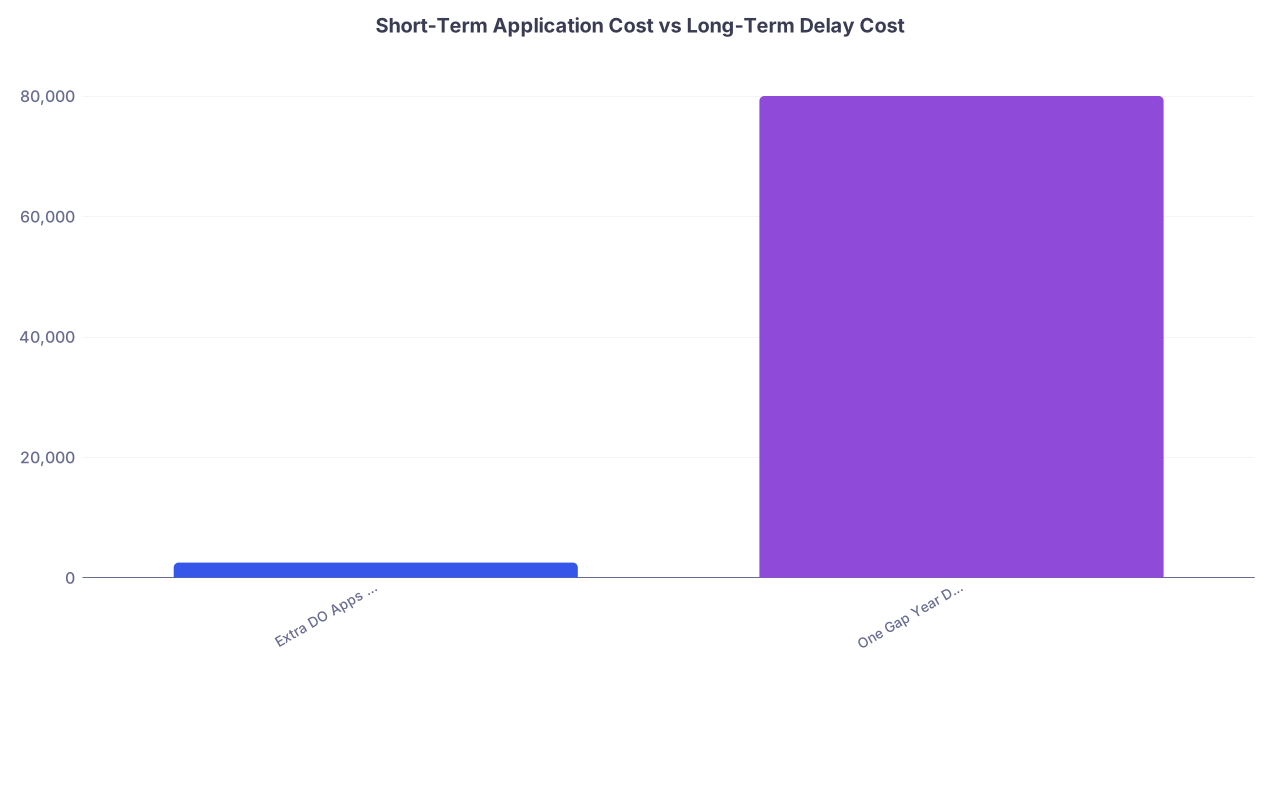
- Extra 10–15 DO schools in one cycle: maybe a couple thousand dollars more in that same year.
- Versus: 1–2+ years delayed physician salary (hundreds of thousands in opportunity cost) plus extra application cycles, exams, and emotional toll.
| Category | Value |
|---|---|
| Extra DO Apps Now | 2500 |
| One Gap Year Delay | 80000 |
The “savings” from not applying DO is microscopic compared to the potential cost of needing additional cycles because you restricted yourself.
This is not an argument that everyone should apply DO. It is a warning: if you can afford an extra $1–3k in the context of a 7–10 year, multi-hundred-thousand-dollar training path, then refusing to hedge your bets is financial nonsense.
Mistake #8: Overvaluing Perceived Prestige, Undervaluing Actual Training and Outcomes
Let me be blunt. A lot of MD-only applicants are prestige-chasing, whether they admit it or not.
They picture:
- The white coat with “MD” embroidered.
- Parents bragging rights.
- The subtle social status bump.
But once you match into residency and start practice, the questions shift to:
- Are you competent?
- Are your patients cared for?
- Do your colleagues trust you?
Patients rarely ask whether their anesthesiologist is MD or DO. They care if they wake up without complications.
Meanwhile, I have watched:
- DO grads outperform MD peers in residency because they were hungrier and more clinically oriented early on.
- MD grads from lower-ranked schools trail DO grads from strong programs in certain settings.
Fetishizing “MD” so hard that you are willing to repeatedly gamble your entire career trajectory on that label is a bad trade for most people.
Again: does bias still exist? Yes, especially at some old-guard academic centers and in a few subspecialties. Ignoring that is naïve. But over-weighting those pockets of bias while under-weighting the stability of simply becoming a physician is its own kind of blindness.
If your real priority is “I want to be a practicing doctor,” then your strategy should reflect that. Not your ego.
When DOES It Make Sense to Apply Only One Track?
There are a few narrow, defensible cases. If you are going to break the rule, do it consciously.
MD-only can make sense if:
- You have truly strong metrics (e.g., 3.85+ and 518+), robust clinical, solid letters, and realistic school list.
- You understand and accept that a small but real chance of shutout exists and you are prepared for extra cycles, if necessary.
- You have strong geographic or institutional pull (state school with strong in-state bias where you are squarely above median).
DO-only can make sense if:
- Your stats are clearly aligned with DO ranges but far below MD competitiveness, and your priority is to avoid wasting MD primaries that have near-zero odds.
- You are genuinely committed to osteopathic practice and have done real shadowing and engagement.
- You apply broadly and early, not just to 3–5 local schools.
Notice the common thread: even in these scenarios, people who do it well:
- Have realistic self-assessment.
- Apply broadly within that one track.
- Have contingency plans if they get shut out.
Most students who get burned did not have those three pieces lined up.
How to Fix Your Risk Management – Practically
If you are still in the planning stage, here is a more sane approach:
Brutally assess your stats and profile
- Compare GPA and MCAT to both MD and DO medians.
- Factor in trends, postbacs, MCAT retakes, URM status, and clinical volume.
Decide your non-negotiables vs preferences
- Non-negotiable: becoming a physician within a reasonable time frame.
- Not non-negotiable: one specific city, “prestige,” never moving away from family.
Use both systems strategically unless you have a very specific, rational reason not to
- If you are anywhere near the middle of the pool, dual-track is the safest path.
- If you are clearly top-tier for MD, you can reasonably focus MD but should still consciously accept risk.
Prepare logistically for both
- Get a DO letter if there is any chance you might apply DO.
- Shadow both MD and DO if possible, so your applications read as genuine.
- Draft school lists that include a range of MD and DO programs with varying competitiveness.
Do the cost vs delay math
- Treat extra applications as insurance premiums, not “wasted” money.
- Ask: “What is the cost if I do not get in this year?” Not just, “What is the cost of this app fee?”
Core Takeaways
Keep these in front of you while you plan:
- Applying to only MD or only DO without a clear, rational justification is not confidence. It is bad risk management.
- Your main objective is not winning an MD vs. DO argument; it is becoming a competent, practicing physician on a sane timeline.
- Dual-track applications (or at least well-thought-out backup plans) protect you from the very real, very common outcome of an empty interview season.