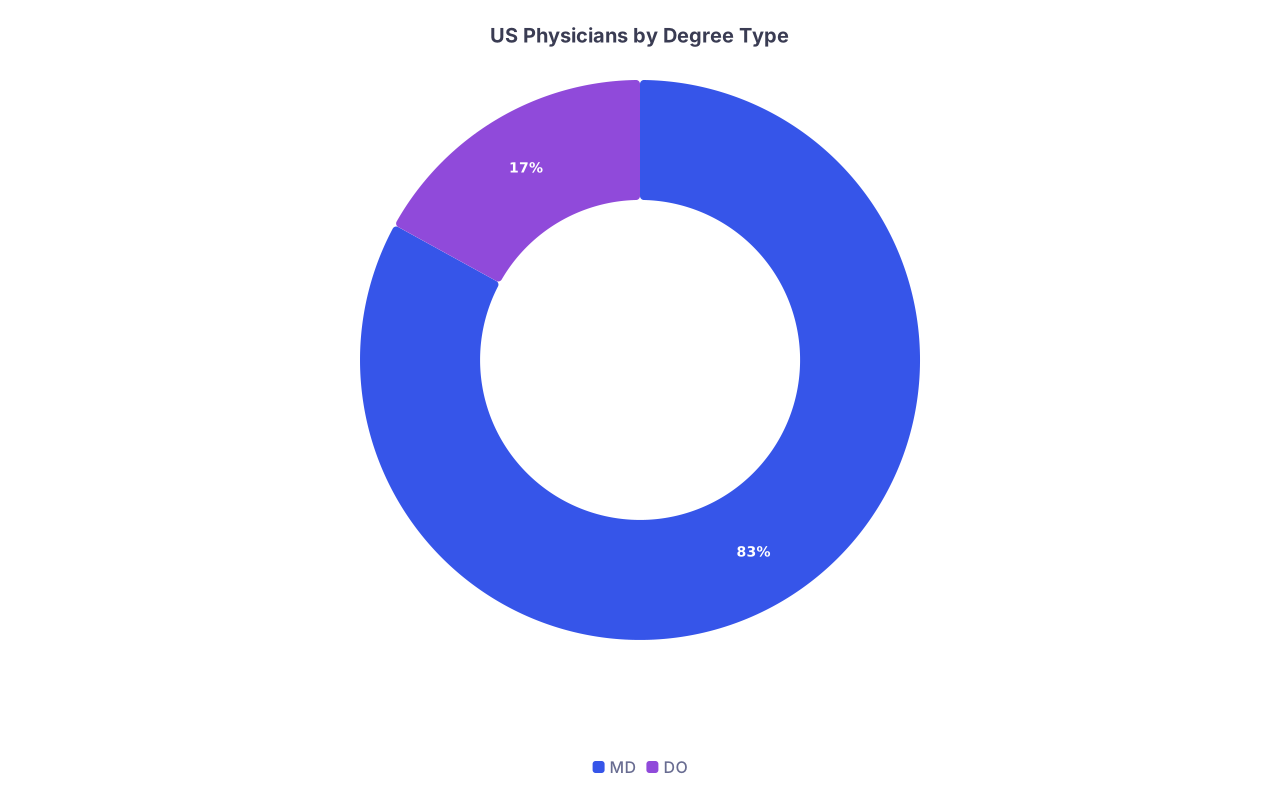
The belief that “DO is just the easier MD” is not only wrong—it can quietly wreck your future options.
If you’re leaning toward DO purely because you think admission will be easier, you’re playing with fire. Not because DO is inferior—it’s not—but because choosing any medical degree for the wrong reason can box you into a career you did not actually want.
Let me be blunt: I’ve watched students panic in July, grab the first DO acceptance “just to have something,” and then spend the next decade fighting uphill battles they never anticipated. The problem wasn’t the DO degree. The problem was the lazy decision-making that got them there.
This article is not anti-DO. It’s anti-bad-strategy.
If you’re serious about medicine, you need to understand the long-term career pitfalls of treating DO as an “easier backup” instead of a deliberate, informed path.
1. The First Big Mistake: Treating “DO vs MD” as Just a Logo Decision
The worst mindset I see:
“I just want to be a doctor, I don’t care if it’s MD or DO. DO is easier, so I’ll go there.”
Sounds humble. It’s not. It’s careless.
MD vs DO isn’t like choosing between two brands of stethoscope. It affects:
- Which specialties are realistically within reach
- Where you can train
- How much extra work you may have to do
- How much explaining you’ll be doing for the rest of your career
When you say “I don’t care,” what you really mean is:
“I haven’t thought this through yet.”
Where this goes wrong
You’re pre-acceptance. Your metrics aren’t ideal. Maybe:
- GPA: 3.2–3.4
- MCAT: 502–506
- Limited clinical or research experience
You hear:
“DO schools are more forgiving. They care about the whole person. Stats aren’t as big a deal.”
So you think you’re making a smart move: same white coat, less pain up front.
Here’s the catch: the front end feels easier. The back end can become brutal if you later decide you want:
- Dermatology
- Orthopedic surgery
- Radiology
- Competitive fellowships at big-name academic centers
Can DO grads match into those? Yes. But you’ll need to be near-perfect. While your MD classmates with similar ambition but slightly better stats might have more built-in runway.
2. The Data You Ignore Now Will Haunt You Later
Most premeds do not bother to look at real match data before committing to “easier DO admissions.” That’s a mistake.
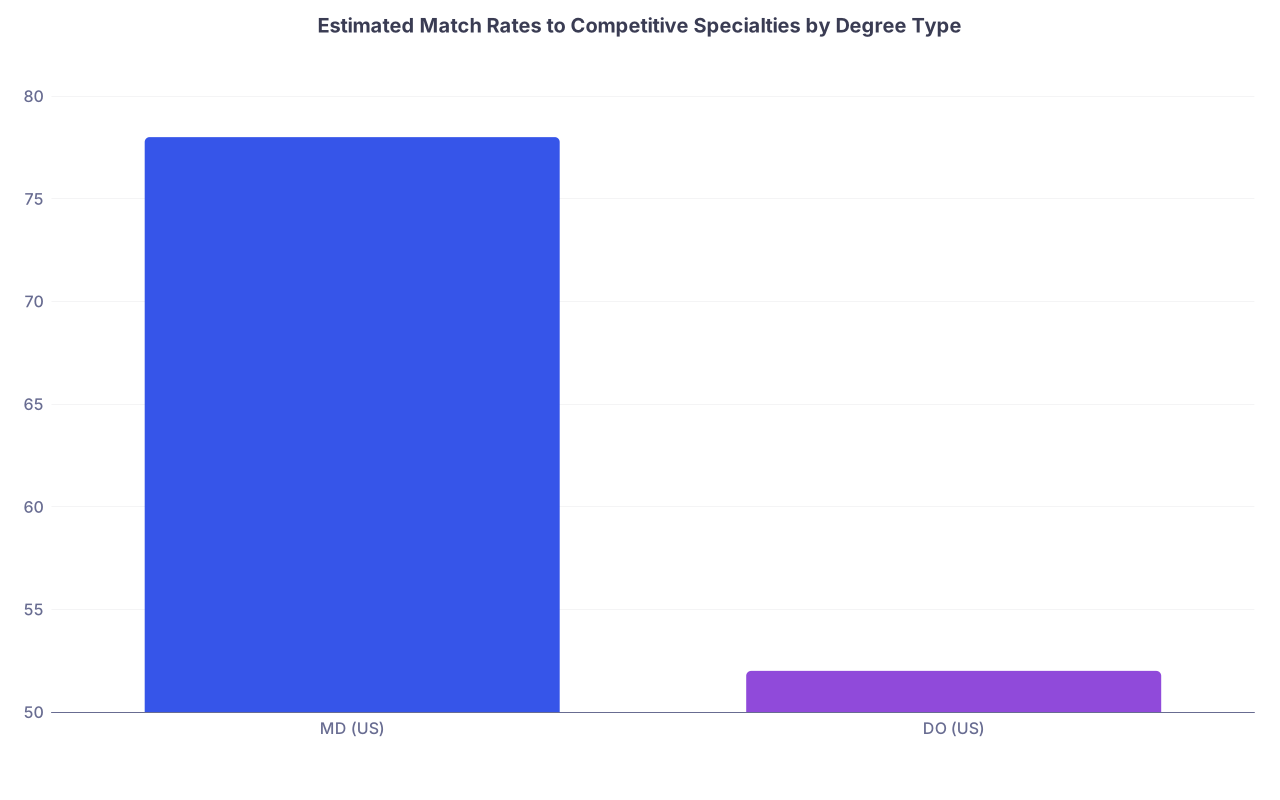
| Category | Value |
|---|---|
| MD (US) | 78 |
| DO (US) | 52 |
These are representative, not universal, but the pattern is consistent:
For highly competitive specialties, DO grads can match—but at lower rates and with higher performance thresholds.
What premeds often overlook:
Program bias still exists.
Some residencies—especially competitive ones—quietly prefer MDs. They might not say it in public, but their match lists say it for them.Research expectations differ.
Many DO schools are not strongly research-focused. If you later target academic neuro, derm, or interventional cards, you may have to create your own research path from almost nothing.Geographic limitations creep in.
Some regions, especially certain elite academic institutions, still take very few DO grads in competitive fields.
The tragedy isn’t that DO is worse.
The tragedy is watching a student who “just wanted to be a doctor anywhere” realize in MS3 that they do care where and what they practice—but by then the structure around them makes it much harder.
3. The Hidden Curriculum Problem: You Won’t Know What You’re Missing… Until You Need It
Here’s a pattern I’ve seen too many times:
- Premed aims low to “just get in somewhere”
- Lands at a newer or lower-resourced DO program
- MS1–MS2: happy enough, passes exams, no real exposure to high-end specialties
- MS3: rotates with a great attending in ortho, derm, or radiology → falls in love
- Suddenly realizes:
- No in-house residency in that field
- No big-name research mentors
- Weak specialty pipeline from their school
Now they’re trying to claw their way into a specialty their school doesn’t really feed into.
Is this fixable? Sometimes. But it’s an uphill climb that could have been avoided by:
- Looking at each school’s match list before you ever apply
- Asking: “Where do their grads go? What specialties? What programs?”
- Not assuming all MD and DO schools give you the same doors
When you choose DO solely because "it’s easier," you’re often not choosing a strong DO school intentionally. You’re just taking the first yes. And that’s where the quality gap starts to hurt.
4. The “I’ll Just Transfer Later” Fantasy
Do not make this mistake:
Counting on transferring from DO → MD if you “do well.”
Transfers between DO and MD are extremely rare and logistically messy. This is not undergrad. You’re not switching from one state university to another if you get better grades.
Most students who tell themselves “I’ll just transfer if I hate it” end up… not transferring.
They stay. Sometimes they adjust. Sometimes they quietly resent it.
If you go DO, assume you are finishing as a DO.
If that sentence makes you flinch—even a little—you’re not ready to make that decision.
5. Long-Term Career Perception: The Thing No One Wants to Acknowledge
You will hear this:
“Patients don’t know the difference between DO and MD.”
Often true. But that’s not the whole story.
Who does know the difference?
- Residency program directors
- Academic physicians hiring for faculty positions
- Certain specialty groups
- Some hospital administrators
Does it always matter? No.
Does it sometimes affect your trajectory, networking, and “automatic prestige”? Yes.
Again, not because DO is bad. But because medicine is still a status-driven, conservative system in many corners. You can rail against that, or you can be aware of it and plan accordingly.
The pitfall: choosing DO as the “easy door” and then later wanting to play in arenas (big-name academic centers, hyper-competitive specialties) that are still biased—subtly or not—toward MD.
6. The Emotional Cost: Regret, Resentment, and Identity Whiplash
You know what hurts more than studying for the MCAT again?
Spending 10 years in a path you didn’t really pick, then realizing it could have been different if you’d had the courage to:
- Take an extra year
- Fix your GPA trend
- Retake the MCAT
- Be strategic about your school list
I’ve heard versions of this more than once from DO residents:
“If I’m honest, I took the first DO acceptance because I was terrified of not being a doctor. Now I want interventional radiology at a major academic center and I feel like I’m running uphill in sand.”
They’re not doomed. But they are carrying extra weight. And the emotional burden is real:
- Constantly feeling like you have to prove you belong
- Second-guessing every earlier decision
- Snapping at anyone who suggests DO and MD are “different” because you’re tired of defending it
If you choose DO intentionally—because you believe in osteopathic philosophy, like OMM, are okay with the match realities, or prefer certain school cultures—that emotional cost shrinks dramatically.
If you choose DO as “easier MD,” you’ll likely resent the very choice you made.
7. When Choosing DO Is Smart—and When It’s a Trap
Let me be clear: there are absolutely good reasons to choose DO.
Smart reasons to deliberately choose DO:
- You genuinely align with osteopathic principles and hands-on treatment
- You’ve researched specific DO schools with strong match outcomes in your likely interests
- You’re okay focusing on primary care, IM, FM, EM, psych, peds, etc., and understand your odds for hyper-competitive specialties may be lower
- You know the match data and accept the trade-offs
Dumb reasons (yes, I said it) to choose DO:
- “My GPA is mediocre and I don’t want to fix it.”
- “MCAT retake sounds miserable.”
- “My friend said DO schools are chill about stats.”
- “I just want to be a doctor and I don’t care about anything else” (while not actually having any clinical experience to support that claim).
You avoid regret not by avoiding DO.
You avoid regret by avoiding lazy thinking.
8. The Premed Shortcut Culture: Why You’re Vulnerable to This Mistake
TikTok, Reddit, Discord—everywhere you look, someone’s selling you this idea:
“Don’t overcomplicate it. Just get in somewhere. MD, DO, Caribbean, whatever. A doctor is a doctor.”
This advice usually comes from:
- People not yet in med school
- People in non-competitive specialties who never tried for something else
- Anonymous users with zero accountability for your outcome
What they don’t tell you:
- Not all “somewheres” are created equal
- Climbing out of a bad match (school + degree + specialty misalignment) is so much harder than just slowing down and applying better
- The fear of “I might not get in” is pushing you to accept any door instead of the right door
Your fear is real. But fear is a terrible strategist. It tells you: “Grab the first acceptance and shut your brain off.”
That’s how people voluntarily walk into long-term career pitfalls with their eyes half closed.
9. Concrete Ways to Avoid the “DO as Easy Escape Hatch” Trap
Here’s how to protect yourself from this mistake without wasting years.
1. Get uncomfortably honest about your competitiveness
Stop guessing. Look at:
- Cumulative GPA and science GPA
- MCAT score (official or realistic FL average)
- State of residence
- Clinical, shadowing, and volunteering hours
- Research or lack of it
Then compare your stats to average MD and DO matriculant data, not applicant data. Ask: “Am I truly shut out of MD right now, or just less competitive?”
2. Decide if you’re willing to take a growth year (or more)
If you’re anywhere close to MD-competitive with fixable gaps, think hard before defaulting to DO just because it’s faster.
Use a growth year to:
- Repair GPA trend with post-bacc or SMP
- Retake MCAT once, properly prepared
- Build real clinical experience so you know what specialties might fit
If you refuse to take extra time because you “just want to start now,” that’s a red flag. You’re prioritizing speed over fit.
3. Investigate specific DO schools like a paranoid detective
Do not treat all DO schools as one blob. They’re not.
Look, school by school, at:
- Recent match lists
- Presence of in-house residencies (IM, EM, anesthesia, ortho, etc.)
- Research opportunities
- Geographic connections to hospitals you actually care about
If a school’s match list is vague, outdated, or looks weak on anything beyond primary care—and you think you might want something more competitive—you’re accepting a risk. Don’t pretend you’re not.
4. Pressure-test your “I don’t care what kind of doctor I am” claim
Shadow broadly. Not just family medicine. Go see:
- A surgeon
- A hospitalist
- A radiologist
- An anesthesiologist
- A psychiatrist
Ask them, bluntly, if being DO would have changed their path. Some will say no. Some will pause. Those pauses matter.
10. Quick Reality Check: Where DO Shines and Where It’s Tougher
To keep this grounded:
DO is usually very solid for:
- Family medicine
- Internal medicine
- Pediatrics
- Psychiatry
- Many EM and IM subspecialties with the right training afterwards
DO is usually more uphill for (not impossible, just harder):
- Dermatology
- Plastic surgery
- Orthopedic surgery
- Neurosurgery
- ENT
- Some radiology and interventional fields
If you are even remotely drawn to those competitive specialties—but you’re choosing DO only because you’re scared to take an extra year or retake the MCAT—you’re setting up Future You for a fight they didn’t have to have.

| Step | Description |
|---|---|
| Step 1 | Premed considering DO |
| Step 2 | Research strong DO schools |
| Step 3 | Reassess long-term goals |
| Step 4 | Apply DO intentionally |
| Step 5 | Consider growth year & improve stats |
| Step 6 | Review match data & specialties |
| Step 7 | Why DO? |
| Step 8 | Ok with match tradeoffs? |
| Step 9 | Still ok with DO limits? |
11. The Bottom Line You Cannot Ignore
Choosing DO is not the pitfall.
Choosing DO for the wrong reason is.
The critical mistakes:
- Treating DO as “easier MD” instead of a distinct, valid path with different trade-offs
- Refusing to fix your application and using DO as a shortcut
- Ignoring match data and school-specific outcomes
- Assuming you’ll never care about specialty or prestige when you haven’t even seen the field up close
You owe Future You more respect than that.
If, after serious research and self-honesty, you choose DO deliberately—that’s a strong decision. You’ll own it. You’ll thrive in it.
If you slide into DO because you panicked and wanted the fastest yes, don’t be surprised when you wake up in MS3 and realize the shortcuts you took at 22 reshaped your entire career landscape.
FAQ (Exactly 4 Questions)
1. Is going DO a mistake if I want a competitive specialty?
Not automatically, but it raises the difficulty level. You’ll likely need top-tier board scores, strong clinical performance, research, and often strategic networking. Some programs in derm, ortho, neurosurgery, etc., still take very few DOs. If your heart is set on those fields and you’re early in the process, it may be smarter to strengthen your application and apply more broadly to MD as well, rather than using DO as a shortcut.
2. Should I take a gap year instead of going straight to a lower-tier DO school?
If your stats and experiences are close to MD-competitive and you care about maximizing specialty and location options, yes, a gap year (or more) is often the smarter move. Use it to raise your GPA trend, retake the MCAT once with a serious plan, and build meaningful clinical exposure. Rushing into a school that doesn’t align with your long-term goals just because it said “yes” first is a common and preventable mistake.
3. How do I know if a specific DO school will limit my options?
Look at the evidence, not the marketing. Study their last 3–5 years of match lists: which specialties, which programs, which regions? Do they have in-house residencies in fields you might want? Are graduates matching into the kinds of places and specialties you could see yourself in? If the data are weak, vague, or dominated by only primary care—and you think you may want something more competitive—that school carries more risk for you.
4. What if I truly don’t care about prestige and just want to practice primary care?
If you’ve had solid primary care exposure and genuinely know that’s what you want, DO can be an excellent fit. Many DO schools emphasize primary care and community medicine. The key is honesty: make sure this isn’t code for “I haven’t explored anything else” or “I’m too scared to aim higher.” If you’ve done the homework and still feel aligned with that path, then choosing DO intentionally, not as an escape hatch, is a strong, defensible choice.
Open a spreadsheet (or even a notes app) today and list your top 5 likely specialties, then pull up match data from 3 MD and 3 DO schools you’re considering—line them up side by side and ask yourself: “If I end up wanting specialty #1 or #2, will I be glad I chose this path or furious I didn’t think harder up front?”