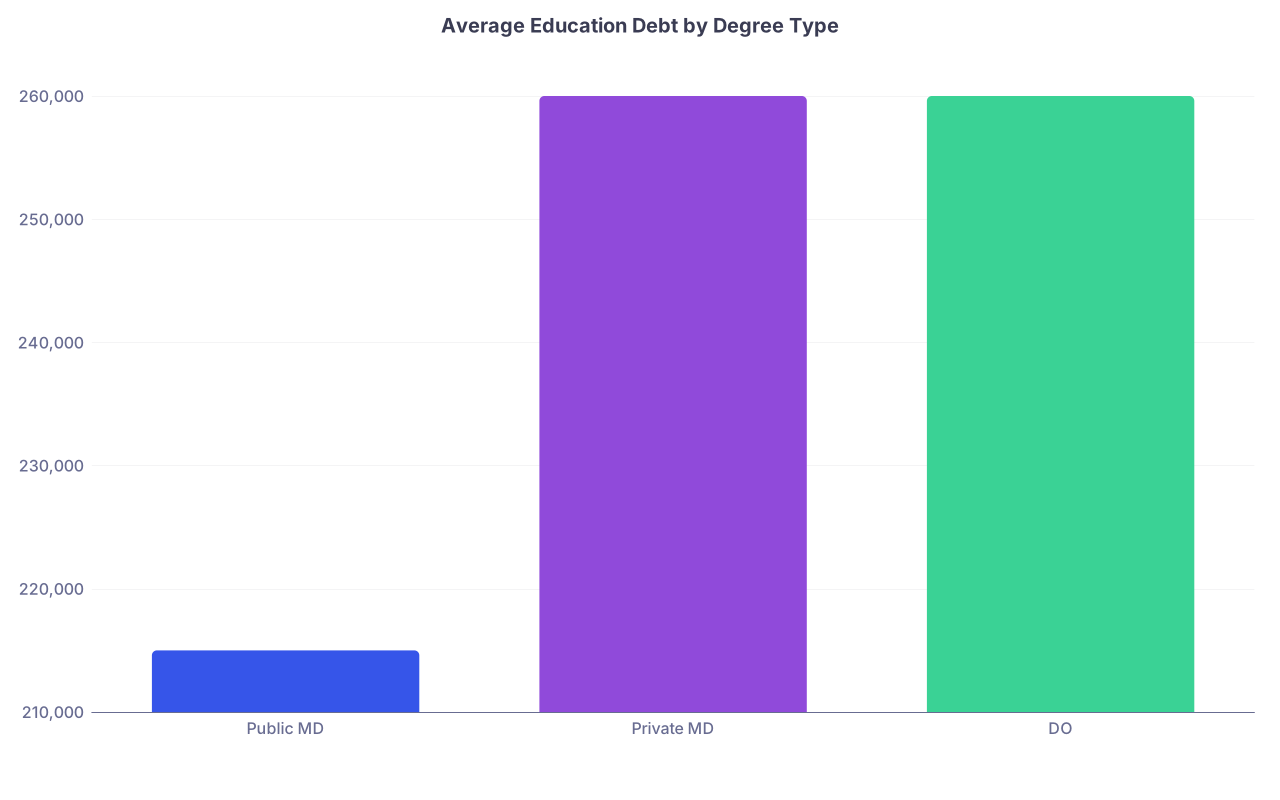
The Biggest Mistakes Students Make When Applying to DO and MD Schools
It is late. Your AMCAS is open in one browser tab, AACOMAS in another. You have 22 half-finished secondaries, a personal statement you do not fully believe, and a spreadsheet of MD and DO schools color-coded in a way that stopped making sense three weeks ago. Someone on Reddit said you “have a good shot at mid-tiers.” Your advisor said, “We will see.” Your parents said, “Just apply everywhere.”
This is where a lot of people quietly torpedo their chances.
Not by being lazy. Not by being “not smart enough.” By making predictable, avoidable strategic mistakes—especially when deciding how to approach DO versus MD schools.
Let me walk you through the biggest ones I see over and over again.
Mistake #1: Treating DO as the “Backup Bin” Instead of a Different Path
If you only remember one thing, remember this: osteopathic schools are not “MD-lite.”
The worst pattern I see:
- Student aims for MD only.
- Applies to 25 MD schools with a 3.4/508.
- Gets no IIs (interview invites) by December.
- Panics.
- Scrambles to throw some DO apps together late, with recycled essays that scream: “I did not seriously consider DO until I was rejected.”
Disaster. And it was predictable.
How this mistake shows up
You are making this mistake if:
- You cannot give a convincing, specific answer to “Why osteopathic medicine?” beyond “I still get to be a doctor.”
- You have zero DO shadowing, zero DO letters, and zero mention of osteopathic principles in anything you wrote.
- You only added DO schools after your MD rejections started rolling in.
DO schools read applications all day. They can smell “backup applicant” from a mile away.
They see things like:
- Personal statements that never say “osteopathic” or “holistic” or show any understanding of OMM, but use “physician” and “doctor” generically.
- Secondaries that clearly were MD prompts with a few words swapped.
- Activities section with zero engagement in any DO-related context.
They are not flattered that you thought of them last.
What you should have done instead
Decide early which of these is true for you:
- MD only (you would rather reapply than attend DO).
- DO only (you are philosophically or strategically committed to DO).
- MD and DO (you genuinely would be happy at either route).
All three are valid. What is not valid is pretending to be #3 while acting like #1 until January.
If you are serious about both pathways:
- Plan for at least one DO letter. Two is better.
- Shadow at least one DO physician, with enough contact to actually learn how they practice and what, if anything, feels different.
- Be able to articulate clearly why you would choose a DO school even if an MD option existed—beyond “statistics.”
If that sounds like too much effort, then be honest: you are not actually applying DO. You are just listing DO schools on AACOMAS.
Do not do that.
Mistake #2: Ignoring How Your Stats Actually Match MD vs DO Reality
This one is brutal because it is usually driven by ego and misinformation.
A lot of students build a list based on:
- What schools sound impressive.
- Where their friends got in.
- Rankings they barely understand.
- A fantasy version of how their GPA and MCAT “should be enough.”
They ignore the numbers.
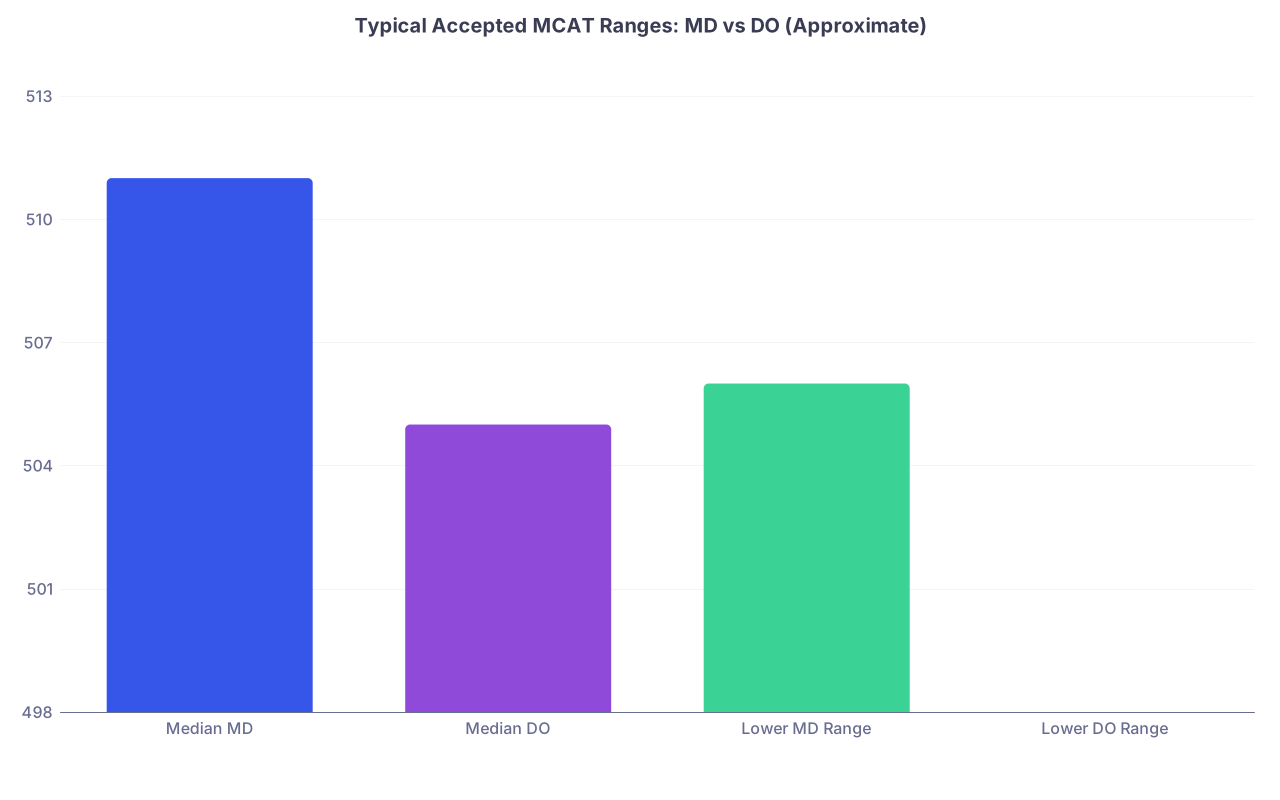
| Category | Value |
|---|---|
| Median MD | 511 |
| Median DO | 505 |
| Lower MD Range | 506 |
| Lower DO Range | 498 |
No, your 501 is not “fine for MD” because “someone on SDN did it.”
Here is the mistake: treating MD and DO as if they have the same statistical bar, or worse, building an MD-heavy list that ignores:
- That MD schools receive absurdly more applications.
- That GPA trends and institutional bias matter.
- That DO schools exist partly to give strong clinical candidates with imperfect numbers a path to being physicians.
Common delusions I see
“My 3.2/507 is going to crush at mid-tier MDs if I write a great personal statement.”
No. You might snag a few looks at mission-fit schools, but “mid-tier” MD is not built for this.“DO schools are for people who couldn’t hack it in MD.”
Also wrong. Some DO matriculants turned down MD offers. Some picked DO intentionally for location, philosophy, or support.“I will just apply broad and see what sticks.”
Translation: you do not understand your competitiveness and are throwing money at the problem.
How to avoid this
Do a sober read of your stats:
- GPA (overall and science)
- MCAT
- Trend (upward, flat, or downward)
- Institutional rigor and major
Then line that up with real data from AAMC and AACOM:
- If you are below median on both GPA and MCAT for most MD schools, you are not a strong MD candidate.
- You might still have a shot, but not with a top-heavy list of “dreams.”
A reasonable pattern for a borderline candidate who is open to both:
- A smaller, very strategic MD list (mission-fit, in-state bias, lower medians).
- A robust DO list, including schools where your stats are at or above their typical admitted range.
Do not let pride trick you into building an MD-dominant list when the numbers scream you need DO in the mix from the start.
Mistake #3: Writing One Personal Statement and Pretending It Works for Both
I see this constantly: one generic essay forced onto both AMCAS and AACOMAS.
On the MD side, it feels vague and cliché. On the DO side, it looks like you do not actually know what osteopathic medicine is.
What goes wrong
For MD schools, weak essays often:
- Rehash the “I want to help people” narrative without any depth.
- Describe shadowing like a tourist: “I saw the doctor talk to many patients.”
- Avoid vulnerability, reflection, or actual change over time.
For DO schools, weak essays usually:
- Never mention osteopathic principles, holistic care, or OMM in a meaningful way.
- Use “MD” explicitly when they mean “physician.”
- Sound like, “I am applying DO because I didn’t get an MD score.”
You do not need two entirely separate essays. But you absolutely need:
- A core narrative about why medicine.
- A DO-specific adaptation that honestly addresses why an osteopathic pathway fits you.
If you paste your MD personal statement into AACOMAS with zero adjustment, you send a clear, unflattering message: “You were a checkbox, not a choice.”
Fix it before you submit
Ask yourself:
If a DO adcom read my personal statement alone, would they:
- Know that I understand anything about osteopathic training?
- See that I have actually thought about the differences, not just the letters?
- Believe I would attend their school if accepted?
If the answer is no across the board, you are making a mistake that will quietly kill your DO chances.
Mistake #4: Underestimating School Mission Fit (Especially for DO)
Too many premeds treat school choice as: rank, location, name recognition.
That is how you end up with people with 1000+ clinical hours, a history of working in community clinics, and an interest in primary care…applying mainly to research-heavy MD schools and ignoring DO programs designed precisely for their profile.
DO schools, in particular, tend to have:
- Strong emphasis on primary care and underserved communities.
- Heavy clinical training focus.
- Specific regional preferences.
MD schools can also be extremely mission-driven. Think:
- University of New Mexico: heavy focus on serving New Mexico’s population.
- Howard, Meharry, Morehouse: missions rooted in addressing care for underserved and minority communities.
If your life story and experiences scream “mission-fit” for certain DO or MD schools, but your list is mostly shiny names with no alignment, you are wasting your best leverage.
The lazy list-building trap
You are in the trap if your process was:
- Grab some T20 MDs “just in case.”
- Add your state MD schools by default.
- Dump in DO schools you have vaguely heard of, with no idea where they are or what they value.
Fix it by reading:
- School mission statements.
- Their community partnerships.
- Their match lists and stated primary care or specialty emphasis.
Then align your list so your best stories match what they claim to care about.
Do not ignore a DO school that is a perfect philosophical match because your roommate has never heard of it.
Mistake #5: Neglecting Timing and Thinking DO Is “More Forgiving”
This one hurts because it looks small but creates a huge gap.
Many students treat MD as “serious, early, polished” and DO as “I can always add those later.” They start MD primaries in June, then mosey into AACOMAS in August or September when things look grim.
Meanwhile, DO schools have already:
- Reviewed and interviewed early applicants.
- Started handing out seats.
- Filled a good portion of their class with people who did not treat them as a “late backup.”
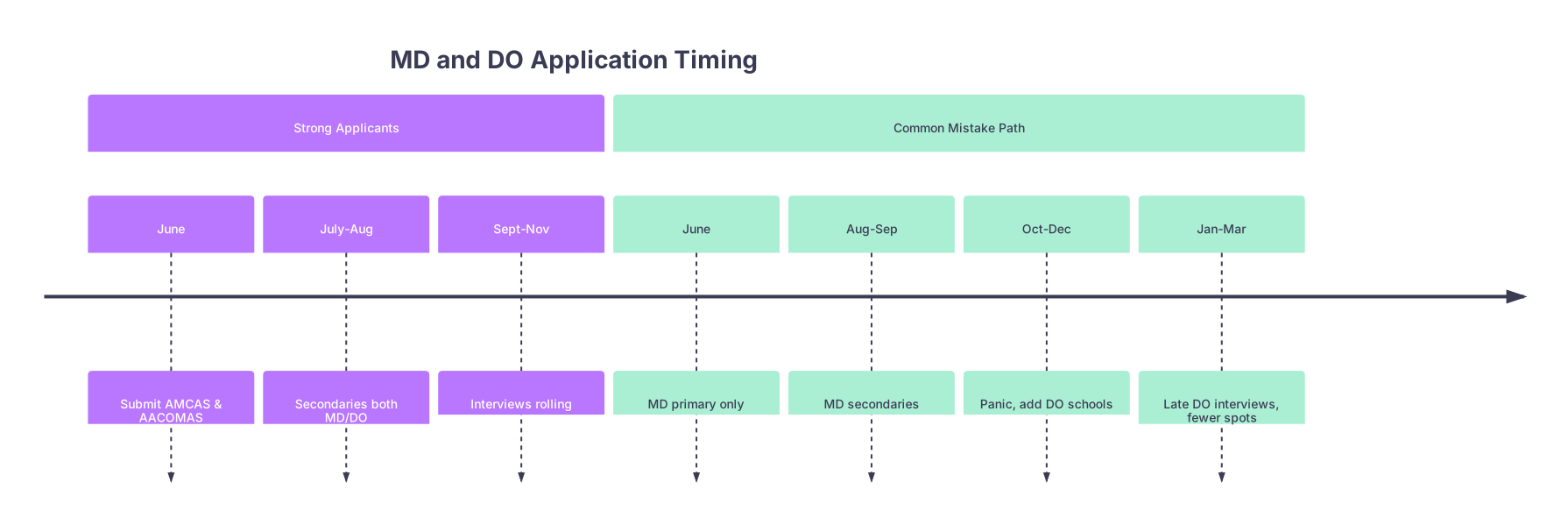
| Period | Event |
|---|---|
| Strong Applicants - June | Submit AMCAS & AACOMAS |
| Strong Applicants - July-Aug | Secondaries both MD/DO |
| Strong Applicants - Sept-Nov | Interviews rolling |
| Common Mistake Path - June | MD primary only |
| Common Mistake Path - Aug-Sep | MD secondaries |
| Common Mistake Path - Oct-Dec | Panic, add DO schools |
| Common Mistake Path - Jan-Mar | Late DO interviews, fewer spots |
You never want to be the applicant showing up after the party started, asking if there are chairs left.
What you should do instead
- Submit both AMCAS and AACOMAS on the early side of “on time.”
- Treat DO secondaries like they matter as much as MD secondaries.
- Do not wait to see how MD goes before touching DO. Decide your strategy up front.
Being “late but strong” is not a magical exception. Late and strong is still worse than early and strong. For DO and for MD.
Mistake #6: Failing to Understand Residency Implications of DO vs MD
I am not going to sugarcoat this. The merger of AOA and ACGME accreditation helped, but it did not erase bias overnight.
The mistake is twofold:
- MD applicants ignoring DO entirely because they are terrified it will “ruin their chances” at some future fellowship they have not even proven they want.
- DO applicants applying blindly without any awareness of how specialty competitiveness and program bias may affect them.
Neither is good strategy.
Reality check
- DO graduates match into almost every specialty, including competitive ones, but on average have a harder time in some hyper-competitive fields and some academic programs that still lean MD-heavy.
- MD graduates generally have smoother access to the full spread of residency programs, especially at research-heavy academic centers.
Does this mean DO cannot match into derm, ortho, plastics? No. They can and do. But the margin of error is smaller. Scores, research, networking, performance all matter more.
The mistake: not thinking at all
You do not need a precise long-term plan as a college junior. But you do need to avoid extremes:
- “I will only do MD because what if I decide I want neurosurgery?” (You have never shadowed surgery. You hate call. You get lightheaded with blood.)
- “I do not care about residency; I will just figure it out later.” (Later is when it is financially and psychologically very expensive to realize you chose a path that makes your goals unnecessarily difficult.)
Better approach:
- Accept that MD generally offers slightly more flexibility at the high end of competitiveness.
- Recognize that DO is a very strong route for those committed to primary care, many internal medicine subspecialties, EM, peds, etc., and even some competitive fields if you are ready to work for it.
- If your stats are borderline for MD and you insist on “MD or nothing,” understand that you are quite literally choosing the risk of never becoming a physician over attending a DO school and then being smart about residency strategy.
Do not make that choice casually.
Mistake #7: Weak or Misaligned Letters—Especially No DO Letter for DO Apps
Another subtle but fatal error: sending a solid MD-style letter pack to DO schools with nothing from a DO physician or anyone familiar with osteopathic training.
It signals exactly what you think it signals: “I did not plan for this.”
If a DO school explicitly recommends or requires a letter from a DO physician and you:
- Ignore it.
- Try to substitute a random MD letter.
- Or scramble last-minute for a one-time-shadowing DO to sign something generic.
…you are telling them you did not care enough to engage with their profession before asking to join it.
You would not apply to a research-heavy MD school with no research and no PI letter and expect to be taken seriously. Same idea.
Plan early:
- Shadow a DO enough that they can actually say something about your character, curiosity, and fit.
- Keep in touch. Do not vanish for a year and then send a one-line email begging for a letter “by next week.”
For MD schools, the parallel mistake is letters that sound generic, lukewarm, or that clearly contradict the “story” you are selling.
If your letters say “quiet, reserved, minimum effort,” and your personal statement says “I am a proactive leader who constantly goes above and beyond,” adcoms notice the mismatch.
Mistake #8: Overvaluing Online Noise and Undervaluing Real Advising
You know this one, but you still fall for it.
Students let:
- Reddit anecdotes.
- SDN doom posts.
- TikTok “MD vs DO hot takes.”
outweigh:
- Their own advisor’s direct knowledge of their file.
- Real accepted students’ experiences.
- Data from AAMC and AACOM.
I once watched a student with a 3.3/499 convince themselves they were “MD-competitive” because one stranger online claimed they had “similar stats and got in.” Never mind that the stranger also had an SMP, 3 years research, and a 515 retake.
They applied almost all MD with a token DO or two. No acceptances. Two years of their life gone to reapplication.
Here is the rule: if your data and your advisor and multiple school medians disagree with what you want to believe from Reddit, Reddit is wrong. Or at least, not about you.
Use online forums for:
- Understanding process.
- Finding secondary prompts.
- Hearing a range of experiences.
Do not use them for:
- Deciding whether you are “MD-competitive” or “too good for DO.”
- Overriding clear, consistent feedback from people who have actually seen your entire application.
Mistake #9: Not Owning Your Story—Letting DO vs MD Define You Instead of the Other Way Around
The last, and maybe biggest mistake: letting the letters (DO vs MD) eclipse everything about who you are, what you care about, and what kind of physician you want to become.
This shows up when:
- Your entire application feels like it was built around “proving” you are MD-worthy or DO-worthy, rather than authentically describing what you have actually done and learned.
- You bend your story to fit whatever you think adcoms want instead of telling the truth clearly and confidently.
- You treat DO as “what I will settle for” rather than “one of two legitimate paths to the work I want to do.”
Here is the irony: the more you obsess about the letters, the less compelling your application becomes to either.
Adcoms want:
- Evidence that you understand medicine is hard and have done unglamorous work anyway.
- Reflection that shows you know yourself and your limits.
- Commitment that looks real, not reactive.
If your whole identity in this process is “MD-or-bust” or “I guess I’ll go DO if I have to,” you will make bad decisions born out of fear. Late DO apps. Unbalanced lists. Wasted cycles.
Drop the ego. Focus on the end game: actually becoming a competent, compassionate physician with a path that fits your profile.
The letters matter—but nowhere near as much as students think while they are panicking over application portals.

Three Things To Walk Away With
Do not treat DO as an afterthought. If you apply, apply early, deliberately, and with essays, letters, and experiences that show you actually understand and value osteopathic medicine.
Be brutally honest about your stats and profile. Build MD and DO school lists that reflect reality, not fantasy, and align them with school missions that genuinely match who you are.
Decide now that you care more about becoming a good physician than about defending three letters on a white coat. Then choose the path—MD, DO, or both—that gives you the best, most realistic shot at that life.