| Category | Value |
|---|---|
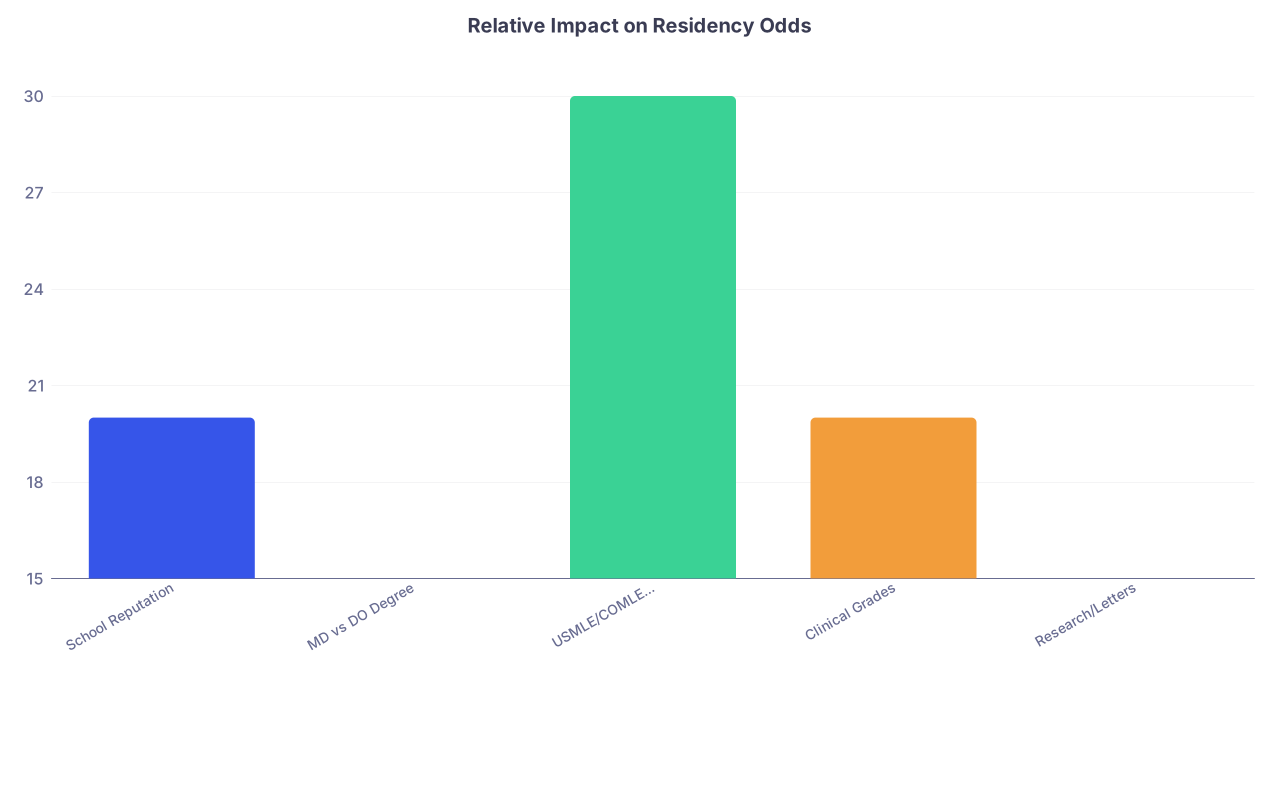
| School Reputation | 20 |
| MD vs DO Degree | 15 |
| USMLE/COMLEX Scores | 30 |
| Clinical Grades | 20 |
| Research/Letters | 15 |
Does choosing a lower-ranked MD beat a higher-ranked DO… or is the school name what really moves the needle?
Here’s the uncomfortable truth you actually need: most premeds obsess over the wrong variable.
They argue in forums about DO vs. MD like it’s Coke vs. Pepsi, while ignoring the fact that a mid-tier MD with an average match history may give you fewer doors than a well-known DO school that’s aggressive about boards, advising, and research. And the school “brand name”? It matters. But not as much as people like to pretend.
Let’s sort this out in a way that actually helps you prioritize your options when acceptances hit your inbox.
The Real Hierarchy: What Matters Most For Residency
You’re not picking a degree. You’re picking how hard or easy it will be to match into the specialty and location you want.
Big picture, for residency competitiveness in 2024+ (with USMLE Step 1 now pass/fail), the order looks roughly like this:
- Your board exam performance (USMLE/COMLEX)
- Your clinical performance and letters of recommendation
- How well your school supports those two (curriculum, advising, rotations)
- MD vs DO status
- School name / institutional prestige
Notice where “school name” and “MD vs DO” sit: important, but not the top of the food chain.
If you’re choosing between acceptances, here’s the blunt framework I use with students:
- Will this school reliably set me up to crush boards?
- Will this school give me strong clinical training and meaningful letters?
- What’s the school’s actual match track record in fields like the ones I’m considering?
- Only then: Is MD vs DO, and the school’s brand, going to limit me for my realistic goals?
You start with outcomes. Not initials.
MD vs DO: Where It Actually Changes Your Life
The MD vs DO conversation is real, but it’s narrower than Reddit makes it sound.
Where MD Still Has The Edge
If any of these are true, MD gives you a cleaner path:
You’re seriously considering ultra‑competitive surgical subspecialties
Think derm, plastics, ENT, neurosurgery, ortho at top academic centers. A few DOs get in every year. They are the absolute top of their class, Step 2 monsters, research machines, often at particularly strong DO schools. If you want these with less friction, MD helps.You want a career in academic medicine at major research institutions
MDs are overrepresented on big‑name faculties. It’s possible as a DO, but you’re starting a bit uphill, especially at places like Mass General, UCSF, Hopkins, etc.You want maximum optionality and don’t trust your future self
If you’re the “I might love neurosurgery, or pediatrics, or anesthesiology” type and you don’t want structural barriers, MD is safer.
Where DO Is Basically Fine (If You Do Your Part)
For these, DO vs MD matters a lot less than your performance:
- Primary care (FM, IM, peds) in most settings
- Psychiatry
- PM&R
- Many community-based internal medicine or general surgery programs
- Most hospitalist jobs afterward
Plenty of DO grads match these every year without drama, especially if they take USMLE Step 2 in addition to COMLEX and attend a DO school with decent match support.
If your choice is: low-support, unknown MD vs strong, established DO with a good match record, and you want IM, FM, or psych? I’d take the better environment over the letters on the diploma.
School Name vs Degree Type: What Actually Moves Programs
Now let’s talk about “school name.”
Program directors don’t think like premeds. They think:
- Can this student handle our workload?
- Will they pass boards?
- Do I know this school produces residents who aren’t disasters?
There are 3 buckets here:
Nationally elite brands
Think: Harvard, Hopkins, UCSF, Stanford, Penn, Columbia. These names alone open doors, especially in research-heavy or competitive fields. MD vs DO is not even a question here because they’re all MD anyway.Solid, recognized US MD and established DO schools
Programs know these schools. They’ve had residents from there. They roughly trust the product.New, unproven, or weaker schools (MD or DO)
Brand doesn’t help much. PDs lean more on scores and letters. If they’ve had a bad experience with grads from there, you’re starting with a small minus sign next to your name.
Between bucket 2 MD and bucket 2 DO, the “name” difference is smaller than you think. I’ve seen:
- A DO student from a well-known osteopathic school match anesthesia at a strong academic program because they had a 250+ Step 2, research, and great letters
- An MD student from a lower-tier MD school struggle to match into their chosen surgical field with mediocre Step 2 and average evals
The degree didn’t save the MD student, and it didn’t block the DO.
How To Prioritize Your Acceptance Options: A Practical Framework
Here’s how I’d rank the deciding factors when you’re staring at multiple offers.
1. Match Outcomes (Real Data, Not Vibes)
Look at each school’s recent match lists. Not the marketing brochure—actual lists.
You’re asking:
- Do they match into the fields I might care about?
- How many grads match into academic vs community programs?
- How many DOs (if DO school) are matching into ACGME academic programs, not just small community spots?
If you’re comparing:
- Mid-tier MD with good internal medicine and psych matches
vs. - DO school with impressive match into FM, IM, EM, plus a sprinkling of anesthesia/ortho/PM&R
The second might actually give you more flexibility than you think.
2. Board Exam Support and Culture
You want a school that:
- Has clear board prep structure (dedicated time, advising, practice exams)
- Has a track record: ask upperclassmen, “What are Step 2 scores like here?”
A strong DO program that pushes USMLE Step 2, has a clear COMLEX/USMLE strategy, and consistent pass rates can beat a disorganized lower-tier MD that shrugs and says “Just study.”

| Step | Description |
|---|---|
| Step 1 | Multiple Acceptances |
| Step 2 | Deprioritize School |
| Step 3 | Prefer MD or Top DO with track record |
| Step 4 | Choose Best Fit & Support |
| Step 5 | Consider Cost & Location |
| Step 6 | Finalize Decision |
| Step 7 | Strong Match History? |
| Step 8 | Board Support & Culture |
| Step 9 | Career Goals Fit |
3. Your Likely Goal Category
If you’re leaning:
- Derm, ortho, ENT, plastics, neurosurgery → favor MD, or a top-performing DO with a proven record in those
- EM, anesthesia, radiology → MD is smoother, but strong DO with USMLE is still viable
- IM with subspecialty aspirations (cards, GI, heme/onc) → MD is helpful but not mandatory if you’re a top DO student
- Primary care, psych, PM&R, hospitalist → pick the place you’ll thrive; DO vs MD is less critical
4. Clinical Rotations and Affiliations
Rotations are where letters and reputation get built.
Ask:
- Where are the core clinicals? Large academic center vs scattered community clinics?
- Are there home residency programs in specialties you care about? (Massive for letters and away rotation opportunities.)
- How do students rate their clinical years—organized or chaotic?
A moderately known school with tight, well-structured clinicals and multiple residency programs on-site beats a “bigger” name with messy rotations and no home programs in your area of interest.
5. Cost and Geography (Yes, They Matter)
Debt changes your options later. A cheaper DO in a city where you have support, less burnout risk, and lower living costs can put you in better shape—financially and emotionally—than an MD that drains you mentally and financially.
Program directors don’t care if you paid $40K or $65K per year. Your scores, letters, and interview performance are what they see.
Concrete Scenarios: How I’d Choose
Let’s get specific.
Scenario 1: MD vs Known DO, Competitive Surgery Curious
- MD: Lower‑tier state MD, modest match into community surgery, some competitive matches but not many
- DO: Well-established DO school, good EM/FM/IM matches, very occasional ortho/ENT success stories
If you’re genuinely surgery‑curious and might want a competitive subspecialty: I’d lean MD. It gives you a higher ceiling with fewer structural obstacles.
Scenario 2: MD vs DO, Strong Primary Care Lean
- MD: Newer private MD, high tuition, mixed match list, heavy debt
- DO: Established DO with very strong FM/IM/PM&R/psych matches, cheaper tuition
If you’re realistically primary care or psych: I’d pick the DO, provided you commit to doing USMLE Step 2 and treating boards seriously. Lower debt + strong support + aligned outcomes wins.
Scenario 3: DO With Strong Support vs “Brand-Name-ish” But Weak Support MD
- MD: Well-known regionally, but students complain about disorganization, limited board support
- DO: Not a household name, but excellent board prep culture, supportive faculty, strong advising
If your goals are internal medicine, EM, anesthesia, or psych: I’d favor the DO with strong support. Being at a “name” MD that does not invest in you is overrated. PDs can tell when a school churns out underprepared grads.
The One Thing You Cannot Outsmart: Your Own Performance
Here’s the uncomfortable part people avoid: the biggest variable is you.
A top‑quartile DO student with:
- High Step 2 score
- Strong clinical evals
- 2–3 solid specialty-specific letters
- A bit of research or leadership
will consistently match better than a bottom‑quartile MD who scraped by, has lukewarm letters, and no signal of excellence.
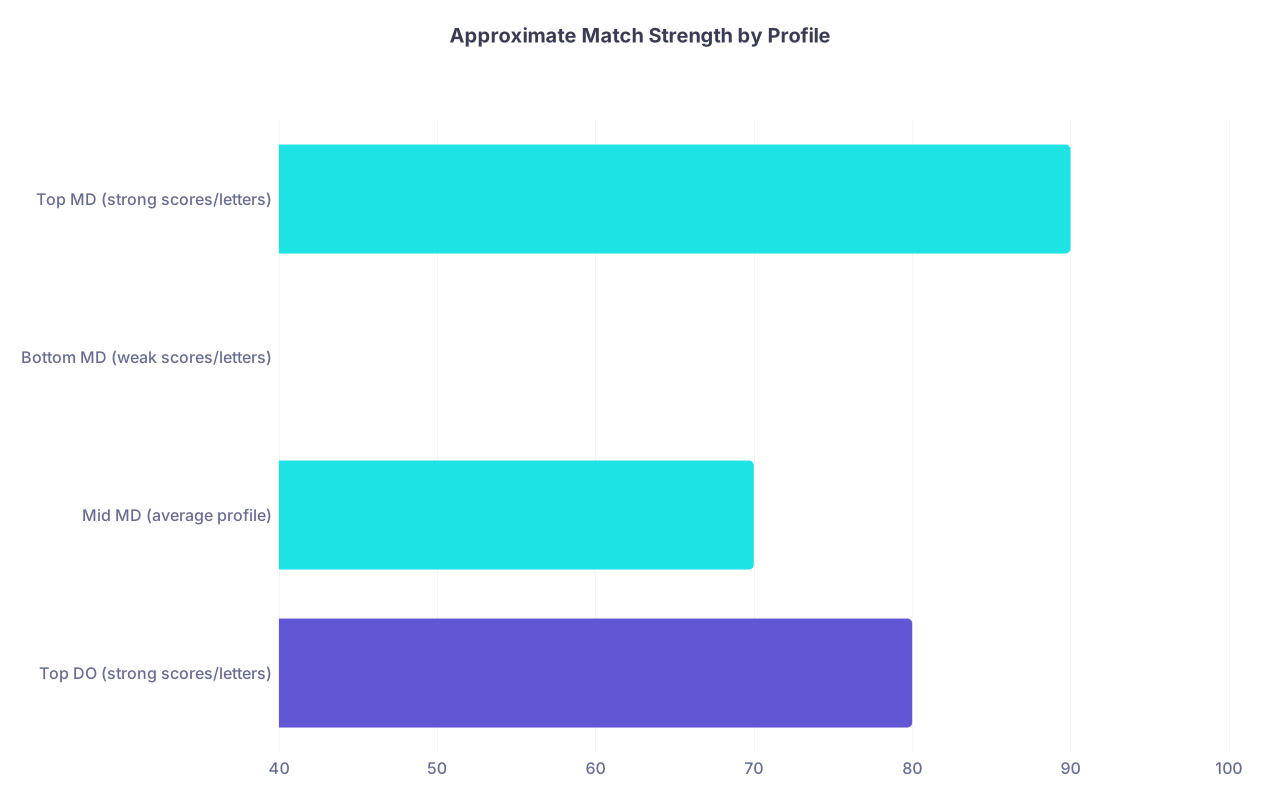
| Category | Value |
|---|---|
| Top DO (strong scores/letters) | 80 |
| Mid MD (average profile) | 70 |
| Bottom MD (weak scores/letters) | 40 |
| Top MD (strong scores/letters) | 90 |
School name and DO vs MD adjust your starting point. They do not override your trajectory.
So when you pick a school, ask a different question:
Where am I most likely to be top‑tier?
- Less toxic environment
- Better teaching
- More accessible faculty
- Reasonable grading and curve
That’s where your match odds really explode.
When Does School Name Truly Beat DO vs MD?
There’s one clear situation where name overwhelms the DO vs MD debate: top‑10 research powerhouses versus everyone else.
A student at Hopkins, UCSF, or Harvard, even in the middle of the class, walks into interviews at places that might never glance at a mid-tier MD or DO application. They’re in a different ecosystem.
If your choice is:
- Hopkins vs any DO → Hopkins, every time
- UCSF vs mid-tier MD → UCSF, almost always
But that’s not the decision most people are facing. Most people are comparing mid-range MDs to decent DOs. In that world, the decision is more nuanced.
| Factor | Favor This School When… |
|---|---|
| Match List | It consistently matches into your probable specialty tier |
| Boards Culture | Students talk about strong board advising and resources |
| Clinical Rotations | Strong home residencies and structured core rotations |
| Degree Type | You want max optionality for ultra-competitive fields |
| Cost | Debt difference will change your life options later |
| Location/Support | You’ll realistically be happier and more stable there |
Bottom Line: How To Actually Prioritize
If you strip away the noise, here’s how to think about your options:
- Match lists and board support first
- Personal performance potential (where you’ll thrive) second
- MD vs DO based on your true specialty risk‑tolerance third
- School name as a tie‑breaker, not the main driver
If you’re staring at an acceptance to a solid DO and a shaky MD and planning to go into primary care or psych, you are not “throwing your career away” by picking the DO. You’re probably making the smarter move.
If you’re dead‑set on orthopedics at a top academic program and you have an MD vs DO choice, MD is the better bet. That’s not elitism. That’s reading the actual match numbers.
Know your risk tolerance. Know your goals. Then pick the school that gives you the highest chance of being excellent, not just the fanciest letters on your white coat.

FAQ: DO vs MD vs School Name
1. If I want a competitive specialty, should I always choose MD over DO?
If you’re genuinely aiming for derm, plastics, ENT, neurosurgery, or ortho, MD is the safer play, especially at schools with solid match history in those fields. That doesn’t mean DO is impossible—but you’ll need to be near the top of your class, crush Step 2, and likely do research and away rotations. If you have a clear MD option and you’re serious about those specialties, I’d lean MD.
2. Is a low-tier MD always better than a high-tier DO?
No. That’s lazy thinking. A high-functioning DO program with strong match results, great board support, and active advising can absolutely beat a chaotic, low-tier MD where students stumble through boards and clinicals. For primary care, psych, PM&R, and even many IM/anesthesia/EM spots, your performance and school environment matter more than “tier.”
3. How much does school prestige really matter for residency?
Outside of the truly elite research schools, prestige is more “nice bonus” than “golden ticket.” Program directors care far more about your Step 2 score, clinical performance, letters, and whether they trust your school’s training. Prestige might get your application a closer look, especially at academic places, but it won’t rescue a weak file. And it won’t tank a strong one coming from a less famous place.
4. Should DO students still take USMLE Step 2?
If you want to keep doors open to a wide range of ACGME residencies, yes. Many program directors are still more comfortable interpreting USMLE scores, and some competitive programs either prefer or strongly expect it. COMLEX alone is enough for certain primary care or DO-heavy programs, but if you’re even slightly specialty-ambitious, plan to take USMLE Step 2 and prepare seriously.
5. How do I compare match lists between schools realistically?
Ignore the marketing fluff. Look at: which specialties are represented, how many matches into academic vs small community programs, and whether there are recent matches in specialties you’re considering. Be wary of schools touting one derm match from five years ago while most of their class goes into prelim/TY or low-support spots. Patterns matter more than isolated wins.
6. If I’m undecided on specialty, how should I choose between MD and DO?
Ask yourself how much you value maximum optionality. If you think there’s a real chance you’ll want a highly competitive specialty or a big academic career, MD is safer. If you’re genuinely okay with primary care, psych, hospitalist IM, PM&R, etc., and you have a DO option that’s cheaper, more supportive, and has strong matches in those areas, that’s a very reasonable choice. When in doubt: pick the place where you’re most likely to be near the top of your class and mentally healthy enough to perform.
Key points: performance beats branding, and environment beats ego. Pick the school that will make it easiest for you to become excellent, not just the one that looks best on a sweatshirt.