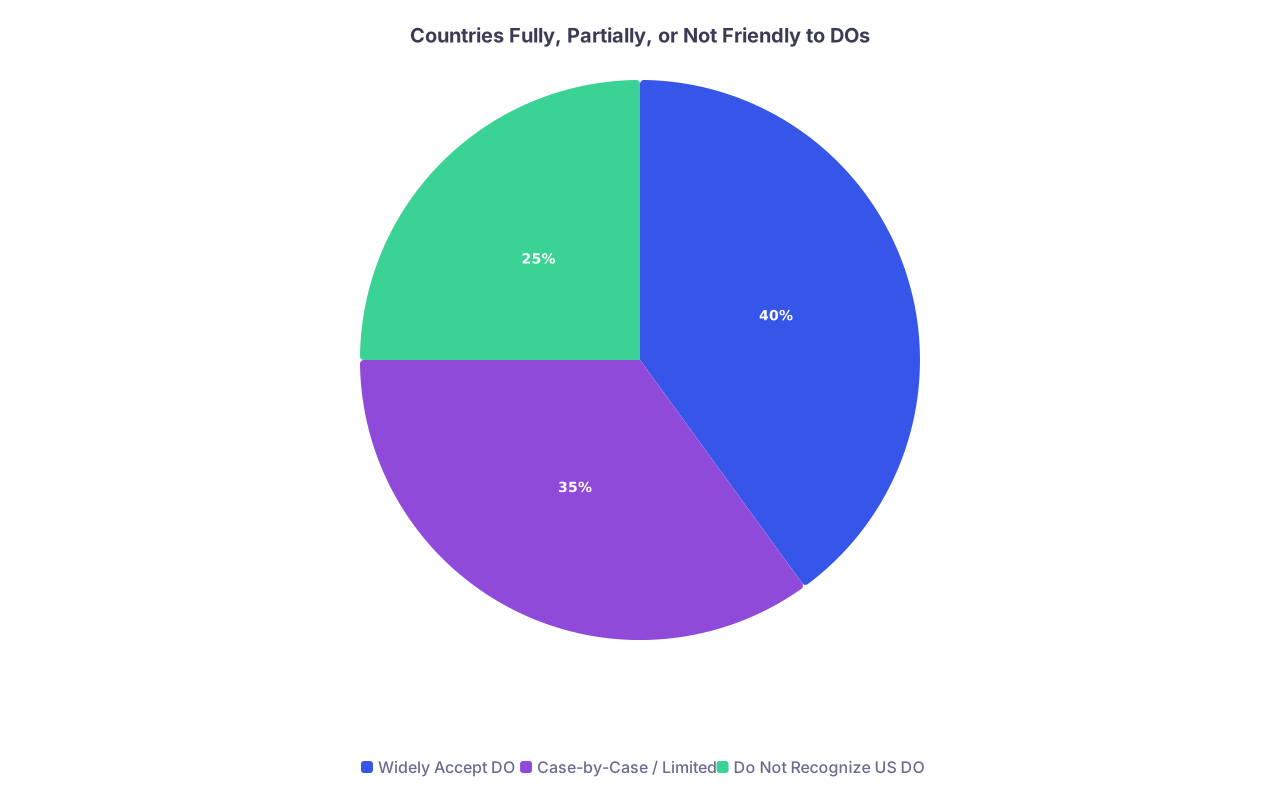
The wrong question will derail your whole career: “Is DO worse than MD?” The right question is exactly what you asked—“Is a high‑tier DO school better than a low‑tier MD?” And sometimes the honest answer is yes.
Let me give you a clear way to compare offers so you don’t screw this up out of fear, ego, or Reddit panic.
Step 1: Drop the “MD > DO” Reflex and Look at Your Actual Goals
Here’s the first hard truth: prestige doesn’t treat every specialty the same.
If you tell me:
- “I want ortho or derm or plastics, no question”
vs - “I just want to be a solid internist, pediatrician, FM, maybe hospitalist”
…I’m going to give you very different advice.
For highly competitive specialties, the average low-tier MD often still has an easier path than the average DO, even from a strong DO program. That’s not because DO students are worse; it’s because the system is biased and path-dependent. Program leadership, alumni networks, historic DO quotas or preferences—these things matter.
But for primary care or moderately competitive fields (IM, peds, psych, anesthesia at many places), a strong DO school with great clinical systems can absolutely beat a shaky, low-tier MD that barely gets its students through Step 1/Level 1.
So the first filter is:
- If you’re truly dead set on a hyper-competitive specialty and are willing to grind like crazy: lean toward MD, even low-tier, if the school isn’t a dumpster fire.
- If you’re open-minded or aiming for primary care, EM, psych, anesthesia, IM: a strong/high-tier DO is 100% a legitimate and sometimes smarter choice.
Now, let’s define “high‑tier DO” and “low‑tier MD” in a way that actually helps you choose.
Step 2: What Counts as a “High‑Tier DO” vs “Low‑Tier MD”?
Forget USNWR lists for a second. For your purposes:
High‑tier DO school = a DO program that:
- Has long-established clinical sites owned or tightly controlled by the school
- Places a decent number of students into ACGME university or strong community residencies
- Publicly lists recent match lists that include:
- Some competitive or mid-competitive specialties (EM, anesthesia, radiology, maybe an ortho/ENT here and there)
- Good internal medicine programs, not just random unfilled community ones
- Has a reputation among residents/attendings as “solid” rather than “who are they?”
Low‑tier MD school = an MD program that:
- Is new or recently opened with multiple provisional LCME citations
- Has unstable or mostly affiliate‑based clinical sites (you’re rotating at random hospitals that don’t care you exist)
- Has poor or very opaque match lists, or a lot of students going unmatched / SOAPing every year
- Is geographically isolated with weak hospital partnerships
In other words, a high‑tier DO has infrastructure and outcomes. A low‑tier MD just has the letters.
Step 3: The Only Comparison Framework You Actually Need
Here’s the framework I use when students send me “DO vs MD” offer screenshots:
Rank each of your offers on these 7 things, in this order of importance:
- Match outcomes (recent, detailed)
- Clinical rotations quality and stability
- Board exam culture and performance
- Geography and network
- School support (advising, mentorship, research access)
- Cost and debt load
- Your specialty goals
You’re not choosing a logo for your white coat. You’re choosing a launchpad for Match.
Let’s walk through each with what to look for and how it might swing DO vs MD.
1. Match Outcomes: Start Here or Don’t Bother
If the school doesn’t publish a recent match list with programs and specialties, that’s already a red flag.
What you want to see:
- Percentage matched into ACGME programs (not just “matched” vaguely)
- For DO schools: how many people match into:
- IM at respectable hospitals
- EM, anesthesia, radiology, PM&R, psych
- Any ortho, derm, ENT, optho, urology at all
- For low-tier MD: are grads matching to:
- Decent university or strong community programs in IM, peds, FM, EM
- Or is it mostly obscure, lower-quality community programs and repetitive SOAP matches?
A high‑tier DO where students routinely match:
- IM at university-affiliated programs
- EM/anesthesia at solid places
- A sprinkle of ortho/PM&R/rads
…can be objectively better than a low‑tier MD with:
- Spotty match lists
- Heavy SOAP reliance
- Weak program names you’ve never heard of
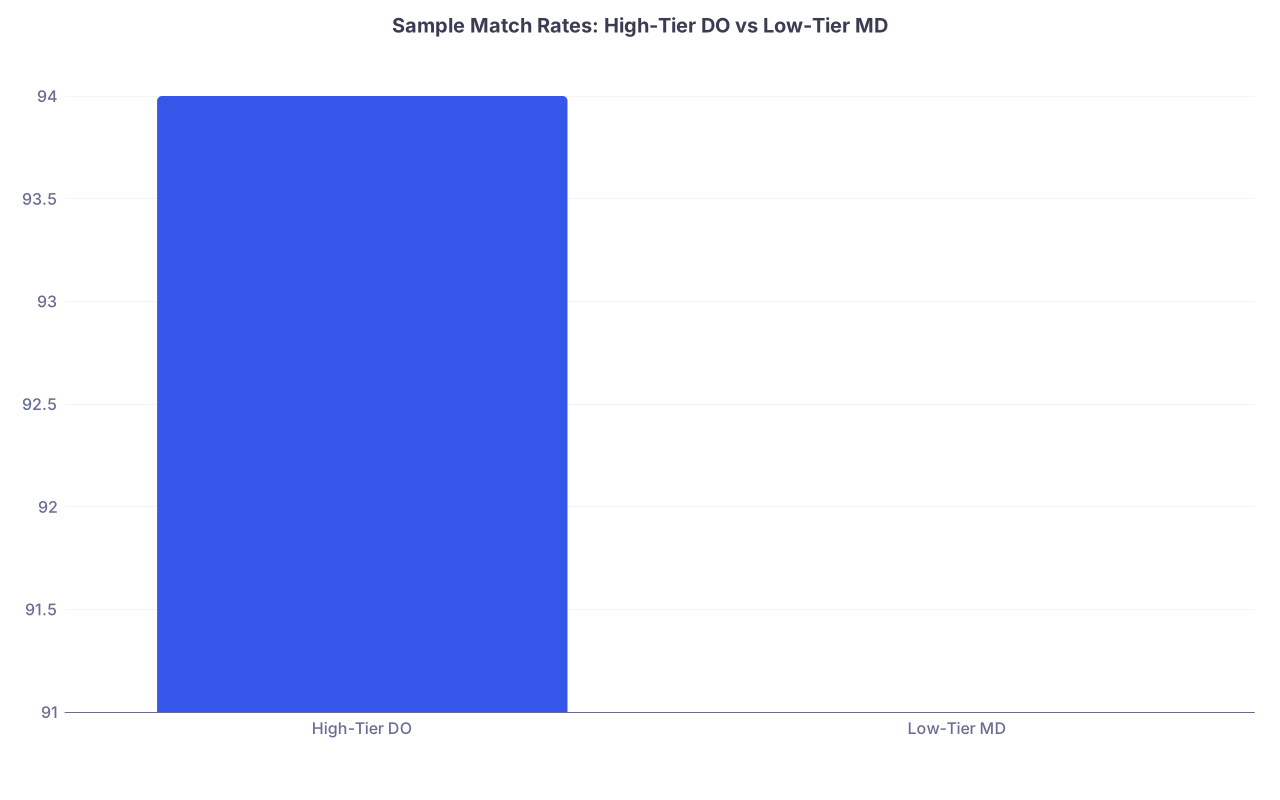
| Category | Value |
|---|---|
| High-Tier DO | 94 |
| Low-Tier MD | 91 |
Those numbers are fake, but the idea stands: if the DO school is consistently placing people into reasonable programs and the MD is barely holding on, the letters alone don’t save you.
2. Clinical Rotations: Where You Spend Your Life Actually Matters
Here’s where a lot of premeds get burned by shiny brochures.
Ask:
- Are core rotations (IM, surgery, OB, peds, psych) all at one or a few main hospitals with residency programs?
- Or are you being sent 3 hours away, changing hospitals every 4–8 weeks, with preceptors who barely remember your name?
Good signs:
- The school owns or controls a main teaching hospital
- You rotate alongside residents (IM, surgery, EM, etc.)
- Stable, long‑term contracts with hospitals
Bad signs (this is where some low-tier MDs and newer DOs fall apart):
- “We’re expanding rotation sites” = they’re scrambling
- Heavy reliance on private preceptors without residents
- Lots of horror stories from M3/M4s about last-minute changes
If the high‑tier DO gives you solid, centralized, resident-rich rotations and the low‑tier MD is basically “we’ll find you something,” the DO is the smarter training environment.
3. Board Exams: Step 1/2 & Level 1/2 Strategy
You cannot ignore board performance culture.
For MD schools:
- Look at USMLE Step 1/2 pass rates and averages if they share them
- Ask upperclassmen: did the school give:
- Dedicated study time?
- Paid question banks (UWorld, Amboss, NBME practice exams)?
- Real guidance or just “good luck”?
For DO schools:
- You care about COMLEX Level 1/2 and whether the school supports USMLE Step 1/2.
- Ask:
- What proportion of students take USMLE?
- Is there built-in support (time off, resources, advising)?
- Are there any residency programs that prefer or require USMLE in your areas of interest?
A high‑tier DO where:
- COMLEX pass rates are high
- Many students take USMLE and match allopathic residencies
- The school has a real plan, not vibes
…can put you in a stronger position than a chaotic low‑tier MD where half the class is scrambling to remediate Step 1 and no one knows what they’re doing.
4. Geography & Network: Where You Train Is Where You Match
Programs prefer “known quantities.” That usually means:
- Home institution students
- Regional schools they’ve worked with for years
So:
- If the DO school is in a region you want to live/practice in and has strong local ties, that’s huge.
- If the MD school is in the middle of nowhere with weak regional hospitals, that “MD advantage” gets diluted.
Here’s how I think about it:
- High-tier DO in a big medical city (Philly, Chicago, Detroit, etc.) with strong local relationships can outperform a low-tier MD in a remote area you’ll struggle to escape from.
- Rotations where you want to match = audition rotations built in.

| Step | Description |
|---|---|
| Step 1 | Choose School Location |
| Step 2 | More Audition Rotations |
| Step 3 | Stronger Local Network |
| Step 4 | Higher Match Chances Nearby |
| Step 5 | Fewer Local Programs |
| Step 6 | Need Away Rotations |
| Step 7 | More Competition for Spots |
| Step 8 | Region With Many Residencies? |
5. Support, Culture, and “Who Has Your Back?”
This part’s underrated.
Ask current students (not admissions):
- Do you actually get helpful advising for Match?
- Are there faculty who will:
- Know you well enough to write real letters?
- Advocate for you if you’re on the bubble?
- What happens to the bottom 25% of the class? Do they still match with support, or are they left to sink?
Some “name” MD schools are sink-or-swim. Some DO schools, especially established ones, fight hard for every student.
I’ve seen:
- DO students with average boards get into solid residencies because their advisors hustled for them.
- MD students at low-tier places silently fail to match because no one cared enough to intervene early.
You want the school where:
- Students commonly say: “Our Dean of Students actually helped me with my rank list,” or “They walked me through SOAP.”
- You hear fewer horror stories of “no one returned my emails.”
6. Money: Don’t Ignore the Debt Anchor
Two offers:
- Low-tier MD: $70k/year tuition + HCOL city
- High-tier DO: $45k/year tuition + LCOL town, plus small scholarship
That’s a massive difference.
I’m not saying choose the cheapest option always. I’m saying: if the DO is significantly cheaper and at least equal or better on match outcomes and training environment, taking on an extra $100k+ just for the letters is usually stupid.
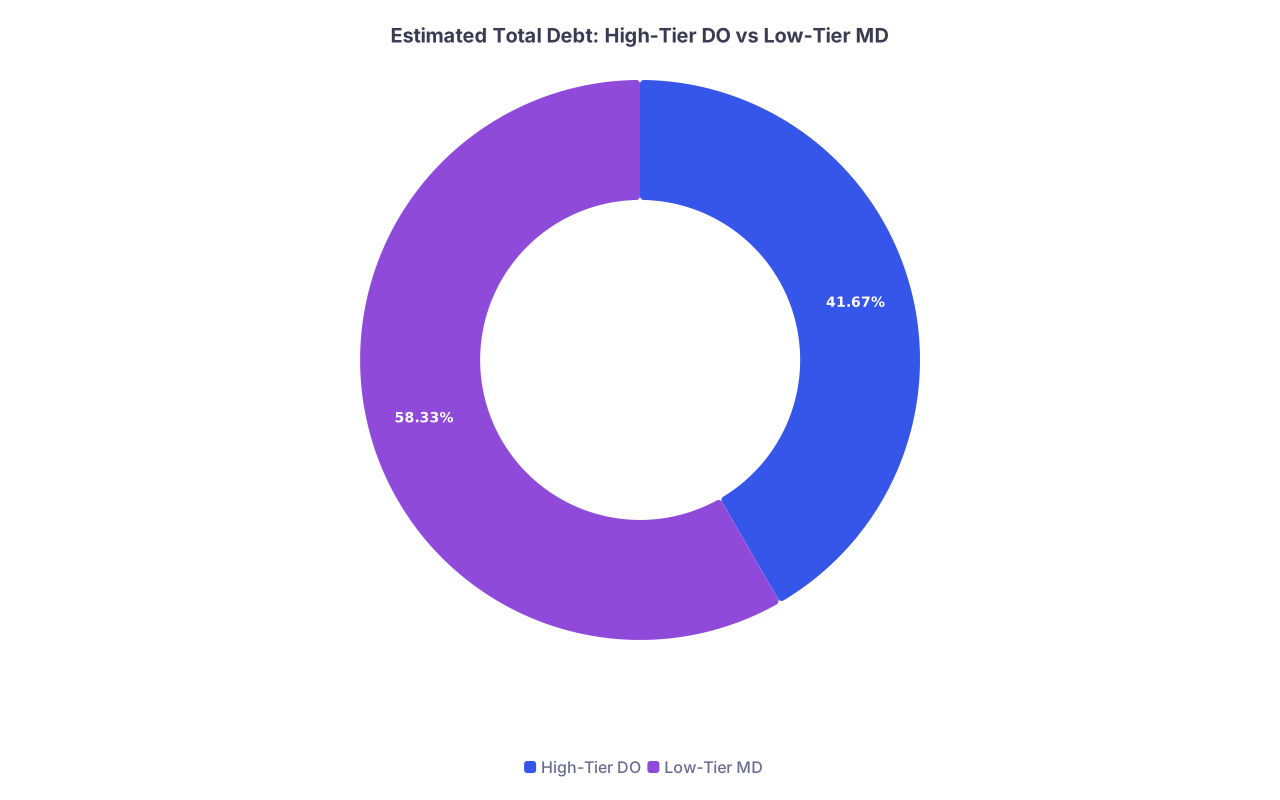
| Category | Value |
|---|---|
| High-Tier DO | 250000 |
| Low-Tier MD | 350000 |
Future you, trying to buy a house or have kids, will care a lot about that 100k.
7. Specialty Goals: How Much Are You Willing to Bet?
Here’s the honest risk breakdown.
If you strongly want:
- Derm, plastics, ENT, neurosurgery, ortho, urology, optho
Then:
- Low-tier MD likely still gives you a slightly better odds baseline than DO, all else equal, because:
- More programs have long-standing habits of favoring MD
- Some PDs still quietly filter DOs out for certain specialties
- But if the MD school is truly weak (bad match, chaotic rotations, no support) and the DO is elite for DO-land, then it’s actually closer than people think. You’re going to be grinding either way.
If you’re aiming for or open to:
- IM, EM, anesthesia at many places, psych, FM, peds, PM&R, pathology, neurology
Then a high‑tier DO can absolutely be equal or better than a struggling MD program. Especially if:
- You’re okay taking USMLE with COMLEX
- The DO school’s match shows consistent success in these fields
When a High‑Tier DO Is Probably Better Than a Low‑Tier MD
I’d personally pick the DO in scenarios like these:
- The DO school:
- Has a long track record, strong match lists, strong regional hospitals
- Offers significantly cheaper tuition or better cost of living
- Gives you stable, resident-heavy rotations
AND
- The MD school:
- Is new or has weak match outcomes
- Has scattered or low-quality rotation sites
- Has concerning Step performance or remediation patterns
Especially if:
- You’re not dead set on derm/ortho/ENT/plastics
- You want to practice in the region where the DO school has strong ties
When a Low‑Tier MD Is Probably Still the Better Risk
I’d lean MD if:
- You’re very serious about a hyper-competitive specialty
- The MD school:
- Has at least decent match outcomes
- Has functioning, structured clinical training sites
- Doesn’t have major accreditation or board performance red flags
AND
- The DO option is:
- New, with unknown match history
- Has shaky clinical placements far from major academic centers
You’re betting on “maximum optionality” in a biased system. MD still buys you that in many fields.
One Last Thing: Stop Looking for a Magic Ranking
No online ranking is going to spit out “Pick School A.” You need to actually:
- Pull the last 2–3 years of match lists
- Ask current M3/M4s real questions about rotations and support
- Put numbers on cost differences
- Write down your top 2–3 realistic specialty interests
Then make a call.

Your Move: A Simple 30-Minute Exercise
Do this today:
- Open a blank document.
- Create three sections for each school:
- Match Outcomes
- Rotations & Board Support
- Cost & Location
- Under each, write:
- 3 concrete pros
- 3 concrete cons
- If you can’t fill this in, email or message 2–3 current students from each school and ask targeted questions:
- “How happy are M3/M4s with their clinical rotations?”
- “What percent of your class took USMLE and how did they do?”
- “Would you choose this school again?”
When you’re done, ask yourself one question:
“If I land in the middle of the class, at this school, how safe am I for a reasonable residency I’d be okay with?”
Choose the school that gives middle-of-the-class you the safest, strongest outcome. Then commit. Stop second-guessing.
Open that doc right now and start with the match lists. If a school can’t show you where their grads go, it hasn’t earned your $200,000 and four years of your life.