The biggest day‑to‑day difference between DO and MD students is not what you think—and it’s much smaller than most premed forums make it sound.
If you drop a random DO student and a random MD student into the same hospital, same rotation, same attending? Ninety percent of their day looks identical: prerounds, notes, lectures, call, shelf studying, collapse into bed. The meaningful differences show up in how they’re trained in the classroom years, what extra skills they practice (OMM/OMT), how some schools structure clinicals, and how the outside world sometimes responds to those letters after their name.
Let’s walk through what actually changes your daily life—and what’s just noise.
Big Picture: DO vs MD Training in Real Life
At the highest level:
- Both DO and MD students do 4 years of medical school.
- Both take anatomy, physiology, pathology, pharm, etc.
- Both do the same core clinical rotations (internal medicine, surgery, peds, OB/GYN, psych, family, etc.).
- Both can enter the same ACGME residency programs now that there’s a single accreditation system.
The differences that actually hit your calendar fall into a few buckets:
- Extra osteopathic coursework and lab (OMM/OMT) for DO students
- Historically different licensing exams and prep (USMLE vs COMLEX)
- Some differences in clinical rotation sites and structure
- Small but real differences in culture, expectations, and external perception
Everything else is mostly myth, ego, or outdated information.
Preclinical Years: What Your Week Actually Looks Like
This is where the main daily difference sits.
Core Science Curriculum: Nearly the Same
Both DO and MD students spend the first 1.5–2 years mostly in classrooms and labs learning:
- Anatomy (lectures, dissection or prosection)
- Physiology
- Biochemistry
- Pathology
- Pharmacology
- Microbiology
- Immunology
- Clinical skills (interviewing, physical exam)
A first‑year Monday at an MD school and a DO school can look nearly identical: 8–12 in lectures, afternoon small groups, simulation lab, or standardized patients, then studying into the night.
Where it diverges: osteopathic manipulative medicine (OMM/OMT).
OMM/OMT: The Extra Chunk of Time DO Students Carry
If you’re a DO student, you’ll have required OMM/OMT training throughout the preclinical years.
That usually means:
- Weekly or near‑weekly OMM lab: 2–4 hours
- OMM lectures integrated with anatomy/physiology
- Practicing hands‑on techniques with classmates on tables
So on Wednesday afternoon, that MD student might be:
- In small‑group case discussions
- Doing independent study
- Maybe going home slightly earlier (in some curricula)
While the DO student is:
- In OMM lab practicing soft tissue, muscle energy, HVLA (where allowed), etc.
- Getting checked off on positioning, hand placement, safety
This is not “just an elective.” At DO schools, it’s a core, tested part of the curriculum, and it does eat time and energy.
For students, that means:
- Less “free” afternoon time for Step/Level prep during the week
- One more subject to keep up with for quizzes and practical exams
- Extra anatomy/biomechanics thinking layered on top of standard content
Is it manageable? Yes. But it’s real. You’ll feel those hours.
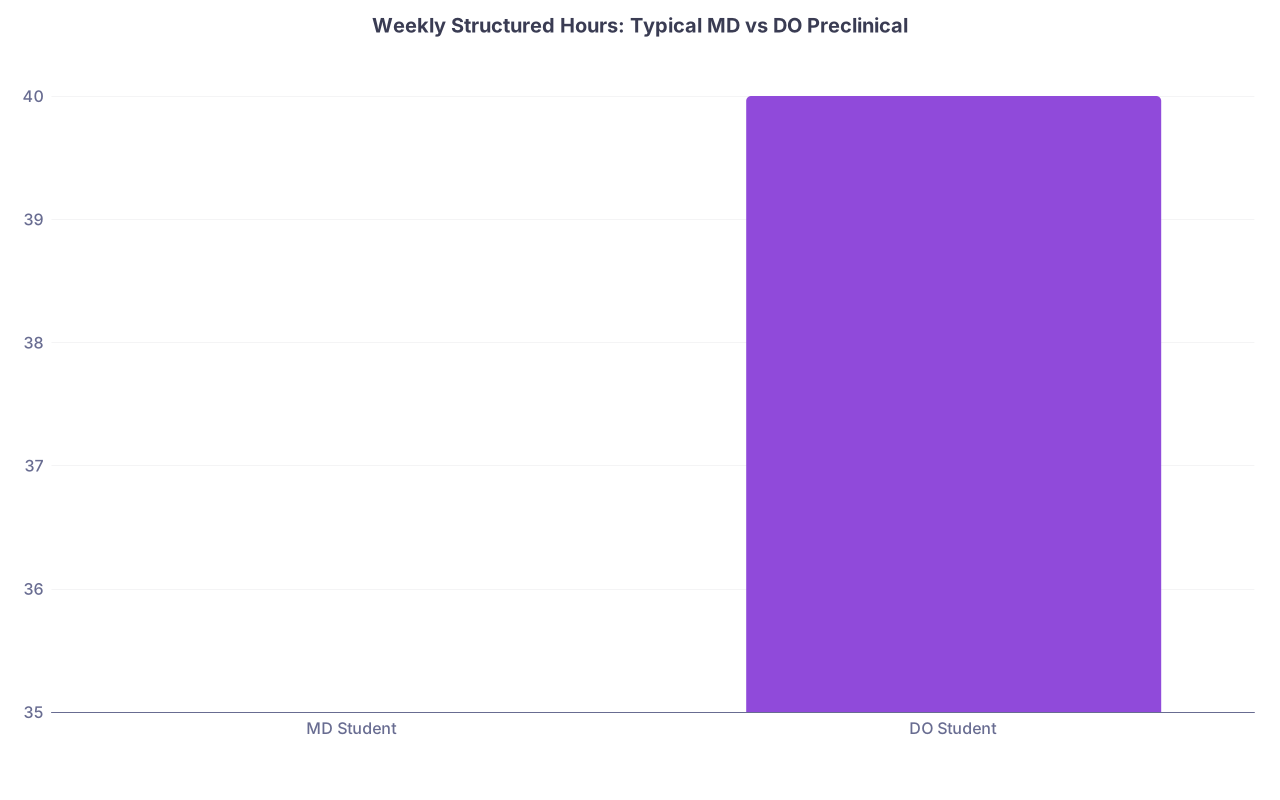
| Category | Value |
|---|---|
| MD Student | 35 |
| DO Student | 40 |
Those numbers are rough and vary by school, but they capture the idea: DO students usually have a few more required contact hours because of OMM.
Day-to-Day Atmosphere and Culture
Culturally, DO schools often:
- Lean harder into “whole person” and primary care messaging
- Talk more about rural/underserved care
- Emphasize communication and bedside manner early
MD schools also care about these things, but DO schools tend to advertise and reinforce them more aggressively. You’ll hear the word “holistic” constantly.
Does that change your literal Tuesday schedule? Not much. It just colors the tone of lectures, clinical skills practice, and what your faculty spotlight as “important.”
Licensing Exams: The Double-Exam Problem for DO Students
Historically, this has been one of the biggest practical differences.
MD students:
- Must take USMLE Step 1
- Almost always take Step 2 CK
- Study timelines built fully around USMLE
DO students:
- Must take COMLEX Level 1 and Level 2 CE
- Often also take USMLE Step 1 and/or Step 2 CK to stay competitive for some residencies
- Need to prep for two similar but non‑identical exams
On the ground, that means:
- Their dedicated study periods might be slightly more complex: extra Qbanks, both NBME and COMSAE equivalents.
- Their day‑to‑day study mix includes OMM and COMLEX‑style questions.
- They have to translate between COMLEX’s style and USMLE’s more clinically‑stemmed style.
Is this improving? Yes. More residencies are comfortable with COMLEX only, but plenty of competitive programs still expect or prefer USMLE scores.
So if you’re a DO student shooting for derm, ortho, ENT, anesthesia, etc., your average “day in dedicated study period” might be:
- Morning: USMLE‑focused questions (UWorld/AMBOSS)
- Afternoon: COMLEX‑style questions and OMM review
- Extra mental bandwidth spent mapping “Do I know this in both question languages?”
That’s not a philosophical difference. That’s you, tired, at 11:30 p.m., still flipping through Savarese.
Clinical Years: Where Things Converge (Mostly)
Once you’re on the wards, DO vs MD matters a lot less than “Do you look competent and pleasant to work with?”
Rotations: Overlap Is Huge
Both DO and MD students do:
- Internal Medicine
- Surgery
- Pediatrics
- OB/GYN
- Psychiatry
- Family Medicine
- Electives/sub‑internships
During a surgery rotation at a large teaching hospital:
- The DO student and the MD student show up for sign‑out at the same time.
- They preround on patients the same way.
- They scrub into the same cases.
- They carry the same service pager (if their resident trusts them).
- Their evaluations often come from the same attending.
Most attendings introduce you to patients as “one of the medical students,” not “this is our DO student.”
Where You Might See Differences
Here’s where the day‑to‑day can diverge:
Rotation sites and structure
Some DO schools rely more heavily on community hospitals, smaller sites, or distributed clinical campuses. MD schools, especially those attached to big academic centers, may keep more rotations “in‑house.”Practically, that might mean for some DO students:
- More driving between sites
- More variability in quality of teaching
- Stronger one‑on‑one time in some community settings
- Less exposure to ultra‑rare pathology or NIH‑level research at baseline
Some DO schools now have robust main teaching hospitals, so it varies a ton by institution, not just DO vs MD.
OMT in clinical practice
A DO student might:- Get pulled into OMT clinics or continuity clinics that use manipulative treatment
- Offer supervised OMT for patients with back pain, headaches, pregnancy discomfort, etc.
- Have preceptors who actively want them to use hands‑on skills
An MD student almost never has that piece built in.
On a family med rotation, an MD student’s day could be: H&P, follow‑ups, charting. A DO student’s day could be identical plus one or two OMT visits sprinkled in.
Faculty expectations
Some DO attendings expect DO students to at least consider somatic dysfunction and OMT in plans. Many do not care. MD attendings rarely think about it.

| Step | Description |
|---|---|
| Step 1 | Arrive at hospital/clinic |
| Step 2 | Pre-round on patients |
| Step 3 | Team rounds |
| Step 4 | Notes and orders |
| Step 5 | Teaching sessions |
| Step 6 | Patient follow-ups |
| Step 7 | Possible OMT visit or clinic |
| Step 8 | Additional charting or study time |
| Step 9 | Sign-out and go home |
| Step 10 | DO Student? |
That’s about as different as the average day gets.
Culture, Stigma, and How People Treat You
You cannot talk about DO vs MD training honestly without touching this.
Among Students
What I’ve seen:
- Within the same hospital, MD and DO students usually get along fine. Most are too tired to care.
- Online, DO students are more defensive, MD students sometimes arrogant, and premeds are the worst about it.
- DO students are often more aware of “having to prove themselves,” especially if aiming for competitive specialties.
Day‑to‑day, that shows up as:
- DO students pushing hard to be the most prepared on rounds.
- Extra focus on shelf and Step/Level scores.
- More pressure when talking to residents about future plans.
Among Attendings and Residents
This depends heavily on geography and specialty:
- In many community and primary care settings, DO vs MD is a total non‑issue.
- In some academic or competitive specialty settings, there’s still bias—sometimes subtle, sometimes not.
- You may hear comments like, “Oh, you’re a DO? Did you also take Step?” or “We don’t really know what COMLEX means.”
That doesn’t show up in your calendar, but it does land in your head. And it can change how you prepare:
- DO student: “I need to crush this rotation so they stop seeing the letters and just see my work.”
- MD student: “I need to perform well; nobody’s doubting the letters.”
Different mental load, same job.
Career Impact and How That Feels During Training
You’re not just living day‑to‑day. You’re playing the long game: match.
Competitiveness and Planning
Reality:
- For primary care and many IM programs: DO vs MD is minimal if you have solid scores, strong clinical performance, and good letters.
- For some competitive specialties (ortho, derm, plastics, ENT, urology, neurosurgery): it’s harder as a DO. Not impossible, but harder.
That can shift your daily focus in school:
MD student aiming IM:
- Still studies hard, but less anxious about “proving MD is legit.”
DO student aiming ortho:
- Anatomy + OMM + COMLEX content + USMLE content
- Research hunting from M1
- Networking earlier with surgeons
- Maintaining high performance on often more scattered clinical rotations
The schedule on paper might be similar, but the pressure you put on yourself is different.
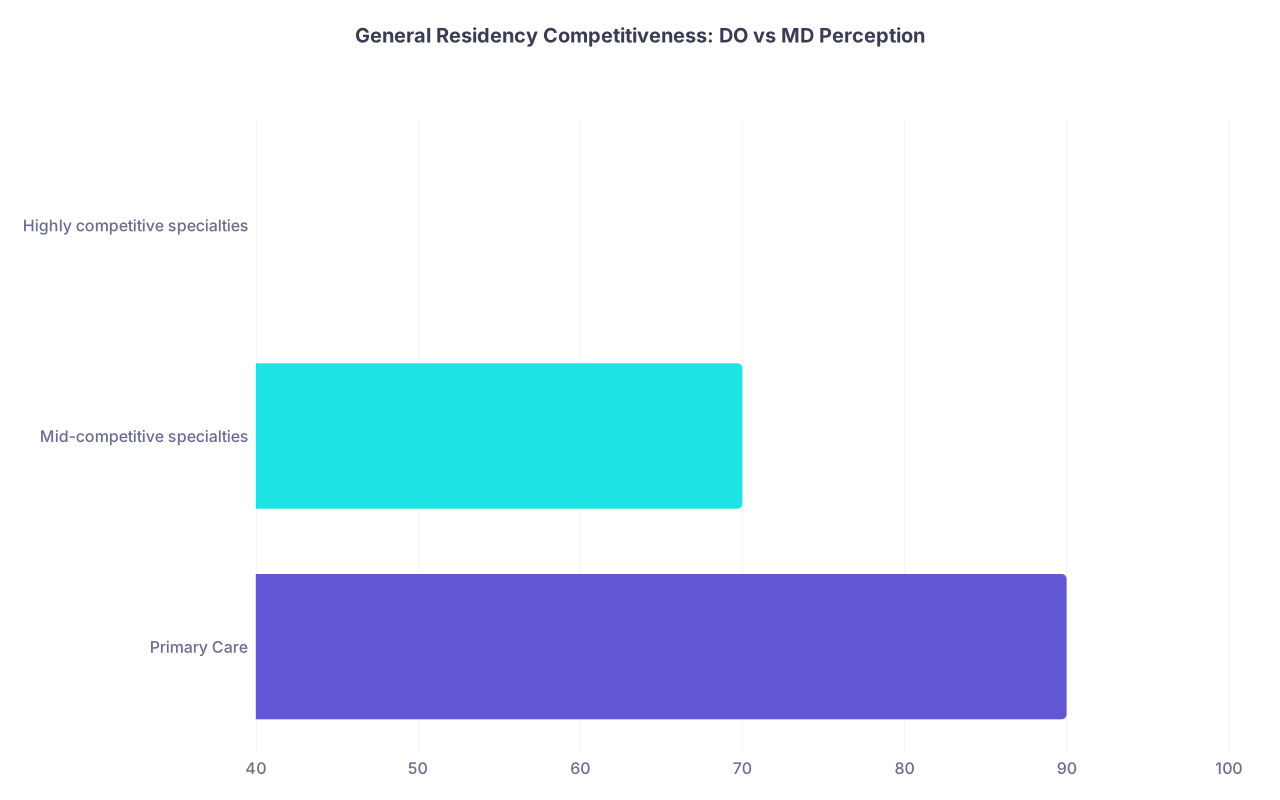
| Category | Value |
|---|---|
| Primary Care | 90 |
| Mid-competitive specialties | 70 |
| Highly competitive specialties | 40 |
Numbers here are conceptual, not official match data—but they reflect the reality: the higher you go in competitiveness, the more DO students feel the gap.
How to Decide: If You’re a Premed Looking at Your Future Days
You’re not choosing between “doctor” and “not doctor.” You’re choosing:
- Do I want the osteopathic philosophy + OMM as a core part of my training?
- Am I okay potentially taking COMLEX and USMLE?
- How risk‑tolerant am I if I might want a competitive specialty?
- Does the specific DO or MD school in question have strong clinical sites and match lists?
Do not compare “DO vs MD” in the abstract. Compare School A vs School B:
- Curriculum structure (systems‑based? P/F? attendance?)
- Clinical placements (big academic center vs community network)
- Match outcomes by specialty
- Support for students (advising, tutoring, mental health)
You won’t live “the DO experience.” You’ll live “this specific school’s experience.”
| Aspect | MD Student Typical Reality | DO Student Typical Reality |
|---|---|---|
| Preclinical schedule | Heavy basic sciences, some clinical skills | Same basic sciences + regular OMM labs/lectures |
| Hands-on training | Physical exam skills, procedures | Physical exam + manipulative techniques (OMM/OMT) |
| Licensing exams | USMLE Step 1 & 2 CK | COMLEX Level 1 & 2 (often plus USMLE Step 1/2 CK) |
| Clinical rotations | Often at main teaching hospital | Mix of community sites, affiliated hospitals, some variability |
| Residency perception | Default standard, judged on performance & scores | Increasingly accepted, but some bias in competitive fields |
| “Extra” study burden | High, but focused on one exam series | High + extra OMM + dual exam strategy for many specialties |
| Daily culture | Varies by school, often research/academic tilt | Often more primary care/“whole person” messaging |
Bottom Line: What’s Actually Different in Your Daily Life?
Condensed:
- Preclinical: DO = MD curriculum + OMM/OMT labs + COMLEX focus. More required contact hours, more subjects to juggle.
- Clinical: Day on the wards is almost identical. Small differences in rotation sites and occasional OMT use.
- Exams: MD = single exam series; DO = COMLEX + often USMLE, meaning more complex study schedules.
- Culture: DO students more frequently feel they need to “prove” themselves, especially shooting for competitive specialties.
- Practical impact: For primary care or general IM, the letters matter less day‑to‑day. For highly competitive specialties, DO students need a more surgical level of planning and performance.
If you remember nothing else, remember this: your work ethic, scores, clinical performance, and professionalism will drive 80–90% of your outcomes. DO vs MD is the remaining 10–20%—still real, especially at the margins, but not the whole story.
FAQ (Exactly 7 Questions)
1. Do DO students actually use OMM every day in clinical rotations?
No. Most DO students do not use OMM daily on rotations. It depends heavily on the site and preceptor. In OMT clinics, family med, sports med, or some inpatient settings with OMM‑friendly attendings, you may use it a few times a week. On surgery, ICU, or many inpatient rotations, you may not use it at all unless your team specifically encourages it.
2. Is the workload heavier for DO students than MD students overall?
In the preclinical years, typically yes, by a bit. DO students have the same core science workload plus OMM labs, exams, and COMLEX‑specific content. If they also plan to take USMLE, their exam prep is heavier. In clinical years, the day‑to‑day workload is more driven by the hospital and service than by DO vs MD.
3. As a DO student, will I be treated differently by patients?
Most patients don’t care or don’t know the difference between DO and MD. Many just hear “doctor” or “medical student.” Some regions (especially in the Midwest and parts of the South) are very familiar with DOs and may even prefer them. Very occasionally you’ll get a patient who asks “What’s a DO?” and you give a 20‑second explanation and move on.
4. Are DO students forced into primary care in their day-to-day training?
No. DO schools emphasize primary care in their messaging and mission, and some have more primary care‑heavy rotations, but DO students still rotate through surgery, subspecialties, and electives. They’re not “forced” into primary care; many simply choose it, and some competitive specialties are harder but not off‑limits.
5. If I know I want a competitive specialty, should I avoid DO schools?
If you have a realistic shot at a strong MD program and you’re dead‑set on something like derm, plastics, or neurosurgery, MD is usually the cleaner path. That said, plenty of DO students match into competitive fields every year—they just work harder to build top scores, strong research, and networking. If your best overall option academically and financially is an excellent DO school with strong match data, that can still be a smart move.
6. Do DO and MD students in the same hospital ever get different responsibilities?
Occasionally, yes, but not because of the letters. It’s usually because of the school’s policies, the rotation’s agreements, or how assertive the student is. I’ve seen DO students get more responsibility than MD students and vice versa. On any given service, the hierarchy is: “Who shows up prepared, trustworthy, and helpful?” not “Who’s DO vs MD?”
7. What’s one concrete thing I should check before choosing a DO vs MD school?
Look up the actual residency match list for the last few years from that specific school. Don’t skim marketing brochures. Look for: which specialties people match into, where they match, and how often. That document will tell you more about what your day-to-day training sets you up for than any DO vs MD debate online.
Open a spreadsheet right now and make three columns: “Specific MD schools,” “Specific DO schools,” and “Non-negotiables for me (specialty interests, geography, support).” Start filling it with real data—match lists, rotation sites, exam support—not just vibes from Reddit. That’s how you choose the letters that will shape your actual days in training.