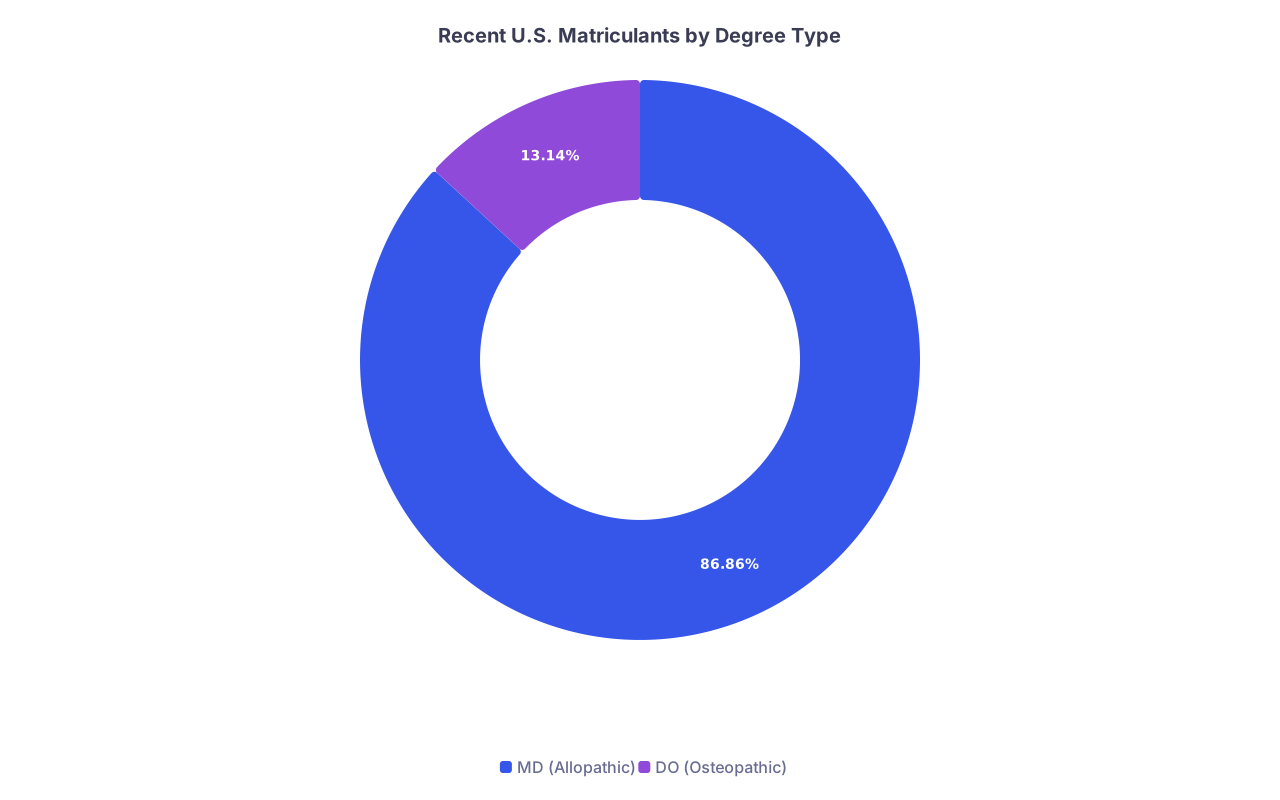
| Category | Value |
|---|---|
| MD (Allopathic) | 58500 |
| DO (Osteopathic) | 8850 |
You’re a year or two out from applying. Your GPA isn’t perfect, your MCAT is… fine but not god-tier, and your group chat is split: half say “Apply MD only or wait a year,” the other half say “Blanket both MD and DO and figure it out later.”
You’re stuck on one core question:
Should you apply to both DO and MD schools, or focus on one path?
Here’s the answer: most people guess. You’re not going to. You’re going to run a simple, ruthless decision framework and let the numbers and your priorities decide.
Step 1: Get Brutally Honest About Your Stats
Before you talk about philosophy, letters after your name, or what your aunt said about “real doctors,” you need to know where you actually stand.
You need three numbers in front of you:
- Cumulative GPA
- Science GPA (BCPM)
- MCAT score (with breakdown)
Now compare yourself to recent matriculant averages. As of recent cycles, ballpark:
| Degree | Avg GPA | Avg Science GPA | Avg MCAT |
|---|---|---|---|
| MD | ~3.75 | ~3.70 | ~512 |
| DO | ~3.55 | ~3.45–3.50 | ~504–505 |
Here’s how to interpret this without sugarcoating:
If you’re at or above MD averages (both GPA and MCAT):
You’re competitive for many MD schools. DO remains an option, but it becomes a strategy choice, not a desperation play.If you’re below MD but around DO averages:
You’re in the classic “borderline MD, solid DO” zone. This is the group that usually benefits most from applying to both.If you’re significantly below even DO averages (e.g., GPA < 3.3, MCAT < 498):
You don’t have an MD vs DO problem. You have a “not ready to apply yet” problem. You should be fixing the application, not arguing about degrees.
Be honest: if your numbers are clearly DO-range only, applying to MD just to “see what happens” is usually a waste of money unless you have something extraordinary (e.g., URM + strong upward trend + elite research + killer story).
Step 2: Decide What Actually Matters to You (Not Reddit)
There are a few real, grown-up questions you need to answer:
How important is your shot at the most competitive specialties?
We’re talking neurosurgery, ortho, derm, plastics, ENT, competitive radiology, etc.How flexible are you geographically?
DO schools are less evenly distributed than MD schools. You might be living in places you never imagined.How much do you care about public perception / prestige?
Not the fantasy version. The real version: what matters for hospitals, patients, and your own ego ten years from now.How fast do you need to start med school?
Are you okay taking 1–2 extra years to improve your app if MD is your top priority?
Let’s build this out with a simple decision flow.

| Step | Description |
|---|---|
| Step 1 | Start: Ready to Apply? |
| Step 2 | Consider MD-focused with improvement year |
| Step 3 | Apply both MD and DO broadly |
| Step 4 | Apply DO-heavy, consider some MD |
| Step 5 | Do not apply yet - repair app |
| Step 6 | Stats near MD averages? |
| Step 7 | Willing to delay 1-2 years to boost odds? |
| Step 8 | Stats near DO averages? |
You don’t need a 5-page values worksheet. You just need to be clear:
Is your priority “MD or bust,” “I just want to be a physician,” or “I want a shot at certain doors staying more open”?
Step 3: Understand What MD vs DO Actually Changes
A lot of online noise. Not a lot of clarity. Here’s the reality.
1. Residency Competitiveness
Since residency is now a single match (MD + DO together), all programs are under one umbrella. But bias still exists.
What’s true:
- For primary care (FM, IM, peds, psych, etc.), DO and MD are both solid pathways.
- For mid-range competitiveness (EM, anesthesia, decent IM programs, OB/GYN), a strong DO student can absolutely match well, especially with good scores, rotations, and letters.
- For ultra-competitive specialties (derm, plastics, neurosurg, ENT, ortho):
It’s harder as a DO. Not impossible, but the bar is higher, and doors close faster.
If you already know you’re obsessed with one of those hyper-competitive fields and you’re not willing to walk away from that dream later, you should lean harder toward MD if there’s any way to reasonably get there.
2. Geographic Distribution and Name Recognition
Patients mostly don’t care. They care if you listen, fix their problem, and don’t act like a jerk.
Hospitals and older physicians sometimes care. Some regions are more MD-heavy, some are DO-friendlier.
- Large coastal academic centers: historically more MD-dominated.
- Community hospitals, Midwest/South: lots of DO presence.
If you’re dead set on a particular city or prestige-heavy institution early in your career, MD tends to give you a slightly smoother default. But not enough to override everything else.
3. Training Differences Day-to-Day
Curriculum overlap is huge:
- Anatomy, physiology, pharm, path — same core medicine.
- DO adds osteopathic manipulative medicine (OMM/OMT) and a more formalized “holistic” framing.
In reality:
- Some DO schools take OMM very seriously.
- Others treat it as “you learn it, pass it, maybe use it later if you care.”
You won’t be doing magical back cracking all day unless you choose to build that into your practice. If you like the idea of hands-on musculoskeletal treatment, DO can be a plus. If you don’t, it’s just another part of the curriculum.
Step 4: Run the Three-Scenario Test
Let’s put this into concrete scenarios so you can see how this framework plays out.
Scenario A: Borderline MD, Solid DO
- GPA: 3.55 cGPA / 3.45 sGPA
- MCAT: 507
- Decent clinical experience, some shadowing, light research, standard extracurriculars
Verdict:
- You are below average for MD, right in the zone for many DO.
- If you apply only MD, expect a lot of silence or pre-interview rejections.
- If you apply both MD and DO, with a smart school list, you probably get at least DO interviews and a good shot at acceptance.
My call:
Apply both MD and DO in the same cycle, but build a DO-heavy list with realistic MD targets (state schools, mission-fit programs).
Scenario B: Strong MD Candidate
- GPA: 3.82 / 3.78
- MCAT: 516
- Research, leadership, solid clinical hours, clear story
Verdict:
- You’re competitive MD almost everywhere except maybe the tippy-top and hyper-selective places.
- You don’t need DO for safety, but you can absolutely include a few DO schools if you’re anxious.
My call:
Focus on MD. Add DO only if:
- You absolutely must start medical school this cycle and cannot tolerate a reapplication year, or
- You have specific DO schools you genuinely like (location, mission, philosophy).
But if you’re just chasing “more options,” your profile is already MD-strong. Don’t dilute your energy, secondaries, and interview bandwidth across 40+ schools without a reason.
Scenario C: Weak This Cycle, Wants MD, Open to DO
- GPA: 3.3 / 3.2 (upward trend last 60 credits)
- MCAT: 503
- Clinical okay, research minimal
Verdict:
- MD this cycle? Very low chance at most places.
- DO? Possibly, especially at schools that like reinvention and trends.
You have three realistic options:
- Fix GPA/MCAT, apply MD-focused in 1–2 years.
- Apply DO-heavy now, accept lower MD odds.
- Don’t apply yet; do formal post-bacc or SMP, then reassess MD vs DO later.
My call:
You should decide what matters most:
- If “MD letters” matter more than time → don’t apply yet, improve, come back stronger.
- If “becoming a physician soon” matters more → apply DO-heavy and maybe toss a very short list of MD Hail Marys if you have a story that makes sense.
Step 5: Financial and Bandwidth Reality Check
Every additional school costs you:
- Money (primary + secondaries, maybe flights)
- Time (secondaries, interview prep)
- Mental bandwidth

| Category | Primary Fees | Secondaries |
|---|---|---|
| 10 Schools | 750 | 1000 |
| 20 Schools | 1400 | 2000 |
| 35 Schools | 2400 | 3500 |
If you apply to 25 MD and 15 DO “just in case,” then actually put effort into only 60% of those secondaries, you just burned thousands of dollars and hurt your chances where you might actually have matched.
My rule of thumb:
- If you’re applying both MD and DO, keep it intentional, not panic-broad.
- Build:
- A tight MD list where your stats are at least near the 10th–25th percentile.
- A realistic DO list that isn’t only the top 3 DO schools everyone wants.
Step 6: Build Your Personal MD/DO Strategy
Here’s the practical breakdown most people fall into:
MD-Only Strategy makes sense if:
- Your stats are comfortably MD-range.
- You’re okay waiting and improving if you don’t get in first try.
- You strongly prefer MD for competitive specialties or prestige reasons.
DO-Only Strategy makes sense if:
- Your stats are squarely in DO range and pretty far from MD.
- You genuinely don’t care about MD letters.
- You want primary care or are flexible on specialty and location.
MD + DO Strategy makes sense if:
- You’re borderline MD, solid DO.
- You want to start med school soon but would prefer MD if possible.
- You’re open to a wide range of specialties and locations.
No strategy is morally superior. What’s dumb is picking a strategy that doesn’t match your numbers, your goals, or your risk tolerance.
Quick Specialty Reality Snapshot
If you’re already thinking specialty, here’s the harsh summary:
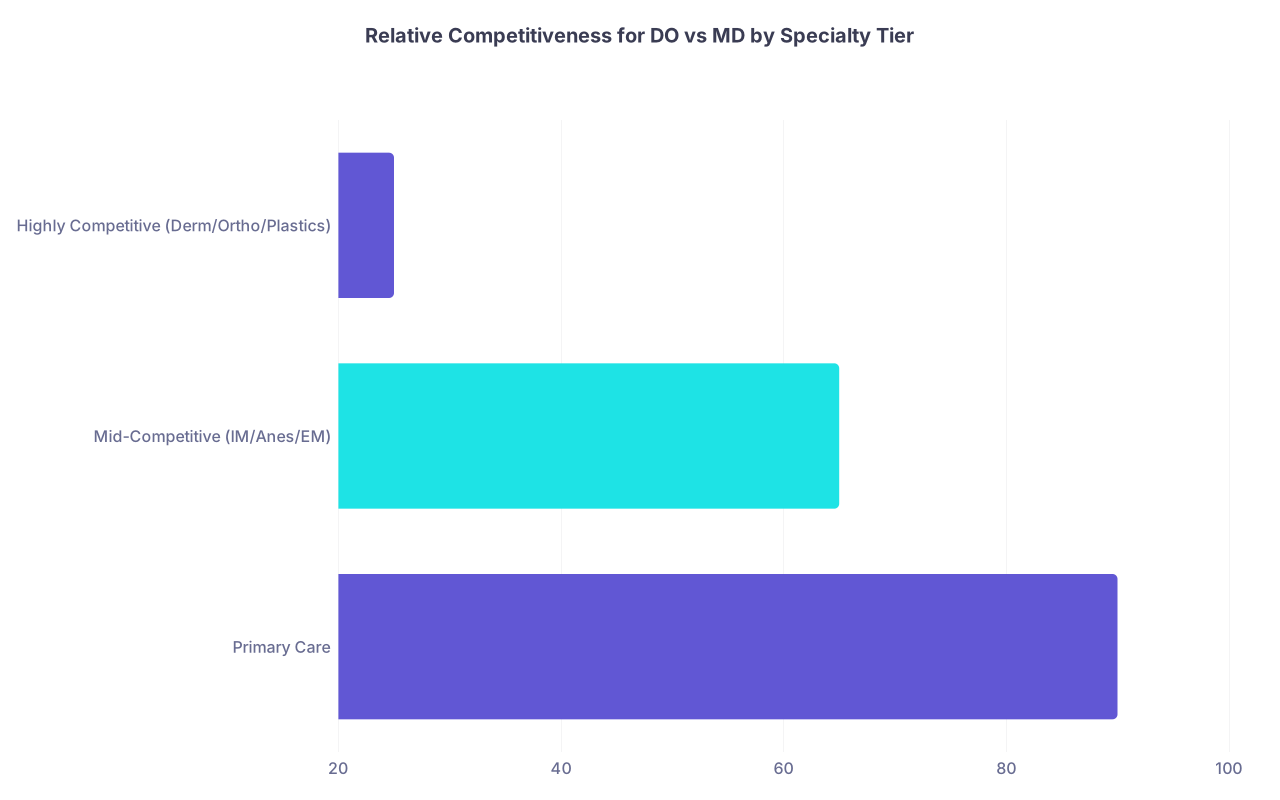
| Category | Value |
|---|---|
| Primary Care | 90 |
| Mid-Competitive (IM/Anes/EM) | 65 |
| Highly Competitive (Derm/Ortho/Plastics) | 25 |
Interpretation (rough, but directionally right):
- Primary care: DO vs MD — almost equal doors if you’re solid.
- Mid-tier: You can absolutely get there from DO, but you must perform well, score well, and hustle.
- Hyper-competitive: As a DO, you’re climbing with a weight vest on. It’s doable for a tiny, high-performing subset. Don’t bank on being that subset without a Plan B.
Step 7: Reality Check Your Ego vs Your Actual Life
Here’s the part people dance around: a lot of MD vs DO anxiety is ego.
In 10–15 years:
- Your patients will call you “doctor.” Not “doctor but are you MD or DO?”
- Your happiness will depend more on:
- Your specialty
- Your practice environment
- Your colleagues
- Your schedule
than on two letters.
I’ve watched people:
- Turn down DO acceptances, reapply MD-only, and end up with nothing after 2 cycles.
- Go DO, crush school, match into anesthesia, EM, IM, psych, whatever — and live really good lives.
You have to choose what risk you’re willing to carry and what you’re actually optimizing for: title, specialty flexibility, or simply becoming a practicing physician.
FAQs
1. If I apply both MD and DO, will MD schools judge me for also applying DO?
No. They don’t see your DO applications. MD and DO use separate primary applications (AMCAS for MD, AACOMAS for DO). There’s no global “this student applied both” flag. What matters is whether your application to them is strong and coherent.
2. Is it harder to match into competitive specialties as a DO?
Yes, on average. For derm, ortho, neurosurgery, plastics, ENT, and some high-tier radiology spots, DO students face more skepticism and need stronger scores, CVs, and connections. It’s not impossible, but if you’re dead set on those fields and not willing to pivot, MD is the safer bet.
3. Are DO schools “easier” to get into?
They tend to have slightly lower average stats for matriculants, so they’re more accessible for borderline applicants. But “easier” is relative — plenty of people get rejected from DO schools too. You still need a real, coherent application with clinical experience, solid letters, and a believable story.
4. Will being a DO limit where I can practice or what I can do?
In the U.S., no. DOs are fully licensed physicians in all 50 states, same prescribing rights, same billing, same ability to be attendings and program directors. Some niche, ultra-prestige academic environments skew MD, but for 95% of real-world careers, DO vs MD doesn’t limit basic practice.
5. If my MCAT is low but my GPA is strong, should I still apply MD?
Maybe, but be smart. If your MCAT is significantly below MD medians (say 503 with a 3.9 GPA), you’re fighting an uphill battle. You can:
- Retake MCAT and improve,
- Apply DO-heavy with a few MDs that are historically MCAT-flexible,
- Or delay a year.
Don’t throw 30 MD apps at the wall with no realistic grounding. That’s just expensive denial.
6. What’s one clear sign I should NOT apply this cycle at all?
If you’re weak on everything — low GPA, low MCAT, minimal clinical, few meaningful activities — and you’re telling yourself “maybe I’ll get lucky,” you shouldn’t apply. Applying isn’t a lottery ticket; it’s a filtered job application. Fix your weaknesses first, then choose MD vs DO with a real shot.
Here’s your next step for today:
Open a blank page and make three columns: “MD Only,” “DO Only,” “MD + DO.” Based on your current stats, your specialty risks, and your willingness to delay a year, put a short, honest list of pros/cons under each. Circle the one that matches your reality, not your fantasy. That’s your strategy.