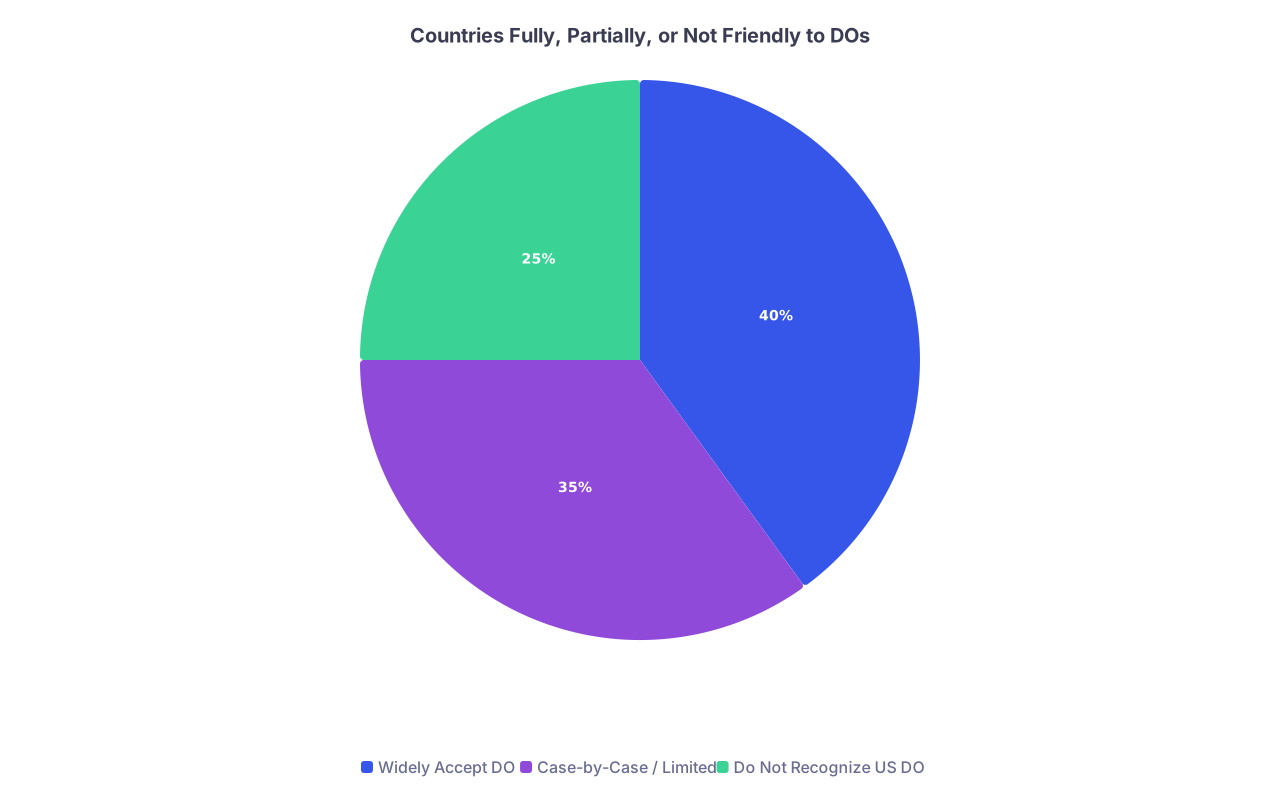
| Category | Value |
|---|---|
| Widely Accept DO | 40 |
| Case-by-Case / Limited | 35 |
| Do Not Recognize US DO | 25 |
You’re early premed, staring at two tabs: one for an MD program, one for a DO program. In the back of your mind is this thought you can’t shake: “If I go DO, am I locking myself out of working overseas? Will some country basically say I’m not a ‘real’ doctor?”
Here’s the blunt answer:
A DO from a U.S. school is a real physician degree. You can absolutely work abroad with it. But. It’s not as plug‑and‑play internationally as an MD. In some countries DOs are treated exactly like MDs. In others, you’re lumped in with chiropractors and manual therapists. And in a few, you’re flat-out blocked.
So if global work is even 10% on your radar, you need clarity now, not in residency.
Let’s go through where a U.S. DO can and can’t work, what the actual pain points are, and how to plan ahead so you don’t get surprised at 35 when you suddenly want to move to New Zealand.
First: What kind of DO are we talking about?
There are two very different “DO” degrees in the world:
- U.S.-trained DO (osteopathic physician) – 4-year medical school, same residency system as MDs, prescribes meds, does surgery, full physician.
- Non‑US DO/osteopath (e.g., in UK, Europe, Australia) – often non‑physician manual/physical therapist focused on musculoskeletal care. No meds. No surgery.
You care about the first one: U.S. DO = physician.
Why this matters:
Many foreign regulators only know the second meaning. So on paper, “DO” to them is someone who does manipulations, not an internist or surgeon. That’s half the battle abroad—proving you are a physician with full training, not a manual therapist.
Big Picture: Does a DO limit international work?
Short version:
- If your dream is to be able to work anywhere without extra headaches → MD is still a slightly cleaner choice.
- If you’re okay with some bureaucracy, targeted planning, and potentially ruling out a small group of countries → a DO is totally workable for international careers.
I’ve seen U.S. DOs:
- Doing NHS hospitalist work in the UK
- Working in Canada after jumping through licensing hoops
- Practicing in New Zealand and Australia after exams and assessments
- Spending years with MSF (Doctors Without Borders), WHO projects, and NGO work across Africa and Asia
So no, a DO doesn’t “kill” global practice. But it narrows your automatic options and adds friction.
Where DOs are generally accepted like MDs
These are places where U.S. DOs are typically recognized as equivalent—or close—to MDs, assuming you also complete residency and board certification in the U.S. Requirements vary, but conceptually you’re seen as a physician.
1. Canada
You can absolutely work in Canada as a U.S. DO, but it’s not a trivial process.
Reality:
- Recognition of U.S. DOs has improved, especially since DOs and MDs now share one U.S. residency accreditation system (ACGME).
- You’ll usually need:
- U.S. residency and board certification
- Successful registration with provincial medical colleges (e.g., CPSO in Ontario, CPSBC in British Columbia)
- Sometimes source verification and case-by-case review of your school and training
Catch: Canada is picky about everyone, even U.S. MDs. So the pain isn’t just “because DO.”
2. United Kingdom (UK)
The UK used to be very confused about DOs because they already had “osteopaths” as non‑physicians. That’s changing.
Current reality:
- The General Medical Council (GMC) does recognize U.S. DOs from accredited schools as acceptable primary medical qualifications, if:
- You’ve completed a recognized U.S. residency (ACGME)
- You pass the necessary exams/assessments (transitioning from PLAB to UKMLA)
- You submit documentation showing full physician scope
Many U.S. DOs have actually gone this route. It’s not automatic, but it’s doable and increasingly standardized.
3. Australia & New Zealand
Both countries can treat U.S. DOs similarly to U.S. MDs, but again, this is through pathways that focus on your training and board certification, not just your degree.
Typical expectations:
- Completed U.S. residency (ACGME-accredited)
- Board certification in your specialty
- Assessment by the relevant medical board/council (e.g., Medical Board of Australia, Medical Council of New Zealand)
- Sometimes supervision or an “area of need” position first
If you’re imagining: “I’ll graduate DO, hop straight to Australia before residency” — no. That’s not how this works. Same for MDs. Postgraduate training is what matters.
4. Many low- and middle-income countries / NGO work
For global health missions, NGOs, and short‑term or project-based work (Doctors Without Borders, Partners In Health, mission hospitals, etc.):
- These organizations usually care that:
- You’re fully licensed in your home country
- You’re appropriately trained in the needed specialty
- They rarely care if your initials are MD or DO.
Country-level licensing is often temporarily waived or simplified when you’re working under an NGO umbrella. I’ve seen DOs doing surgery in sub‑Saharan Africa and ICU work in Southeast Asia under these models.
Where DOs face partial acceptance or extra friction
Now the middle group. Places where DOs aren’t outright banned, but you’ll be treated as a special case.

Countries that only recently started understanding DOs
A group of countries—especially in Europe and the Middle East—have slowly started updating their rules as they see more U.S. DOs.
Common patterns:
- They require detailed curriculum documents and accreditation proof
- They might insist on evaluating you individually rather than by degree type
- They may initially say “we don’t recognize DO” until you push back with documentation from COCA (the osteopathic accreditor) and U.S. federal/State recognition
These include parts of:
- Western Europe (outside the UK)
- Gulf countries (e.g., UAE, Qatar, Saudi Arabia)
- East Asia (varies heavily by country and hospital system)
Some DOs do get through. But it’s more work than an MD would face.
Countries that confuse DO with non‑physician osteopath
In places where “osteopath” is clearly a non‑physician allied health profession, regulators may default to:
“You’re a DO → that’s a manual therapist → you are not a doctor here.”
Examples:
- France
- Italy
- Some Scandinavian countries
- Parts of Latin America
In these places, sometimes you can win after a long battle with documents and legal review. Sometimes you can’t. Depends heavily on the specific national law.
Where DOs are effectively blocked (right now)
There are countries that, as of the latest data, simply don’t recognize U.S. DOs as equivalent to MDs and won’t license you as a physician. That doesn’t mean “forever,” but it does mean “don’t count on it for your career plans.”
Patterns where DOs are more likely to be blocked:
- Countries with very rigid lists of acceptable medical degrees (often only foreign MDs from certain schools)
- Places where their law literally defines “doctor” as someone with an MD or a specific local degree name
- Countries where “DO” is already legally defined as a non‑physician profession and they don’t want the confusion
This group is not massive, but it includes enough countries that if you dream of “I want total geographic freedom,” DO is a slight handicap.
The REAL bottlenecks: It’s not just the letters
Most students over-focus on “MD vs DO” and ignore the bigger issues that matter for international work.
1. Your residency and board certification
Foreign systems mostly care about:
- Where you did residency
- Was it recognized (ACGME in the U.S.)
- Are you board-certified in your specialty
A U.S. MD who failed to match, did no residency, and just has the degree? Much less internationally mobile than a U.S. DO who did a strong ACGME residency and is board-certified.
If you want options:
- Match into an ACGME-accredited residency
- Complete it
- Get ABMS/AOBMS board certification
Without that, both MD and DO struggle abroad.
2. Specialty choice
Some specialties travel better:
- Internal medicine, family medicine, pediatrics, emergency medicine, anesthesia, psychiatry — usually easier to place abroad
- Super niche U.S.-only fields can be problematic (some fellowships that don’t translate well to foreign systems)
If you’re dead set on, say, transplant surgery in a very specific European country, I’d advise MD + early research + early contact with that country’s system. DO isn’t impossible, but it’s one more barrier you’re stacking on top of an already hard path.
3. Language and local exams
Everywhere outside the English-speaking world:
- You’ll usually need local language proficiency
- You may need to pass local medical or licensing exams regardless of MD/DO
So “I want to be a cardiologist in Germany” is not simple for a U.S. MD either. You’re going to learn German, pass German exams, and then deal with equivalence. DO status is just one piece.
Strategic advice: If you’re premed and want international options
Let me be direct. Here’s how I’d think through this if we were sitting in advising:
Step 1: Be honest about how serious the “international” piece is
Rank yourself:
- Level 0 – “I might want a service trip once.” → DO vs MD doesn’t matter
- Level 1 – “I’d like occasional global health projects/NGO trips.” → DO is fine
- Level 2 – “I could see myself working 1–3 years in the UK/Canada/Australia, but not sure.” → DO is workable but MD is slightly cleaner
- Level 3 – “Permanent move abroad or ability to go almost anywhere is a real long‑term goal.” → MD is the safer bet
If you’re Level 2–3 and you have a realistic shot at MD acceptance, especially at a solid U.S. MD program, I’d lean MD. Not because DO is bad. Because friction builds over a 30‑year career.
Step 2: If you choose DO, choose strategically
Some DO schools have stronger reputations and better match data, especially into competitive residencies. That matters for your future mobility.
Look for:
- Strong ACGME residency match rates
- Graduates matching into a wide range of specialties and academic centers
- Solid board pass rates
Being a DO with a high-quality residency background often beats being an MD with weak training when you apply abroad.
Step 3: Keep documentation and accreditation proof
Many DOs abroad end up sending:
- COCA accreditation details
- Letters from the school explaining DO = physician
- U.S. licensing documents
- Residency and board certification proof
If you know international work is in your future, keep good paperwork. Save PDFs. Get official letters early.
Where DOs clearly can do what you’re imagining
If your picture of “international work” is:
- Working with an NGO in sub‑Saharan Africa for a year after residency
- Doing hospitalist medicine in the UK or Australia for a few years
- Moving to Canada eventually, after U.S. training
- Doing periodic trips to Central America for surgical missions
A U.S. DO is compatible with all of that. You may have extra forms or explanations compared with an MD, but it’s doable. There are DOs currently doing each of these things.
Where you get into real trouble is the “I want maximum geographic optionality and zero friction” dream. That’s MD’s turf.
Quick comparison: MD vs DO for international work
| Factor | U.S. MD | U.S. DO |
|---|---|---|
| General international recognition | Higher, more automatic | Good but less automatic |
| Confusion with non‑physician role abroad | Rare | Common in countries with non‑physician osteopaths |
| Canada / UK / Australia / NZ | Pathways well established | Pathways exist but sometimes more case-by-case |
| NGO / global health missions | Strong | Strong |
| Ability to work “almost anywhere” with least friction | Best option | More limited and variable |
Planning timeline if you care about working abroad
Here’s a rough flow of when to think about what:

| Step | Description |
|---|---|
| Step 1 | Premed: Choose MD or DO |
| Step 2 | Med School: Keep options open |
| Step 3 | Residency: ACGME program & Boards |
| Step 4 | Early Career: Research target countrys rules |
| Step 5 | Apply for Licensure/Work Visa Abroad |
| Step 6 | Short or Long-Term International Practice |
You don’t need every detail now. But you do need to avoid closing doors early—like choosing an unaccredited route, skipping board certification, or assuming “mission work” requires no credentials.
FAQ: DO Degree and International Work (6 questions)
1. Can a U.S. DO work in Europe?
Sometimes, yes. The UK is the most straightforward for U.S. DOs, with established pathways through the GMC once you have U.S. residency and board certification. In other European countries, it’s mixed: some may recognize you as a physician after case-by-case review; others see “DO” and assume you’re a non‑physician osteopath. You’ll run into more confusion and paperwork than an MD, and there are countries where you simply will not be recognized as a physician.
2. Can a U.S. DO join Doctors Without Borders (MSF) or similar NGOs?
Yes. MSF and other major NGOs care that you’re a fully licensed, appropriately trained physician in your home country. U.S. DOs meet that bar. Your specialty, language skills, and prior experience matter more than whether you’re MD or DO. Both MDs and DOs routinely work with these organizations.
3. Is it easier to work abroad with a Caribbean MD than a U.S. DO?
Not automatically. Many countries care about where you did residency and whether you’re board-certified, not just where you did med school. A U.S. DO with a strong ACGME residency and boards is often better positioned than a Caribbean MD who struggled to match or has weaker training. If you’re comparing a solid U.S. MD vs U.S. DO, MD has the edge abroad. If you’re comparing “any MD” vs “strong DO + strong residency,” the answer is more nuanced.
4. Will going DO stop me from ever practicing in Canada?
No, but it may make things somewhat more bureaucratic. U.S. DOs have moved to Canada and practiced there. You’ll need to navigate provincial licensing rules, show equivalence of training, and sometimes go through extra verification compared with a U.S. MD. But it’s possible, especially if you complete an ACGME residency and hold board certification in a needed specialty.
5. Should I avoid DO if I’m 100% sure I want to live abroad long-term?
If you are truly certain that long‑term, permanent overseas practice is a non‑negotiable life goal—and you have a realistic shot at U.S. MD admissions—then yes, MD is the cleaner, less restrictive choice. A DO does not make it impossible, but it does narrow your countries and adds friction. If international work is more of a “maybe” rather than a “must,” DO can still be a perfectly reasonable path.
6. For short-term mission trips, does MD vs DO matter at all?
Practically, no. For short-term mission trips, medical brigades, or NGO-based volunteer work, what matters is that you’re licensed, competent, and often supervised within the mission’s structure. Both MDs and DOs go on these trips constantly. The MD vs DO distinction barely registers there compared to issues like malpractice, local approvals, and ethical project design.
Key Takeaways
- A U.S. DO is a real physician degree, and you absolutely can work abroad—but MD still has smoother, broader recognition overall.
- Your residency quality, board certification, and specialty often matter more for international options than whether you’re MD or DO.
- If global mobility is a core life goal, tilt toward MD if you can; if it’s a “nice to have,” a DO with strong training is usually more than enough.