Last week, a student showed me two acceptance letters on her phone. One was from a “solid but not famous” MD program. The other was from a nationally respected DO school with a great match list. Her words: “If I pick wrong, I feel like I’m screwing up the rest of my career.”
If that’s you right now—mid‑tier MD in one hand, strong DO in the other—this isn’t a hypothetical decision. This is where your future specialty, debt, and day‑to‑day training get shaped. Let’s cut through the noise and get specific about how to choose strategically.
Step 1: Stop Asking “MD vs DO?” and Ask This Instead
The generic internet argument is “MD vs DO: which is better?” That’s the wrong question for you. You’re not choosing conceptually between degrees. You’re choosing between:
- A specific MD school with its own match outcomes, location, culture, and cost
- A specific DO school with its own match outcomes, location, culture, and cost
Your actual question is:
“Given my stats, goals, and risk tolerance, which specific offer gives me the best path to the kind of career I want?”
You do not need a perfect answer. You need a rational, defensible one.
Here’s how I’d break this down if we were on a Zoom call and you shared your exact schools and interests.
Step 2: Be Brutally Honest About Specialty Goals and Competitiveness
This is the fork in the road most premeds pretend doesn’t exist.
A. If you’re strongly drawn to the most competitive specialties
I’m talking about:
- Dermatology
- Plastic surgery
- Orthopedic surgery
- Neurosurgery
- ENT
- Integrated vascular, CT surgery, IR, etc.
And, realistically, also:
- Competitive radiology programs
- Competitive anesthesia programs
- Top‑tier academic anything
If this is you—and not just “I kind of like derm TikToks,” but you’ve shadowed, you understand the field, and your eyes light up when you talk about it—then:
Default choice: take the MD seat, unless the DO option is head‑and‑shoulders above on objective metrics and the MD is unusually weak.
Why? Not because DOs “can’t” match into those fields. They can and do. But the margin for error is razor thin:
- Many competitive programs still have few or no DO residents.
- Some program directors will read your file with bias, even if they won’t say it out loud.
- With Step 1 pass/fail, brand and school reputation now matter more for initial screening.
If you told me:
“I’m 90% sure I want ortho or plastics, and this MD is a standard mid‑tier allopathic school with a solid match history across specialties.”
I’d tell you plainly: go MD, and then work like hell.
B. If you’re leaning toward moderately competitive specialties
Stuff like:
- Emergency medicine
- General surgery
- Anesthesiology
- Radiology (non‑elite programs)
- OB/GYN
Here the choice becomes more nuanced. DO applicants can absolutely be competitive here, and many DO schools match extremely well into these.
Now you look harder at the specific match lists and the school’s support structure.
- Mid‑tier MD with average match into your targets vs
- Strong DO that consistently matches into your targets, including university programs
You’re allowed to go DO here without “ruining your chances.” But it needs to be a deliberate choice based on the real outcomes of that DO school.
C. If you’re open to primary care or broad‑based fields
Family medicine, internal medicine, pediatrics, psych, etc.
If you genuinely like these and you’re not going to be secretly resentful if you end up in them, then:
MD vs strong DO is much closer to a tie.
In that situation, other factors (cost, location, culture, support) should drive your choice more than letters on a diploma.
Step 3: Pull the Match Lists and Read Them Like a Program Director
This is where people get lazy. Don’t.
You have two schools. You’re about to stake 4+ years and hundreds of thousands of dollars on one of them. Spend a few hours doing this right.
Go to each school’s website. If they don’t post match lists publicly, email admissions and ask. Or ask current students. You want the last 3 years, minimum.
Now, evaluate with this kind of lens:
Breadth of specialties
- Does the MD school regularly match into the fields you’re eyeing?
- Does the DO school?
- For example: if you’re eyeing EM and the DO school consistently matches 10+ into EM every year (including university hospitals), that’s a green flag.
Type of programs
Look at the program names, not just “matched.” You want to see:- University‑based programs (e.g., “University of X”, “X School of Medicine”)
- Major teaching hospitals
- Not just community programs in the middle of nowhere (a few is normal; only those is a problem)
MD vs DO match pattern
For your DO school, check:- How many graduates match into ACGME (now just “residency programs,” but historically MD‑dominant sites)?
- Are there DO grads at large academic centers in your fields of interest?
An honest tier comparison
Sometimes the “mid‑tier MD” is actually really solid and over‑performs.
Sometimes the “strong DO” is a marketing phrase and their match list is mostly small community FM/IM.
If, after doing this, you see:
- MD: consistent matches into a wide range of specialties, including competitive ones, at decent academic programs
- DO: strong in primary care and a handful of mid‑tier specialties, but thin in the competitive fields you might want
Then the MD choice is obvious if you care about optionality.
On the other hand, if you’re looking at something like:
- MD: decent, but mostly regional placements, limited into your target field
- DO: big name in the osteopathic world, regularly matching into solid academic programs, and specifically strong in your field of interest
Then the DO seat is not a “consolation prize.” It may actually be the strategically better fit.
Step 4: Understand Structural Advantages and Real Bias
Let me be blunt: the letters “MD” still carry systemic advantages. Denying that is delusional.
Built‑in advantages for MD students
- Screening bias: Some program directors, faculty, and selection committees prefer MD. Some institutional filters quietly screen DOs more harshly.
- Academic ecosystem: MD schools, on average, have more NIH funding, more big‑name faculty, more established research infrastructure. Not all, but many.
- Geographic and prestige access: Certain elite academic residencies still have almost no DOs on their rosters.
This doesn’t mean DO is “inferior.” It means the friction is different. You’ll need better board scores (COMLEX + strong Step 2), stronger clinical evaluations, and more hustle to land the same spot in some places.
An MD school, even mid‑tier, often gives you:
- Slightly wider interview nets with less explanation required
- Easier access to some research and home academic departments
- A smoother path if you later decide to chase something competitive.
If you want maximum flexibility and you’re at all prestige‑sensitive: that MD acceptance is powerful.
When a DO school still wins
A strong DO school can be the right move if:
- You’re sure you’re okay with the fields they clearly place well into
- They’re offering meaningfully lower tuition or better scholarships
- Their board prep support and clinical rotations are robust
- Their environment fits you better, and you’ll realistically perform higher there
You can absolutely have a stellar career as a DO. But don’t pretend the structure around you is identical. It isn’t.
Step 5: Cost, Debt, and How Much You’re Willing to Suffer
Now we do the ugly math.
You need to compare:
- Tuition (4 years, with projected increases)
- Estimated cost of living by location
- Any grants/scholarships offered
Then ask: Am I really willing to pay an extra $60K–$150K for the MD letters, or the DO environment, or the location? And will that difference likely come back to me in career options or my sanity?
If the MD is:
- $15K/year more expensive, and
- Gives you broader options, and
- You’re not drowning in existing debt
I’d tell most students: that’s a premium worth paying for the MD path, especially if you have any lean toward competitive or academic fields.
If the difference is more like:
- DO is in‑state and much cheaper
- MD is out‑of‑state private, obscenely expensive
And your likely career target is primary care or hospitalist IM?
Then you don’t get extra morality points for lighting money on fire to have “MD” on your coat. Taking the significantly cheaper DO and living a sane financial life is not a bad play.
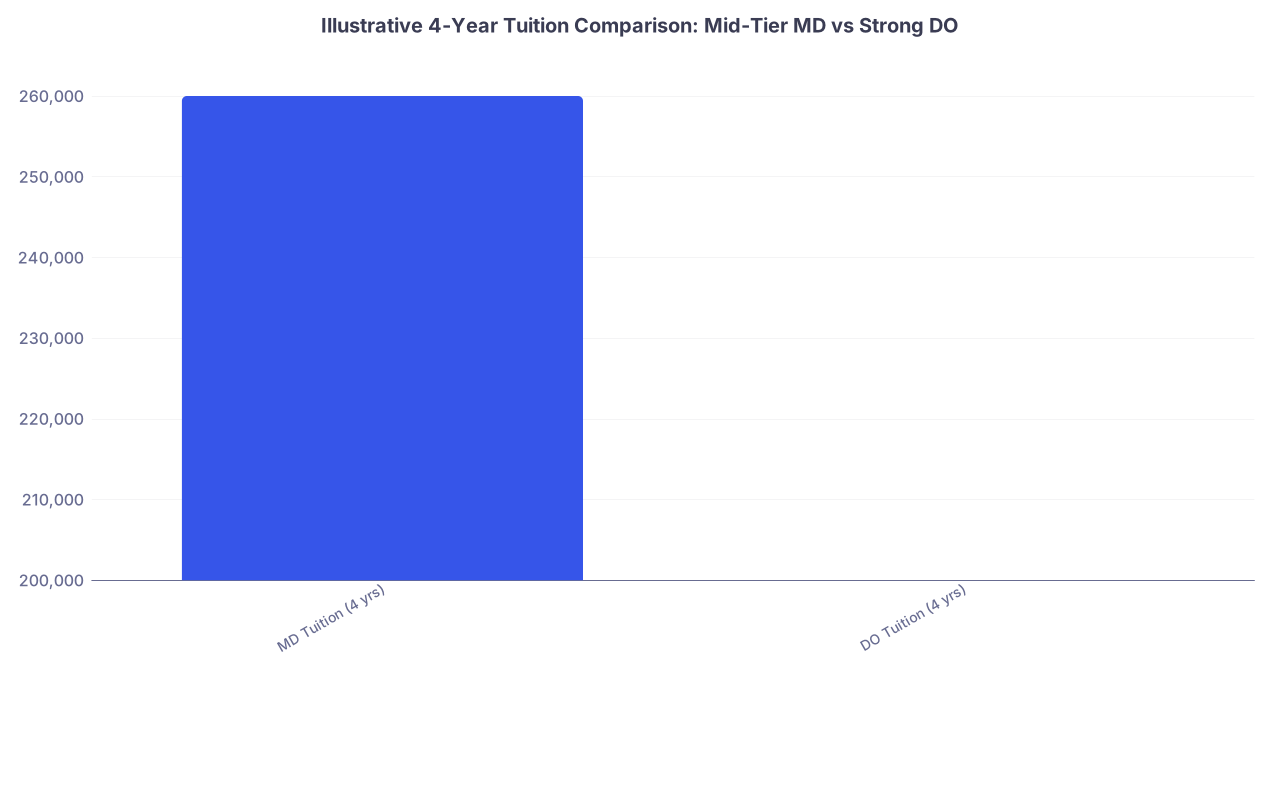
| Category | Value |
|---|---|
| MD Tuition (4 yrs) | 260000 |
| DO Tuition (4 yrs) | 200000 |
Step 6: Training Environment, Rotations, and Support
Here’s something that’s under‑discussed: you cannot outperform a system that doesn’t give you chances.
Look hard at:
Clinical rotation structure
- Does the MD school have a strong home university hospital?
- Does the DO school use mostly community sites? Are they stable or constantly changing contracts?
- Are there audition/sub‑I opportunities at academic centers you care about?
Advising and career support
- How early do students get specialty advising?
- Are there dedicated staff for residency advising?
- Do they help you plan away rotations strategically?
Board prep track record
For DO schools, you must know:- Step 2 CK pass rate and average, not just COMLEX
- How many students actually take USMLE Step 2 (if few do, that can hurt competitiveness at some programs)
Research and mentorship
If you even suspect you may want academic medicine, you want:- Active research faculty in your areas of interest
- A history of students publishing and presenting
- Mentors who have connections at residency programs
A mid‑tier MD with well‑organized clinicals, strong specialty advisors, and a university hospital is usually a more fertile environment than a DO school that’s scrambling for rotation sites each year. Not always, but often.
Step 7: Personality Fit and Realistic Self‑Assessment
This is where strategy meets self‑knowledge.
Ask yourself:
- Do I thrive in more traditional, academic, sometimes high‑pressure environments (common at MD schools)?
- Or will I actually do better in a smaller, more mentoring‑heavy, maybe more “tight‑knit” DO environment?
- Am I disciplined enough to grind hard for boards and class rank regardless of environment?
Some people do better at the “prestige game” of a mid‑tier MD. Others get lost, anxious, and average. At a DO school that’s a better personality fit, they might rank higher, crush boards, and match better.
You’re not trying to pick the school that sounds fancier. You’re trying to pick the school where you will realistically be in the top 25–50% of performance, not struggling at the bottom.
Clue: If you’ve historically thrived by being a big fish in a slightly smaller pond, a strong DO that really supports you can be a great call.
Step 8: Concrete Decision Framework (Use This)
Let me give you a simple decision filter. If we were on a call, I’d literally walk you through questions like these:
Specialty clarity (scale 1–5)
- 1 = no clue, everything seems fine
- 5 = I’m dead set on a super competitive specialty
If you’re 4–5: lean MD unless the MD school is truly weak or the DO school is truly exceptional in your target field.
Debt sensitivity (scale 1–5)
- 1 = I’ll take on more debt for better options
- 5 = I’m extremely debt‑averse
If you’re 4–5 and the DO is significantly cheaper, that pushes toward DO especially if your specialty targets are flexible.
Location/Personal constraints (family, partner, etc.)
- If one school makes your personal life much more stable and you’re already stressed, that matters more than Reddit thinks.
Match list alignment
Look at the last 3 years. For your top 2–3 interest areas:- Does the MD produce more grads in those areas at stronger programs? → MD advantage
- Does the DO punch above its weight specifically in your target fields? → DO might be better for you
Gut check: Bias acceptance
Ask yourself plainly:- Can I live with occasionally having to prove myself a bit more because of DO letters, if I pick that path?
- Or will that eat at me?
You are allowed to care about prestige. You are not obligated to. You just need to stop lying to yourself about it.
Step 9: A Few Realistic Scenarios
Let’s run through a few quick composites I’ve actually seen.
Scenario 1: The “Maybe Derm, Maybe Psych” Student
- MCAT: 517, strong GPA, good research
- MD: Mid‑tier public, solid match across fields including some derm, neuro, radiology
- DO: Strong DO with good psych and FM, almost no derm
You’re flirting with competitive fields. You also like psych.
Strategic choice: Mid‑tier MD. It keeps derm, rads, and other options open. If you decide you love psych, you’ll still match fine from that MD.
Scenario 2: The Primary Care‑Bound, Debt‑Averse Student
- Feels strongly about rural FM or outpatient IM
- MD: Private, expensive, big city, no scholarship
- DO: In‑state, much cheaper, strong FM/IM match, lots of rural rotations
Strategic choice: Strong DO, hands down. You do not need extra debt and an MD label for a career local programs will happily take you for as a DO.
Scenario 3: The “I Might Want Ortho but I’m Not Sure” Student
- Likes MSK, sports, maybe ortho or PM&R
- MD: Mid‑tier with decent ortho match, active ortho department
- DO: Very strong DO with a historically good ortho match, lots of grads into both DO and ACGME ortho programs
This one is tricky. You’d compare match lists and research opportunities hard.
If the DO has a clearly stronger track record in ortho, you might rationally go DO despite the letters. If they’re roughly similar, the MD still wins on broad optionality.
Step 10: How to Make Peace With Your Choice
Once you choose, commit. You can’t spend four years obsessing over the road not taken.
If you pick MD:
- Use the structural advantages. Seek research early, find mentors in potential specialties, treat Step 2 like a high‑stakes exam.
- Do not coast because “the letters will save me.” They won’t.
If you pick DO:
- Plan early to take Step 2 CK and aim to crush it.
- Be proactive about research and away rotations at places that take DOs seriously.
- Lean hard into your school’s strengths and mentorship; become the kind of student PDs remember.
I’ve seen DO grads outmatch MD grads regularly. And I’ve seen MD grads squander every advantage. The degree is leverage, not destiny.
Key points to walk away with:
- Stop thinking in abstract MD vs DO terms; compare these two specific schools on match outcomes, cost, environment, and how they fit your realistic specialty goals.
- If you’re seriously eyeing highly competitive specialties or want maximum flexibility, a mid‑tier MD usually offers structural advantages—worth some extra cost, but not infinite.
- A strong DO can be the smartest play if it’s significantly cheaper, aligns with your likely fields, and offers a training environment where you’ll realistically perform at a high level. Once you choose, stop second‑guessing and focus on becoming an excellent medical student.