The myth that “DO means you can’t do Derm or Ortho” is flat-out wrong—but it is rooted in some brutally annoying reality.
You’re not crazy for being scared of this. The system really is harder on DO students for the most competitive specialties. But “harder” is not the same thing as “impossible,” and a lot of people mix those up.
Let’s actually unpack this, not in the fake motivational way, but in the “what are my real odds and what can I actually do about it” way.
The Fear: “If I choose DO, I’m closing doors forever”
Let me say the thing out loud the way it runs through your head at 2 a.m.:
“If I go DO, no top derm or ortho program will ever take me. I’ll be stuck. I’ll regret this forever. I should just not go to med school if I can’t match something competitive. Or I should reapply until I die trying for MD.”
Yep. That spiral.
You’ve probably seen:
- Reddit threads where someone says, “Just be realistic, derm and ortho are basically off the table for DO.”
- Old forum posts quoting specific programs that “don’t take DOs.”
- Match statistics where MDs dominate competitive specialties.
And then your brain translates all of that into: “I’m done.”
Here’s the honest version:
DOs do match into dermatology, orthopedics, plastics, ENT, etc. Every year. Just not in huge numbers. And not by accident.
There is bias. There are barriers. Some programs still won’t even look at DOs. But there are pathways, and people are quietly walking them while everyone else screams on the internet.
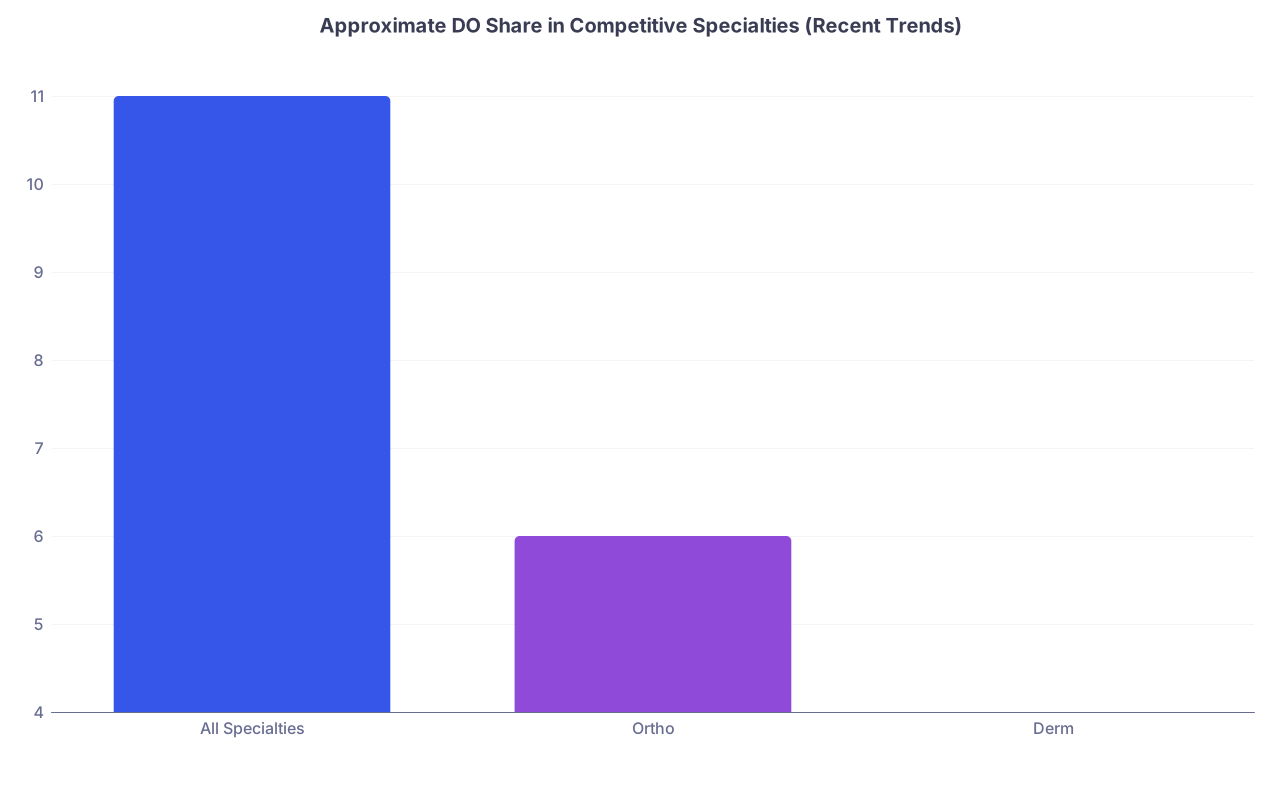
| Category | Value |
|---|---|
| All Specialties | 11 |
| Ortho | 6 |
| Derm | 4 |
These numbers aren’t exact year-by-year, but they’re directionally correct: DOs are a minority overall, and an even smaller slice in the super-competitive fields. That’s the uphill part.
Uphill doesn’t mean “cliff.”
How programs actually see DO vs MD (not the sugar-coated version)
Here’s what’s really going on behind closed doors when programs review applicants.
A lot of MD faculty trained in a world where DOs were mostly separate. Some still don’t understand what osteopathic schools are like now. So they lean on shortcuts:
- MD school = “I know this pipeline.”
- DO school = “Unknown, is this equivalent? Do I trust their grading, rigor, clinical rotations?”
It’s lazy. But it happens.
Then layer on this: competitive specialties already get way more qualified applicants than they can possibly interview. So they start using “filters” as a crude weapon.
Things that get used as filters:
- USMLE Step 2 CK score (Step 1 is pass/fail now, but old habits die hard)
- School name (brand)
- DO vs MD
- AOA (for MDs), class rank, home program, research productivity
If a program says: “We average 800 applications, we can only interview 80,” it’s easier for them to say, “Let’s only look at MDs + a few DOs with crazy Step scores and research” than to individually investigate every DO file.
Is that fair? No.
Is it happening? Yes.
Does it mean every program does this? No.
You’ll see patterns like:
- Some derm and ortho programs routinely interview and match DOs.
- Others never have a DO resident. Like, ever. Those are basically walled off unless something very unusual connects you.
Your job isn’t to pretend there’s no wall. Your job is to find the doors that actually exist.
Reality check: DOs do match Derm and Ortho (who are these unicorns?)
Let’s talk about who actually wins these spots as a DO, because it’s not random “good vibes” and “manifesting.” There’s a pattern.
The DOs I’ve seen match derm/ortho usually had combinations of:
- Very high Step 2 CK (think: 255+ kind of territory for derm/ortho competitiveness)
- Strong class rank (top 10–15%)
- Solid or excellent research output (posters, publications, often specifically in that specialty)
- Away rotations where they absolutely crushed it and got strong letters
- Strategic targeting of programs that have a track record of taking DOs
They’re not all super-geniuses. But they are usually very deliberate. They decide early, “I’m going for this,” and then they align everything around that target.
The uncomfortable part:
If you go DO and want derm or ortho, you really don’t get the luxury of a “lazy” first two years. Or a mediocre Step 2. Or being vague about specialty until late 3rd year. MDs get away with that more.
You have less margin for error. That’s the real, un-fun truth.
But also: a lot of MDs don’t match derm or ortho either. People act like MD = golden ticket. It’s not. It’s just a slightly easier starting position.
The numbers are scary—so use them correctly
You’ve probably doom-scrolled through match data. Let’s make that a little more concrete and a little less nightmare fuel.
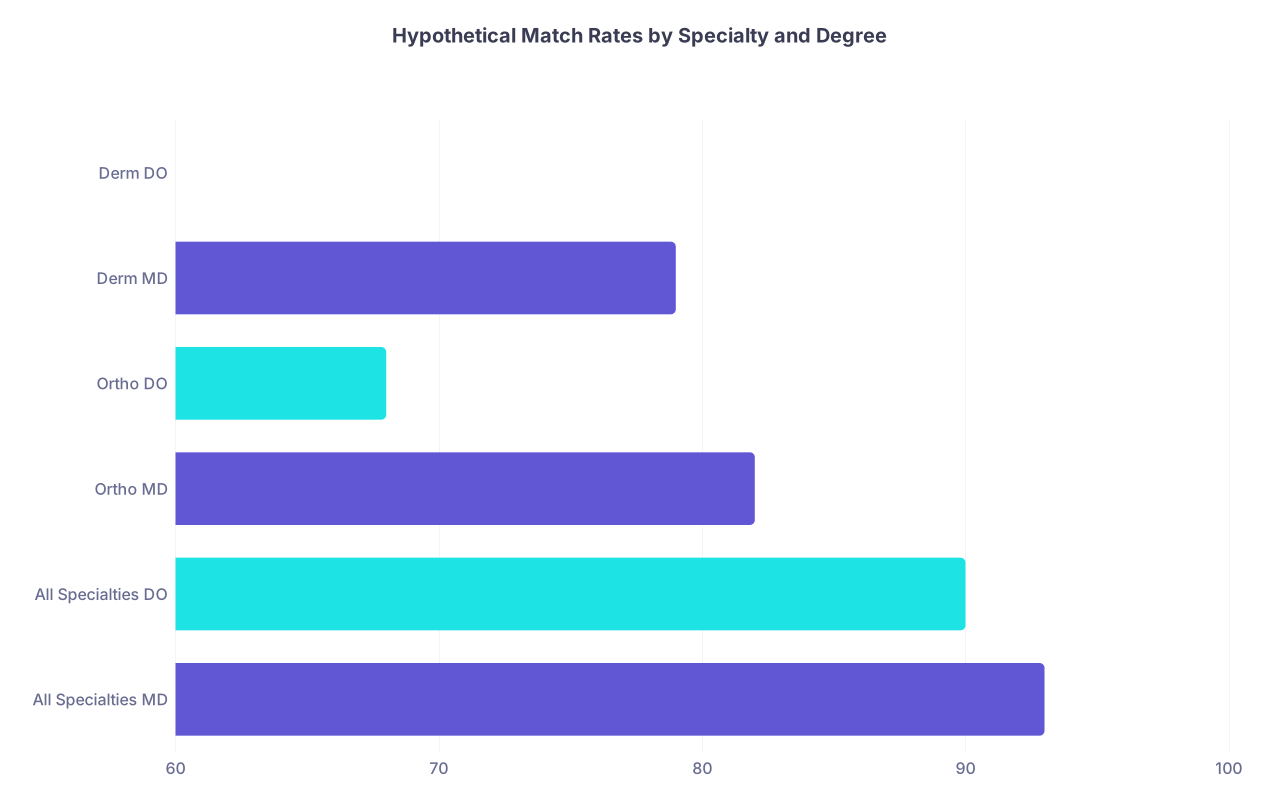
| Category | Value |
|---|---|
| All Specialties MD | 93 |
| All Specialties DO | 90 |
| Ortho MD | 82 |
| Ortho DO | 68 |
| Derm MD | 79 |
| Derm DO | 60 |
Again, this is illustrative, not an official table. But the pattern is real:
- Overall, DOs do match at high rates. It’s not like 50/50 coin flipping.
- In hyper-competitive specialties, DO match rates are lower than MD, sometimes a lot lower.
- Lower ≠ zero.
What this should tell you:
- If you’re going DO and aiming for derm/ortho, “average” isn’t going to cut it.
- You need to be aiming to be one of the strongest DO applicants in the pool, not just “solid overall.”
Scary? Yes.
Impossible? No.
“Should I just not go DO if I might want derm or ortho?”
This is the big question under everything you’re asking.
Here’s the blunt answer:
If you are absolutely, 100%, no-doubt obsessed with derm or ortho, and you already know you’re a high performer (strong MCAT, strong GPA, strong test taker), then yeah, MD gives you a statistically easier road. That’s just factual.
But “I might want derm or ortho” is different from “I will die if I don’t do derm or ortho.”
The real trap is this:
You turn down DO now because of something you might want later, then you reapply 2–3 cycles chasing MD, and maybe you still don’t get in. Now you’ve lost literal years of your life based on a maybe.
Meanwhile, every year there are DOs who match:
- Ortho through programs that respect their clinical performance
- Derm through places that know their research and away-rotation work
- Competitive but slightly more forgiving fields (anesthesia, EM, radiology) where DOs are very well represented
The decision you’re actually making is:
“Would I rather be a DO physician with an uphill battle for certain specialties,
or risk not being a physician at all for the sake of a slightly easier shot at a few fields?”
This is where people mess themselves up, because their fear of closed doors makes them slam the only open door in their own face.
What you can start doing now if you’re premed or early med student
You want something actionable, not just “believe in yourself.” So here’s the more uncomfortable but useful version.
If you’re still premed:
- Stop pretending stats don’t matter. If you want the option of a competitive specialty, you need to treat the MCAT like it’s your first “can I do this?” test. Crush it if you can.
- Apply broadly to MD and DO. Don’t artificially limit yourself. Let the cycle tell you where you’re competitive.
- If you only get DO and you’re devastated: give yourself time to grieve the “MD image” you built in your head, then ask: “If I never did derm or ortho, would I still want to be a doctor?” If the answer is yes, DO is not a bad path. At all.
If you’re already in DO school and even thinking derm or ortho:
You don’t have the luxury of pretending this is a casual idea. You either:
- Treat it like a serious plan now, or
- Accept it might realistically be off the table later.
That looks like:
- Making Step 2 CK a top priority from day one (yes, even before you’re supposed to be thinking about it).
- Getting A’s in your preclinical courses to set yourself up for strong class rank.
- Getting involved with research as early as you reasonably can, ideally in or near the field you’re considering.
- Not waiting until 4th year to suddenly “discover” you want ortho.
I’ve watched DO classmates pivot too late and then beat themselves up: “If I’d known I wanted derm second year, I would’ve done XYZ differently.”
You can’t know for sure. But you can prepare in a way that keeps competitive fields possible instead of accidentally closing them.
The hidden advantage no one likes to admit DOs sometimes have
Here’s something interesting I’ve noticed that nobody talks about:
A lot of DO students in competitive specialties are hungrier and more intentional than some MD peers. Because they know they’re fighting perception, they:
- Show up earlier on rotations
- Volunteer for more cases
- Obsess over evaluations
- Build real relationships with faculty because they can’t rely on prestige alone
Program directors aren’t blind. The ones who actually work directly with DO students often end up being genuinely impressed.
You can’t control the biased program that filters you out at the PDF stage.
You can control the impression you make at the programs that do give you a shot.
And that’s why some DOs quietly slide into derm and ortho every single year while Reddit swears it never happens.
Where worst-case thinking helps you and where it wrecks you
Your brain loves worst-case scenarios:
- “What if I go DO and never match anything competitive?”
- “What if I aim for derm and fail and end up unmatched forever?”
- “What if I regret all of this?”
Some of that anxiety is actually useful if you weaponize it.
Useful version:
“I might face bias as a DO—so I’m going to work my ass off to be undeniable.”
Self-destructive version:
“I might face bias as a DO—so I guess there’s no point in trying, or even going.”
One drives over-preparation.
The other drives paralysis.
You’re reading this because you’re anxious but still looking for a way through. That’s actually a good sign.
So… can a DO do dermatology or ortho or not?
Straight answer:
Yes. They can. People do. Every single match cycle.
But:
- You’ll likely need higher exam scores and stronger applications than many MD peers competing for the same thing.
- Some programs will quietly (or openly) shut you out. You won’t change their minds from the outside.
- You’ll need strategy: early planning, targeted research, smart away rotations, and mentors who have done it or seen it.
If that makes you say: “I still want it, I’ll do what it takes,” then DO does not close those doors. It just makes them heavier and harder to open.
If that makes you say: “Honestly, I just want to be a doctor and have a good life, I don’t need derm or ortho specifically,” then DO is more than enough and you can stop torturing yourself.
FAQ (read these slowly, not in a panic)
1. If I go DO, should I just assume derm and ortho are off the table?
No, but you should assume you’re playing on “hard mode.” Don’t casually assume it’ll work out because you got good grades in undergrad. If you’re serious about those fields as a DO, you need to approach med school like a long-term campaign for a competitive residency: strong preclinical grades, high Step 2 CK, relevant research, and rockstar performance on rotations. The option is there, but it’s something you actively build, not something that just happens.
2. Is it smarter to reapply for MD than to accept a DO seat if I’m worried about competitive specialties?
Be very careful here. Reapplying for MD makes sense only if: your stats are close to MD-competitive already, you have concrete ways to improve (retake MCAT, boost GPA, strengthen experiences), and you’re genuinely okay with potentially losing 1–2 years and still not getting MD. If being a physician at all matters more to you than the exact letters, turning down a DO acceptance just because of a hypothetical future derm/ortho interest is a risky gamble.
3. Do program directors actually care about DO vs MD once they meet you?
The honest answer: some do, many don’t. The rigid ones filter you out before they ever see your face. The ones who give you an interview usually care much more about how you think, how you communicate, your clinical skills, and your letters. Once you’re in the room and in the hospital with them, DO vs MD matters less than whether you’re someone they trust at 3 a.m. on call. Your job is to get in front of the programs that actually interview DOs—and then make it impossible for them not to rank you.
4. I’m premed and already panicking—what’s one thing I can do today that actually helps?
Pick one: either tighten your school list or tighten your plan. If you haven’t applied yet, open a spreadsheet and label which schools are MD, which are DO, and which are realistic given your stats. Don’t just throw apps randomly. If you’re already in school (or accepted), sit down and write a one-page “If I aim for a competitive specialty, here’s my game plan” document: Step goals, research ideas, people you could ask for mentorship. Seeing it on paper will make the monster in your head feel smaller and more beatable.
Open a blank page right now and write this at the top: “If I end up DO and still want a competitive specialty, here’s what I’ll do about it.” Then fill in three concrete actions—study, research, or people to reach out to. Give your fear a plan, not just a microphone.