You’re sitting at your desk with five tabs open: a DO school, three MD schools, Reddit, and SDN. Someone in a thread just said, “Top academic centers don’t really hire DOs,” and now your stomach has dropped.
You had actually gotten kind of excited about a DO school. You liked the vibe. You have a shot there. But now your brain is screaming:
What if I go DO and attendings at big-name hospitals roll their eyes at my degree?
What if PDs toss my application as soon as they see “DO”?
What if I kill myself for the next decade and still feel like the “lesser” doctor in the room?
Let’s walk through this honestly. Not sugar-coated, not doom-posting. Just the reality of how a DO degree lands at academic centers in 2024+ and what you’d actually be up against.
The uncomfortable truth: there is a bias — but it’s not what Reddit dramatizes
I’m not going to lie to you and say, “There’s zero difference, everyone’s equal, love and light.” You’re not 12. There are real patterns.
Here’s the short version:
- Yes, some academic centers still have bias against DOs.
- No, it’s not universal. It varies wildly by specialty, region, and specific program.
- The bias is shrinking, but it’s not magically gone.
- Your degree (DO vs MD) is one signal. Your performance is a much louder one.
The people who scream “DOs are absolutely equal everywhere” are lying to you.
The people who scream “DOs are second-class citizens and never get academic jobs” are also lying to you.
Reality sits right in the messy middle. And that’s what your anxiety needs to understand.
Where DOs actually stand at academic centers right now
Let’s talk actual outcomes, not vibes.
At many mid-tier academic centers, especially in IM, FM, peds, psych, EM, anesthesia, PM&R, you will absolutely find DO residents and DO faculty. Not “token” one-per-department. Real numbers.
Do you see DOs as chairs of departments at Harvard, Hopkins, UCSF in the most competitive specialties? Rarely. Are there DOs on faculty at strong university programs? Yes. I’ve seen DO attendings at places like Cleveland Clinic, Mayo regional sites, big state flagship hospitals, academic-affiliated community programs, etc.
The distribution tends to look something like this:
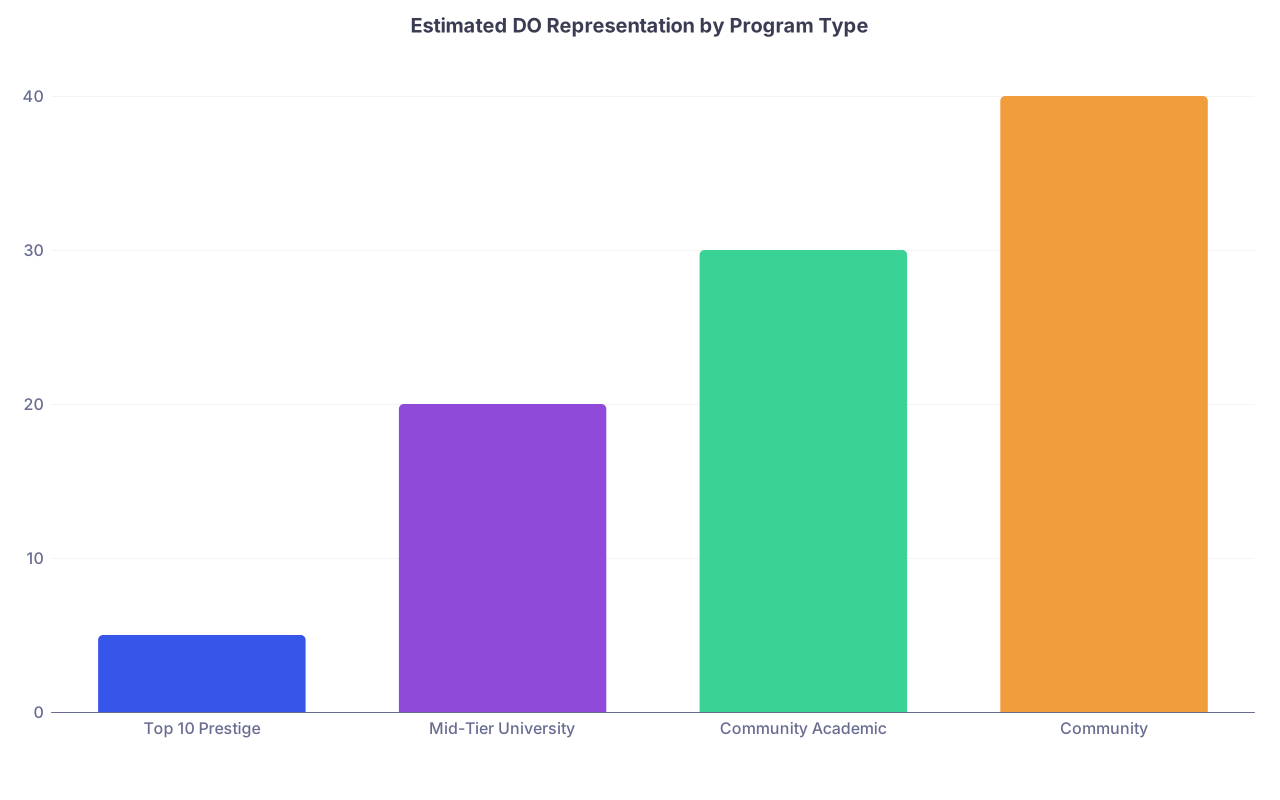
| Category | Value |
|---|---|
| Top 10 Prestige | 5 |
| Mid-Tier University | 20 |
| Community Academic | 30 |
| Community | 40 |
These aren’t literal percentages, but the pattern is right:
The higher you go in pure prestige/flexing-on-Instagram territory, the fewer DOs you see. The more you move toward real, functional academic centers and community-affiliated teaching hospitals, the more DOs you see.
So no, you’re not “locking yourself out of academic medicine” by choosing a DO school. That’s just not true. But if your dream is “cardiology attending at Mass General” or “peds neurosurgery at CHOP,” then yes, doors can be narrower and the climb steeper as a DO.
Key phrase: narrower, not non-existent.
The three big fears about DO respect, one by one
1. “Attendings at big hospitals won’t respect me”
You’re picturing walking into an OR or ICU and someone squinting at your badge:
“Oh… a DO. Huh.”
Does that happen? Very occasionally, yeah. Usually with older, very traditional faculty or in super competitive procedural fields. But what I’ve actually seen is this:
- If you’re competent, prepared, and not a mess on rounds, nobody cares what your diploma says.
- People forget within about 3 minutes whether you’re DO or MD and start caring about whether you help or create work.
The disrespect most learners feel has way more to do with hierarchy than degree. Intern vs attending. MS3 vs everyone. That’s the brutal part, not “DO” on your ID.
The people who truly obsess over “MD vs DO” in day-to-day clinical work are usually:
- premeds on the internet, or
- deeply insecure residents/attendings trying to feel superior about something.
The real test is: Can you interpret labs, present succinctly, think through a differential, not panic when a nurse asks you a question? That’s what gets you respect on real wards.
2. “Program directors at academic centers won’t even look at my application”
This fear is more grounded.
Here’s what actually happens:
- Some of the very top, academic, ultra-competitive programs explicitly or quietly prefer MDs, especially in derm, ortho, plastics, ENT, neurosurg, maybe radiology and ophtho.
- Some programs filter DOs out with Step score cutoffs, school reputations, or just institutional bias.
- But a huge chunk of academic and academic-affiliated programs do interview and match DOs — especially if they have strong Step 2 scores, strong letters, and real clinical performance.
Match lists from many DO schools show grads going to university programs in IM, peds, EM, anesthesia, PM&R, psych pretty regularly. Not just once-in-a-decade unicorns.
The people who get completely shut out tend to have weak applications across the board: low scores, poor clerkship comments, minimal research, or applying too top-heavy. The DO vs MD label then becomes the easy thing to blame.
I’m not saying the degree never blocks you. I’m saying most people underestimate how much the rest of the application matters.
3. “I’ll never be faculty / do research / teach residents if I’m a DO”
Academic medicine isn’t one monolith job where everyone works at the same three hospitals. There’s a spectrum:
- Elite “brand name” academic (think big coastal powerhouses)
- Strong state/public university centers
- Community hospitals with university affiliation
- VA hospitals with academic ties
- Smaller residency programs with lighter research footprint
DOs are all over that spectrum, just heavily clustered away from the very top prestige tier. I’ve seen DOs:
- Run clerkships
- Be APDs and PDs
- Publish papers
- Lead QI projects
- Teach residents daily at big, recognizable centers
You might not end up as the endowed-chair-of-the-super-fancy-department. But you can absolutely teach, publish, and be “academic” in the way that actually matters day to day: helping learners and improving patient care.
So… should you be scared? Yes. But scared of the right things.
You’re right to be cautious. This is your whole career. The problem is your anxiety is zoomed in on the label and ignoring the trajectory.
What actually matters more than DO vs MD for respect at academic centers:
- How well you do on Step 2 (Step 1 is pass/fail now; Step 2 talks loud)
- Your clinical evaluations and letters from rotations
- If you do rotations/auditions at academic centers and don’t crash and burn
- Whether you have at least some research or scholarly work in your chosen field
- Your professionalism and how residents/attendings remember you
That stuff? That drives respect way more than your initials.
The dark joke is: a mediocre MD from a no-name school with poor Step 2 and bad clinical comments will get less respect — and fewer opportunities — than a strong DO who crushes everything.
Your fear is: “Will my DO degree doom me?”
The real question is: “Am I willing to do the work to neutralize the disadvantage and then some?”
If the answer is no — if you want maximum margin for error and you know you’re not going to be a grinder — then yes, chasing MD makes sense if you can. Not because DO is “bad,” but because MD is slightly easier mode for certain doors.
Situations where DO vs MD matters a lot for academic centers
Let’s be blunt. There are specific scenarios where being a DO makes the path harder:
- You want a hyper-competitive subspecialty at a top academic home base (derm at UCSF, ortho at HSS, plastics at Mayo Rochester, etc.)
- You’re dead-set on top 10 IM with the goal of cards/GI/onc at the most elite fellowships
- You want to swim exclusively in that Ivy/Top-10 ecosystem for prestige reasons
Could a DO still get there? Rarely, but yes.
Will you need stellar scores, heavy research, connections, and strategic rotations? Absolutely. The tolerance for weaknesses is lower.
If you’re premed right now and you 1000% know your life dream is “neurosurgeon at MGH,” then yeah, I would fight like hell for an MD seat somewhere before you commit DO. Because you’re purposely picking a steeper climb for a very narrow, specific summit.
But most people don’t actually want that. They think they do because the internet told them to. They want to be respected, competent, decently paid, not miserable, maybe involved in some teaching or research, maybe in a nice city. That’s all doable as a DO.
Where DO is almost a non-issue (if you perform well)
There are fields and paths where DO vs MD really fades, especially at solid academic or academic-affiliated centers:
- Internal Medicine (not the hyper-elite places, but tons of university programs)
- Pediatrics (again, outside the hyper-famous ones)
- Family Medicine
- Psychiatry
- PM&R
- Emergency Medicine (still competitive in some places, but DOs are common)
- Anesthesia (depends on program, but lots of DOs in this space)
At many of these programs you’re more likely to get side-eyed for being unprepared on rounds than for being a DO.
You will still feel some internalized imposter syndrome — that’s almost guaranteed if you hang out online too much — but the actual lived experience day-to-day can be much more “we’re all drowning together” and much less “the MDs look down on you from their thrones.”
The thing nobody tells you: your school choice matters as much as the letters
Not all DO schools are equivalent in the eyes of academic centers. Same with MD schools.
Program directors talk about:
- How their past residents from X school performed
- Whether students from that school are well-prepared clinically
- Whether they tanked the boards or not
- Whether they were a nightmare for professionalism
So you might be freaking out about DO vs MD while ignoring a bigger issue: School strength and support.
A mid-range DO school with strong clinical sites, alumni at academic centers, solid match track record into your chosen field might actually position you better for academic stuff than some newer, low-support MD school that’s still figuring things out.
If you’re premed, this is what you should quietly stalk:
- Match lists: are there residents at academic centers or only at random unopposed community programs?
- Rotations: do they have affiliations with academic hospitals or just small community clinics?
- Alumni: are DO grads landing fellowships or faculty positions anywhere academic?
That’s where a lot of your future respect and opportunities will be baked in.
How to not hate yourself in 10 years if you pick DO
You’re scared of two things at once:
- Actual external bias.
- Internal regret. That little voice saying, “I settled. I’m less.”
The external bias you can’t fully control but you can outwork. The internal regret you can control by making a conscious, eyes-wide-open decision rather than a panic move.
If you choose DO, make yourself a deal:
- You will treat your performance as non-negotiable. You’re not allowed to coast and then blame the degree.
- You will plan for academic involvement early: research, case reports, teaching, contacts.
- You will be strategic about which programs and regions are DO-friendly, especially for away rotations and residency apps.
- You will not spend four years obsessively doomscrolling about how no one respects you instead of actually building a strong CV.
And if you truly can’t stomach the idea that someone, somewhere might silently judge your degree? Then be honest with yourself: you might need to reapply, take extra time, or adjust your specialty dreams toward MD-heavy pathways. That’s a valid decision. Just don’t pretend it’s not about prestige if it is.

| Step | Description |
|---|---|
| Step 1 | Start DO School |
| Step 2 | Strong Step 2 Score |
| Step 3 | Solid Clinical Evaluations |
| Step 4 | Research/Scholarly Work |
| Step 5 | Sub-I / Away at Academic Center |
| Step 6 | Strong Letters from Academic Faculty |
| Step 7 | Apply to Academic & Affiliated Programs |
| Step 8 | Match at Academic/Teaching Hospital |
| Step 9 | Teaching, QI, Research Activities |
| Step 10 | Academic Faculty Opportunities |
That’s the path. Not “DO” magically cutting you off. But each step requires intention.
What you can do today if you’re freaking out
If you’re premed:
- Pull up 2–3 DO schools you’re actually considering.
- Find their most recent match list and circle (literally, with a pen) any university/academic centers you recognize.
- Then do the same for a couple of mid-tier MD schools you’re considering.
Compare actual outcomes, not Reddit opinions. That will tell you a lot more about future respect and academic doors than the letters alone.
If you’re already in a DO program:
- Find the PGY-1s and PGY-2s who matched into academic centers or strong programs. Email or ask them: “What actually mattered? What would you do differently?” Then copy-paste their strategy as much as you can.
FAQ (exactly 5 questions)
1. If I know I want an academic career, should I avoid DO at all costs?
No. You should avoid choosing blindly. If your dream academic life is extreme prestige (Ivy-level IM, top cards fellowship, derm at a top 10), then MD is objectively a smoother route and you should seriously consider reapplying or broadening your MD options. But if your version of “academic” is being faculty at a solid university-affiliated hospital, doing some teaching and QI work, maybe publishing here and there, DO can absolutely get you there if you’re a top performer. Academic ≠ only Harvard and Hopkins.
2. Will attendings and residents at academic centers actually treat me differently as a DO student or resident?
Sometimes, a little. Especially older attendings who trained in a very MD-only era. You might get occasional subtle comments or questions about your school. But most of the time what they care about is: Are you reliable? Do you read? Do you improve? A bad MD student gets far less respect than a strong DO student. The day-to-day “treatment” you feel will track much more with your competence and work ethic than your initials.
3. Is it true that DOs don’t match competitive specialties at academic programs?
Not “don’t.” Just “less often and with less margin for error.” DOs match ortho, derm, ENT, etc., including at academic centers, but the bar is high: strong Step 2, research, away rotations, strong letters, networking. If you’re DO and want something very competitive at a big-name academic program, you have to go in assuming you need to be near the top of the applicant pool. If you know you don’t want to live like that, aim for less cutthroat fields or be willing to shift your expectations.
4. Will patients care that I’m a DO instead of an MD?
Most won’t even notice. Some will ask what DO means, and a tiny fraction may request an MD if they’re very particular or misinformed. But the vast majority just want someone who listens, explains, and doesn’t seem rushed or clueless. Ironically, you’re way more likely to be judged on your communication skills, appearance of confidence, and whether you seem to care than on your degree type. The “patient won’t respect me as a DO” fear is mostly an internal insecurity echoing back at you.
5. If I choose DO and later feel stuck, is it too late to have an academic career?
No, but you’ll have to be deliberate. You can build an academic trajectory during residency: get involved in research, QI, teaching med students, presenting at conferences. Many academic centers hire from their own residency and fellowship graduates. If you’re a standout resident at a solid university or academic-affiliated program, they may not care that much that your diploma says DO. The window doesn’t slam shut at med school graduation; it just means you have to start stacking academic receipts consistently instead of assuming the degree alone will carry you.
Open a tab right now for one DO school and one MD school you’re considering. Find their latest match lists and count how many grads went to university or academic-affiliated programs in the specialties you care about. Don’t just skim—write the numbers down. That’s your reality check, not the loudest person on Reddit.