
Worried I’m Selling Myself Short by Considering DO: Questions to Ask Yourself
What if choosing DO quietly closes doors I don’t even know exist yet—and I only realize it when it’s way too late to fix?
If that’s the tape playing in your head, you’re not alone. I’ve heard some version of this from so many premeds: “I like the DO philosophy… but I’m scared I’ll regret it.” Or the more brutal one: “Am I only considering DO because I’m not good enough for MD?”
Let’s actually say the worst thoughts out loud, because they’re already yelling in your head anyway.
- “Am I selling myself short if I go DO?”
- “Will people think I ‘couldn’t cut it’ for MD?”
- “Will I be blocked from certain residencies forever?”
- “What if my future self is furious I didn’t push harder for MD?”
I’m going to walk through the stuff you actually need to ask yourself. Not the sugar‑coated brochure version. The uncomfortable, reputation, match, doors‑closing kind of questions. And yeah, we’ll talk about scores, specialties, and whether the “DO stigma” still matters.
But I’m not going to tell you “DO and MD are exactly the same!!!” because that’s just not fully honest. The real question is: are the differences big enough—and relevant enough—to your life—to call DO “selling yourself short”?
Let’s dig in.
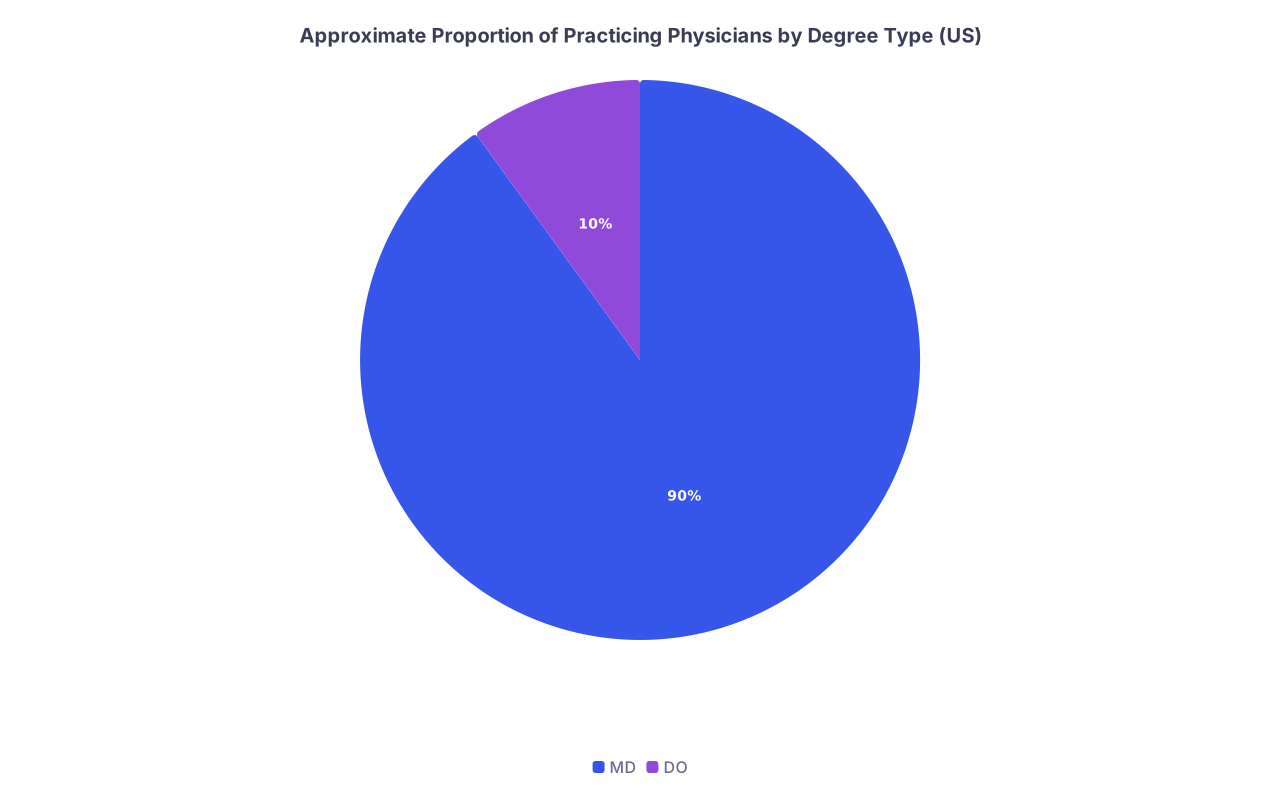
| Category | Value |
|---|---|
| MD | 90 |
| DO | 10 |
Question 1: If your stats were perfect, would you still consider DO?
This is the brutal gut‑check.
Take away your current GPA, MCAT, and application scars for a second. Imagine you’ve got a 3.9+ GPA and a 520+ MCAT, strong research, solid ECs, everything shiny.
Now ask yourself:
If every MD school and every DO school said, “We’d love to have you,”
would you still put any DO school at the top of your list?
If your honest answer is, “No, I’d only choose MD,” then right now DO might be more of a coping mechanism than a genuine preference. Not necessarily wrong, but it’s good to know what’s actually driving you.
On the flip side, maybe your answer is: “Actually, yeah, I’d still consider some DOs because I like the whole patient‑centered / OMM / slightly less cut‑throat vibe.”
Then DO isn’t “selling yourself short.” It’s just another path to what you want.
If your entire interest in DO disappears the moment your imaginary stats improve, that tells you something. It means a lot of this is rooted in fear and scarcity, not in values or fit. And that’s okay. But call it what it is.
Question 2: What specialties are you really not willing to give up?
Not your “I kind of think derm looks cool” fantasy. I mean, which specialties would you be absolutely gutted to lose access to?
Because whether people like to admit it or not, certain hyper‑competitive specialties are still harder from a DO starting point, especially at top academic centers.
Let’s be specific. If you told me right now:
- “I will die if I can’t match derm, plastics, ENT, neurosurgery, or ortho”
- “I want a big‑name academic institution, NIH‑level research, and a super subspecialized fellowship”
then yeah, going DO probably makes your road tighter. Not impossible, but narrower. You’d need top percent scores, stellar research, strong mentorship, probably audition rotations at MD programs. It can be done, but the margin for error shrinks.
If instead your list sounds like:
- “I’m open to IM, peds, FM, psych, EM, anesthesia, OB/GYN… I mostly just want to be a solid clinician with a decent life”
then DO is absolutely not “selling yourself short” in any meaningful way. Most DOs match into these specialties and practice side‑by‑side with MDs. Their patients don’t care about the letters. Their licenses are the same.
This is where you have to be brutally honest with your own ambition. Not the ambition you tell your parents. The one that shows up at 2am when you’re stalking match lists.
If your true dream is hyper‑competitive specialty + prestigious academic center + big research career, DO isn’t an automatic no, but MD does keep more doors unlocked by default.
If your true dream is “I just want to be a doctor and not be miserable getting there,” DO is a very legitimate, not‑less‑than path.

Question 3: How realistic is your MD Plan A… and what happens if it fails?
This is the part most people avoid because it feels like “giving up.” But ignoring risk doesn’t make it go away.
Say your stats are something like:
- GPA: 3.3–3.5 (with some upward trend maybe)
- MCAT: 505–510
- Solid but not jaw‑dropping ECs
- Maybe some red flags: a withdrawal, a C in orgo, a delayed graduation, etc.
People will tell you, “You can absolutely still do MD! Just apply broadly!” And they’re not totally wrong. Someone with that profile does get into MD every year.
But here’s the issue: you don’t apply as a statistic; you apply as a single human with one timeline.
You’re not asking, “Can someone with my stats get into MD someday?” You’re asking, “Will I get in, during this application cycle or the next, without burning out, going broke, or delaying my life 3–5 more years?”
That’s a different question.
Ask yourself:
- How many more cycles am I honestly willing to do if I don’t get MD? One? Two? More?
- Am I willing to take a glide year, retake MCAT, do an SMP/post‑bacc, spend thousands again?
- If I apply MD‑only this year and don’t get in, will I be okay mentally doing it all over again?
Some people are. They’re like, “I’ll reapply 3 times if I have to, I don’t care, it’s MD or bust.” That’s a valid choice. Risky, but valid.
Others are quietly whispering, “I don’t think I have the mental energy for multiple rejections and cycles. I just want a path that actually leads somewhere.”
If you’re in the second group, then applying DO isn’t you selling yourself short. It’s you choosing a real shot at becoming a physician instead of gambling everything on a narrow MD window just to feel better about the letters.
Question 4: Are you afraid of actual differences… or of other people’s judgment?
A lot of the DO panic isn’t about training. It’s about shame.
Shame that Aunt Linda will say, “So… is that like a real doctor?”
Shame that your old lab partner who’s going MD will secretly feel superior.
Shame that your parents will never brag as hard.
You know what that is? Ego. Not evil. Just human.
Ask yourself bluntly:
- Am I more afraid of the reality of DO (extra OMM, some programs harder to access, maybe slightly different reputation), or
- Am I more afraid of telling people, “I’m going to a DO school”?
Because the long‑term reality:
- Your patients won’t care.
- Your paycheck won’t care.
- Your license won’t care.
- Your day‑to‑day life as a physician will be mostly indistinguishable from an MD in the same specialty in the same setting.
The only people who will obsess over it are:
- Some premeds
- A minority of older doctors who haven’t updated their biases
- You… if you haven’t worked through your own feelings about prestige
If you choose DO but then spend 10 years feeling secretly lesser, you’ll make yourself miserable for no reason.
So here’s the uncomfortable exercise:
Picture yourself telling people you’re going to: “[Random State] College of Osteopathic Medicine.”
Does your stomach drop? Do you instantly think, “People will know I wasn’t good enough for MD”?
If yes, then your problem isn’t DO vs MD. It’s how you tie your worth to prestige.
You can still choose MD if that matters to you. But at least be honest about why.

| Step | Description |
|---|---|
| Step 1 | Want to be a physician |
| Step 2 | Strongly consider DO + select MD |
| Step 3 | Prioritize MD, maybe reapply |
| Step 4 | Apply broadly MD + DO |
| Step 5 | Focus on fit, geography, cost |
| Step 6 | Stats MD-competitive? |
| Step 7 | Hyper-competitive specialty dream? |
Question 5: What are you actually optimizing for: letters, lifestyle, or likelihood?
You can’t optimize for everything at once. At least not without lying to yourself.
Pick your priority order—for you, not for some imaginary admissions dean.
Some people will say:
- Letters (MD only)
- Prestige institution
- Everything else
That’s honest. If that’s you, you may accept more risk, more cycles, more time.
Others might realize their real order is more like:
- High likelihood of actually becoming a physician
- Reasonable training environment / not soul‑crushingly toxic
- Decent lifestyle and geographic flexibility
- Letters, as long as I can treat patients and pay my bills
If your list looks like that, DO is not “selling yourself short.” It’s aligning with what you actually care about, instead of what people think you should care about.
Ask yourself:
- Five years from now, would I rather be:
- An M1 at an MD school after two failed cycles, a retake MCAT, and a ton of financial and emotional cost,
- Or a PGY‑1 DO resident actually practicing medicine?
There’s no universal right answer. But there is a right answer for you.
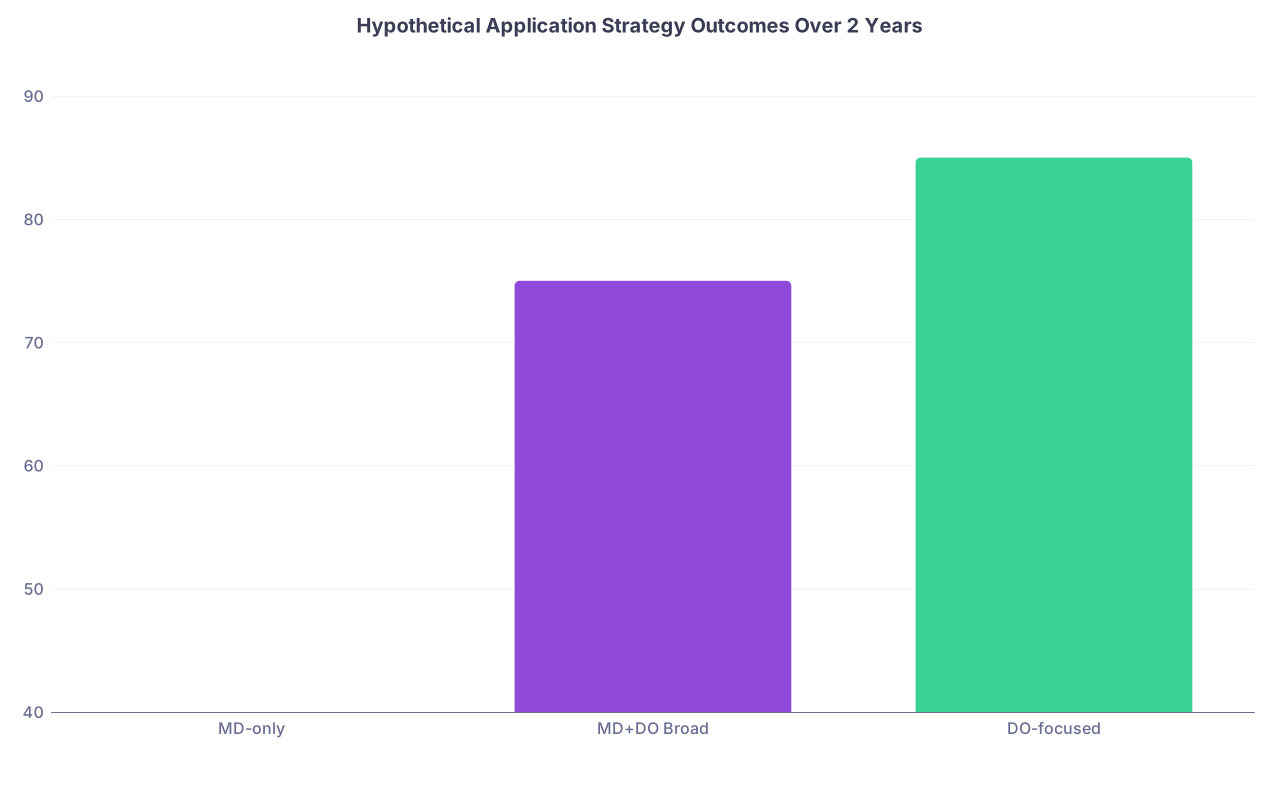
| Category | Value |
|---|---|
| MD-only | 40 |
| MD+DO Broad | 75 |
| DO-focused | 85 |
Question 6: Have you actually looked at match lists and outcomes… or just memes?
A lot of DO fear is based on outdated or secondhand noise.
Go to actual DO school websites. Pull up their match lists from the last 2–3 years. Look at:
- Are they matching into the specialties you’d realistically want?
- Where geographically are people going?
- Are there university‑affiliated residencies in the mix or mostly community?
Then do the same with a few mid‑tier MD schools. Not the top 10. Normal ones.
You’ll probably notice something uncomfortable and reassuring at the same time:
- The DO lists don’t look like trash. At all.
- The MD lists aren’t wall‑to‑wall derm/ortho/neurosurg either. IM, FM, peds, EM, psych everywhere.
You’ll also see patterns. Certain DO schools feed strongly into primary care. Others have solid IM/EM/psych matches, a few competitive specialty hits each year from top students.
That’s reality. Not Reddit opinion.
If the match lists from several DO schools look like lives you’d be okay living, then what exactly are you “selling short”?

Question 7: If you woke up tomorrow already accepted DO, how would you feel?
Strip away the application circus for a second.
Imagine it’s March. Email pops up:
“Congratulations! You’ve been accepted to [DO School].”
And that’s it. You are 100% guaranteed to become a physician if you show up and do the work.
No more studying for MCAT. No more rewriting personal statement. No more wondering if this was all a giant mistake.
What’s your first emotional reaction?
Relief so heavy you could cry?
Or a sinking feeling of “I guess I’ll take it… but I wish it were MD”?
If the relief wins, that tells you how much the certainty matters to you. Your nervous system is screaming that a secure path means more than perfect letters.
If the sinking feeling dominates, you’ve got a harder call. It might still be the right move to take the DO acceptance—future you as a practicing doctor is still better than future you stuck in limbo. But at least you’ll know there’s grief to process. Grief for the MD fantasy version of your life that didn’t happen.
You’re allowed to grieve that. And still choose DO. Both can be true.
So… are you “selling yourself short” by considering DO?
Here’s the harsh truth: You only sell yourself short if you choose a path that doesn’t fit your values, goals, and risk tolerance—just to impress people who won’t live your life.
If your real priorities are:
- Becoming a physician
- Without destroying your mental health or spending 5 extra years in premed purgatory
- In a solid, respectable specialty where patients trust you
Then choosing DO isn’t selling yourself short. It’s dropping the fantasy that only MD is “good enough” and stepping into an actual, concrete route to the life you say you want.
If your true, non‑negotiable dream is ultra‑competitive specialty + big‑name MD institution, and you’re willing to delay, retake, reapply, and suffer for that—then yes, you may feel like DO is selling yourself short. In that very specific context.
The hard part is being brutally honest with yourself about which camp you’re actually in.
Not the camp that sounds noble. The one that lets you sleep at night.

FAQ (Exactly 5 Questions)
1. Will I be blocked from certain specialties if I go DO?
Not completely blocked, but the bar is higher for some. Fields like derm, ortho, ENT, neurosurgery, and plastics can be tougher from a DO background, especially at top academic centers. You’ll need top scores, strong research, and smart networking. For IM, FM, peds, psych, EM, anesthesia, and many OB/GYN and surgery spots, DOs match every year and practice right alongside MDs.
2. Do patients actually care if I’m DO instead of MD?
Most don’t. Many don’t even know the difference. They care if you listen, explain, and help them feel better. You’ll have the same prescribing rights, same licenses, same ability to bill. The people who care most about DO vs MD are premeds, some med students, and a shrinking group of older physicians.
3. Is it smarter to apply MD‑only first and save DO as a backup later?
If your stats are borderline for MD and you really don’t want to reapply, going MD‑only is a risky gamble. You could lose an entire cycle and still end up applying DO later. If you’d be devastated by not starting med school soon, applying broadly MD + DO in the same cycle is usually more realistic.
4. Will I always feel “less than” if I go DO?
That depends on you, not the degree. Some people carry a chip on their shoulder for years because they never worked through their own prestige hang‑ups. Others are too busy seeing patients, getting board certified, and living their lives to care. If you choose DO, you may need to actively challenge that “not good enough” story, or it’ll eat at you.
5. If I can realistically get into MD, is DO still a valid choice?
Yes. Choosing DO when you could have chosen MD isn’t automatically irrational. Some people prefer certain DO schools’ locations, culture, or support systems. Some like the OMM focus or slightly less cutthroat vibe. If DO better matches your values, mental health needs, or life situation, choosing it isn’t selling yourself short—it’s choosing fit over ego.
Key Takeaways:
- You’re only “selling yourself short” if you pick a path that doesn’t match your actual goals and risk tolerance, just to protect your ego.
- DO limits a few hyper‑competitive routes but is a solid, legitimate path to being a physician in most specialties.
- Be brutally honest about what matters more to you right now: letters on your badge, or a real, achievable path to becoming the doctor you keep saying you want to be.