
You finish a residency interview day, you're exhausted, and you do the "responsible" thing: send thank-you emails that night. Next morning, your stomach drops. You thanked the categorical track when you interviewed for prelim. You referenced Dr. Patel's research when you actually spoke with Dr. Nguyen about ICU teaching. Or worse, you sent a warm thank-you to the wrong faculty member entirely.
I've seen this happen more than applicants want to admit. Smart people. Strong candidates. Completely preventable mistake.
Here's why this error is dangerous: it doesn't just look awkward. It raises the exact concern you do not want attached to your file, carelessness. Programs may read a wrong-details thank-you as a credibility problem, an attention-to-detail problem, or a sign that you're blasting generic notes to everyone. None of those interpretations help you.
Don't spiral. Don't disappear. And definitely don't hope nobody noticed.
This is fixable if you move quickly and keep your correction clean. The goal isn't to write the perfect redemption email. The goal is simpler: restore accuracy, minimize noise, and avoid making the second mistake that usually does more damage than the first.
First Red Flag Check: What Counts as a "Wrong-Details" Thank-You?
Not every imperfection needs a rescue mission. But plenty do.
A "wrong-details" thank-you usually falls into four buckets:
People errors
- Wrong interviewer name
- Wrong faculty title
- Wrong program or institution
- Thanking someone who didn't interview you
Fact errors
- Misstating a research project
- Mentioning the wrong rotation, clinic, or patient population
- Referring to a conversation that didn't happen
- Claiming interest in a feature this program doesn't even offer
Timing errors
- Wrong interview date
- Wrong session type
- Wrong event reference, like saying "at second look" when there was no second look
Tone errors
- Accidentally implying a promise, ranking intent, or assumption
- Writing something that sounds copied-and-pasted
- Overfamiliar comments that misread the interaction
Small errors can still be risky. Don't underestimate these:
- Misspelling a physician's name
- Using the wrong degree or title
- Confusing "internal medicine" with "medicine-pediatrics" or "preliminary medicine"
- Referencing a fellowship or track the program doesn't have
- Thanking them for discussing global health when the conversation was actually about QI
My triage rule is blunt: if the error creates factual confusion or makes you look careless, treat it as correction-worthy.
If it's a comma splice, leave it alone. If it's the wrong person, wrong track, wrong project, wrong conversation, or wrong name spelling that changes identity, fix it.
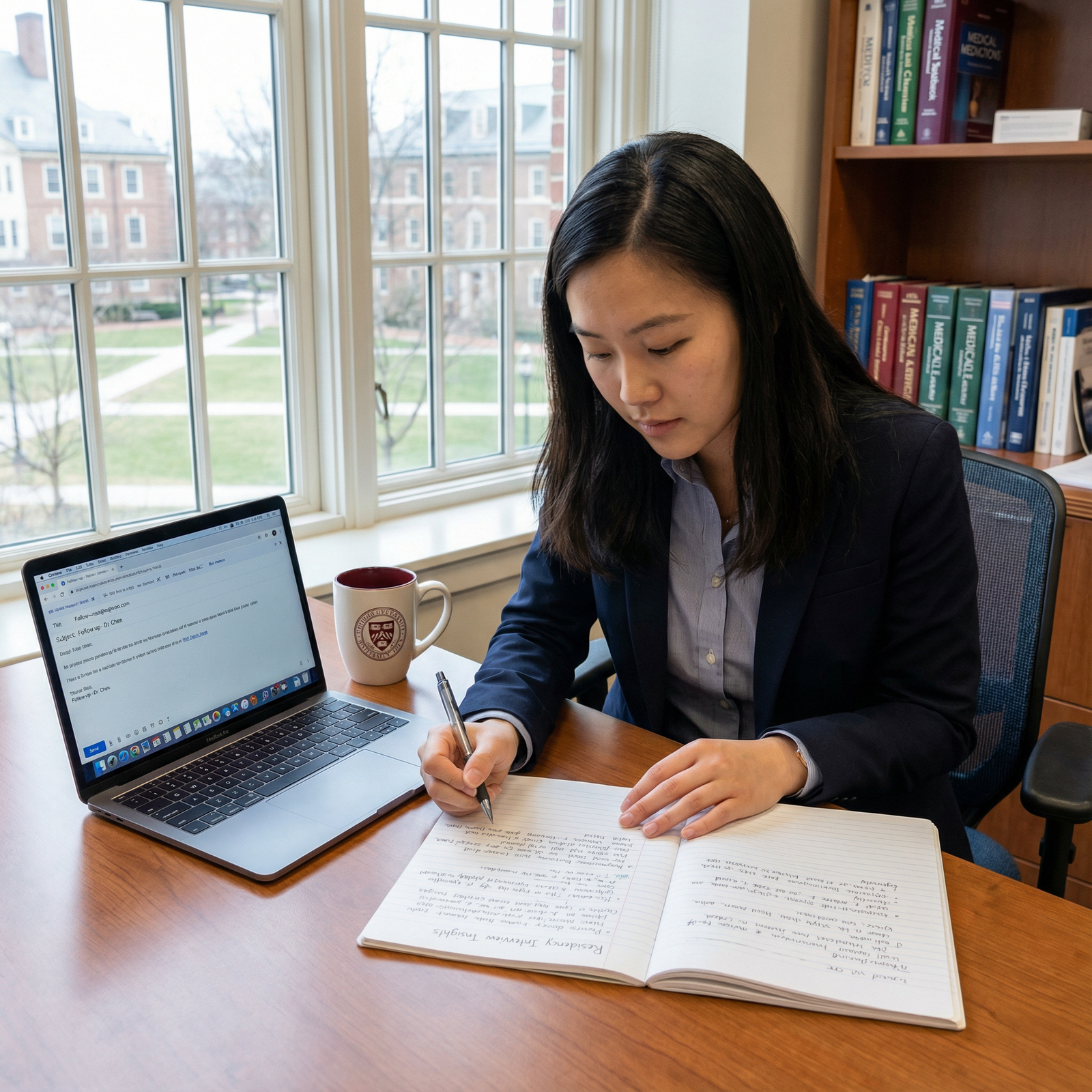
Don't Make This Mistake: The "Wait Too Long and Hope" Strategy
This is where applicants make the situation worse. They notice the error, feel embarrassed, then freeze. Bad move.
Programs don't hold your email in a ceremonial inbox for later. Many read thank-yous quickly. Some interviewers skim them the same day. If your message contains a factual mistake, waiting does not make it gentler. It just makes the error sit there uncorrected.
Use this timing rule:
- Within 24 hours: send a short correction ASAP
- Within 1-3 days: still correct it, with a brief apology
- After 3-5 days: correct it only if it still matters or could create confusion
- Much later: don't resurrect a minor error just to soothe yourself
If you sent the same wrong detail to multiple relevant people, send a consistent correction to those affected. Don't send one version to one faculty member and a different explanation to another. That's how messy stories start.
And don't machine-gun the inbox:
- Not one correction
- Then another clarification
- Then a "just to reiterate"
- Then a rewritten thank-you
One clean correction. That's it.
Choose the Least-Damaging Fix: Edit, Re-send, or Separate Correction?
You do not get points for clever email tricks. Especially "maybe I can recall it." No. Assume the original message exists and has been seen.
Here's the safest way to decide:
1. If the error is minor and non-confusing
Examples:
- Tiny typo
- Missing comma
- Slightly clunky sentence
Best move: usually do nothing.
2. If the error is moderate
Examples:
- Wrong date
- Wrong rotation wording
- Slightly incorrect project title
- Wrong faculty title
Best move: send a short correction if the error affects clarity or professionalism.
3. If the error is major
Examples:
- Wrong interviewer name
- Wrong program track
- Referencing another institution
- Attributing a conversation or research interest to the wrong person
- Saying something false about your interaction
Best move: send a separate correction immediately.
A few protective rules:
- Don't silently edit and assume the problem is solved. The recipient may have already read the original.
- Don't re-send the full thank-you rewritten from scratch unless the original was unusable. That often draws more attention than necessary.
- Don't over-broadcast your error. Use Reply-All only if the original went to a small, clearly relevant group and the correction matters to all of them.
- Don't copy people who weren't involved. You are correcting confusion, not publishing your mistake.
When in doubt, I prefer the short correction email. It shows maturity. You noticed an error, owned it, fixed it, moved on. That's better than pretending the error doesn't exist.
Correcting Wrong Details Without Creating New Mistakes (A Safe Formula)
Here's the formula. Simple on purpose.
- Acknowledge the error
- State the correct detail
- Reaffirm your interest
- Close with thanks
That's the whole structure. Don't decorate it.
The safe structure
Sentence 1: Acknowledge
- "I realized my earlier note misstated one detail."
- "I'm writing to correct a detail from my prior email."
- "I wanted to briefly clarify one point from my thank-you note."
Sentence 2: Correct
- "I appreciated speaking with Dr. Nguyen about ICU teaching, not Dr. Patel."
- "I interviewed for the preliminary track, and I wanted to correct that reference in my earlier message."
- "The project I meant to reference was your quality improvement work on readmissions."
Sentence 3: Reaffirm
- "I remain very interested in your program and appreciated the opportunity to learn more."
- "My enthusiasm for the program is unchanged, and I was grateful for the interview day."
Sentence 4: Thank
- "Thank you again for your time."
- "Thank you again for the conversation and consideration."
That's enough. Four sentences can do the job.
Tone discipline matters
This is where people sabotage themselves. They get uncomfortable and start explaining.
Don't do this:
- "I was exhausted after a long travel day and had several interviews this week..."
- "My email app auto-filled the wrong name..."
- "Someone told me the wrong information..."
- "You must have noticed..."
No. None of that helps.
Use language that owns the mistake without dramatizing it:
- Good: "I realized I misstated..."
- Bad: "There seems to have been some confusion..."
- Good: "I'm writing to clarify..."
- Bad: "You may have misunderstood what I meant..."
See the difference? Self-owned, factual, brief. That's the standard.
Micro-rules that prevent a second mistake
Before sending the correction:
- Re-read every proper noun
- Check spelling of names in the signature line or website
- Verify track, specialty, center, and institution name
- Keep it to 3-6 sentences
- Don't attach anything unless asked
- Don't add new achievements, updates, or sales pitches
Your correction email is not a stealth second application. Keep it on mission.

Copy-and-Paste Correction Examples (Common Scenarios)
Use these as templates. Replace the placeholders carefully. And yes, carefully means checking them twice.
1. Wrong interviewer name
Template: Subject: Brief correction to my earlier thank-you
Dear Dr. [Correct Name], I realized my earlier thank-you note misstated your name, and I wanted to correct that. Thank you again for speaking with me about [topic]. I appreciated the opportunity to learn more about [program name] and remain very interested in the program. Thank you again for your time.
Do not:
- Re-explain how the mistake happened
- Mention multiple other faculty to prove you remember the day
- Apologize three times
Optional clarification sentence: "I especially appreciated our discussion of [specific topic]."
2. Wrong program track
Template: Subject: Clarification regarding my thank-you note
Dear Dr. [Name], I'm writing to correct one detail from my earlier email: I referenced the [wrong track], but I interviewed for the [correct track]. I appreciated the chance to learn more about the program and remain very enthusiastic about the fit. Thank you again for your time and consideration.
Do not:
- Pretend the track distinction doesn't matter
- Add rank-language or promises
- Turn this into a letter of intent
Optional clarification sentence: "I was particularly glad to hear more about [feature relevant to correct track]."
3. Misattributed research project
Template: Subject: Brief correction
Dear Dr. [Name], I wanted to briefly correct a detail from my prior note. The project I meant to reference was your work on [correct project], rather than [omit the wrong project if possible]. I appreciated hearing about that work and remain very interested in the academic environment at [program]. Thank you again for the conversation.
Do not:
- Invent familiarity with the project
- Add citations, attachments, or a PDF of your CV
- Overcompensate by sounding like you suddenly did a literature review overnight
Optional clarification sentence: "Our discussion of [correct topic] was especially memorable."
4. Incorrect rotation or clinical experience reference
Template: Subject: Quick correction to my earlier note
Dear Dr. [Name], I realized I misstated the clinical experience we discussed in my earlier thank-you. I meant to refer to [correct rotation/service/clinic], and I appreciated hearing how residents are involved there. Thank you again for the interview and for sharing more about the training experience at [program]. I remain very interested in the program.
Do not:
- Guess if you're not sure
- Use vague filler to hide the error
- Add extra details that may create another factual mistake
Optional clarification sentence: "I found your description of resident autonomy there especially helpful."
5. Wrong date or interview session
Template: Subject: Clarification
Dear Dr. [Name], I'm writing to correct a small detail from my prior message: I referenced the wrong interview date/session. Thank you again for speaking with me during the [correct date or session]. I appreciated the opportunity to learn more about [program] and remain grateful for your time.
Do not:
- Make the correction bigger than it is
- Recount your full interview schedule
- Sound frantic
Optional clarification sentence: "I especially appreciated our discussion during the resident Q&A/interview session."
6. Accidental duplicate thank-you to the wrong group
This one happens when applicants forward or copy the wrong thread. Messy. Fix it fast.
Template: Subject: Apology and correction
Dear [Coordinator/Dr. Name], I realized my earlier thank-you was sent to the wrong recipient group, and I wanted to correct that directly. Thank you for your time and for your role in my interview experience with [program]. I appreciated the opportunity to meet the team and remain very interested in the program. Please disregard the earlier misdirected message.
Do not:
- Blame Outlook, Gmail, ERAS, or "technology"
- Forward the mistaken thread around
- Attach new materials
Optional clarification sentence: "I'm sorry for the confusion and wanted to provide the correct note promptly."
Minimal correction template for borderline cases
If the issue is real but small, use this:
Dear [Name], I wanted to briefly clarify one detail from my earlier note: [correct detail]. I appreciated the chance to speak with you and remain very interested in [program]. Thank you again for your time.
That's enough. Clean. Controlled. Professional.
After You Fix It: The Follow-Up That Builds Trust (Not Noise)
Once the correction is sent, stop picking at it.
Your next step is not another apology. It's not a "just checking you saw my correction." It's not a new paragraph proving you're attentive now. That instinct is anxiety talking, and anxiety writes terrible follow-up emails.
Do this instead:
- Return to your normal communication cadence
- Use only accurate, necessary follow-up
- Send one strategic follow-up later only if the program's norms allow it
- Keep future messages specific and fact-checked
Before any later contact, do an accuracy audit:
- Correct program name
- Correct institution name
- Correct faculty names and titles
- Correct track
- Correct references to conversation topics
- Correct spelling in subject line and signature
My recommendation for the week after interview season starts:
- If you notice a factual error, correct it within 24-48 hours
- Then stop
- If appropriate, send one normal follow-up later
- Avoid repeated status-check emails unless invited
The trust-building move here is boring competence. That's good. Programs like boring competence. What they don't like is chaos dressed up as enthusiasm.
Action Steps
If you sent a wrong-details thank-you, do this today:
Identify the error type
- Person, fact, timing, or tone
Decide if it creates confusion
- If yes, correct it
- If no, don't manufacture drama
Send one brief correction
- Acknowledge
- Correct
- Reaffirm
- Thank
Proofread like your credibility depends on it
- Because it does
Move on
- No spiraling
- No repeated apologies
- No inbox clutter
The big lesson? Don't wait and hope. Hope is not a communication strategy. Accuracy is.