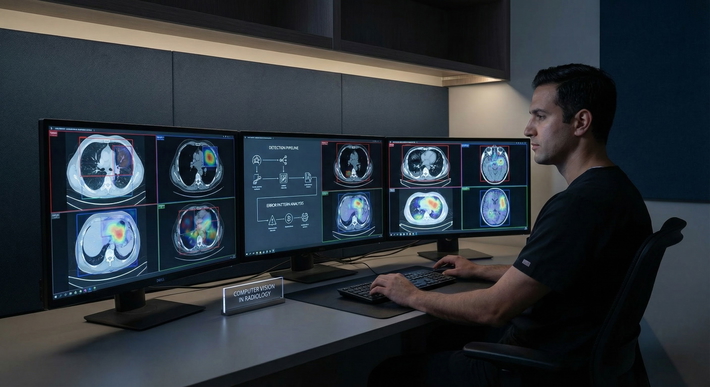
I've watched this scene more times than I can count. A program director cracks open an applicant's imaging portfolio between clinic and a faculty meeting. Thumb on the screen. Two, maybe three seconds per case. No scoring sheet. No leisurely appreciation of your "AI-enhanced" aesthetic. The first filter isn't sophistication, it's trust. Can I believe this person? Do these annotations sound like a clinician, or like someone who let a generator do the talking?
That's the moment that decides whether your portfolio gets a real look or a polite burial in the "maybe later" pile. Most applicants still think they're being graded on polish. They're not. They're being pattern-matched for clarity, completeness, and clinical reasoning under time pressure. AI-generated imaging doesn't automatically tank you. What tanks you is unverifiable material dressed up as mastery. What saves you is consistency, authenticity signals, and interpretive maturity that reads like someone who has already started thinking like a doctor.
Let me tell you what really happens behind the closed doors of selection meetings, and how to build a portfolio that survives a seven-minute scan.
This article is for educational purposes only. It is not financial advice, not legal advice, and not tax advice. Figures vary by individual circumstances, so consult a qualified professional before acting.
The Moment Your Portfolio Gets Opened (and the Real Reaction)
Picture a PD with 400 files and a Tuesday that already went sideways. Your PDF opens. The first page either orients them instantly or forces them to hunt. That friction matters more than your cleverest reconstruction.
Behind the scenes, most programs don't "grade" portfolios with rubrics. They do rapid pattern recognition. Clear source labeling? Good. Same template on every case? Good. Findings that lead to a ranked differential and a next step? Better. Overconfident impressions on suspiciously perfect images with zero caveats? That's when the mental red flag goes up, and it goes up fast.
Faculty talk about this in plain language. "Feels performative." "Looks generated, no disclosure." "Annotations read like a brochure." Those comments stick. Conversely, a clean disclosure plus real reasoning gets a different reaction: "This applicant knows the limits of the tool." That line is currency.
AI-generated imaging is assumed, rightly or wrongly, to mean one of three things: you lacked access to real cases, you wanted volume without effort, or you thought flash would compensate for thin clinical thinking. Your job is to prove a fourth story: you used the medium deliberately, labeled it honestly, and put your interpretive brain next to every frame. Consistency beats cleverness. Authenticity signals beat resolution. Maturity beats magic.
I've sat with attendings who skimmed an entire "stunning" portfolio in under five minutes and still wrote one note: unclear what's real. That note ends interviews more often than a missing research project.
What PDs Actually Want: The "Three Gates" Framework
Forget the fantasy that someone will lovingly score every pixel. Reviewers run you through three gates. Fail the first and the rest barely matter.
Gate 1 is authenticity. Can the reviewer believe the images and annotations reflect real de-identified cases or defensible educational simulations? Source clarity is non-negotiable. If they can't tell what they're looking at, real, simulated, or AI composite, you've already lost altitude.
Gate 2 is competence. Do your findings, differentials, and next steps show progression from pattern recognition to clinical reasoning? Spotting a density is table stakes. Ranking alternatives with one-line logic and stating what you'd do next is what separates applicants from tourists.
Gate 3 is communication. Captions, impression statements, and uncertainty should sound like a clinician, not a marketing deck. Hedge when the image demands it. Name artifacts. Don't sell certainty you didn't earn.
Here's the insider framing most applicants never hear: PDs often compare your portfolio against peers using heuristics, tone, structure, completeness, rather than a formal rubric. Your work isn't judged in isolation. It's judged against the last five portfolios that felt honest and the last five that felt like theater.
If you only remember one thing from this section: design for the gates, not for your ego.
Authenticity: The #1 Unspoken Concern With AI Images
PDs are not anti-AI. They're anti-unverifiable material that could mislead clinical judgment, or worse, signal that you don't know the difference. I've heard the same line in multiple selection rooms: "I don't care that they used a model. I care that I can't tell what I'm supposed to trust."
Show your work without oversharing. Document, case by case or in a clear front-matter statement, whether images are (a) real de-identified cases, (b) simulations built for teaching, or (c) AI-generated composites. Burying that information in fine print is a choice, and it reads as avoidance.
Minimum context fields that reviewers love, every single time:
- modality
- protocol assumptions if simulated
- patient-level constraints (age range, clinical scenario, not identifiers)
- what you would do next in real life
That last one is the sleeper hit. Next steps prove you didn't stop at "pretty picture."
Disclosure language that signals professionalism is simple and calm. Something like: Educational simulation generated for teaching pattern recognition. Not a real patient study. Limitations include possible generator artifacts and imperfect anatomic boundaries. Included because it isolates a specific interpretive skill, distinguishing X from Y under incomplete information, and pairs with explicit confirmation steps I would pursue clinically.
That paragraph does more work than a thousand "AI-assisted" badges slapped on without explanation. It reduces skepticism because it shows you understand the tool's failure modes. Faculty notice. They remember who treated AI like a colleague with known biases versus who treated it like a magic printer.
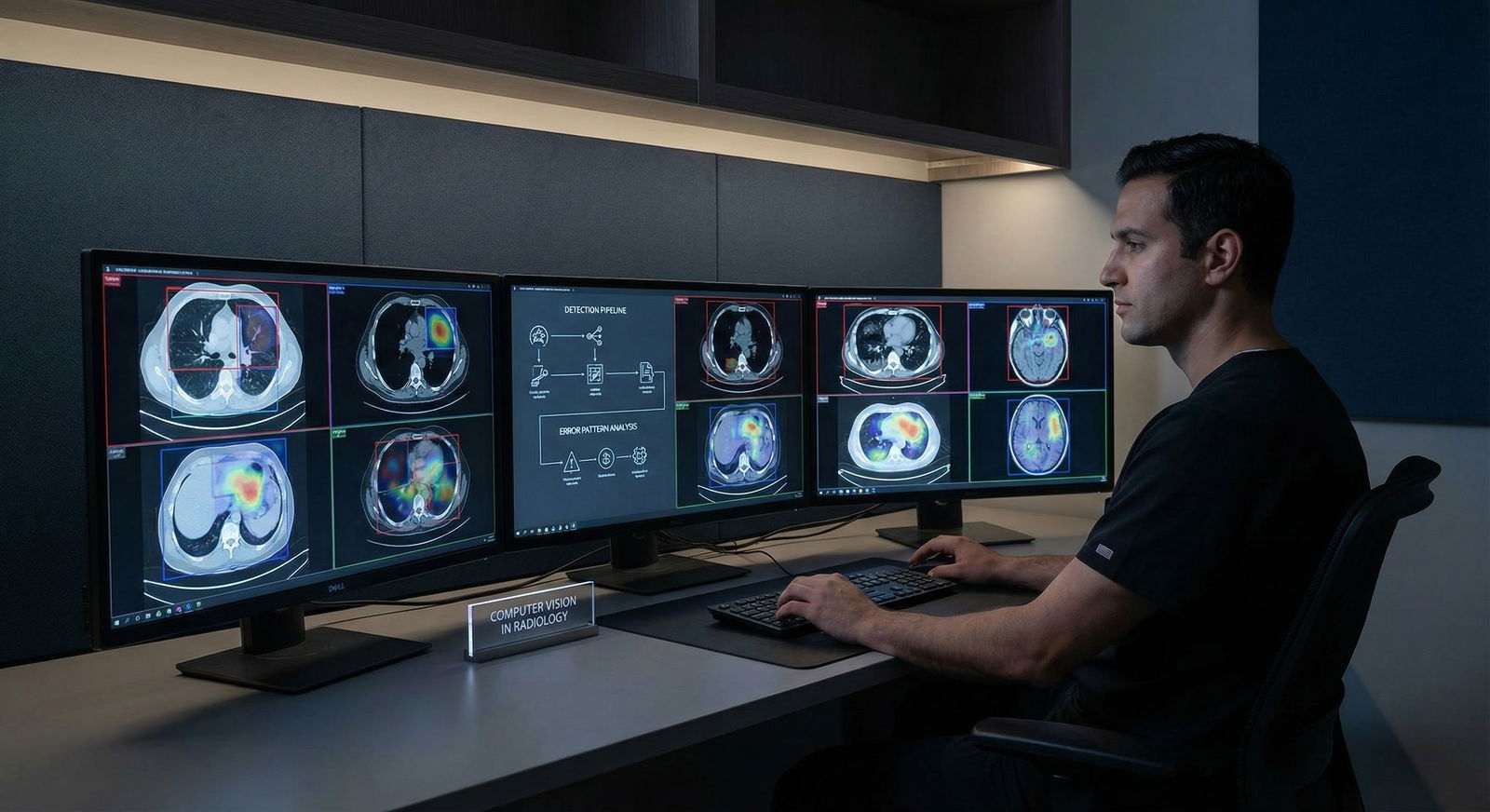
If you skip disclosure because you're worried it'll "look less impressive," you've misunderstood the audience. Reviewers would rather see an honest simulation with sharp reasoning than a gorgeous fake presented as gospel. Every time.
Competence Signals: What to Put Next to the Image (So It Reads Like a Clinician)
PDs look for interpretation literacy: not just what you see, but how you reached it. The image is the prompt. Your brain is the product.
Use an annotation formula that works under fatigue:
- Key findings, concise, ordered, anatomic.
- Image-quality caveats, motion, positioning, contrast phase, reconstruction limits, generator artifacts if relevant.
- Differential ranked with one-liner logic, not a laundry list; a short stack with why #1 beats #2.
- Immediate next steps, labs, additional sequences, clinical correlation, follow-up timing, escalation.
That's the spine. Everything else is decoration.
AI-generated portfolios can actually shine here if you lean into the contrast between appearance and clinical meaning. The model can make something look definitive. You can refuse to be seduced. Showing uncertainty on purpose, naming what the image cannot prove, is a maturity signal. I've seen applicants win quiet respect by writing, in effect: This looks like Z. It could still be Y if the phase is off. Here's how I'd settle it.
The common failure mode is the opposite: overly confident impressions that ignore artifacts, positioning, and alternative diagnoses. "Diagnostic for..." on a single imperfect frame is how you tell faculty you haven't been burned yet. Real clinicians get burned. Then they write better impressions.
Weight your effort the way reviewers weight their attention.
Notice what's not 90%: the pretty picture. Interpretation matters. Reasoning and next steps matter almost as much combined. Communication and uncertainty handling still move the needle, especially when two applicants look similar on paper.
The "Limitations" Section That Separates Pros From Performers
Reviewers remember how you handle imperfect cases more than how you handle perfect ones. That's not inspirational poster talk. It's selection-room reality. Perfect cases are forgettable. Your response to ambiguity is not.
If you're using AI-generated or heavily simulated images, disclose limitations without writing a legal brief or making excuses. Name the real ones: generator artifacts, hallucinated structures, boundary uncertainty, modality mismatch risk, and the fact that AI can invent convincing nonsense. Then stop apologizing and start adding value.
The move that works: discuss what would confirm the diagnosis in real life. Correlations. Dedicated sequences. Prior comparisons. Targeted labs. Physical exam findings that change pre-test probability. Follow-up imaging windows. Turn the limitation into teaching: If this were a real case, I would... and here's why.
That sentence is a differentiator. Performers polish. Pros reason under constraint. Faculty can smell the difference from a hallway away.
I tell applicants the same blunt thing every cycle: a portfolio without limitations reads like a highlight reel. Highlight reels don't teach us how you'll behave when the study is garbage at 2 a.m.
Build a Portfolio That Scores High in 7 Minutes: Structure That Holds Attention
PD review behavior is predictable. Scan order is usually overview → top cases → diversity → clarity → professionalism. If your overview fails, they may never reach your best case.
A structure that performs:
- a one-page index with case titles, modalities, and a one-line teaching point
- then 6-10 cases max
- each case on the same template
- disclosures up front, not scavenger-hunt style
Case diversity without chaos means you vary pathology and modality while keeping annotation structure identical. Chest radiograph, CT PE protocol simulation, MSK MRI teaching composite, fine. Five different fonts and three caption styles, not fine. Randomness signals you didn't design for reviewer time constraints. Volume is not a virtue. Attention is the scarce resource.
Avoid the trap I still see every year: thirty images, twelve layouts, zero through-line. It screams "I collected" instead of "I curated." Curation is the professional behavior. Collection is a hobby.
Design the first sixty seconds like a landing page for exhausted experts. Tell them what they're about to see, how it was sourced, and why each case earns its slot. Then get out of the way.
Case Templates That Work (Even When Images Are AI-Generated)
You need a repeatable template. Not because PDs love bureaucracy, because consistency lowers cognitive load and makes competence easier to spot.
For each case, lock this sequence:
- Clinical vignette (brief, de-identified, scenario-level)
- Imaging summary (modality, key technique assumptions)
- Key findings
- Ranked differential with one-line logic
- Next steps
- Limitations / disclosure
- One teachable moment
That last item is where applicants leave free points on the table. Every case should include one teachable moment: what you almost missed, what you ruled out, what mattered most, or where a junior learner typically overcalls. That's how you show judgment instead of regurgitation.
Label AI-generated material without burying it. Use consistent badges (AI-sim, Educational composite, De-identified real case), footnotes, and one clear disclosure statement at the start of the portfolio. Same language every time. If the reviewer has to decode your system, your system failed.
A workable opening disclosure might read: This portfolio includes a mix of de-identified teaching cases and AI-generated educational simulations. Each case is labeled at the top. Simulations are used only to isolate interpretive skills and always include limitations and real-world confirmation steps.
Then stick to it. No bait-and-switch halfway through.
When the image is AI-generated, your template still carries the weight. The vignette sets pre-test framing. Findings stay disciplined. Differentials stay ranked. Next steps stay concrete. Limitations stay honest. Teachable moment stays sharp. Do that six to ten times and you've built something that survives a hostile skim.