
You hit submit on ERAS, the screen refreshes, and that's it. Months of rotations, Step exams, research, rewrites, awkwardly polished personal statement drafts, and one hundred tiny decisions are suddenly frozen in digital amber. Then the spiral starts. Not the noble kind. The ugly, 2 a.m. kind.
What if a person never really reads this?
What if some quiet scoring system grabs my board scores, notices a gap in my timeline, hates how I described a research year, and dumps me into a reject pile before a program director ever sees my name? What if I did everything "right" and still got filtered out by a black box that doesn't know me, doesn't care, and definitely won't explain itself?
That fear isn't irrational. AI-powered residency screening is real. It's not science fiction, and it's not just tech people showing off at conferences. Programs are drowning in applications, and many are using software tools to sort, rank, flag, and triage files faster than any committee can manage by hand. Faster sounds good when you're the one reading 4,000 applications. It feels awful when you're the one being reduced to fields, keywords, and scores.
Here's the point of this guide: strip away the mystique. I'm going to explain what AI-powered residency screening actually is, why programs are leaning on it, what these systems may look for, where the risks are, and what you can do right now to make your application less likely to get misread, misclassified, or quietly ignored. Because yes, the system is imperfect. But no, you are not powerless.
Opening Scenario: When the Black Box Decides Your Future
I've watched applicants obsess over all the usual things, Step 2 score, number of publications, whether one awkward phrase in a personal statement ruined everything. But lately the fear has changed. It's not just "Will they like me?" It's "Will they even see me?"
That's a worse kind of anxiety. At least human rejection has a face, even if you never meet it. Algorithmic rejection feels ghostly. You imagine your application sliding through a pipeline, getting diced into categories, compared against patterns, assigned a score you'll never know, and disappearing without a sound. No interview. No explanation. Just silence. The kind that makes you refresh your inbox like it owes you rent.
And honestly? That fear makes sense. AI screening promises efficiency, consistency, and speed. Programs love that. Applicants don't, because efficiency from the institution's side can feel like erasure from yours. The process becomes more opaque, more impersonal, and harder to "read." There's no obvious person to impress, no single gatekeeper to persuade, and no easy way to know whether your strengths translated cleanly into a system built to process volume, not nuance.
Still, panic alone won't help. Strategy might. You don't need to become a tech expert or write like a robot. You do need to understand the machinery well enough to stop handing it easy reasons to sideline you. That's what this article is about. Not false comfort. Realistic control.
What AI-Powered Residency Screening Actually Is
AI-powered screening, in plain language, is software that helps residency programs sort applications before deeper human review. That sorting can be simple or sophisticated. Sometimes it's just automated filtering based on rules: minimum board score, visa status, graduation year, failed attempt history, geographic preference, things like that. Brutal, but straightforward.
Then there's keyword matching. That's less "intelligence" and more pattern detection. The system looks for certain words, phrases, experiences, or credentials in structured fields or narrative sections. Think research terms, leadership titles, specialty-specific experiences, or wording that aligns with a program's priorities. Crude? Sometimes. Effective at scale? Unfortunately, yes.
The most anxiety-inducing category is machine-learning-based prediction. These systems use historical data to identify patterns associated with outcomes programs care about: interview offers, ranking decisions, maybe even resident performance proxies. That's where the black-box feeling gets stronger. The model may weigh combinations of factors in ways no applicant can easily see.
Here's the reassuring part, and I mean actually reassuring, not fake brochure reassuring: AI usually does not replace humans entirely. It typically prioritizes, flags, or triages. A human reviewer often still looks at top-ranked applications and many borderline ones. But "often" is doing a lot of work there. If your file lands too low in the stack, the practical result may be the same as automatic rejection.
Why Residency Programs Are Adopting AI Screening
Because they're overwhelmed. That's the whole story, with a few layers of institutional self-justification on top.
Programs get flooded with applications. Hundreds. Sometimes thousands. Faculty reviewers are busy, program directors are stretched thin, and no one is carefully savoring each file with tea and soft piano music in the background. They're skimming, triaging, and trying not to drown. AI tools are attractive because they promise speed without total chaos.
And to be fair, software can help. It doesn't get tired at midnight. It doesn't forget what mattered in the first fifty applications compared with the next two hundred. It can apply the same rules consistently, catch structured signals quickly, and surface applicants who fit certain criteria. Humans are inconsistent. They just are. Anyone pretending otherwise hasn't sat in enough selection meetings.
But there's a dark side, and it's not subtle. Efficiency can flatten people. If a program over-relies on automated screening, it may reward what's easiest to quantify and miss what actually makes someone a strong physician-in-training. Worse, if the underlying criteria are biased, the software can industrialize that bias at scale. Very elegant. Very efficient. Very wrong.
This is why applicants feel trapped. You're told to be authentic, but the system rewards standardization. You're told your story matters, but the software reads fields more easily than nuance. You're told not to worry, while the process becomes less transparent every year. That mismatch is the problem.
What AI Systems May Look For in Your Application
Let's say the quiet part out loud: machines like structured data. Clean fields. Consistent dates. Standardized metrics. They don't "understand" you in the way a thoughtful mentor might. They process signals.
That usually means board scores, clerkship grades, class rank, AOA or other honors, research productivity, publications, presentations, geographic preference, signaling behavior, graduation year, visa status, and experience categories may be especially easy to analyze. If it fits neatly in a box, it's machine-friendly. If it lives in a subtle anecdote in your personal statement, it's much harder for a system to use well.
Narrative sections still matter, but differently. Personal statements, meaningful experiences, and descriptions of activities may be scanned for specialty-relevant keywords, clarity, specificity, and internal consistency. Generic filler hurts you here. "Passionate about patient-centered care" means almost nothing if every other applicant says the same thing. A machine won't be charmed by vague sincerity. Honestly, neither will a tired human.
What worries applicants most, and they're right to worry, is that little things can look bigger to software than they should. A gap in training without explanation. A date mismatch between two sections. A title written three different ways. Missing fields. Experience descriptions so vague they don't communicate actual work. Those issues can lower a confidence score, trigger flags, or simply make your application harder to classify cleanly. Ambiguity is expensive in a screening environment.
That doesn't mean you need to stuff your application with buzzwords like a maniac. Please don't. It means you should describe real experiences in clear, specific language. If you did quality improvement, say what you did. If you led a clinic initiative, name the work. If you had a leave, explain it professionally where appropriate. Make it easy for both a machine and a human to follow the thread of your application without having to guess.

The Risks: Bias, Transparency, and the Fear of Being Misread
This is the part applicants hate hearing because it confirms their worst suspicions: yes, AI can be biased. Not magically biased on its own, like a haunted spreadsheet. Biased because it learns from historical choices, flawed labels, incomplete data, and institutions that already had preferences baked in.
If a model is trained on past interview decisions or prior resident selection patterns, it may end up favoring applicants who resemble people the program has already liked. That can punish nontraditional candidates, career changers, applicants with leaves of absence, those from less familiar schools, or anyone whose path doesn't look neat on paper. And medicine loves neat paper. More than it should.
I've seen strong applicants tie themselves in knots over this. The student who took time off to care for a parent. The applicant who found medicine after another career and has incredible maturity but a less conventional timeline. The DO or IMG candidate wondering whether a system trained on historical institutional habits will quietly discount them before their story gets a fair hearing. These fears are not melodrama. They are grounded in how predictive systems can fail.
Then there's transparency. Or rather, the lack of it. Most applicants never know why they were rejected. Was it a board cutoff? A missing signal? A poor specialty fit? A narrative section that didn't align with program priorities? A machine-generated rank score? A human reviewer in a bad mood after clinic? Silence covers all of it, and silence breeds paranoia.
That opacity is corrosive. It makes normal applicants feel helpless and already-anxious applicants feel haunted. The worst part is that they often can't tell whether they should improve their application, widen their list, rewrite their descriptions, or simply accept that the process was arbitrary. That uncertainty is one of the ugliest features of AI-assisted selection. It doesn't just decide. It hides.
How Applicants Can Reduce the Odds of Being Screened Out
You can't control whether a program uses AI. You can control whether your application gives that system easy reasons to misunderstand you. That matters. A lot.
Start with completeness. Fill out every relevant field carefully. Don't leave sloppy omissions for later and forget them. Don't let one experience have a date range that conflicts with another section. Don't make your research output sound like three different activities because you changed the wording each time. This is boring work, and boring work saves applications.
Then get specific. Programs and screening tools both respond better to concrete descriptions than vague self-promotion. "Conducted chart review and presented findings on diabetic foot infection readmissions at departmental QI meeting" is useful. "Engaged in impactful research to improve patient outcomes" is fluff. Fluff is not your friend. It sounds fake to humans and uninformative to machines.
Explain oddities before they become red flags. If you have a gap, a leave, a delayed exam, a transfer, or an unconventional path, don't panic, but don't pretend the issue is invisible either. Where the application format allows, address it directly and professionally. You're not confessing a crime. You're preventing lazy interpretation.
You also need what I call signal hygiene. Clean dates. Consistent terminology. Standard titles. Accurate role descriptions. Formatting that doesn't create confusion. If one section says "student researcher," another says "research assistant," and a third says "project lead" for the same experience, you may know what you mean. The system may not. Neither may the reviewer skimming at speed.
Tailoring matters too. Not fake tailoring. Real alignment. If you're applying to a community-focused program, your application should make your community work easy to see. If a program values academic productivity, don't bury your scholarship under vague experience blurbs. A good application doesn't just say, "I'm excellent." It says, "I fit what you care about," in a way that is obvious on first pass.
And please don't overcorrect by sounding robotic. You are not trying to impress a search engine. You're trying to create a file that is easy to process accurately. There's a difference. Clarity is not phoniness. Structure is not selling out. It's survival.
What This Means for the Future of Residency Selection
More automation is coming. I wish I had a gentler sentence for you. I don't.
The likely future is hybrid review: software does the first sort, humans review prioritized files, and institutions get increasingly defensive about how "holistic" the process still is. Some of that will be true. Some of it will be branding. Programs want efficiency, and they are not going back to manually reading every file from top to bottom when applications keep rising.
At the same time, pressure for explainability is growing. That's a good thing. Applicants, advisors, and institutions are starting to ask harder questions about fairness, transparency, and whether these tools actually improve selection or just make it look more organized. They should. Medicine shouldn't accept black-box gatekeeping just because everyone is tired.
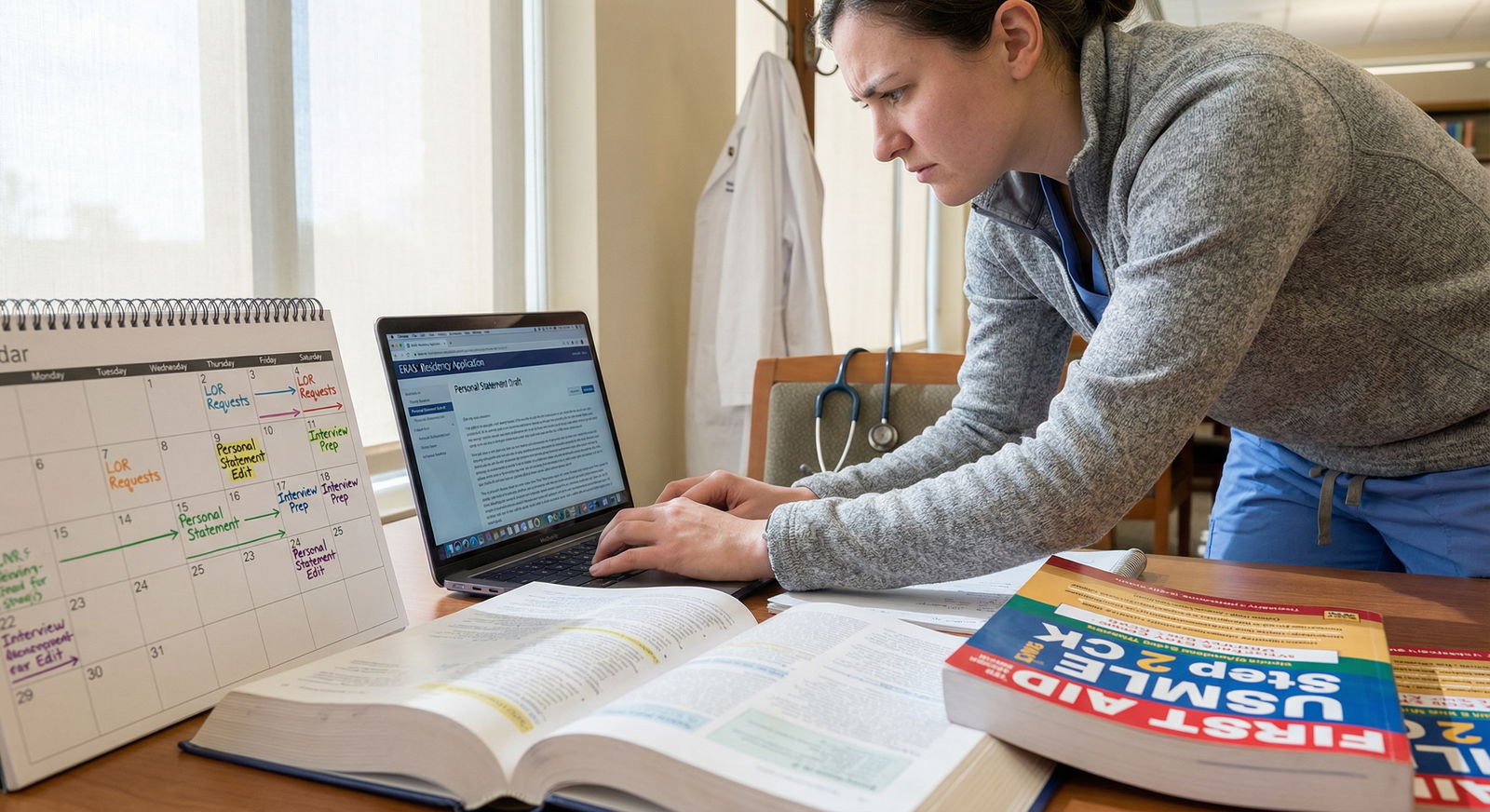
For applicants, the practical lesson is simple and a little annoying: presenting your story strategically matters more now, not less. Stats still matter. They always will. But your ability to package your experiences with clarity, consistency, and relevance is becoming part of the competition. A messy excellent application can lose to a clean very-good one in a triage-heavy system. That's not noble. It's just true.
Still, don't let the future talk make you fatalistic. A well-built application is not invisible. Strong alignment, clean structure, and specific storytelling still break through. AI can shape access. It does not erase quality when that quality is presented in a way the process can actually read.
Conclusion: Don't Let the Algorithm Write Your Ending
AI-powered residency screening is real, imperfect, and increasingly baked into the application process. That's the bad news. The less-bad news is that it usually supports human review rather than replacing it entirely, and applicants can absolutely prepare for that reality.
Your job is not to outsmart a secret machine. That fantasy wastes time. Your job is to submit an application that is complete, consistent, specific, strategically aligned, and hard to misread. No unexplained messes. No vague filler. No assuming a reviewer will "get what you meant."
If you're applying this cycle, do one practical thing today: audit your application like both a machine and an exhausted faculty reviewer will read it. Then get a mentor, advisor, or brutally honest senior resident to review it before you submit. Don't wait for the algorithm to be merciful. Build a file that gives it fewer chances to be unfair.