
The fastest way to sound naive about AI in interviews is to gush about “revolutionizing healthcare” without saying anything concrete.
You want to come across as curious, grounded, and realistic—not like someone who just watched a couple of YouTube videos and discovered ChatGPT last week.
Here’s exactly how to talk about your interest in AI in healthcare without sounding clueless, hype-driven, or dangerous.
1. The Core Formula: How You Should Frame Your AI Interest
Use this structure and you’re 80% of the way there:
- Start with a specific problem, not “AI”
- Then mention a realistic AI-enabled solution
- Add one risk or limitation you’re aware of
- End with your role as a future clinician, not as a wannabe “health tech visionary”
Example answer (for a med school or residency interview):
“I’m interested in how AI can support clinical decision-making in areas with high cognitive load, like oncology treatment planning. For example, tools that can sift through large guideline updates and trial data to suggest evidence-based options tailored to a patient’s profile. I’m also very aware of the risks—especially bias in training data and overreliance on algorithms—so I see AI as something that needs strong clinical oversight rather than a replacement for clinicians. As a future physician, I’d like to be the kind of person who understands enough about these tools to use them safely, question them when they’re wrong, and explain them clearly to patients.”
Notice what this does:
- No buzzwords like “disrupt,” “revolutionize,” “solve healthcare.”
- It anchors AI in a domain (oncology), a task (decision support), and a risk (bias/overreliance).
- It positions you as a responsible user and translator, not an amateur engineer.
If you memorize one pattern, make it that.
2. The Landmines: What Makes You Sound Naive About AI
Let me be blunt: interviewers have heard some truly terrible AI answers. You don’t want to join that list.
Common red flags that make you sound naive
Vague hype
- “AI is going to revolutionize everything in healthcare.”
- “I think AI will completely replace radiologists.”
- “We’ll solve burnout with AI.”
These are conversation enders, not starters. They signal you haven’t thought about the real-world mess of implementation, regulation, or patient care.
Total tech blindness
- Acting like AI is purely good, with no downsides.
- No mention of bias, privacy, explainability, safety, or workflow burden.
- Ignoring that most “AI” tools fail not in the lab, but in the clinic.
Confusing AI with magic
- Talking about AI “understanding” patients or “caring.”
- Treating large language models like sentient teammates rather than pattern recognizers.
Role inflation
- Saying you want to “build” AI systems if you have zero coding, data, or research background.
- Presenting yourself as a future health tech leader with no evidence of any tech-related initiative.
Ignoring patient perspective
- No concern about consent, transparency, or how you’d explain AI use to a worried patient.
If your answer could also be given by a tech bro who’s never seen a hospital, it’s not good.
3. What “Smart” Sounds Like: Concrete Ways to Talk About AI
Let’s build a few ready-to-use frameworks you can adapt on the fly.
A. If you’ve actually used AI tools
Say you used AI for:
- Literature summaries
- Drafting patient education materials
- Brainstorming frameworks or checklists
Talk about it like this:
“I’ve experimented with large language models as a tool for drafting patient education materials and summarizing studies. For example, I once asked a model to generate a basic explanation of heart failure at a sixth-grade reading level, then I edited it heavily for accuracy and clarity. It’s helpful for getting a first draft or a structure, but I’ve seen it invent references and gloss over nuance, so I treat it as a starting point that requires strong clinical and scientific judgment.”
Key moves:
- You describe a specific use case.
- You admit limitations (hallucinations, lack of nuance).
- You show you’re not outsourcing your brain to the model.
B. If you don’t have hands-on AI experience
Don’t fake it. Anchor in curiosity and literacy, not expertise:
“I wouldn’t call myself technical, but I’ve been deliberately trying to build ‘AI literacy’ as a future clinician. I follow how AI is used in imaging and risk prediction, and I’ve read about tools like sepsis prediction models that performed well in development but struggled in real-world deployment. That’s part of why I’m interested—not just in what AI can do, but in how we validate it, monitor it, and make sure it actually fits into clinical workflows without adding burden or harm.”
This is how you signal:
- You read beyond headlines.
- You know models can fail in deployment.
- You care about implementation and safety, not just accuracy numbers.
C. If you actually code or do research in AI
Now you need to avoid the opposite mistake: going too technical and losing your interviewer.
“I’ve worked on a project applying machine learning to predict hospital readmissions based on EHR data. My role was mainly data cleaning, feature engineering, and evaluating model performance. The big lesson for me wasn’t the algorithm—it was how messy the data was, and how much a model can ‘look good’ statistically but still be clinically useless if you don’t involve clinicians in designing what questions to ask and what outputs are actionable. That’s really shaped how I think about AI: you can’t separate the tech from the clinical context.”
That’s what mature sounds like. You don’t flex jargon. You talk about messy reality.
4. The Three Themes You Have To Hit
If AI comes up, having opinions in these three areas makes you sound prepared and thoughtful:
| Theme | What You Should Convey |
|---|---|
| Safety & Bias | You know AI can harm if unchecked |
| Clinical Judgment | AI supports, not replaces, clinicians |
| Patient Trust | You care about transparency and explanation |
1. Safety, bias, and unintended consequences
You don’t need to recite a textbook. Just show you’re not blind to risks:
“I think one of the biggest issues is biased training data leading to unequal performance across patient groups. For example, algorithms that under-detect disease in underrepresented populations. I’d want to know how a tool was validated, on which populations, and how its performance is monitored over time before trusting it in my practice.”
2. Clinical judgment and responsibility
Say this out loud in some form:
“I see AI as a tool that can augment clinical reasoning, not replace it. The responsibility for patient care still sits with the clinician who has to synthesize the AI output with the patient’s story, values, and the clinical exam.”
That line alone will make a lot of interviewers relax.
3. Patient communication and trust
Interviewers perk up when you remember the actual human in the bed:
“If I’m using an AI-enabled tool that influences diagnosis or treatment, I think patients deserve to know that. I’d want to be able to explain, in plain language, what the tool does and doesn’t do, and reassure them that I’m not blindly following a computer but using it as one piece of information among many.”
That’s what separates a future clinician from a tech fan.
5. How To Answer Common AI-Related Interview Questions
Let’s script out some common questions and strong, concise ways to handle them.
Q1: “What do you think about AI in medicine?”
Bad: “It’s the future.”
Better:
“I think AI will become a routine part of the toolkit in areas like imaging, risk prediction, and documentation support. The challenge isn’t ‘Can it work?’—we already know it can in controlled settings. The real challenge is: Does it integrate into workflow, does it reduce or increase clinician burden, and is it safe and fair for patients? I’m excited about it, but I’m also cautious. I’d like to be the person in the room who understands both the medicine and enough of the tech to ask good questions.”
Q2: “Are you worried AI will replace doctors?”
Don’t be dramatic. Be practical:
“I’m not worried about AI replacing physicians any time soon. I am worried about physicians who don’t understand AI being replaced by those who do. The core of medicine—clinical judgment, uncertainty management, empathy, shared decision-making—isn’t going away. But the tools we use will change, and I want to be prepared to use them wisely instead of ignoring them or fearing them.”
Q3: “How have you used AI personally?”
If you’ve used it for school or work:
“I’ve used large language models to help brainstorm study schedules and to get initial outlines of summaries, but I don’t trust them for facts without checking primary sources. I’ve also tried using AI to rephrase explanations at different reading levels, then I verify the content. It’s a productivity tool for me, not a substitute for actual understanding.”
If you’ve barely used it:
“My use has been fairly light so far—mostly experimenting with question explanation or drafting. I’m less interested in using it heavily right now and more focused on building enough understanding to evaluate future clinical tools critically.”
Both are fine. Just don’t pretend you’re something you’re not.
6. Simple Phrases You Can Steal
Here are “ready-made” lines that make you sound thoughtful, not naive:
- “I see AI as augmentation, not automation, of clinical care.”
- “The question for me is less ‘Can AI do this?’ and more ‘Should AI do this, and under what guardrails?’”
- “I’d want to know how this tool was validated, and on which patient populations.”
- “Who’s accountable when the AI is wrong? That matters to me as a future clinician.”
- “Patients deserve transparency about how technology is involved in their care.”
- “Even a very accurate model can be clinically useless if it doesn’t fit into real workflows.”
Use a few of these and you’ll sound like you’ve actually thought it through.
7. How To Prepare In 60 Minutes If Your Interview Is Soon
You don’t need a whole course. Here’s a fast prep plan.

| Step | Description |
|---|---|
| Step 1 | Start - 60 minutes |
| Step 2 | Pick 1-2 clinical areas where AI is used |
| Step 3 | Scan 2 short articles or summaries |
| Step 4 | Draft 2-3 sentences on promise |
| Step 5 | Draft 2-3 sentences on risks |
| Step 6 | Write your personal AI use example |
| Step 7 | Memorize one safety and one patient trust line |
| Step 8 | Practice 2 full answers out loud |
| Step 9 | Done - Confident baseline |
If you want concrete topics to Google:
- “AI in radiology reading assistance”
- “Sepsis prediction algorithms EHR”
- “Bias in medical AI tools” You’ll pick up enough examples in an hour to sound informed.
8. Quick Reality Check: What Interviewers Actually Want To Know
They’re not testing whether you can build a neural network. They’re trying to see:
- Are you hype-prone or grounded?
- Will you be safe with powerful tools, or reckless?
- Can you think beyond yourself and consider patients and systems?
- Do you have enough curiosity to keep learning as the field evolves?
If your AI answer shows humility, curiosity, and basic literacy, you’ve already cleared the bar.
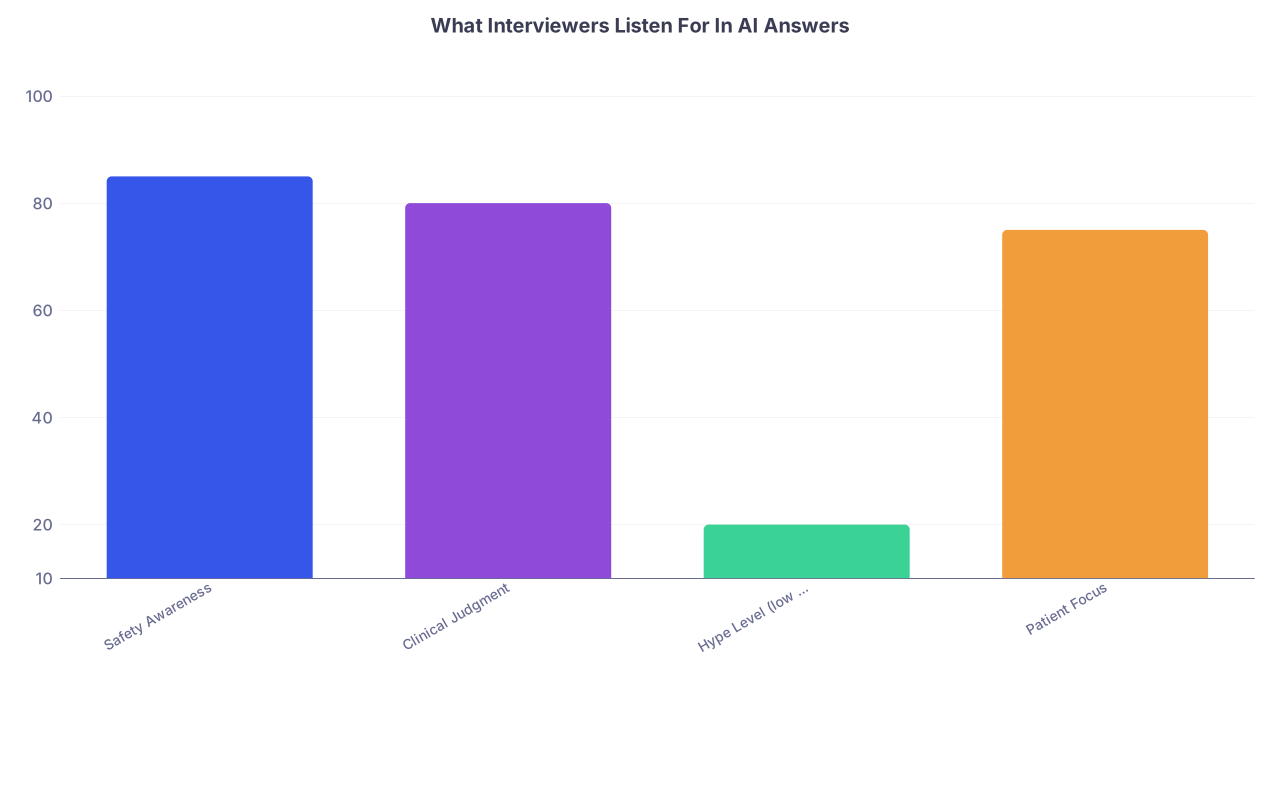
| Category | Value |
|---|---|
| Safety Awareness | 85 |
| Clinical Judgment | 80 |
| Hype Level (low is good) | 20 |
| Patient Focus | 75 |
FAQ (exactly 5 questions)
1. Do I hurt my chances if I say I’m skeptical about AI?
No—if your skepticism is thoughtful, not reactionary. Saying, “I’m skeptical of overreliance on AI because of issues like bias, lack of transparency, and the risk of eroding clinical skills, but I’m open to tools that prove safe and useful,” makes you look serious. Saying, “AI is bad and I don’t want it anywhere near my practice” makes you look out of touch.
2. What if I’m genuinely not that interested in AI? Do I have to pretend?
You don’t. You just can’t sound ignorant. A safe stance: “It’s not my primary passion area, but I recognize it’ll shape the future of healthcare. I want to be literate enough to use tools responsibly, ask good questions about them, and advocate for patients as they’re implemented.” That’s honest and mature.
3. Should I bring up AI myself, or only respond if they ask?
If your AI interest is real and backed by something (research, projects, reading), it’s fine to bring it up briefly when discussing future interests. Just don’t let it dominate every answer. If it’s more casual interest, wait until they ask—AI is a hot topic, it’ll come up often.
4. How technical do my answers need to be?
Not very. Mentioning “machine learning,” “large language models,” or “risk prediction tools” is plenty. Overdoing jargon (“transformers,” “gradient descent,” “attention mechanisms”) usually backfires unless your interviewer is deeply technical and invites that level of detail. Aim for “intelligent non-specialist.”
5. What if I get asked about a specific AI tool I’ve never heard of?
Admit it and pivot intelligently: “I’m not familiar with that particular tool, but I’m very interested in how these systems are validated and monitored. How has your institution found using it in practice?” Curiosity beats pretending. Turning it into a conversation also shows good interpersonal skills.
Key takeaways:
- Lead with specific problems, realistic uses, and clear risks—not generic AI hype.
- Emphasize safety, clinical judgment, and patient trust; position AI as a tool you’ll use wisely, not worship.
- Be honest about your level of expertise, but show you’re curious, teachable, and grounded in real patient care.