What actually changes in your career if you stop seeing one patient at a time and start re‑engineering the system using data?
That’s the real question behind “Is a Master’s in Biomedical Informatics worth it for clinicians?” Not the tuition number. Not the course list. It’s about whether this degree meaningfully upgrades your leverage, income, and long‑term relevance in a healthcare system that’s getting more algorithmic by the month.
Let me walk you through this like you’re a busy clinician who doesn’t have time for fluff.
The Short Answer: Who It Is and Isn’t Worth It For
For clinicians, a Master’s in Biomedical Informatics is usually worth it if:
- You want to move into clinical informatics leadership (CMIO, Associate CMIO, Informatics Medical Director).
- You’re serious about health IT, digital health, or data‑driven quality improvement as a core part of your career, not a side hobby.
- You like working with EHRs, workflows, decision support, and data projects more than adding another clinic half‑day.
It’s usually not worth it if:
- You just want a small salary bump and to keep doing the exact same clinical job.
- You’re not willing to step away from full‑time clinical to do more systems‑level work.
- You’re “informally techy,” but hate meetings, politics, and long‑term change projects.
If you’re looking for “Will I ROI 100% in 2 years just from salary?” — probably not. If you’re thinking “Will this unlock a fundamentally different career arc in a healthcare system that’s being rebuilt around data?” — for many clinicians, yes.
What a Biomedical Informatics Master’s Actually Does For a Clinician
Most clinicians think “informatics” means “EHR super user.” That’s cute, and wrong.
A good biomedical informatics program trains you to:
- Design and evaluate clinical decision support (CDS) that doesn’t annoy everyone.
- Understand data standards (HL7, FHIR, SNOMED, LOINC, ICD, etc.) well enough to build or fix real systems.
- Translate clinical problems into data, workflow, and product requirements for IT and vendor teams.
- Lead or co‑lead EHR implementations, optimization, and digital health projects without being lost.
You stop being “the doc who’s good with computers” and become “the person we need in the room for every major data/IT decision.”
That’s a different level of influence.
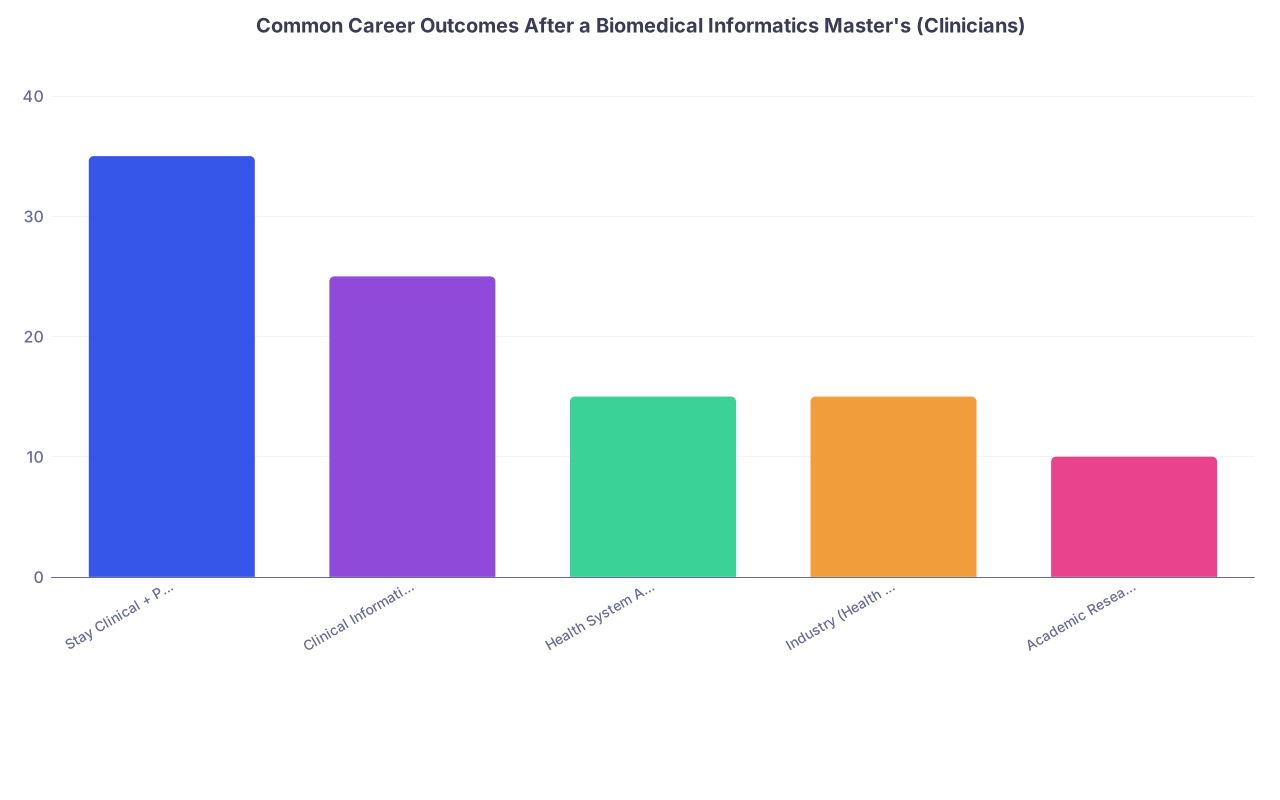
| Category | Value |
|---|---|
| Stay Clinical + Projects | 35 |
| Clinical Informatics Leadership | 25 |
| Health System Admin/Strategy | 15 |
| Industry (Health Tech) | 15 |
| Academic Research Focus | 10 |
Numbers are approximate, but this is the rough shape I’ve seen across programs.
Career Paths: What You Can Actually Do With It
1. Clinical Informatics Leadership
This is the classic path: clinician + informatics degree → CMIO track.
Example roles:
- Associate CMIO for ambulatory
- Medical Director for Clinical Informatics
- Service line informatics lead (e.g., ED, ICU, oncology)
- Quality and informatics hybrid roles
What you actually do:
- Lead EHR optimization projects.
- Design decision support: order sets, alerts, care pathways.
- Evaluate new digital health tools, AI tools, or vendor add‑ons.
- Mediate between clinicians and IT. Translation central.
Typical pay (US, ballpark ranges):
| Role | Typical Range (USD) |
|---|---|
| Full-time clinician (no leadership) | $220k–$450k |
| Clinical + informatics FTE mix | $250k–$450k |
| Associate CMIO / Med Dir Informatics | $280k–$500k |
| CMIO at mid/large health system | $350k–$650k |
| Industry medical director / informatics | $250k–$450k |
Will a master’s guarantee you CMIO? No. But without formal training, you’re fighting uphill against people who have both degrees and experience.
2. Staying Clinical With Added “Informaticist” Work
This is the sweet spot for many hospitalists, ED docs, primary care, anesthesiologists, etc.
You might:
- Keep 0.6–0.8 FTE clinical
- Do 0.2–0.4 FTE informatics / quality / data projects
You become the person who:
- Champions more rational order sets.
- Builds or tests predictive risk scores in the EHR.
- Helps deploy remote monitoring, telehealth workflows, or AI triage tools.
The master’s doesn’t just pad your CV — it makes you actually effective in those roles so you’re not winging it.
3. Health Tech / Industry Roles
If you’re burned out on clinical, or just more interested in building tools than fighting for RVUs, this path is very real.
Roles you’ll see:
- Clinical informatics lead at an EHR vendor or digital health startup
- Medical director for product or data science team
- Implementation or strategy lead for health IT consulting
This is where the degree + clinical background combo shines. You’re rare: you speak “clinic” and “SQL-ish” at the same time.
4. Academic and Research Tracks
If you’re planning to do:
- Outcomes research
- AI/ML in healthcare
- Population health analytics
- NIH-funded informatics work
Then a formal informatics degree is borderline mandatory at major academic centers. You’ll write grants, lead data‑heavy studies, and build tools that actually get deployed, not just stuck in a PDF.
Content: What You Actually Learn (and Why It Matters)
Most biomedical informatics master’s programs for clinicians cover:
Clinical informatics fundamentals
Workflow analysis, CDS design, EHR architecture.Data standards and interoperability
HL7, FHIR, terminologies, how systems actually talk to each other.Databases and basic analytics
SQL, data models, queries, dashboards, registries.AI / ML basics in healthcare
Enough to understand what’s real vs hype, and to work with data scientists.Human factors and usability
Why “just add another alert” is usually terrible design.
Some programs are more CS/AI heavy (e.g., Stanford BMI, Harvard DBMI). Others are more clinical informatics / applied (OHSU, Vanderbilt, AMIA-partnered programs).
You don’t need to become a pure programmer. But you should come out:
- Comfortable reading pseudocode and simple SQL.
- Able to define a data pull like: “All adults with HbA1c > 8.5% and no endocrinology follow‑up in the last 6 months.”
- Able to say “No, that model is statistically ‘good,’ but clinically useless.”
Time, Money, and Opportunity Cost
Let’s be blunt: this isn’t cheap.
Time
Common structures:
- 1 year full-time (intense, usually for residents/fellows or full career break).
- 2–3 years part-time, online/hybrid, while working clinically.
If you’re mid‑career, part‑time programs are more realistic and more common.
Money
Tuition ranges (US):
- Mid‑tier / online / state-affiliated: ~$25k–$50k total
- Big‑name private (Harvard, Stanford, etc.): $60k–$100k+ total
Then add:
- Lost clinical income if you cut shifts
- Travel and time for in‑person sessions (if hybrid)
Does it “pay back”? Not via a simple raise like “+$30k the day after graduation.” More like:
- You become the obvious choice for paid leadership roles.
- You get first dibs on system‑level projects, promotions, and external opportunities.
- You can pivot to industry or higher‑paying admin roles if clinical becomes unsustainable.
This is a career arc investment, not a coupon code.
Is This Better Than Just Doing a Clinical Informatics Fellowship?
For physicians, this is a real decision: master’s vs fellowship vs both.
Here’s the practical breakdown:
| Path | Pros | Cons |
|---|---|---|
| Clinical Informatics Fellowship | ABPM board eligibility, structured training, protected time | Lower pay during training, 2 years |
| Biomedical Informatics Master’s | Flexible, works mid‑career, industry-credible | No board eligibility by itself |
| Both (Fellowship + Master’s) | Strongest academic / CMIO track | Max time + cost |
If you want to be a board‑certified clinical informaticist (physicians only), fellowship is the formal path now.
If you’re:
- A PA, NP, RN, pharmacist, PT/OT, or other clinician
- A physician who doesn’t want another full fellowship
…then a master’s is usually the top option.
I’ve seen many MDs do: 1–2 years as “informal” informatics lead → master’s part‑time → formal leadership role. That works too.
Who Should Probably Not Do This Degree
Let me save you $60k.
It’s probably not worth it if:
You hate meetings and politics
Real informatics work is 20% data, 80% humans. If you don’t want to persuade colleagues, negotiate with IT, and present to committees, this will feel miserable.You just want to “be better at the EHR”
You don’t need a master’s for that. Ask for super user training, build templates, watch good YouTube channels, join your EHR optimization committees.You have zero interest in data, workflows, or systems
If reading about CDS, interoperability, or AI in healthcare makes your eyes glaze over, this is not your lane.You already have significant informatics leadership and industry options
Some senior clinicians are already de facto CMIO/VP equivalents. For them, a degree may be more “nice branding” than functional.
The Future of Healthcare: Why This Degree Is Getting More Valuable
Healthcare is clearly moving in a direction where:
- Algorithms, pathways, and risk scores guide more decisions.
- EHRs + digital front doors + remote monitoring define the patient experience.
- AI/ML tools are being thrown at every part of the system, often badly.
Someone has to:
- Decide which tools are safe, ethical, and not trash.
- Adapt them to local workflows.
- Monitor their impact, bias, and unintended consequences.
That “someone” cannot be just IT or data science. They don’t live in the clinic.
We’re heading toward a world where every major health system has:
- A strong clinical informatics department
- Clear physician and nurse informaticist roles
- Tighter integration with data science and AI groups
A master’s in biomedical informatics is essentially a bet that:
- These roles will expand.
- They’ll become more formal and better compensated.
- Clinicians who can speak data + care delivery will have disproportionate influence.
That’s a bet I’m comfortable making.

| Step | Description |
|---|---|
| Step 1 | Clinician |
| Step 2 | Skip degree, focus on clinical |
| Step 3 | Informal projects, no degree |
| Step 4 | Clinical informatics fellowship +/- masters |
| Step 5 | Part-time biomedical informatics masters |
| Step 6 | Interested in systems and data work |
| Step 7 | Want formal role in informatics |
| Step 8 | Physician and open to training |
How to Decide If It’s Worth It For You – A Simple Test
Ask yourself:
In 5–10 years, would I be happier:
- Seeing patients 9 sessions a week, with minimal systems influence
- Or 4–6 sessions + major influence on how care is delivered?
Do I get more energized by:
- A perfectly run clinic day
- Or fixing a broken process across the entire department, even if it takes months?
When leadership emails about “EHR optimization,” “CDS,” “data dashboard,” or “AI pilot,” do I:
- Delete
- Or think, “I want in on that”?
If you pick the second option consistently, the degree is very likely worth at least exploring seriously.
FAQs
1. Is a Master’s in Biomedical Informatics necessary to become a CMIO or clinical informatics leader?
Not strictly necessary, but it’s becoming close to the norm at larger systems. For physicians, ABPM clinical informatics board certification plus some formal training (often a master’s) is what many big hospitals expect for CMIO‑track roles. At smaller or rural hospitals, you may still rise based on experience alone, but the ceiling is usually lower and more fragile.
2. Do non-physician clinicians (NPs, PAs, RNs, pharmacists) benefit as much from this degree?
Yes — sometimes more. Many non‑physicians hit a ceiling in traditional clinical or admin ladders. Informatics gives them a distinct career track where their clinical background plus data/IT skills make them indispensable. Nurse informaticist, pharmacy informatics lead, clinical applications manager — these are very real, stable careers with influence and decent pay.
3. How technical do I need to be? I’m not a programmer.
You don’t have to be a full‑time software engineer. But you do need to be comfortable with:
- Basic programming or scripting concepts
- Reading or writing simple SQL queries
- Understanding how data flows through systems
If you’re allergic to anything that looks like code, this will be a grind. If you can tolerate learning some technical basics to be more effective, you’ll be fine. The goal is translation and design, not building entire systems solo.
4. What’s the difference between “Biomedical Informatics” and “Health Informatics” programs?
“Biomedical informatics” programs (especially at academic centers) tend to be:
- More rigorous on data, modeling, and research methods
- More tightly linked to CS, biostats, or data science departments
“Health informatics” programs vary wildly — some are excellent and applied, others are glorified EHR user courses with a master’s price tag. You have to read syllabi carefully. Look for:
- Courses in data standards, CDS, analytics, AI/ML in healthcare
- Faculty who actively work in informatics or data science
- Projects tied to real health systems or vendors
5. If I’m already doing informal informatics work, will this degree still help?
Yes, and probably a lot. Right now you’re likely reinventing wheels and learning on the job. A master’s gives you:
- Frameworks and proven methods instead of trial and error
- Credibility when you want more FTE, leadership, or a promotion
- A portable credential if you change institutions or move into industry
If you’re already the “informaticist” without the title, a formal degree often turns your unofficial work into an actual career path.
Bottom line:
If you’re a clinician who genuinely likes systems, data, and redesigning care — not just complaining about the EHR — a Master’s in Biomedical Informatics is one of the few degrees that can seriously shift your career trajectory in the next decade. It won’t magically fix burnout or instantly raise your salary, but it can move you from frustrated cog to architect of how care gets delivered. And that’s worth a lot.