Last year I sat in a conference room with three fellowship directors arguing over two applicants. On paper, they were nearly identical—same Step scores, same tier of residency, similar research productivity. One got ranked in the top five. The other barely made the list. The deciding factor? Not “work ethic.” Not “passion.” It was how convincingly they proved they could operate in a healthcare system that’s becoming more software than stethoscope.
Let me walk you through what actually happens behind those closed doors when fellowship directors look at so‑called “digital native” applicants. Because they are looking. And if you think your comfort with apps and social media automatically counts as a strength, you’re already missing half the game.
The Unspoken Shift: Why “Digital Native” Matters Now
Here’s the blunt truth: most current fellowship directors did not train in the world they’re now running. They grew up on paper charts, pagers, and dictation phones. Now they’re being forced to lead programs in a system built on EHRs, AI decision support, telehealth, remote monitoring, and quality dashboards.
That mismatch makes them nervous. Nervous leaders look for people who can protect them from looking obsolete.
“Get me someone who doesn’t freeze when IT rolls something out,” one interventional cardiology director said after a disastrous EPIC upgrade year. “I’m too old to be the guinea pig.”
So when you show up as a “digital native,” you’re not just the young person who can type fast. You’re being evaluated—often unconsciously—as:
- A potential translator between clinical reality and tech
- A risk (social media, data breaches, rogue ‘influencer’ behavior)
- A competitive asset (for research, innovation, reputation)
- A headache (if you come across as entitled, tech‑arrogant, or dismissive of older workflows)
Every decision they make about you in interviews, letters, and your CV is colored by that tension.
The First Secret Filter: Are You a “Tool User” or a “Toy User”?
Program directors won’t say this out loud, but I’ve heard the same phrase over and over in ranking meetings:
“Is this tech helping them take better care of patients, or is it just a toy they like to play with?”
They’re trying to separate two kinds of digital natives.
The toy user
This is the resident who can talk for ten minutes about the newest note‑taking app but can’t explain the hospital’s quality metrics. They brag about following “med Twitter” but don’t know their own length‑of‑stay data or complication rates.The tool user
This is the applicant who uses the same skills—coding, data analytics, social media fluency—but ties them to patient care, system improvement, or scholarship. The tech isn’t the point; it’s the leverage.
Directors look for specific signals you’re in the second group.
| Aspect | Tool User Signal | Toy User Signal |
|---|---|---|
| CV | Quality, outcomes, implementation projects | Endless “app” or “startup” fluff |
| Interview | Talks impact and workflow | Talks features and buzzwords |
| Letters | “Improved a process” | “Knows a lot about tech” |
| Online presence | Educational, measured | Edgy, reactive, attention‑seeking |
One oncologic surgery applicant I watched sail up the rank list had only modest research, but a killer story: he built a simple Python script that flagged cases where pathology data and operative notes didn’t match, and got pathology and surgery quality teams to actually use it. No app store. No startup. Just a basic tool that saved people time and caught errors.
That’s the archetype directors quietly want more of.
What They Scan Your CV For (That You Don’t Realize)
You think they’re just counting publications. They’re not. They’re pattern‑matching.
They look at your timeline and ask: “Does this person use digital tools to extend their clinical mind—or to distract from lack of depth?”
Here’s where they linger longer than you think:
1. Research and QI Projects That Touch Data
Fellowship directors are obsessed with who can handle data without melting down. Healthcare is drowning in it: registries, dashboards, outcome databases, AI outputs. They do not expect you to be a biostatistician. They do expect you to be literate.
They’re drawn to bullets like:
- “Used SQL/Python/R to extract and analyze…”
- “Built a simple dashboard to track…”
- “Led an EHR‑based QI project that…”
Not because they care what language you coded in, but because it tells them: this person won’t be helpless when the fellowship’s data scientist emails them a CSV and says, “Here’s the cohort, run with it.”
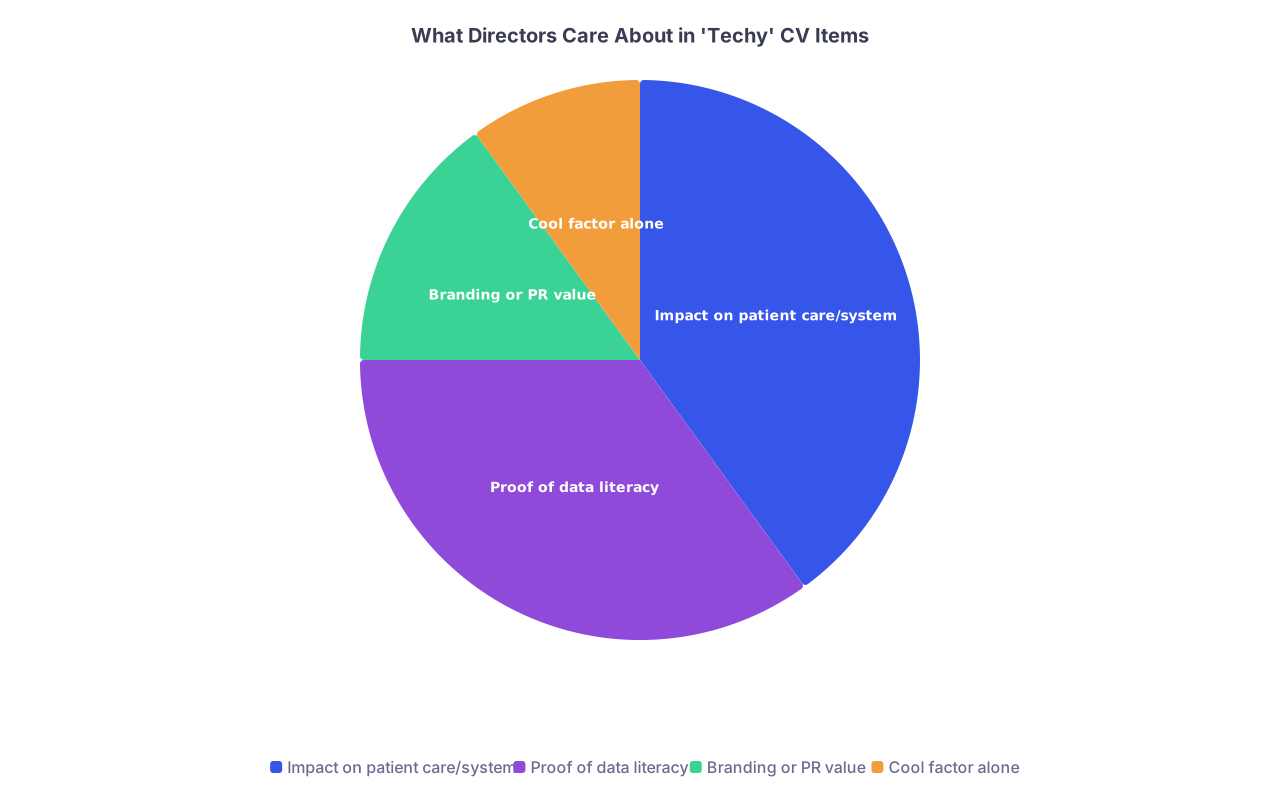
| Category | Value |
|---|---|
| Impact on patient care/system | 40 |
| Proof of data literacy | 35 |
| Branding or PR value | 15 |
| Cool factor alone | 10 |
2. Evidence You Can Survive the EHR Jungle
Nobody advertises this, but internal evaluations and hallway gossip carry a lot of weight. Directors informally ask:
“Is this person dangerous in the chart?”
“Do they document like a lawyer or like a teenager texting?”
If you’ve been a superuser, helped roll out an EHR change, fix templates, or teach co‑residents how not to drown in clicks—that moves the needle. Especially if a letter explicitly says:
“Dr. X became our go‑to resident for optimizing Epic templates; their changes decreased documentation time for our team and reduced note clutter.”
That reads as: safe, efficient, future‑proof.
Weak signal? “Tech savvy.” Strong signal? “Improved how we all use the EHR.”
3. Telehealth and Remote Care Experience
Many directors are still faking comfort with telehealth. They click Join Visit, pray the audio works, and hope nobody asks them about remote monitoring metrics.
They’re now being judged by their institution on:
- Telehealth no‑show rates
- Patient satisfaction scores
- Appropriateness of visits
- Billing accuracy
So an applicant who can say:
“I helped standardize our telehealth workflow for post‑op visits and reduced our no‑show rate from 18% to 7% over six months”
suddenly looks extremely valuable. You just told them you understand efficiency, patient behavior, and digital care delivery. That’s not fluff. That’s money, quality metrics, and reputation.
The Social Media Double‑Edged Sword
Let’s talk about the part nobody will be honest with you about in public: your digital footprint.
Some fellowship directors Google every applicant. Others pretend they don’t. Their faculty do. Their coordinators do. Residents do. Someone looks, and those impressions leak into the ranking conversation.
Here’s the calculation they’re making in their head:
“Is this person a future asset or a future PR risk?”
I sat in a meeting where an applicant’s rank position dropped ten spots because a senior faculty member said, “I don’t want to work with the guy who subtweets his attendings.” The applicant never named anyone. But the tone was unmistakable: contempt, snark, victimhood. It was enough.
On the flip side, a pulmonary/critical care applicant with a modest but professional presence—short case pearls, links to guidelines, no drama—got praise from an older director who barely uses email properly: “She looks like someone we could put on a panel, she presents herself very well online.”
Translation: safe to hand a microphone, safe to feature in institutional PR.
What “Good” Looks Like to Them
They’re not looking for follower counts. They’re scanning for:
- Emotional tone (measured vs reactive)
- Professional boundaries (no selfies with intubated patients, no mocking families, no HIPAA landmines)
- Respect for colleagues (no vague‑booking about “toxic attendings”)
- Signal of educator potential (threads, explainer posts, patient education, link to institutional work)
If you ever blew off steam online during residency, now is the time to scrub or lock it down. Directors may never confront you directly about it. They’ll simply drop your rank a tier and you’ll never know why.
The Quiet Fetish: Data‑Comfortable, Not Data‑Obsessed
There’s a specific type many fellowship directors secretly love: the resident who is comfortable with data, but not intoxicated by it.
You’ve probably seen the opposite. The PGY‑3 who can’t have a clinical discussion without referencing an obscure preprint, three subgroup analyses, and a p‑value to four decimal places. That person often gets labeled as “smart but exhausting.” Directors are wary of those.
What they want instead:
- Someone who can pull their own data from departmental databases or EHR reports
- Someone who can talk to biostats without sounding either arrogant or lost
- Someone who understands that models—even AI—are tools, not oracles
In ICU fellowships, cardiology, oncology, you’re going to be working with or around predictive analytics tools. Sepsis alerts. Readmission scores. Risk calculators.
The secret screening question in interviews is often: “Does this person look like they’ll blindly trust a model, or reflexively reject it?”
They’re searching for the middle: the fellow who’ll ask, “Show me the validation data, the population, the false positive rate,” and then integrate it with bedside judgment.
How They Read Your “Innovation” and “Startup” Stuff
A lot of digital natives come in hot with startup talk. Hackathons. Pitch competitions. App prototypes. Directors’ reactions to this are very mixed.
Some love it. Many are skeptical. A few are outright turned off.
Why? Because they’ve seen the same pattern too many times: grand ideas, minimal follow‑through, no actual implementation.
Here’s how they subconsciously sort your innovation bullet points:
Tier 1 – Implemented, used, improved care
“Co‑developed a digital triage tool now embedded in clinic workflow; reduced wait times by X%.”Tier 2 – Piloted with real users, evaluated
“Led pilot of symptom‑tracking app with 50 CHF patients; measured adherence, readmissions, and patient satisfaction.”Tier 3 – Built thing, never left the sandbox
“Created app for medication reminders during a hackathon.”Tier 4 – Idea only, buzzword salad
“Interested in leveraging AI and blockchain to revolutionize…” (this is where eyes glaze over)
If you’re heavy on Tiers 3 and 4, frame them as early experiments and emphasize what you learned about implementation difficulty, regulation, UX, data security. Otherwise it reads as: “Plays with toys, doesn’t finish.”
How Directors Use You to Future‑Proof Their Programs
Here’s a candid line I heard from a cardiology fellowship director at a private, mid‑sized program:
“We need at least one fellow each year who can actually work with the new registry and not hate it.”
That’s the strategy at many places now. They’re not trying to make the whole program tech‑obsessed. They’re trying to build a portfolio of fellows:
- The researcher
- The workhorse clinician
- The future division chief
- The educator
- The digitally fluent builder
If you can credibly occupy that last role, you become disproportionately valuable.
Directors think things like:
- “This applicant could be our go‑to for the new AI decision support rollout.”
- “This person can be the liaison between IT and the fellows.”
- “We could put their name on our telehealth expansion project.”
That’s how you quietly jump 10–15 spots on a rank list without more papers or a better Step score.
How to Signal the Right Kind of “Digital Native”
So how do you present yourself as the kind of digital native fellowship directors actually want?
1. Anchor Everything to Patient Care or System Improvement
Do not talk about tech for its own sake. At all.
Instead of: “I’m really interested in AI in radiology.”
Say: “I’m interested in how AI triage tools might change which patients we call back sooner—and how we make sure they don’t amplify existing disparities.”
Instead of: “I built an app for medication adherence.”
Say: “I worked on a prototype that helped us test which reminders patients actually respond to; we learned SMS worked far better than app notifications for our older population.”
You’re signaling: I understand context, tradeoffs, and human behavior—not just code.
2. Show You Can Work With Non‑Tech People Without Being a Jerk
Directors are looking for a specific interpersonal attribute: can you introduce new processes without alienating the nurse who’s been here 20 years or the attending who still uses a pocket PDA?
Examples that impress:
- “I worked with our clinic nurses to design an EHR template that mirrored their old paper workflow so the transition was less painful.”
- “We held short lunch‑and‑learn sessions and collected feedback after two weeks, then revised the tool based on what the staff told us.”
That’s gold. That says: this person doesn’t confuse being right with being effective.
3. Be Ready With One or Two Clean Digital Stories
In interviews, they’ll throw you softballs that are really tech questions in disguise:
- “Tell me about a systems problem you helped improve.”
- “What are you most proud of outside of pure clinical care?”
- “How have you used data in your work?”
You should have at least one story that clearly demonstrates:
- Identification of a problem
- Use of some digital tool/data/tech skill
- Collaboration with others
- Measurable result (even small)
- Reflection on what you’d do differently
No jargon dump. No buzzwords. Just a clear arc.

| Step | Description |
|---|---|
| Step 1 | Problem |
| Step 2 | Tech or data approach |
| Step 3 | Collaboration |
| Step 4 | Result or impact |
| Step 5 | What you learned |
Run your answers through that structure and you’ll come across as intentional, not gimmicky.
4. Clean Up and Curate Your Online Presence
Do not overcomplicate this. You don’t need to become an influencer. You do need to avoid looking reckless or immature.
Bare minimum:
- Lock down or clean any personal accounts with venting, partying, or snark about work
- Ensure professional profiles (LinkedIn, any public X/Instagram/YouTube) are calm, informative, and controversy‑free
- If you do any public education, make it easy to find a few good examples—directors love to show off fellows who look good externally
Think of it this way: could they comfortably put your Twitter handle on a slide labeled “Our Fellows” in front of the CMO? If the answer is no, fix it.
Where This Is All Headed (And What That Means For You)
The “future of healthcare” tag gets abused a lot, but in fellowships it has a concrete meaning: your training years will sit right on the inflection point of how digital medicine actually gets integrated—or fails.
Fellowship directors are under pressure from above to:
- Participate in registries and quality reporting
- Incorporate AI tools “because the system bought them”
- Expand telehealth
- Show data‑driven outcomes to justify their existence
They’re under pressure from below (residents and fellows) to:
- Modernize workflows
- Offer experience with new tools
- Support academic productivity using large data sets
You, as a digital native, are being hired not just as labor, but as a bridge.
If you show them you can be:
- Technically comfortable but not arrogant
- Data‑literate but not blinded by numbers
- Social‑media aware but not reckless
- Innovation‑minded but respectful of implementation reality
—you’ll quietly float to the top of rank lists, even in programs that swear all they care about is “fit” and “clinical excellence.”
They still care about those. They just increasingly define “excellent” as “able to thrive in a healthcare system that runs more and more on screens and code.”
FAQ
1. I’m not a coder or data scientist. Can I still be seen as a strong “digital native” applicant?
Yes. Directors don’t need you to write production‑level code. They want proof you’re not afraid of data or new tools. A solid EHR‑based QI project, experience optimizing templates, or leading a telehealth workflow change can signal exactly what they’re looking for without a single line of Python.
2. I have an old social media account with some questionable posts from early med school. Do programs really care?
Some won’t check. Some will. The problem is you’ll never know which. Clean or lock it down. Anything that looks disrespectful to patients, colleagues, or institutions can quietly hurt you. No one will email you about it; your rank will just drop.
3. How do I put “techy” things on my CV without sounding like hype?
Anchor every item to a concrete outcome: time saved, errors reduced, adherence improved, education delivered. “Built a dashboard that reduced weekly report prep time from 2 hours to 20 minutes” reads far better than “Developed an innovative dashboard leveraging advanced analytics.”
4. Is it worth doing a separate informatics or data‑science degree to be competitive?
Only if you genuinely want that training. Most fellowship directors don’t require it. A focused portfolio of real projects using existing tools in your hospital often impresses them more than another degree—especially if you can tell clear stories of implementation, not just coursework.