The robotics buzz in medicine is badly overrated—and program directors are far less impressed than you think.
If you are banking your application on a flashy “robotics in healthcare” project, you are walking straight into one of the most common hype traps I see.
You are not competing against your classmates. You are competing against what PDs have already seen go wrong: a decade of shallow robotics posters, nonfunctional demos, and “AI-robot” buzzwords slapped on basic Arduino kits. They are tired of it.
Let me walk you through the mistakes that quietly sink otherwise decent applications—and how to avoid wasting hundreds of hours on tech projects that do nothing for you.
The Core Misconception: “Tech = Impressive”
The biggest mistake: assuming that anything involving robotics or AI automatically looks impressive to PDs.
It does not.
Faculty and PDs have been pitched the same story repeatedly:
- “We built a robotic assistant for the ICU.”
- “Our low-cost surgical robot could transform care in low-resource settings.”
- “We developed an AI-robot triage system.”
Then they see:
- No deployment
- No validation
- No actual clinical use
- A single poster at a minor conference and then… nothing
They learn very quickly: tech buzzwords are cheap. Outcomes are not.
What actually moves the needle:
- Clear clinical problem
- Real feasibility
- Evidence that you can execute and finish something
- Honest understanding of limitations
If your “robotics project” is a tech toy with a clinical fig leaf, PDs will smell it in about 20 seconds.
The Robotics Hype Trap: 7 Project Types That Do Not Impress
Here is where students get burned. Repeatedly.
1. The “Arduino With a Stethoscope” Project
You know this one. A team builds a small wheeled robot or arm that:
- Follows a line
- Avoids obstacles
- Maybe holds a stethoscope or syringe
Then they add “for use in hospitals” to the title and frame it as healthcare innovation.
PD red flags:
- No regulatory awareness (FDA, IEC standards, basic safety concerns)
- No IRB, no clinical pilot, no end-user feedback
- No cost or maintenance analysis
- Vague endpoints like “could someday reduce staff workload”
Translation in a PD’s head: “Undergraduate robotics project rebranded as medicine.”
If your robot could appear at a high school STEM fair with almost no changes, it is not a serious healthcare project.
2. The Untested “Smart Hospital Delivery Robot”
The premise: a robot that moves meds/supplies/food around the hospital. Sounds useful. In reality, most of these projects die for the same reasons:
- No integration with pharmacy, EMR, or logistics
- No solution for elevator access, secured doors, or safety clearances
- No infection control plan
- No realistic cost justification vs. existing porters or pneumatic tube systems
Students show a video of a robot moving down a hallway in a lab. PDs have seen that video a hundred times. They know what is missing: the ugly operational details.
If you cannot explain:
- Who maintains it
- Who fixes it at 3 a.m.
- What happens when it fails mid-route
- Who is legally liable for a mis-delivered medication
you are not pitching a clinical robotics project. You are pitching an idea.
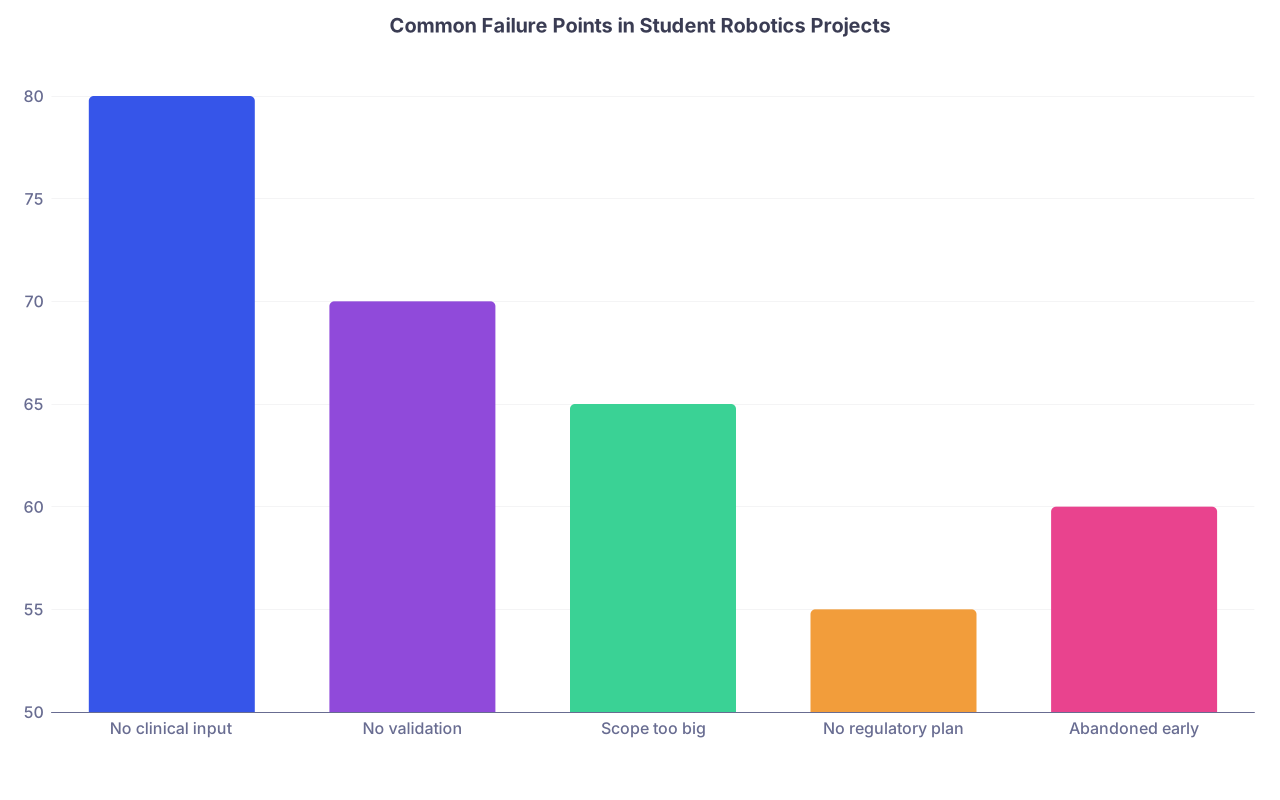
| Category | Value |
|---|---|
| No clinical input | 80 |
| No validation | 70 |
| Scope too big | 65 |
| No regulatory plan | 55 |
| Abandoned early | 60 |
3. The Non-Clinical “Surgical Robot” Attachment
Another trap: students bolt something cheap onto a simulator or robotic platform and call it “advancing surgical robotics.”
Common versions:
- 3D-printed instrument holder for a benchtop trainer
- Add-on haptic feedback prototype “for robotic surgery” that never touches an OR
- DIY camera systems for a laparoscopic box trainer
Individually, these are fine student engineering exercises. What they are not: evidence that you understand surgical robotics in an actual clinical ecosystem.
What surgeons and surgical PDs notice missing:
- No testing on real cases, or even recorded case videos
- No human factors work
- No evaluation of workflow disruption
- No discussion of sterilization, durability, or OR compatibility
So when a student writes “developed a novel surgical robot system,” but the details reveal no proximity to real surgery, it feels inflated. And inflation kills credibility.
If your work never left a lab table or a SimLab closet, say so. Call it what it is: early prototyping, simulator work, or instrumentation design—not “transforming surgical care.”
The “Poster Factory” Robotics Project
This category hurts applicants the most because it wastes enormous time for very little return.
Pattern:
- Big, ambitious robotics or AI-robot idea
- Rapid early excitement
- Rush to generate something, anything, that can be presented
- Tiny, uncontrolled pilot in an artificial setting
- Poster at a regional meeting with grand language
Then it dies.
PDs are used to seeing CVs full of one-and-done robotics or AI posters with no follow-up:
- 2021: Prototype robot for vital sign monitoring
- 2022: Smart wheelchair navigation aid
- 2023: AI-robot triage assistant
No paper. No longitudinal work. No sustained line of inquiry. Just tech tourism.
They ask themselves: Is this person committed to solving hard problems, or just chasing cool gadgets?
Repeated shallow projects make you look unfocused and easily distracted by shiny objects. PDs in any field—IM, surgery, EM, neurology—care more about depth than the topic itself.
If your robotics exposure is:
- One short summer project
- A single poster with “preliminary results”
- No continued involvement after the abstract
then do not oversell it as the centerpiece of your scholarly identity.
Mistakes in How You Present Robotics Work
Even when the underlying project is decent, many applicants sabotage themselves with how they frame it.
1. Buzzword Overload
If your abstract or ERAS entry reads like this:
“Developed an AI-enhanced robotic platform leveraging machine learning, IoT, and cloud-based analytics to optimize patient-centered care delivery”
you have already lost them.
PDs want to know:
- What specifically you did
- What actually worked
- What you measured
- What changed in patient care or workflows (even in a simulated way)
Every time you write “AI-driven” or “revolutionary,” you better have something solid behind it. Most do not.
2. Vague Personal Role
Another fatal error: no clarity about what you actually did.
I see entries like:
“Collaborated on development of a novel robotic platform for ICU monitoring.”
What does that mean?
- Did you code?
- Did you collect data?
- Did you run user testing with nurses?
- Were you just in the Slack channel?
PDs assume the least flattering interpretation when it is vague.
If you mostly:
- Labeled images
- Assembled off-the-shelf hardware
- Ran a pre-written script
- Helped with a poster layout
then say so clearly, and highlight whatever real responsibility you did own.
Vagueness reads like padding.
3. Overclaiming Clinical Impact
Students often jump straight from prototype to “this could transform healthcare in low-resource settings.”
Red flags:
- No implementation in any real low-resource setting
- No cost analysis
- No training or maintenance plan
- No acknowledgment of infrastructure needs (electricity, connectivity, repairs)
Faculty who actually work in low-resource environments find this particularly irritating. They have seen too many “innovations” that never survive outside a conference presentation.
If your project never left a well-funded university lab, do not pretend it is ready for rural clinics.
Robotics That Does Impress PDs (And Why)
Robotics itself is not the problem. The problem is superficial robotics.
I have seen robotics projects that genuinely helped applicants stand out—but they shared very specific characteristics.
1. Ruthlessly Narrow Scope
Impressive projects usually solve one small, concrete problem well. For example:
- Improving stability and ergonomics of a specific instrument holder on a laparoscopic trainer, tested with 12 residents and quantified performance changes
- Building a simple, robust, low-cost positioning device for ultrasound probes, with clear metrics on reproducibility and time to set up
- Adding a safety interlock to an existing clinical device, validated by bench testing and user feedback
These are not sexy TED-talk ideas. They are boring, practical, and real. PDs love boring, practical, and real.
2. Clear Clinical Partner and Feedback
Serious robotics work in medicine always has:
- A specific clinical champion: “worked with Dr. X in colorectal surgery”
- Real end-user input: “iterated after feedback from 7 ICU nurses and 3 respiratory therapists”
- Demonstrable use in a realistic environment: sim lab, OR observation, ICU bedside trial, etc.
If your only collaborators were other students and an engineer, the project lives in an academic bubble. You want the fingerprints of busy clinicians on your work.
3. Honest, Measurable Outcomes
The strongest robotics projects often have modest-sounding but concrete results:
- “Reduced average setup time for procedure by 20% in a simulated environment”
- “Improved inter-operator consistency of probe position from X mm to Y mm”
- “No device failures over N simulated procedures”
No grand “transformative” claims. Just hard numbers and clear limits.
| Aspect | Weak Project Signal | Strong Project Signal |
|---|---|---|
| Scope | Huge, vague “reinvent hospital logistics” | Narrow, specific task or workflow |
| Clinical involvement | None or single e-mail from physician | Ongoing input from specific clinicians |
| Environment | Only lab bench / classroom | Sim lab and/or pilot in clinical-like setting |
| Outcomes | “Could improve care” | Defined metrics with pre/post or comparative data |
| Continuity | One poster, then dead | Multi-semester work, evolving prototypes |
How To Avoid Wasting Your Time on Empty Robotics Projects
You can absolutely work in robotics and not fall into the hype trap. But you must be ruthless early.
Step 1: Interrogate the Clinical Problem First
Before touching a motor or writing a line of code, ask:
- Who exactly is the user? Nurse? RT? Surgeon? Patient?
- What do they currently do without your robot?
- How often does this problem actually occur?
- What happens if nothing changes?
If you cannot answer those without hand-waving, you do not need a robot. You need to go shadow and listen.

| Step | Description |
|---|---|
| Step 1 | Idea for robotics project |
| Step 2 | Define specific clinical user |
| Step 3 | Shadow and interview clinicians |
| Step 4 | Drop or rethink project |
| Step 5 | Find clinical champion |
| Step 6 | Define narrow, testable outcome |
| Step 7 | Design minimal prototype |
| Step 8 | Test with real users in realistic setting |
| Step 9 | Can you describe current workflow in detail |
| Step 10 | Is robotics clearly better than low tech fix |
If you get stuck at “better than a low-tech fix” (e.g., a cart, checklist, container, or simple protocol change), kill the project. PDs respect that judgment.
Step 2: Demand Real Ownership of Work
Do not sign onto a robotics project where your role is basically “extra hands.”
Ask explicitly:
- Which part will I be responsible for end-to-end?
- What will exist only because I did it?
- How will we evaluate whether my component works?
If the answer is “you will help with everything” or “just join the team; we will see,” that usually means you will be a peripheral contributor with little to say on interviews.
You are better off with a smaller, more defined sub-project you fully own.
Step 3: Plan for One Real Output, Not Five Shaky Ones
Another trap: spreading yourself across multiple half-baked robotics/AI ideas.
A protective strategy:
- One primary robotics project
- One clear milestone: submission-ready manuscript, completed pilot, robust device testing, or grant proposal
- Willingness to say no to side ideas that fragment your time
PDs are far more impressed by:
- 1 well-executed, clinically grounded robotics project
than by:
- 4 unrelated posters with no depth
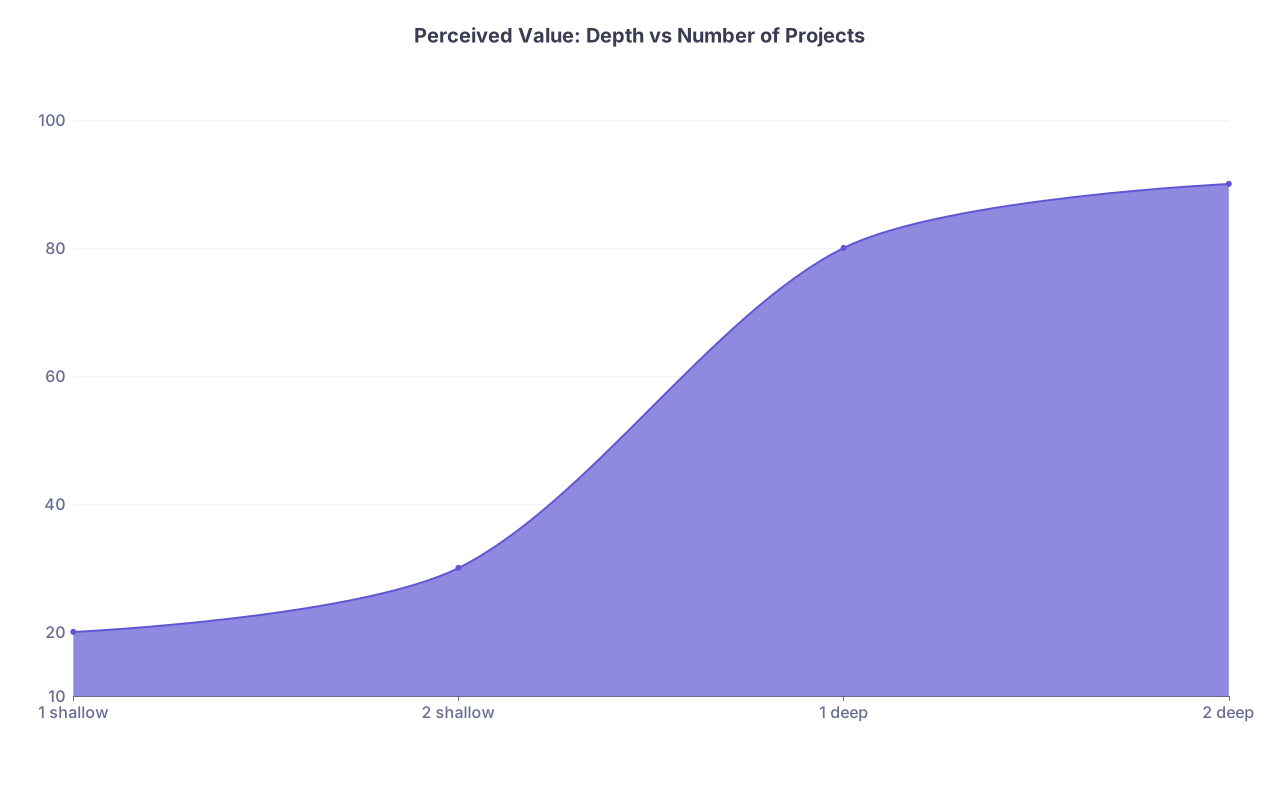
| Category | Value |
|---|---|
| 1 shallow | 20 |
| 2 shallow | 30 |
| 1 deep | 80 |
| 2 deep | 90 |
Step 4: Write Your ERAS/CV Description as If a Cynical PD Is Reading It
Because they are.
Before you commit months to a robotics project, draft the 3–4 line ERAS description you would ideally write at the end. Read it brutally:
Bad version:
“Led development of innovative AI-powered healthcare robot that could transform patient care delivery in the ICU.”
Better version:
“Designed and implemented a low-cost robotic arm attachment for stabilizing ultrasound probes during central line simulations; tested with 10 residents, reducing probe adjustment time by 25% in a standardized task.”
The second one may sound less flashy to you. To PDs, it screams:
- You understand specificity
- You measured something real
- You finished something
If you cannot imagine a concrete, honest end-point description before you start, that is a warning sign.
Red Flags That Your Robotics Project Will Not Impress
Here is the short, blunt checklist. If you see multiple of these, reconsider.
- No named clinician partner; just “our team”
- Project leader has no track record of finishing anything
- No clear evaluation metric beyond “feasibility”
- No plan for deployment even in a sim lab or pilot
- Lots of talk about patents, startups, and disruption, but no talk about user workflow
- Your role is “helping with hardware/software” with no defined task
- The first three slides of the pitch deck mention “AI,” “cloud,” and “IoT,” but not a single nurse, RT, or MA
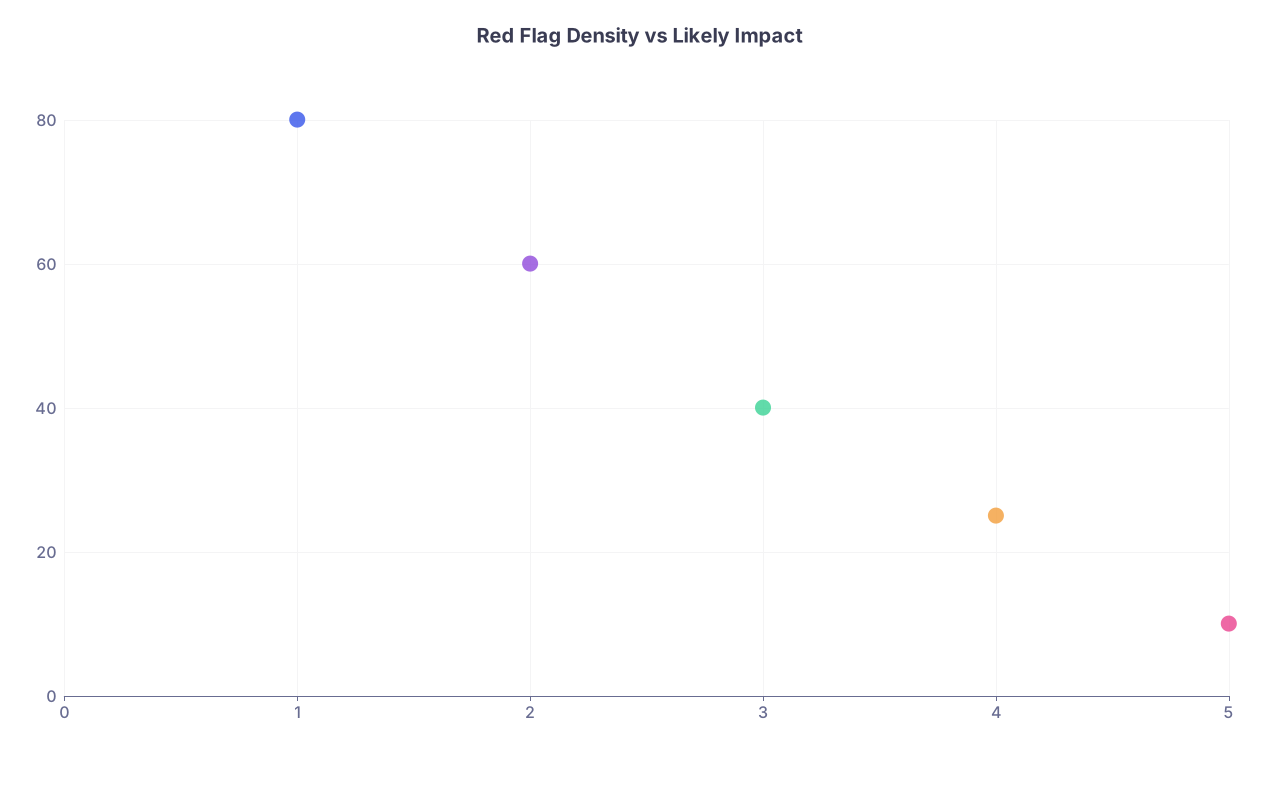
| Category | Value |
|---|---|
| Proj A | 1,80 |
| Proj B | 2,60 |
| Proj C | 3,40 |
| Proj D | 4,25 |
| Proj E | 5,10 |
High red-flag density correlates strongly with “great coffee chat story, weak PD impression.”
Final Reality Check
I am not anti-robotics. I am anti-wasting-your-time-on-performative-robotics.
You want to be the applicant who:
- Knows the difference between a demo and a deliverable
- Chooses gritty, clinically grounded work over shiny slides
- Can explain precisely what you built, measured, and learned—without hiding behind buzzwords
Because PDs are not looking for the next Silicon Valley keynote speaker. They are looking for residents who can identify real problems, work honestly, and finish what they start.
FAQ (5 Questions)
1. Does doing any robotics project help for competitive specialties like neurosurgery or ortho?
Only if it is serious, clinically anchored, and shows depth. A shallow robotics project will not rescue a weak application in neurosurgery, ortho, or any other competitive field. Strong letters, clinical performance, and consistent scholarly work matter more than the word “robotics” on your CV.
2. Is it better to skip robotics entirely if I cannot find a good clinical partner?
Usually yes. You are far better off doing high-quality outcomes research, QI, or traditional clinical projects with strong mentorship than forcing a solo robotics project that is disconnected from reality. Tech without clinical grounding impresses engineers more than PDs.
3. I already did a weak robotics project. Should I leave it off my application?
Not automatically. If you can describe your role honestly and concisely without exaggeration, it is fine to include. Just do not center your narrative on it. Place more emphasis on projects where you had clear ownership and meaningful results, even if they were non-tech.
4. Do I need publications from a robotics project for it to matter?
A publication helps, but it is not mandatory. What matters more is evidence of real progress: rigorous testing, clear outcomes, iterative design with clinicians, and continuity over time. An honest, well-done, unpublished robotics project can still look strong if presented clearly.
5. How do I talk about robotics in interviews without sounding like I am overhyping it?
Be specific, modest, and transparent about limitations. Focus on: the problem you targeted, what exactly you built or did, how you evaluated it, what did not work, and what you would change. If you say, “This was a small, early-stage project, but it taught me X about clinical workflows and Y about working with nurses and engineers,” you will come across as mature, not naive.
Key points to remember:
- Robotics and AI do not impress PDs by default; depth, realism, and honesty do.
- Shallow, hype-driven tech projects can quietly damage your credibility.
- A small, clinically grounded, well-finished project beats five flashy but empty robotics posters every time.