You’re on night float, it’s 2:15 a.m., and the senior is rattling off a plan that includes “throw it into MDcalc, check if Epic flags sepsis, and see if the AI note writer catches anything we missed.” You’re still trying to remember the MELD score and suddenly everyone’s talking about machine learning, digital health, and “data-driven care.”
You do not have time to learn everything. So the real question is: which “future-of-medicine” skills are actually worth investing in now, during med school, and which can wait (or be ignored entirely)?
Here’s the straight answer.
The Core Principle: Learn Skills That Compound, Not Buzzwords That Expire
You’re not trying to become a full-stack engineer. Or a prompt-engineer. Or the blockchain-doctor of LinkedIn.
You want three things:
- Skills that make you better at caring for patients today.
- Skills that will still matter 10–20 years from now.
- Skills that give you leverage: more impact per unit of effort.
To keep this concrete, let’s look at key “future” skill areas and sort them into three buckets:
| Skill Area | Priority for Med Students | Time Investment |
|---|---|---|
| Clinical Data Literacy | Essential | Moderate, ongoing |
| Using AI & Clinical Decision Tools | Essential | Low–Moderate, ongoing |
| Digital Health / Telemedicine | High | Low, focused |
| Practical Coding / Automation | Medium (selective) | Moderate, optional |
| Research Methods & Causal Thinking | Essential | Moderate, built-in |
| Blockchain / Crypto / NFTs | Low | Skip for now |
That’s the map. Now the details.
Skill #1: Clinical Data Literacy (Non‑Negotiable)
If you only seriously invest in one “future” skill, make it this one.
Not “learn R and build random forests.” I mean: understand data well enough that you’re not blindly trusting whatever some app or algorithm spits out.
You should be comfortable with:
- Risk prediction vs diagnosis
- Calibration vs discrimination (is the model giving realistic risk, not just ranking people?)
- Sensitivity/specificity vs PPV/NPV in real-world prevalence
- How bias enters models (garbage in, garbage out—but more subtle)
This is where your biostats and EBM courses either matter or they don’t. Most schools teach p-values and Cox models; very few teach you how that translates into a deployed sepsis alert in your EMR.
What to actually learn:
- How clinical prediction models work at a high level. Not the math—just structure: input features, training data, output risk.
- The difference between “this test is associated with” and “this test causes.”
- How to read a model paper and ask:
- What population did they train on? Is that my patient?
- How was it validated? Internally only, or external dataset?
- How well calibrated is it? Does a “20% risk” actually mean 20 out of 100?
If you want structure, I’d aim to be able to read and explain one solid paper on:
- A sepsis prediction model
- A readmission risk model
- A cardiovascular risk calculator update
Once you can explain those to a classmate without hand-waving, you’re in a good spot.
Skill #2: Using AI & Clinical Decision Tools Safely and Effectively
You do not have to build AI systems. You do have to live with them.
The near future of medicine is not “doctor replaced by AI.” It’s “doctor working with 3–5 layers of decision support, risk scores, and auto-drafted notes—some of which are quietly wrong.”
So your actual job is to become very good at:
- Knowing when to trust AI-driven tools.
- Knowing when to override them.
- Knowing how to explain these tools to patients and colleagues.
Types of tools you’ll see (or already see):
- EMR-based risk scores (sepsis alerts, early warning scores, readmission risk).
- Imaging triage (AI marking critical CT head bleeds).
- Note-generation and coding assistants.
- Triage/chat tools in outpatient portals.
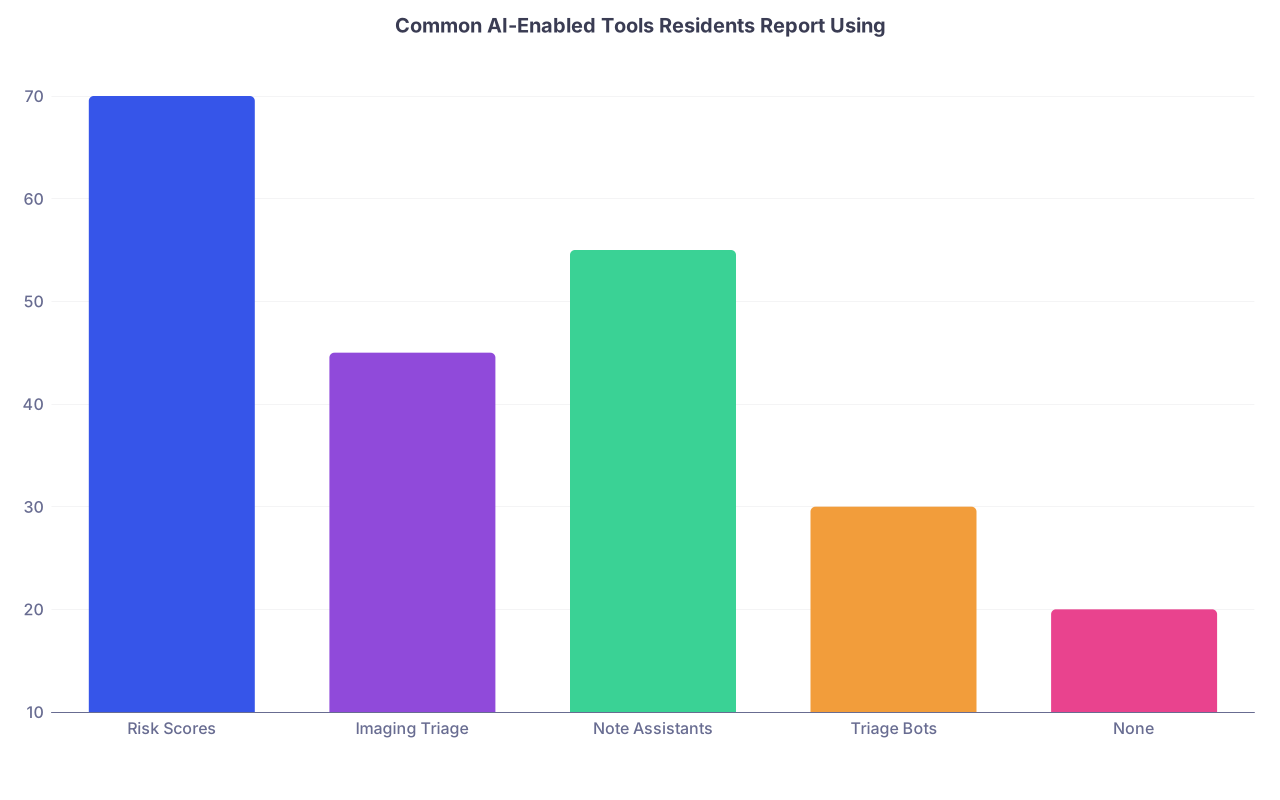
| Category | Value |
|---|---|
| Risk Scores | 70 |
| Imaging Triage | 45 |
| Note Assistants | 55 |
| Triage Bots | 30 |
| None | 20 |
What’s worth learning as a med student:
How these systems can fail:
- Distribution shift: model trained on one hospital/population, used on another.
- Gaming: staff unconsciously document to “make the score look better.”
- Alert fatigue: good alerts get ignored because of too many bad ones.
Basic “model governance” questions:
- Who is responsible when the model is wrong? You need a mental answer.
- Where is the training data from? Are some groups underrepresented?
- What happens if I ignore this recommendation?
Real-world use:
- During rotations, ask: “How well does this alert actually perform here?” Nurses and residents will tell you the truth.
- Notice patterns: are there patient groups it systematically overcalls or undercalls?
Practical move right now: pick a single AI or clinical decision tool you encounter (e.g., Epic sepsis best-practice alert), read the original validation paper if possible, then watch 10–20 real cases and see how often it’s right or useless. That’s your “future of medicine” lab.
Skill #3: Digital Health & Telemedicine – Learn the Workflow, Not the Hype
Telemedicine is not going away. Remote monitoring is not going away. Patient-generated data from wearables—not going away.
But you don’t need to become the guru of every gadget. You just need to understand:
- What problems these tools actually solve.
- Where they break care.
- How to run a good virtual visit.
Core competencies worth having:
Telemedicine etiquette and structure
- How to do a proper history over video or phone.
- What physical exam maneuvers are realistic remotely (and what’s fantasy).
- How to safety-net: “Here are three reasons you should go to the ED tonight instead of waiting.”
Remote monitoring sanity checks
- Understanding what home BP monitoring can and can’t tell you.
- Basics of CGMs, wearables, and their levels of reliability.
- How to stop the flood of meaningless data: specify what you actually care about (e.g., trend of average BP over 2 weeks, not each reading).
Asynchronous care
- Patient portal messages, refill protocols, follow-up systems.
- Clear boundaries for what’s appropriate for messaging vs in-person.
You can learn 80% of this by:
- Doing a tele-rotation if your school offers it.
- Watching a good attending run a high-quality video visit and dissecting their structure.
- Reading your institution’s telehealth documentation policies (yes, the boring part).
Skill #4: Practical Coding & Automation – Optional, but High Leverage for Some
Coding is not mandatory. Don’t let the Twitter doctors guilt you into thinking you must learn Python to be relevant.
But for a subset of students, learning basic coding and automation is absolutely worth it. Because it gives you leverage to:
- Pull and analyze your own clinical data for quality improvement or research.
- Build small tools that save your team real time (e.g., scripts to clean data, auto-generate reports).
- Communicate effectively with engineers and data scientists without getting snowed.
Three realistic levels:
| Level | What You Can Do | Time Needed |
|---|---|---|
| Level 0: User | Use existing tools, no code | None |
| Level 1: Scripter | Simple Python/R scripts, basic SQL | 20–40 hours start |
| Level 2: Builder | Small apps/dashboards with a team | 100+ hours |
My honest recommendation:
- Everyone: reach Level 0 (obviously).
- If you’re interested in academic medicine, QI, or informatics: at least Level 1.
- Only go to Level 2 if you truly enjoy it.
At Level 1, focus on:
- Python or R (pick one, stop debating).
- Basic data handling: CSVs, simple stats, plotting.
- Light SQL if your institution allows query access.
Avoid the trap of “I’m learning five languages” or “I’ll build the next Epic.” That’s fantasy. Aim for: “I can explore a dataset from my hospital and answer a practical question in a weekend.”
Skill #5: Research Methods & Causal Thinking – Old Skill, New Stakes
Yes, research methods feel old-school, not “future.” But the explosion of algorithms makes this more important, not less.
Here’s the problem: a lot of AI/ML in healthcare is just fancy correlation. If you can’t recognize junk causal claims, you will be misled by very slick model papers and consulting firms.
What you actually need to learn:
- How confounding works in observational data.
- Why “we adjusted for X, Y, Z” does not magically fix bias.
- What difference-in-differences, instrumental variables, or target trial emulation try to do (high level is enough).
- When an RCT is feasible—and when it’s not.
This doesn’t require a PhD. It requires you to take your EBM seriously and seek out at least one mentor who thinks deep about methods, not just cranks out p<0.05 papers.
If you want one simple litmus test to train:
- Every time someone says “this intervention reduced readmissions by 20% in our data,” you ask: “What else changed at the same time?” and “Did sicker patients get selected into/not into this intervention?”
Do that for a year. Your brain rewires.
Overrated or “Not Worth Your Limited Time” During Med School
Let’s be blunt. Some “future of medicine” topics are mostly noise for you right now.
Blockchain in healthcare
Could it matter someday? Sure. But until you’re solid on data, AI, QI, and clinical skills, worrying about distributed ledgers for medical records is misallocated effort.Learning every new app and gadget
Today’s darling RPM platform is tomorrow’s dead startup. Focus on the underlying concepts—data quality, workflow integration, patient usability.Over-specialized AI frameworks
You don’t need to fiddle with TensorFlow or PyTorch in med school. Unless you’re already deep into CS. The opportunity cost is huge; your core clinical foundation is more important.Endless “future tech” conferences
One or two can be inspiring and give you perspective. Ten is procrastination dressed up as ambition.
How to Fit This In Without Losing Your Mind
You’re already maxed out. So you need a minimal, realistic plan.
Here’s a practical structure that won’t wreck your Step studying:

| Step | Description |
|---|---|
| Step 1 | Pick 1-2 core skill areas |
| Step 2 | Attach to existing activities |
| Step 3 | Find 1 mentor or attending |
| Step 4 | Do 1 small project or case reflection |
| Step 5 | Present or write it up |
Concrete example for a third-year:
- Core focus: AI tools in clinical care + data literacy.
- Attachment: On IM rotation, follow how the sepsis alert behaves.
- Mentor: Ask an attending who complains intelligently about EMR to meet once, pick their brain.
- Mini-project: Track 30 sepsis alerts; how many were clinically helpful vs noise? Present at residents’ noon conference or submit as a short QI abstract.
That’s it. You’ve learned more practical “future of medicine” than 90% of your class.
Quick Visual: What Actually Matters Long-Term
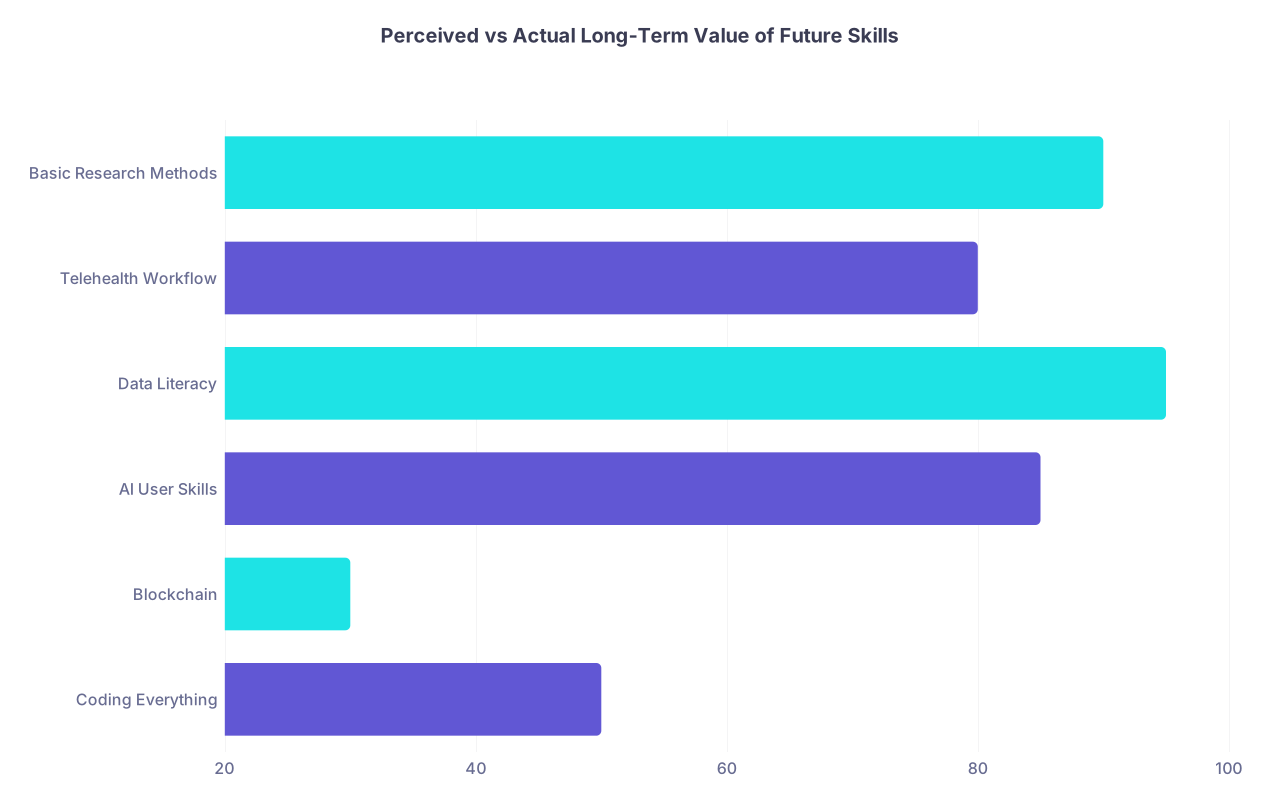
| Category | Value |
|---|---|
| Coding Everything | 50 |
| Blockchain | 30 |
| AI User Skills | 85 |
| Data Literacy | 95 |
| Telehealth Workflow | 80 |
| Basic Research Methods | 90 |
The flashy stuff (coding everything, blockchain) feels exciting but has narrower payoff. The unsexy stuff (data literacy, causal thinking, knowing how to work with AI safely) compounds for your whole career.
What You Can Safely Ignore (For Now)
You have permission to ignore:
- Building your own EMR.
- Becoming “fluent” in 3–4 programming languages.
- Attending every hackathon or “disrupt healthcare” weekend.
- Being the med student expert on VR surgery, AR glasses, robotic everything.
If one of those is a true hobby, fine. But do not sacrifice core clinical competence or sleep for it.
Your future self as an attending will care far more that:
- You can smell bad data from across the room.
- You can push back when an algorithm is being misused on your patients.
- You can work well with tech teams and ask the right questions.
FAQ: Future-of-Medicine Skills in Med School
1. Do I really need to learn to code as a medical student?
No. Coding is optional. Useful, but very much optional. If you enjoy it and it comes easily, learning basic Python or R can give you real leverage in research and QI. But forcing yourself through hundreds of hours of code at the expense of physiology, path, or clinical skills is a bad trade. Prioritize being an excellent clinician who can reason about data; add coding if and when it supports your goals.
2. How can I tell if an AI or prediction tool is safe to use with my patients?
Start with three questions: Who was this tool trained and validated on? How does its performance look in a population similar to my patients? And what are the stakes if it is wrong—are we talking annoyance, or harm? In practice, you watch how the tool behaves on the wards, talk to nurses and residents about their real-world experience, and read at least one validation paper. If the tool’s behavior consistently clashes with your clinical judgment in obvious ways, treat it as a noisy signal, not a command.
3. I’m interested in “digital health” but my school doesn’t have a formal track. What can I do?
You do not need a formal track. Look for: telehealth clinics, remote monitoring projects, patient-portal initiatives, or QI programs around readmissions or chronic disease management. Volunteer to help with a small piece—process mapping, data collection, patient education materials. Find one attending who’s clearly involved in digital efforts, ask for a 20-minute meeting, and say, “I’d like to help on something small and finishable.” That beats enrolling in three vague “innovation” electives with no real work.
4. How do I avoid being overwhelmed by how fast technology is changing?
Anchor yourself to durable skills: reasoning about data, communicating clearly with patients, understanding workflow, and learning quickly. The specific tools will change; those foundations do not. Limit your “future hype” diet—maybe choose one high-quality newsletter or podcast instead of chasing every news story. And constantly connect new tech back to concrete clinical questions: Does this help me diagnose better, treat better, or make care safer and more humane?
5. Is it worth doing a dedicated informatics or digital health degree during med school?
For 90% of students, no. Those degrees are most useful if you are certain you want a career heavy in systems design, health IT leadership, or serious data science. If you are merely curious, you will get more value from taking one or two focused courses, doing a mentored project, and reading on your own. Extra degrees cost time and money; only pursue them if they clearly support a career path you already care about, not as a vague insurance policy.
6. What’s one simple “future-of-medicine” habit I can start this month?
Pick one predictive tool or AI system you see on the wards—sepsis alerts, early warning scores, readmission risk, imaging triage—and start a mini log. For 20–30 patients, record when the tool fired and whether it was actually useful in that case. Then sit down with a resident or attending and talk through the pattern. You’ll train your eye for how these tools really behave, and you’ll build the exact mindset you need for whatever tech comes next.
Open your current rotation’s list of orders or alerts. Identify one algorithm, risk score, or digital tool that’s quietly influencing patient care. Tonight, look up how it’s supposed to work and what data it uses. Tomorrow, watch it in three real patients and ask yourself: did it help, or did we just work around it? That’s how you start learning the future of medicine, without waiting for some formal curriculum to catch up.