The idea that you must have formal AI or data science training to be a competitive physician is wrong—and also a little dangerous.
You do not need a data science degree, a certificate, or a portfolio of machine learning projects to match well, get a strong job, or be an excellent clinician. But you do need to be AI-literate enough not to be left behind—or worse, to use tools you do not understand in ways that hurt patients.
Here is how to think about it like a grown-up, not like a panicked applicant reading LinkedIn posts.
The core answer: no degree required, but literacy is non‑negotiable
Let me give it to you straight:
You do not need:
– a master’s in data science
– a CS minor
– formal AI fellowship
– 20 GitHub repos in PythonYou do increasingly need:
– basic understanding of how clinical AI tools work and fail
– enough numeracy to read a ROC curve and calibration plot
– the judgment to know when not to trust an algorithm
– the vocabulary to talk to data people without sounding lost
Being a competitive physician in the next 10–20 years will look more like being “AI fluent” than “AI credentialed.”
If you’re premed, in med school, or a resident, your goal is simple:
Be the doctor who can safely use, question, and explain AI—not the one trying to out-code the data science team.
What actually matters for competitiveness in the AI era
There’s a lot of noise around “AI in medicine.” Strip it down to what actually moves the needle for your career.
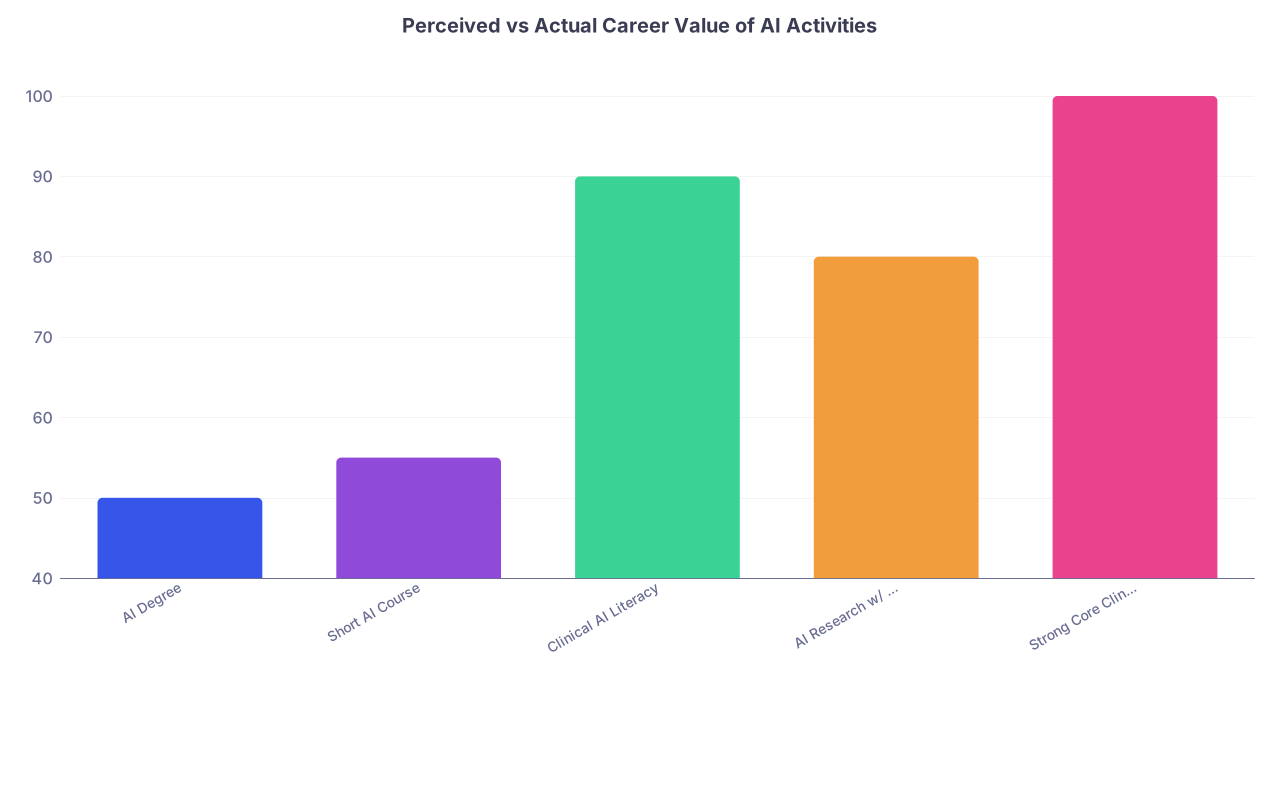
| Category | Value |
|---|---|
| AI Degree | 50 |
| Short AI Course | 55 |
| Clinical AI Literacy | 90 |
| AI Research w/ Publication | 80 |
| Strong Core Clinical Skills | 100 |
Interpretation, not the raw numbers: programs still value your clinical competence above everything, then your ability to think and work with new tools. Extra letters after your name are nice, not mandatory.
What PDs and employers actually look for
I’ve sat in rooms where residency program directors and department chairs talk about this. No one says, “We rejected her because she didn’t take a machine learning bootcamp.”
They talk about:
- “Will this person be safe on day one?”
- “Can they adapt to new systems without drama?”
- “Do they understand their tools, or just click buttons?”
- “Are they curious and able to learn new tech without hand-holding?”
If you show:
- strong clinical fundamentals
- comfort using EHRs, decision-support tools, and basic analytics
- some awareness of AI’s strengths and limits in your field
…you’re competitive. If on top of that you have real AI-related contributions (actual implemented quality projects, published work, or leadership in tech committees), that’s gravy, not the main course.
Levels of AI engagement: which tier do you actually need?
Think of AI involvement in medicine in four tiers. Most physicians only need the bottom two—and that’s fine.
| Level | Description | Who Needs It Most |
|---|---|---|
| 1. User | Safely uses AI tools and understands basics | Almost all clinicians |
| 2. Translator | Bridges clinicians and data teams | Interested clinicians, future leaders |
| 3. Builder | Co-develops/validates models | Academic/industry-focused docs |
| 4. Specialist | Deep ML/AI career | Rare, niche career path |
Level 1 – Informed user (non‑negotiable for everyone)
You must at least:
- Know what sensitivity, specificity, PPV, NPV, AUROC, calibration mean in plain language.
- Understand that a well-performing model on paper can still be biased or unsafe in your population.
- Be able to explain to a patient:
“This tool helps us estimate your risk, but it is not perfect; here’s how I’m using it and what I’m not delegating to it.”
No formal training required. This is just upgraded evidence-based medicine.
Level 2 – Clinician–data translator (highly valuable, optional)
This is where you become the bridge:
- You can say to the data team:
“This model’s outcome definition doesn’t match how we actually code sepsis on the floor.” - You can say to colleagues:
“This alert triggers based on X and Y; don’t ignore it, but don’t follow it blindly when Z is present.”
For this, you’ll want:
- modest stats comfort
- basic exposure to model development concepts
- experience on at least one real project (QI, workflow change, or pilot AI tool)
Formal degree helpful? Sure. Required? No.
Levels 3–4 – Builders and AI specialists (niche but real paths)
If you want to:
- build algorithms,
- publish in JAMA/NEJM Digital Medicine,
- work at Google Health, Epic, or an AI startup,
- or lead a health system’s AI strategy at a technical level,
then, yes, formal training becomes very useful. That could be:
- MS in Biomedical Informatics or Data Science
- PhD in relevant field
- Clinical informatics fellowship
- Serious, multi-year self-taught portfolio (and I mean real, production-grade work)
This is a distinct career track. Physician–data scientist. Different from “competitive clinician who uses AI well.”
When formal AI/data science training actually helps
Let’s separate three scenarios.

Scenario 1: You just want to be a strong clinician
You do not need formal AI training.
What you should do instead:
Take a short, targeted course in:
– clinical epidemiology and biostatistics
– intro to AI in healthcare (many med schools now have electives; Coursera/EdX has decent options)During rotations, intentionally:
– ask how decision-support tools were validated
– ask why the team trusts or ignores specific EHR alerts
– look up the evidence behind risk calculators you useRead:
– a few key review papers or consensus statements in your specialty on AI/ML
– guidelines or FDA announcements on AI tools in your area (e.g., imaging AI in radiology, CDSS in EM)
That gets you 90% of what you need.
Scenario 2: You want AI to be a visible strength on your application
Still no degree required, but now you need tangible work, not just “took a course.”
Stronger moves:
Join or start a QI / data project that:
– uses existing hospital data to solve a clinical problem
– evaluates a predictive model or tool already in your system
– creates a better risk stratification workflow, even without fancy MLGet on a research project where your role is more than “chart reviewer”:
– help define the problem and outcomes
– join meetings with the data team
– contribute to study design and interpretationPresent something:
– local or national conference poster
– internal grand rounds or journal club on AI in your specialty
– a short talk on “How our sepsis alert actually works and why we changed it”
That shows programs: “This person can think with data and isn’t scared of technology.”
Scenario 3: You want a hybrid clinician–data scientist career
Okay, now formal training is worth a serious look.
Reasonable paths:
- MD + MS in Biomedical Informatics / Data Science (before, during, or after med school)
- Residency followed by a Clinical Informatics fellowship (ABPM recognized)
- PhD path if you are heavily research-focused
But even here, I’ll be blunt: there are plenty of MDs doing excellent AI work with no formal degree, but with:
- strong stats/CS self-education
- close collaborations with PhD data scientists
- several substantial projects under their belt
Degrees help formalize and accelerate it. They’re not the only path, but they do buy credibility and skill density.
Concrete skills to build (instead of chasing credentials)
Skip the vague buzzwords. Here’s what actually helps you work with AI tools and data in clinical practice.
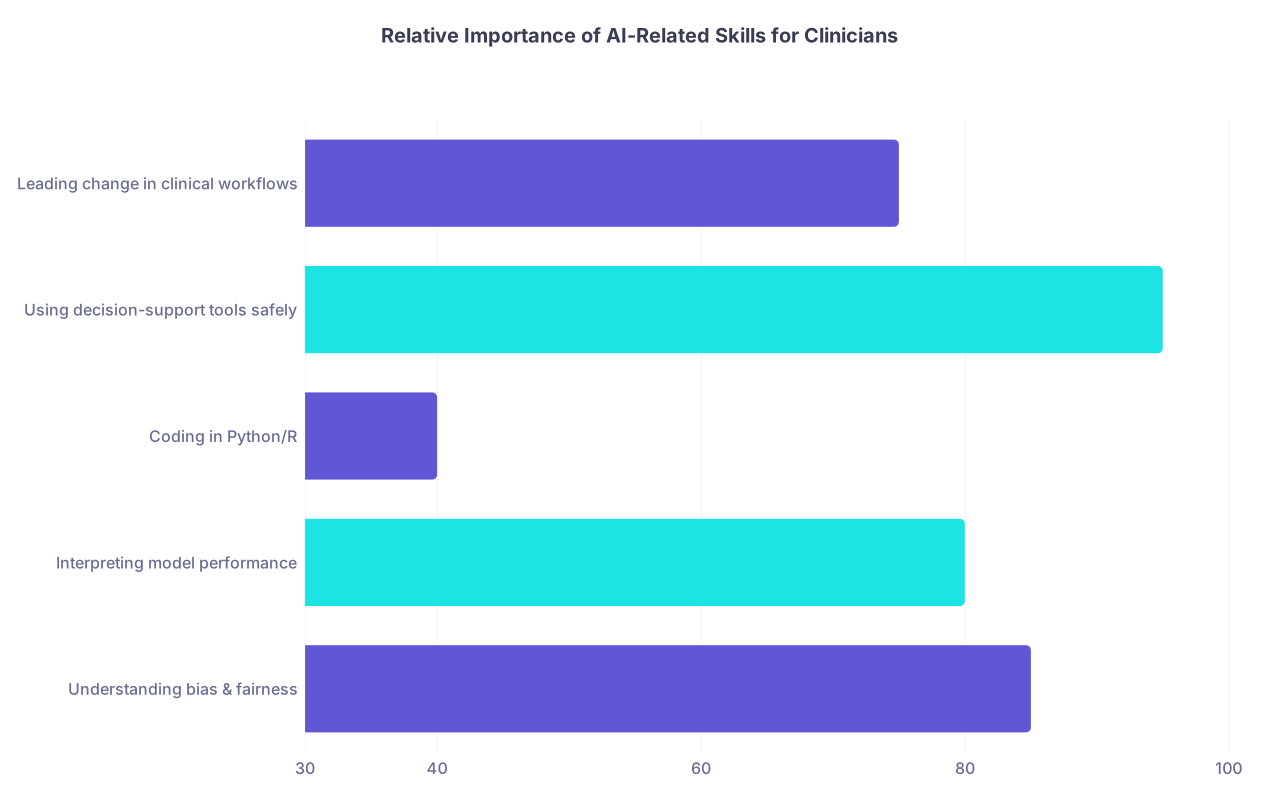
| Category | Value |
|---|---|
| Understanding bias & fairness | 85 |
| Interpreting model performance | 80 |
| Coding in Python/R | 40 |
| Using decision-support tools safely | 95 |
| Leading change in clinical workflows | 75 |
1. Reading performance metrics like a grown-up
You should be able to look at a figure or paper and say:
- “This AUROC of 0.88 is nice, but what’s the PPV at the threshold they actually use?”
- “The model performs worse in older adults or non-English speakers—how does that affect my population?”
- “They never did external validation; this may not generalize to our hospital.”
That’s not data science. That’s modern EBM.
2. Understanding workflow and data realities
I’ve seen more AI projects die on this hill than on algorithm performance.
You want to be the doctor who notices:
- “We document this variable differently on nights vs days; your model’s input is unreliable.”
- “You’re predicting ICU transfer, but by the time the alert fires, we’ve already escalated most of these patients.”
- “If you add one more alert to our EHR, people will just click past it.”
This is where smart physicians are indispensable.
3. Being conversant in how models are built (without writing them yourself)
You should roughly know:
- what training vs validation vs test sets are
- what overfitting means
- the difference between discrimination and calibration
- what “drift” and “retraining” refer to in practice
So when the data team says, “We retrained the model after COVID changed admission patterns,” you don’t stare blankly.
4. Basic comfort with data tools (optional but helpful)
You do not need to master Python to be a good doctor. But:
- knowing enough SQL or Excel/Sheets to explore simple datasets
- being able to plot and summarize outcome rates or alert responses
- maybe dabbling in a guided Python notebook for simple modeling
…makes collaboration smoother and earns you respect from technical teammates.
How to signal “AI savvy” on applications without a degree
This is the part you actually care about if you’re applying soon.

| Step | Description |
|---|---|
| Step 1 | Decide Interest Level |
| Step 2 | Learn Core Concepts |
| Step 3 | Plan Formal Training |
| Step 4 | Join QI or Data Project |
| Step 5 | Present or Publish Work |
| Step 6 | Look at MS or Informatics Programs |
| Step 7 | Clinician Only or Hybrid? |
On ERAS / CV / interviews, focus on:
1–3 specific projects where you:
– improved a workflow using data or a tool
– helped evaluate a predictive model or alert
– contributed to an AI-related study (even observational)Clear, non-buzzword descriptions:
– “Analyzed performance of an EHR-based sepsis alert; identified high false-positive rate overnight and helped adjust threshold and messaging.”
– “Led journal club on AI in mammography; focused on limitations in minority populations and implications for our clinic.”
Avoid fluffy lines like “passionate about AI and data science” without substance. Committees see right through it.
When formal AI/data science training is overkill (and a bad idea)
I’ve seen students delay graduation, take on huge debt, or tank Step prep to chase an AI credential they thought would “differentiate” them. It didn’t.
Bad signs you’re overdoing it:
- You’re considering a degree mostly because “everyone is doing AI now.”
- You have no clear use case—no clinical problem you care about, just FOMO.
- You’re already struggling with core medical content but want to layer advanced stats on top.
Reality check: being an excellent, reliable, thoughtful clinician is still rarer and more valuable than being yet another person who can run XGBoost.
If you have limited bandwidth (and everyone does), prioritize:
- Core medical knowledge and clinical performance
- Evidence-based medicine and statistics
- Practical AI literacy and a couple of real projects
Only then think about major formal training.
FAQ: Formal AI & Data Science Training for Physicians
1. Will not having any AI or data science on my CV hurt my residency chances?
No. Programs do not expect everyone to have AI experience. What would hurt you much more is weak clinical evaluations, poor exam scores, or no meaningful involvement in anything. If you have zero AI-related activity but strong traditional experiences (research, leadership, teaching, QI), you’re perfectly competitive.
2. If I’m really interested, is an AI/DS master’s best done before med school, during, or after?
If you truly want a hybrid career, the most efficient timing is usually combined with or immediately after residency (e.g., an informatics fellowship that includes formal training). Premed or preclinical degrees risk becoming outdated by the time you’re actually in a position to apply them. Exceptions exist if you’re dead set on a research-heavy career from day one.
3. Do I need to learn Python or R to be considered “AI literate” as a physician?
No. Coding is helpful, not mandatory. For most clinicians, it’s far more important to understand how models are evaluated, where they can fail, and how they fit into workflow. If you enjoy coding, great—use it to partner more deeply with data teams. But do not confuse writing scripts with being a better doctor.
4. How much AI knowledge is expected in residency or job interviews now?
Usually, very little—even for tech-forward programs. What impresses people is thoughtful, realistic commentary, like acknowledging both the promise and the limitations of AI tools you’ve seen. Being able to discuss one or two concrete examples from your rotations or projects is more compelling than throwing buzzwords around.
5. I want to start today. What’s one concrete step that will actually move the needle?
Pick one AI- or data-related paper in your target specialty this week. Read it carefully. Then: summarize its main findings, limitations, and your take on clinical implications in a one-page note or a 5-minute talk, and present it to a mentor, team, or journal club. That single exercise will level up your AI literacy more than passively binge-watching online courses.
Open your current CV or ERAS draft right now and ask yourself:
“Where, if anywhere, do I show that I can think clearly about data and tools in patient care?”
If the answer is “nowhere,” pick one realistic project or paper this month and fix that.