
The usual advice about “getting AI experience” in medicine is vague and useless.
“Do research.” “Join a startup.” “Work on QI.” That’s not a plan. That’s a slogan.
Here’s the real answer: startup vs academic lab vs QI team is not about which is “best” for AI — it’s about which fits what you actually want out of your career over the next 3–5 years. Each path teaches a very different slice of “AI in healthcare.”
You’re not choosing a brand. You’re choosing a skill set, a network, and a reputation.
Let’s break it down.
The One-Page Answer: Who Should Choose What
If you don’t want theory, you want a decision:
- If you care about publications, fellowships, and academic credibility → favor academic labs.
- If you care about operational impact, leadership, and real-world implementation → favor QI teams.
- If you care about product-building, risk tolerance, and non-traditional careers → favor startups.
Most smart people do a mix of two across med school / residency. Doing all three at once usually means you’ll do all three badly.
| Path | Best For | Main Outputs | Risk Level |
|---|---|---|---|
| Academic Lab | Papers, fellowships, PhD/NIH path | Publications, grants | Medium |
| QI Team | Clinical impact, leadership | QI projects, metrics | Low |
| Startup | Product and industry careers | Products, roles, equity | High |
What “AI Experience” Actually Means (And What It Doesn’t)
People use “AI experience” like it’s a single thing. It’s not.
In healthcare, “AI experience” typically breaks down into a few buckets:
- Understanding how models are built and validated (data, labels, bias, performance metrics).
- Knowing how to integrate tools into workflows (EMR, nursing, clinical buy-in).
- Being able to speak both languages: clinical and technical.
- Having proof you can own and execute a project to the finish line.
Notice what’s not required: you don’t have to be a full-stack ML engineer writing cutting-edge models from scratch. That’s one niche. Most clinically-oriented people will be:
- Translators
- Implementers
- Evaluators
- Product-minded clinicians
Different settings give you different parts of that toolkit.
Path 1: Academic Lab – The “Serious” AI Credential
Academic labs are where you build credibility and signal. If you want people to take you seriously when you talk about AI safety, policy, or methodology, this is where that happens.
What you actually do in an AI/ML academic lab
This is what I see over and over in real labs:
- Clean and label data (yes, a lot of it is tedious).
- Design retrospective studies of algorithms (often using existing datasets).
- Help write methods and results sections.
- Present posters at conferences (e.g., AMIA, MICCAI, RSNA).
- Occasionally help with model development if you have coding skills (Python, PyTorch, TensorFlow, etc.).
If you join a strong lab, your work can turn into:
- First- or second-author papers on AI tools, validation studies, or bias analyses.
- Named contributions to known projects or open-source datasets.
- Letters of recommendation from people who are actually cited in the field.
That’s what programs and employers care about. Not “I shadowed an AI team once.”
Who should prioritize academic labs
You should lean heavily toward an academic AI lab if:
- You’re aiming for top academic residencies or fellowships in competitive specialties (radiology, derm, neurosurg, cardiology, etc.).
- You’re considering a PhD, MPH, MS in data science, or a research-heavy career.
- You want to work on foundational questions: fairness, explainability, validation, regulation.
If your dream job is something like “Director of AI in Radiology at a large academic center” — labs are your home turf.
Pros and cons of academic labs for AI
Pros:
- Publications and citations — still the currency of academia.
- Mentorship from people actually shaping the field.
- Access to large, curated datasets.
- Strong letters and a coherent narrative on your CV.
Cons:
- Slow pace. A project can take 12–24 months to see daylight.
- Risk of being the “data grunt” if you don’t advocate for meaningful roles.
- Less exposure to real deployment and product constraints.
If you want a clean, prestigious signal that you’re serious about AI, the academic lab is the most reliable route.
Path 2: QI Team – Where AI Actually Touches Patients
If academic labs are about theory and validation, QI teams are about operations and impact. They don’t care how fancy the model is. They care whether fewer patients fall through the cracks and nurses stop wanting to quit.
QI is massively underrated for AI experience.
What “AI in QI” actually looks like
Here’s what a typical AI-adjacent QI project might involve:
- Working on deployment of a risk score (sepsis, deterioration, readmission) and measuring how it affects outcomes.
- Redesigning workflows so clinicians actually see and use an alert at the right time.
- Tracking hard outcomes: time to antibiotic, length of stay, missed follow-ups, etc.
- Cleaning up the mess when you realize the model’s firing too often or in the wrong population.
You’ll touch:
- Clinical workflow mapping (who does what, when, where).
- Change management (getting buy-in from nurses, attendings, admin).
- Basic analytics (run charts, control charts, pre-post analysis).
That’s gold. Because in the next 5–10 years, the main bottleneck isn’t building more models — it’s getting existing tools safely and sanely embedded into care.
Who should prioritize QI teams
You should strongly consider focusing on QI if:
- You like systems thinking and operations more than algorithms.
- You’re aiming for chief resident, medical director, CMIO, or quality leadership roles.
- You want to tell real stories at interviews: “We implemented an AI-based alert, and here’s how it changed X and Y.”
If you’re the kind of person who enjoys fixing broken discharge processes or redesigning order sets, QI is your playground.
Pros and cons of QI for AI
Pros:
- Direct line from your work to patient outcomes and clinician experience.
- Easier to explain and defend on applications: “Here’s the baseline, here’s the intervention, here’s the result.”
- Builds leadership, communication, and change-management skills.
Cons:
- Fewer traditional pubs (though QI publications and presentations are growing).
- You might be working with AI tools, not building them.
- Less glamorous on paper if selection committees only look for “AI” and see “QI” and don’t read deeply.
If you care about whether AI actually helps patients rather than just generating buzzwords, QI should not be an afterthought. It’s core.
Path 3: Startup – High Risk, High Learning, No Guarantees
Startups are where you see the ugly, real-world constraints: money, regulation, hospital politics, sales cycles, and technical debt. You’ll stop romanticizing AI real fast.
You’ll also learn things no academic lab or QI committee will ever teach you.
What you actually do in a healthcare AI startup
Depends on stage and structure, but typical med-student/resident roles look like:
- Clinical advisor / intern: giving feedback on product fit, workflows, and UX.
- Doing early user interviews with clinicians at pilot sites.
- Helping define evaluation metrics and clinical validation plans.
- Writing white papers, regulatory documents, or clinical content.
- If technical: contributing to data pipelines, annotation schemes, or model evaluation.
You’re much closer to:
- Product decisions: “Will clinicians actually use this?”
- Regulatory strategy: “Is this a medical device? Do we need FDA clearance?”
- Business reality: “We have 6 months of runway — what matters most?”
You learn fast, or you get left behind.
Who should prioritize startups
You should lean into startups if:
- You’re genuinely open to non-traditional careers: industry, entrepreneurship, product, venture.
- You’re comfortable with ambiguity and risk.
- You want to see how AI tools go from idea → prototype → sale → deployment.
- You value responsibility early over titles and formal structure.
If the idea of eventually being a CMO of a digital health company or founding your own AI tool excites you more than being a department chair, startups are your lab.
Pros and cons of startups for AI
Pros:
- Ridiculously fast learning curve about the full lifecycle of AI in healthcare.
- Exposure to design, regulation, reimbursement, IT integration, and sales.
- Strong signaling to tech-forward orgs and hybrid academic-industry roles.
Cons:
- Very hit-or-miss in terms of structure and mentorship.
- Often no publications, and your work can vanish if the company pivots or dies.
- Easy to get used for “free clinical validation help” without credited impact if you’re not careful.
Done well, a startup stint can make you stand out. Done poorly, it can look like a vague “consulting internship” that no one understands.
How to Choose: A Simple Decision Framework
Let me give you a no-nonsense way to make the decision.

| Step | Description |
|---|---|
| Step 1 | Start - Want AI Experience |
| Step 2 | Academic Lab Focus |
| Step 3 | QI Team Focus |
| Step 4 | Startup Focus |
| Step 5 | Pick 1 Primary Path |
| Step 6 | Mix 2 Paths Max |
| Step 7 | Main Goal Next 5 Years |
| Step 8 | Time Available |
Ask yourself three questions:
What do I want my CV to scream in 3–5 years?
- “Serious academic with AI publications”? → Academic lab.
- “Systems leader who implemented real tools”? → QI.
- “Clinician who builds usable products”? → Startup.
What do I actually enjoy doing week-to-week?
If you hate coding and statistics, don’t pretend you’re going to enjoy model validation. If you hate meetings and politics, QI might drain you. If you hate uncertainty, startups will stress you out.What’s my realistic time and energy budget?
Most trainees have bandwidth for one serious commitment and maybe one lighter, opportunistic one.
A good pattern I’ve seen work:
- Med school: Academic lab + small QI project involving decision support or risk scores.
- Residency: QI-heavy with occasional industry collaboration (piloting a vendor AI tool).
- Fellowship / early attending: Then decide whether to lean more academic, operational, or industry.
How Each Path Plays on Applications and Future Jobs
Let’s be concrete.
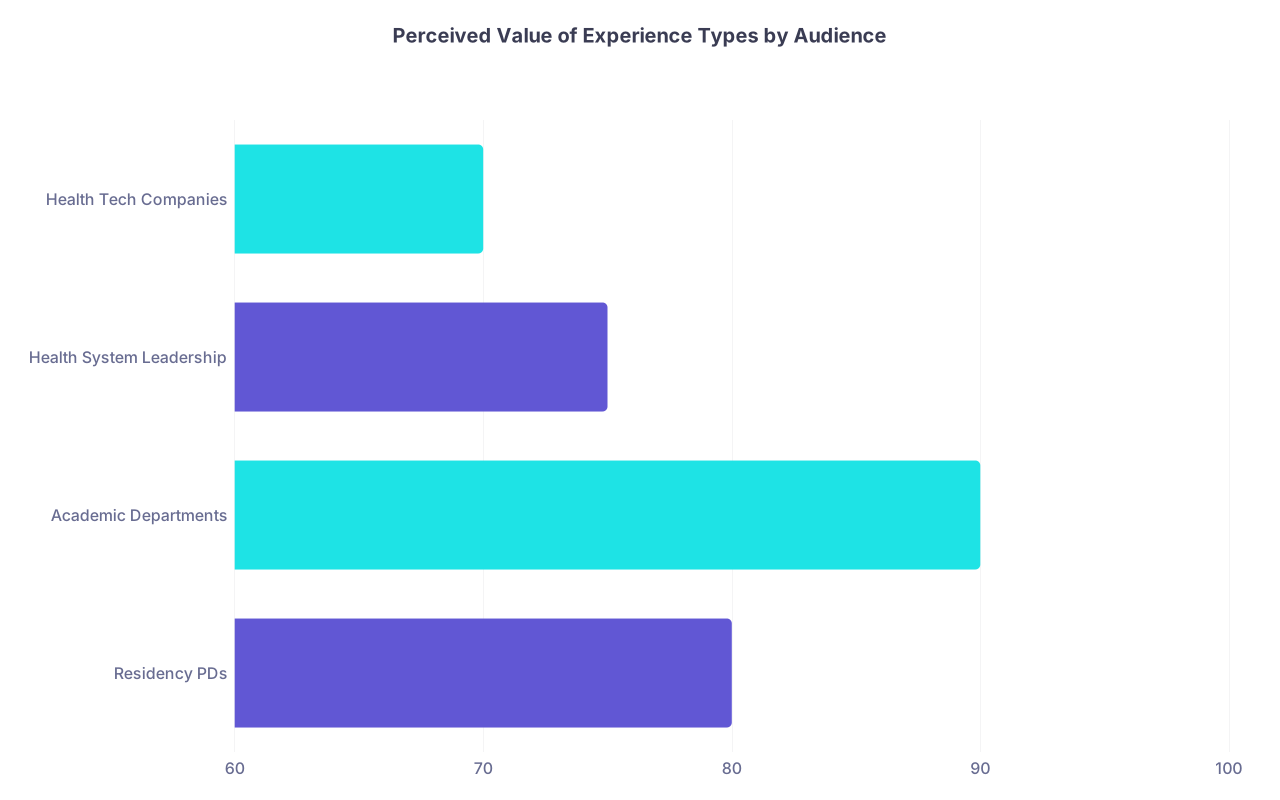
| Category | Value |
|---|---|
| Residency PDs | 80 |
| Academic Departments | 90 |
| Health System Leadership | 75 |
| Health Tech Companies | 70 |
That chart is obviously approximate, but here’s the point: different audiences care about different receipts.
Residency and fellowship applications
- Academic labs: Big plus, especially with first-author AI-related work and known mentors.
- QI: Solid plus, especially if tied to real outcomes and leadership roles.
- Startups: Variable. Some programs love it, some don’t know what to do with it. Needs a clear story.
Academic careers
- Strongest signal: Labs + peer-reviewed publications.
- Useful but secondary: QI and industry collaborations that show real deployment and impact.
Industry / health tech careers
- Strongest signal: Startups + any lab or QI experience.
- They care that you understand customers, workflows, and regulation — not just that you can quote AUCs.
How to Not Waste Your Time in Any of These
Regardless of path, look for these things:
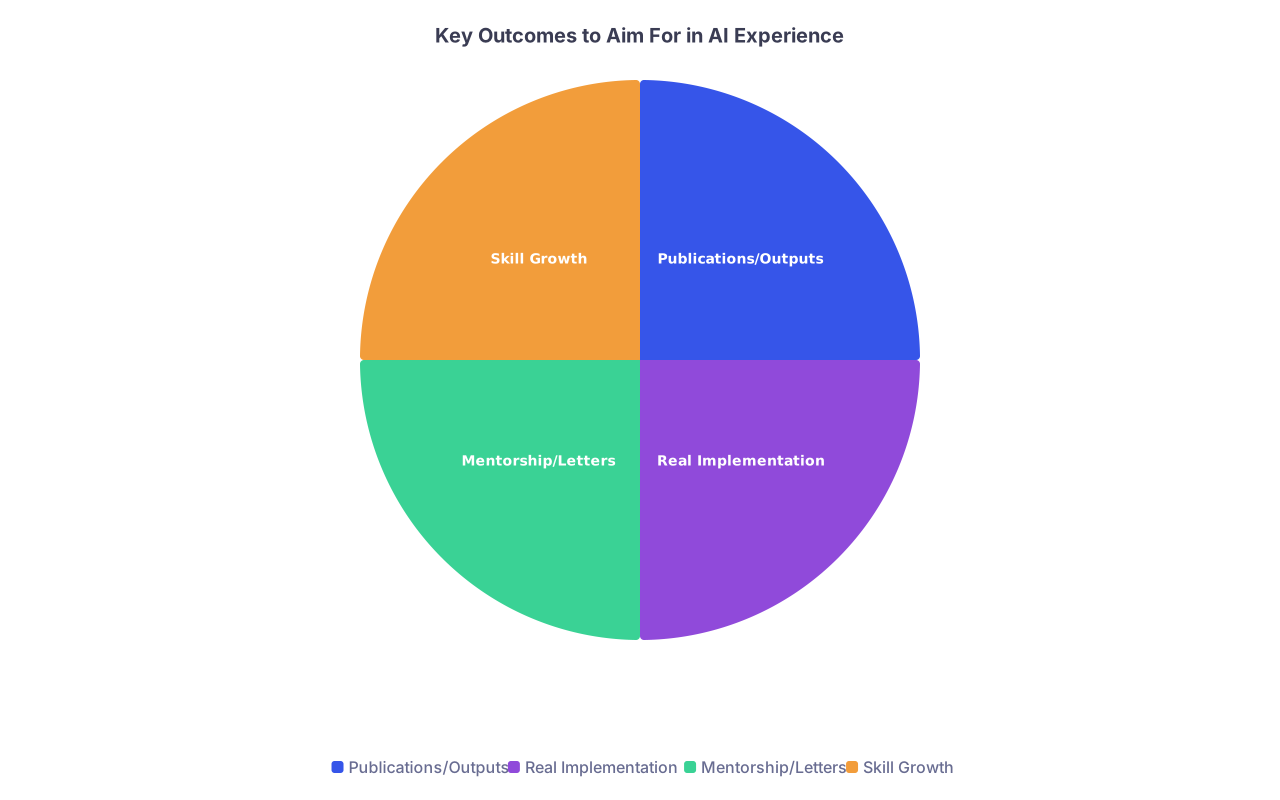
| Category | Value |
|---|---|
| Publications/Outputs | 25 |
| Real Implementation | 25 |
| Mentorship/Letters | 25 |
| Skill Growth | 25 |
You want:
- A tangible output: paper, poster, product release, QI project completed, pilot deployment.
- A clear role you can articulate: what you led, owned, or made happen.
- At least one strong mentor who can speak about you in detail.
- Actual skill growth: not just sitting in meetings.
Red flags:
- “Just help us with a few things” with no clear project.
- “You’ll get authorship later” with no timeline or structure.
- “We can’t pay you, but it’s great exposure” + disorganized leadership.
Ask directly: “If I join, what will a successful 6–12 months look like for me? What concrete outcomes are realistic?”
If they can’t answer that clearly, be cautious.
Putting It Together: A Reasonable Strategy
If you’re completely undecided, here’s a simple, defensible plan:
- Start with one small academic or QI project that you can finish in 6–9 months. Get a win.
- In parallel, shadow or advise a startup lightly — a few hours a month — just enough to see if you like that world.
- After a year, double down on whichever environment:
- Gave you the most energy
- Produced the clearest outcomes
- Matches where you want your career story to go

You don’t need the perfect choice out of the gate. You need one solid experience that proves you can engage with AI in a meaningful, outcome-oriented way. Then you build from there.
FAQs (Exactly 7)
1. Which is best if I want to match a competitive specialty?
Academic lab experience wins on average, especially if you can get first-author AI-related publications and strong letters from known faculty. Pair that with at least one QI or implementation project, and you look both smart and practical. Pure startup experience without any academic or QI grounding is a harder sell unless the program is very tech-forward.
2. Do I need coding or data science skills to join any of these?
No, but it changes your role. In labs, coding (Python, R, basic ML libraries) lets you touch real model development and analysis instead of just data wrangling. On QI teams, SQL or basic analytics help but aren’t required — workflow and leadership matter more. At startups, clinical insight and product sense can be enough, but basic technical literacy earns you a seat at more serious conversations.
3. Can QI projects actually count as “AI experience”?
Yes — if you’re working with AI-enabled tools or decision support systems. For example: optimizing workflows around an EMR sepsis alert, piloting a readmission risk score, or evaluating the impact of an imaging triage algorithm. If you can describe how the model works at a high level, what its limitations are, and show outcome changes, that absolutely counts as AI experience.

4. What if my school doesn’t have a big AI lab?
Then lean on two things: QI and external collaborations. Many hospitals are already buying AI tools; ask to join implementation or evaluation projects. You can also reach out to remote academic mentors (people with published AI-in-medicine work) and join multi-site or database projects. For startup exposure, look for remote internships or advisory roles with companies working in your area of interest.
5. Will time at a startup hurt my chances in traditional academia?
Not if it’s framed correctly and not if you abandon all academic output. Academia increasingly likes people who understand implementation and industry. The problem is when your only “research” is a vague startup role with no outputs, no publications, and no clear narrative. Pair even a modest lab or QI publication with a well-told startup story, and many academic places will see it as a strength.

6. How do I talk about my AI work in applications or interviews?
Translate everything into three things: problem, intervention, outcome. For example: “We noticed clinicians were ignoring a sepsis alert (problem). I led a project to redesign the alert timing, add education, and update our protocol (intervention). Alert adherence went from 35% to 68%, and time to antibiotics dropped by 45 minutes (outcome).” Then add one or two sentences about what you learned about AI limitations and safety.
7. Is it possible — or smart — to be involved in all three: lab, startup, and QI?
Possible, yes. Smart, usually not, unless you’re very deliberate. Spreading yourself across three domains often means nothing gets far enough to be impressive. A more realistic approach is: pick one primary (where you aim for a strong, finished product or publication) and one secondary (lighter involvement or exposure). You can move between them over time — just don’t try to juggle everything at once while also surviving med school or residency.

Key points to walk away with:
- “AI experience” is not one thing. Academic labs, QI teams, and startups each give you a different — and valuable — slice of the puzzle.
- Pick your primary path based on your 3–5 year goals: academic credibility (lab), clinical impact and leadership (QI), or product and industry skills (startup).
- Whatever you choose, chase real outcomes: a paper, a completed QI project, a deployed tool, or a product launch — not just meetings and buzzwords.